


The landscape of B2B sales has fundamentally changed. Today's buyers complete 70% of their purchase journey before ever speaking with a sales representative, which means traditional outbound tactics alone won't cut it anymore. B2b demand generation marketing has emerged as the strategic framework that successful companies use to create awareness, build interest, and nurture prospects through increasingly complex buying cycles. Unlike simple lead generation that focuses on volume, demand generation builds genuine interest in your solutions, educates potential buyers, and creates a predictable pipeline of qualified opportunities. For businesses looking to scale predictably in 2026, understanding and implementing a comprehensive demand generation strategy isn't optional, it's essential for survival.
Understanding B2B Demand Generation Marketing Fundamentals
B2b demand generation marketing represents a holistic approach to creating and nurturing demand for your products or services throughout the entire buyer journey. This isn't just about collecting contact information; it's about building relationships, establishing authority, and positioning your company as the obvious solution when prospects are ready to buy.
The core difference between demand generation and traditional lead generation lies in the strategic intent. While lead generation focuses on capturing contact details and pushing them to sales immediately, demand generation takes a comprehensive approach that emphasizes education, value delivery, and relationship building first.
The Modern Demand Generation Framework
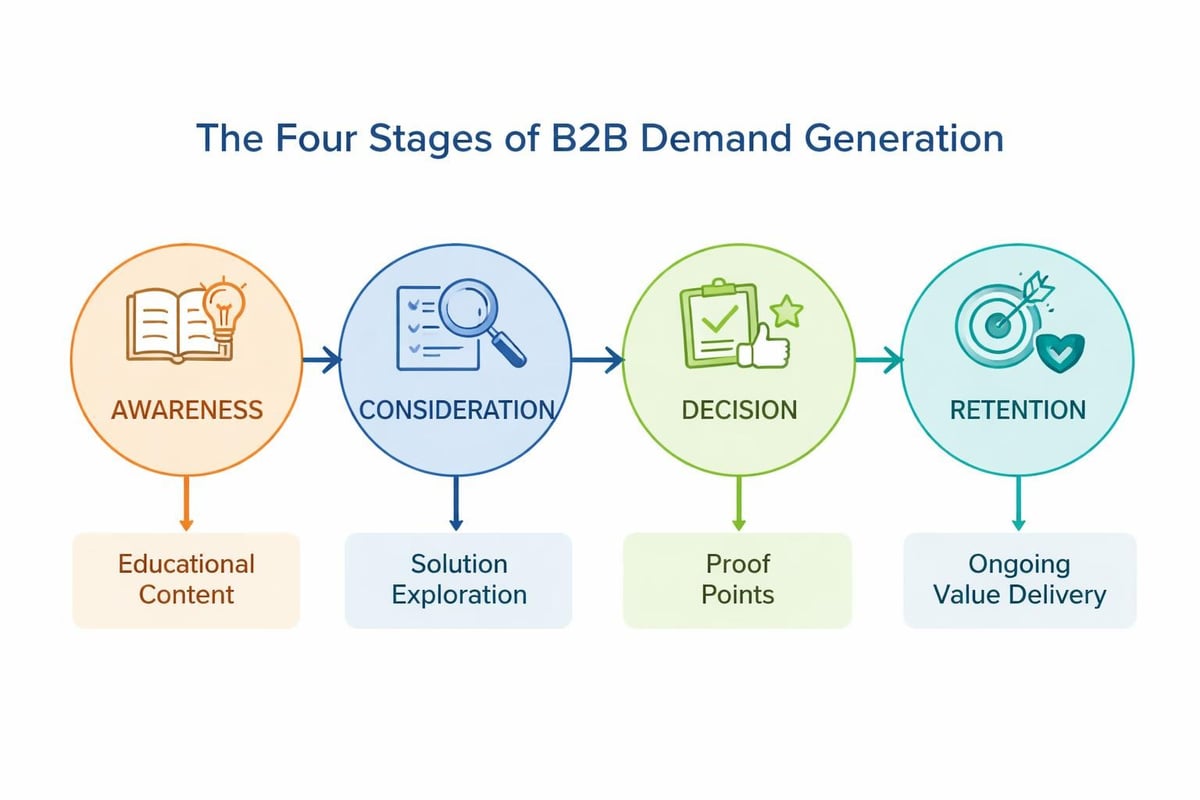
In 2026, successful b2b demand generation marketing operates across multiple integrated channels and stages:
- Awareness Stage: Creating valuable content that addresses prospect pain points before they know your solution exists
- Consideration Stage: Providing educational resources that help buyers understand their options and evaluate solutions
- Decision Stage: Delivering proof points, case studies, and specific demonstrations that make the buying decision clear
- Retention Stage: Continuing to provide value that prevents churn and creates expansion opportunities
Companies like Adstra have transformed this framework by integrating AI systems that automate and optimize each stage, ensuring prospects receive the right message at precisely the right moment in their journey. This level of personalization and timing was impossible just a few years ago, but it's now table stakes for competitive demand generation programs.
Building Your Demand Generation Strategy
Creating an effective b2b demand generation marketing strategy requires more than just selecting tactics from a menu. You need a coherent framework that aligns your marketing efforts with actual buyer behavior and business objectives.
Defining Your Ideal Customer Profile
Everything in demand generation starts with knowing exactly who you're trying to reach. Your Ideal Customer Profile (ICP) should include:
- Firmographic data: Company size, industry, revenue, geographic location
- Technographic information: Current technology stack, digital maturity, tools they use
- Behavioral indicators: Content consumption patterns, engagement signals, buying triggers
- Pain points: Specific challenges your solution addresses uniquely well
The more precisely you define your ICP, the more efficiently your demand generation engine will perform. Companies that attempt to target everyone end up resonating with no one. Generating qualified leads in the US market requires this level of precision, particularly in competitive verticals where buyers have numerous options.
Creating a Multi-Channel Approach
Modern buyers don't follow linear paths to purchase. They research across multiple channels, consume various content formats, and engage with brands in unpredictable ways. Your b2b demand generation marketing must meet them wherever they are.
| Channel | Primary Use | Best For | Conversion Timeline |
|---|---|---|---|
| Professional networking, thought leadership | Executive engagement, brand building | 3-6 months | |
| Nurturing, personalized outreach | Direct relationship building | 1-3 months | |
| Content Marketing | Education, SEO, authority building | Top-of-funnel awareness | 6-12 months |
| Paid Search | Intent capture, direct response | Bottom-of-funnel conversion | Immediate-1 month |
| Webinars | Deep education, proof of expertise | Mid-funnel engagement | 1-2 months |
Tools like Leadriver have made multi-channel outreach significantly more manageable by automating LinkedIn and email sequences while maintaining personalization at scale. This combination of automation and human touch is precisely what separates effective demand generation from spam.
Content That Drives Demand
Content sits at the absolute center of b2b demand generation marketing. But not all content is created equal, and creating content for the sake of publishing won't move the needle on pipeline or revenue.
Strategic Content Development
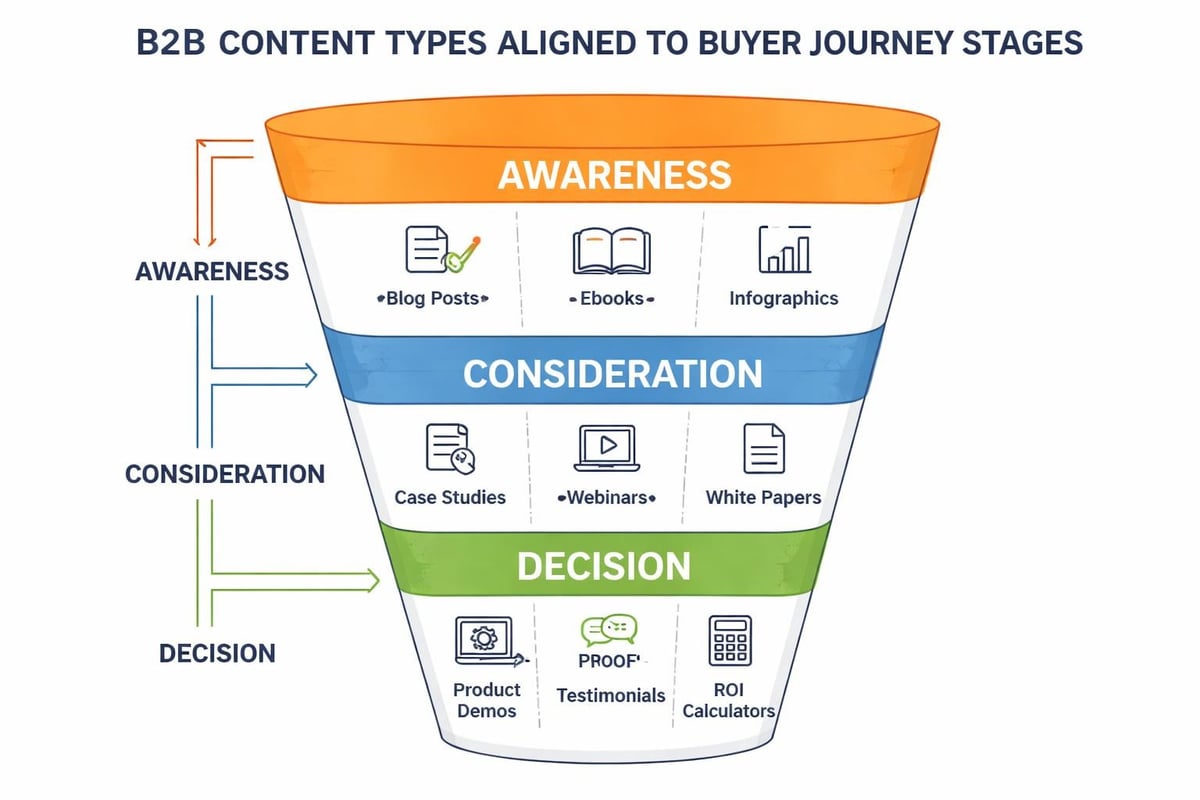
Your content strategy must map directly to your buyer's journey and address specific questions, concerns, and objections at each stage:
Top-of-Funnel Content educates buyers about problems they may not fully understand yet. This includes educational blog posts, industry research, trend analyses, and thought leadership pieces that demonstrate expertise without pushing products.
Middle-of-Funnel Content helps prospects evaluate solutions and understand options. Comparison guides, webinars, case studies, and detailed how-to resources perform exceptionally well here. Understanding what defines qualified leads helps you create content that attracts the right prospects at this critical stage.
Bottom-of-Funnel Content removes final objections and facilitates decision-making. Product demonstrations, ROI calculators, customer testimonials, and free trials or consultations help prospects take that final step.
Leveraging AI for Content Optimization
The integration of AI tools in marketing has fundamentally transformed how quickly and effectively companies can create demand-driving content. AI systems can now analyze which topics resonate with your ICP, suggest content angles based on competitive gaps, and even optimize distribution timing for maximum engagement.
However, AI should augment human creativity and strategic thinking, not replace it. The most effective b2b demand generation marketing programs in 2026 combine AI efficiency with human insight and genuine understanding of customer pain points.
Lead Scoring and Qualification Frameworks
Not every person who engages with your content is ready to buy. Effective lead scoring ensures your sales team focuses time and energy on prospects most likely to convert while marketing continues nurturing those who need more time.
Building a Behavioral Scoring Model
Modern lead scoring combines explicit data (information prospects provide directly) with implicit data (behavioral signals from their engagement patterns):
- Email engagement: Opens, clicks, reply rates
- Website behavior: Pages visited, time on site, resources downloaded
- Content consumption: Which topics they're interested in, progression through funnel content
- Social engagement: LinkedIn profile views, post interactions, connection requests
- Firmographic fit: How closely they match your ICP criteria
According to research on B2B demand generation best practices, companies that implement lead scoring see a 77% increase in lead generation ROI compared to those that don't qualify leads before passing them to sales.
The Qualification Handoff Process
Creating clear criteria for when marketing-qualified leads (MQLs) become sales-qualified leads (SQLs) prevents friction between teams and ensures prospects receive appropriate attention at the right time. This handoff should include:
- Minimum score threshold based on engagement and fit
- Specific behavioral triggers (requesting demo, pricing page visits, etc.)
- Clear SLA for sales follow-up timing
- Feedback loop when sales disqualifies leads
Companies implementing guaranteed growth models, like Adstra's approach to transforming cold leads into ready-to-buy customers, rely heavily on this precision to ensure every qualified opportunity receives immediate, appropriate attention.
Technology Stack for Demand Generation
Your b2b demand generation marketing efforts are only as effective as the systems supporting them. The right technology stack amplifies your team's capabilities and creates efficiencies that manual processes simply cannot achieve.
Essential Platform Categories
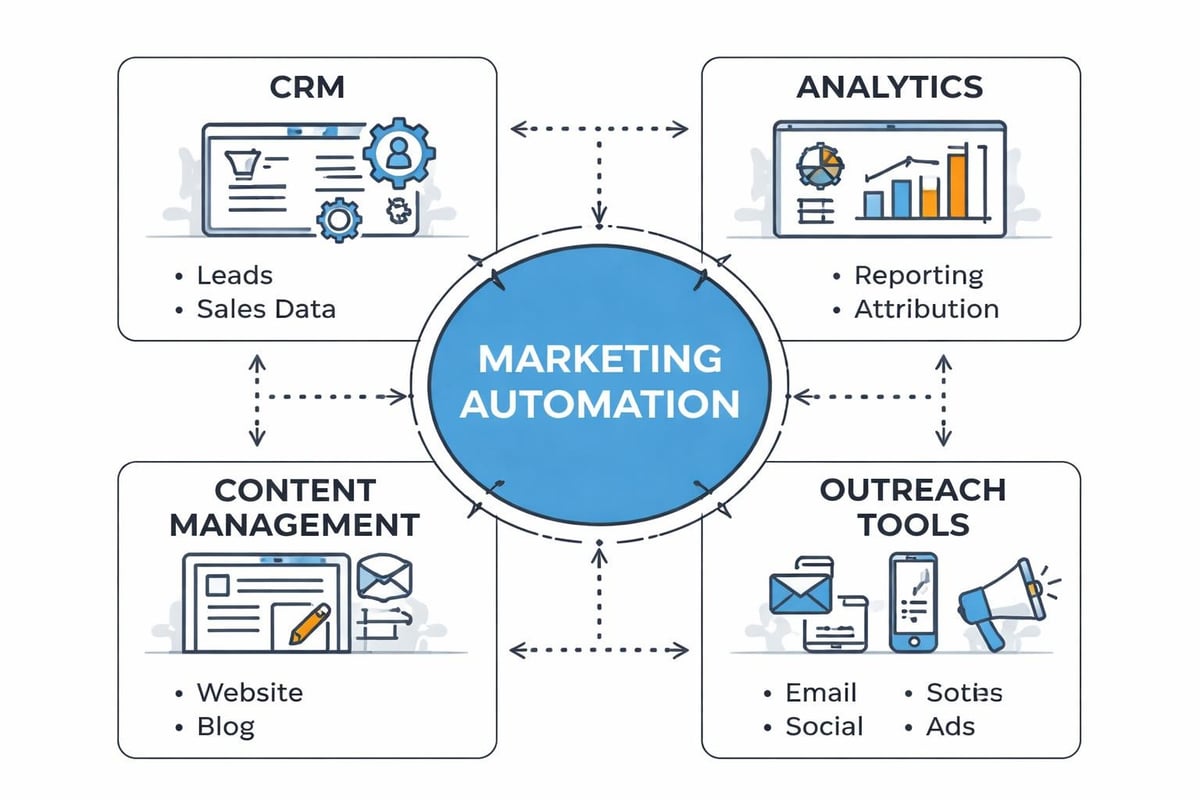
Marketing Automation Platform: Your central nervous system for demand generation, managing email campaigns, lead scoring, progressive profiling, and campaign attribution. Options range from enterprise solutions like Marketo and HubSpot to more specialized platforms.
CRM Integration: Seamless data flow between marketing and sales systems ensures no opportunity falls through cracks and provides complete visibility into the customer journey.
Intent Data Tools: These platforms identify companies actively researching solutions in your category, allowing you to prioritize outreach to prospects already in buying mode.
Account-Based Marketing Tools: For targeting specific high-value accounts with personalized campaigns across multiple touchpoints.
Analytics and Attribution: Understanding which channels, campaigns, and content pieces actually drive pipeline and revenue is critical for optimization.
Multi-channel outreach platforms like Leadriver have become increasingly valuable by consolidating LinkedIn automation, email sequencing, and lead finding capabilities into single platforms, reducing complexity while increasing effectiveness.
Measuring Demand Generation Success
What gets measured gets managed, and b2b demand generation marketing requires sophisticated measurement approaches that go beyond vanity metrics like website traffic or email open rates.
Key Performance Indicators That Matter
The most meaningful metrics tie directly to business outcomes:
| Metric | What It Measures | Why It Matters | Target Benchmark |
|---|---|---|---|
| Marketing Qualified Leads (MQLs) | Volume of qualified prospects | Top-of-funnel health | Varies by industry |
| MQL to SQL Conversion | Quality of lead qualification | Marketing-sales alignment | 25-40% |
| Cost Per Acquisition | Efficiency of spend | Program ROI | Industry dependent |
| Pipeline Velocity | Speed through sales cycle | Program effectiveness | Increasing trend |
| Customer Lifetime Value | Long-term revenue impact | Strategic value | 3x+ CAC |
According to comprehensive demand generation frameworks, companies that track these metrics consistently and optimize based on insights achieve 2-3x better results than those focused solely on vanity metrics.
Attribution Modeling Challenges
Understanding which touchpoints deserve credit for conversions is notoriously difficult in B2B, where buying cycles stretch months and involve multiple decision-makers. Effective attribution requires:
- First-touch attribution: What created initial awareness
- Last-touch attribution: What drove the final conversion
- Multi-touch attribution: How all touchpoints contributed throughout the journey
- Time decay models: Giving more credit to recent interactions
The reality is that b2b demand generation marketing rarely succeeds because of a single tactic or channel. Effective lead generation strategies combine multiple approaches working in concert, making accurate attribution both critically important and genuinely challenging.
Advanced Tactics for 2026
As buyers become more sophisticated and markets more competitive, b2b demand generation marketing must evolve beyond basic tactics to capture attention and drive results.
Account-Based Marketing Integration
ABM flips traditional demand generation by targeting specific high-value accounts with personalized campaigns rather than casting wide nets. This approach works exceptionally well for:
- Enterprise sales with long cycles and large deal sizes
- Industries with limited total addressable markets
- Companies seeking to break into specific accounts
- Organizations with clear ICP and account lists
Successful ABM requires tight alignment between marketing and sales, personalized content creation at scale, and sophisticated tracking of account-level engagement across multiple stakeholders.
Conversational Marketing and Chatbots
Modern buyers expect immediate responses to questions. Implementing intelligent chatbots on high-intent pages allows you to:
- Qualify visitors in real-time based on their questions and needs
- Route hot prospects to sales immediately
- Provide instant answers that prevent drop-off
- Gather information that informs future nurturing
However, chatbots should enhance human interaction, not replace it entirely. The best implementations use AI to handle initial qualification and information gathering, then seamlessly transition to human representatives for complex discussions.
Video and Interactive Content
Static content increasingly struggles to capture and maintain attention. B2B SaaS companies generating qualified demos have found that video demonstrations, interactive assessments, ROI calculators, and personalized video messages dramatically improve engagement and conversion rates.
These formats work particularly well because they:
- Deliver information more efficiently than text
- Create stronger emotional connections with prospects
- Demonstrate solutions in action rather than describing them
- Provide personalized experiences at scale
Avoiding Common Demand Generation Mistakes
Even experienced marketers fall into predictable traps that undermine b2b demand generation marketing effectiveness. Being aware of these pitfalls helps you avoid them.
Mistake 1: Prioritizing Quantity Over Quality
Generating thousands of unqualified leads creates more problems than it solves. Sales teams waste time on prospects who will never buy, marketing budgets get depleted on low-value activities, and actual opportunities get lost in the noise. Focus relentlessly on attracting and nurturing your ICP, even if that means smaller total numbers.
Mistake 2: Neglecting Existing Customers
Customer retention and expansion often provide better ROI than new customer acquisition, yet many demand generation programs focus exclusively on net-new business. Your current customers already trust you and understand your value. They should be easier to upsell, cross-sell, and expand than cold prospects.
Mistake 3: Ignoring the Dark Funnel
Most B2B buying research happens in private channels: peer conversations, Slack communities, review sites, podcasts, and dark social. Marketing platform selection should account for these hidden touchpoints, using tools that provide visibility into intent signals even when direct attribution is impossible.
Mistake 4: Inconsistent Follow-Up
Speed to lead matters tremendously. Companies that contact prospects within five minutes of inquiry are 100x more likely to connect than those waiting 30 minutes. Yet many organizations have response times measured in days, not minutes. Automation and clear processes ensure no opportunity goes cold due to slow follow-up.
Building Your Demand Generation Team
Technology and strategy matter, but people execute demand generation. Building the right team with appropriate skills, clear roles, and effective collaboration determines success.
Essential Roles and Responsibilities
A complete b2b demand generation marketing team typically includes:
- Demand Generation Manager: Overall strategy, campaign planning, performance tracking
- Content Creators: Writers, designers, video producers creating assets that educate and convert
- Marketing Operations: Technology management, data integrity, automation setup
- Performance Marketers: Paid media, SEO, conversion optimization
- Sales Development Reps: Following up on qualified leads, booking meetings, initial qualification
Smaller organizations might consolidate roles, while enterprises often have specialists in each area. The key is ensuring all functions are covered adequately based on your program's scale and complexity.
Marketing and Sales Alignment
The eternal conflict between marketing and sales sabotages demand generation at most companies. Marketing complains that sales doesn't follow up on leads, while sales complains that marketing sends garbage. Breaking this cycle requires:
Shared definitions of what constitutes a qualified lead, agreed upon by both teams based on data about what actually converts.
Regular communication through weekly or bi-weekly meetings where both teams review pipeline, discuss lead quality, and align on priorities.
Closed-loop reporting that shows marketing exactly what happens to leads after handoff, including conversion rates, deal sizes, and sales cycle length.
Shared incentives where both teams are measured on pipeline generation and revenue, not just their individual metrics.
Companies implementing these alignment strategies consistently outperform those where marketing and sales operate in silos, often seeing significant improvements in customer acquisition efficiency and effectiveness.
The Future of B2B Demand Generation Marketing
Looking ahead, several trends will shape how b2b demand generation marketing evolves over the coming years. Companies that adapt quickly will gain significant competitive advantages.
AI-powered personalization will move beyond simple name insertion to truly individualized experiences based on role, company, industry, and behavioral signals. Marketing will feel less like broadcasting and more like one-to-one conversations at scale.
Privacy-first marketing will require new approaches as third-party cookies disappear and privacy regulations tighten. First-party data collection, value exchange models, and permission-based marketing will become even more critical.
Community-led growth will complement traditional demand generation as buyers increasingly trust peer recommendations over vendor content. Building and nurturing communities where customers help each other creates organic demand that traditional marketing cannot replicate.
Revenue attribution clarity will improve through better technology and data integration, allowing marketers to prove ROI more definitively and optimize spending with greater precision.
According to expert perspectives on demand generation in B2B, companies that invest in these emerging capabilities now will be best positioned for success as buyer expectations and market dynamics continue evolving rapidly.
Mastering b2b demand generation marketing in 2026 requires sophisticated strategy, integrated technology, compelling content, and relentless optimization based on performance data. The companies that will thrive are those that view demand generation not as a campaign or tactic, but as a comprehensive system for creating, capturing, and converting buyer interest throughout increasingly complex journeys. Adstra specializes in building these systems through AI-powered lead generation and appointment automation that transforms cold prospects into ready-to-buy customers, delivering predictable revenue growth through our guaranteed partnership model. If you're ready to revolutionize your demand generation approach and achieve measurable results, let's talk about how we can help you build a system that consistently delivers qualified opportunities to your sales team.