
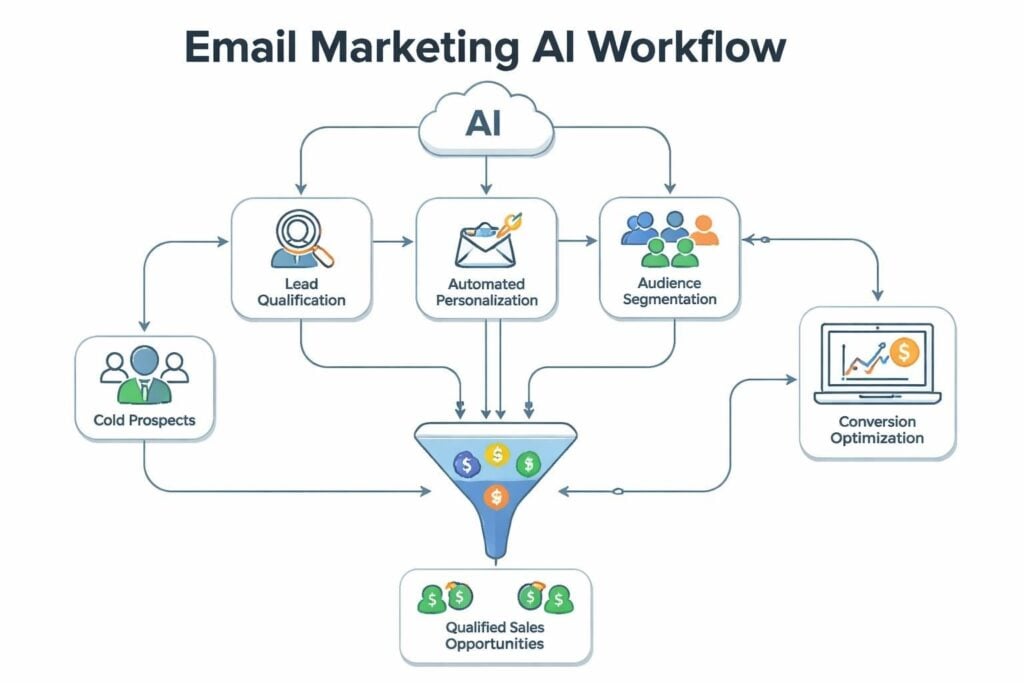
The inbox has become a battleground for attention, and traditional email marketing tactics are losing the war. Spray-and-pray campaigns generate dismal open rates, generic messages fail to resonate, and manual segmentation consumes countless hours while delivering mediocre results. But artificial intelligence is rewriting the rules of engagement, transforming email from a mass-communication tool into a precision instrument for converting cold leads into ready-to-buy customers. Email marketing AI doesn't just automate repetitive tasks-it fundamentally changes how businesses nurture relationships, predict customer behavior, and drive predictable revenue growth at scale.
The Evolution of Email Marketing in the AI Era
Email marketing has traveled a long road from batch-and-blast campaigns to today's sophisticated, data-driven strategies. The introduction of AI in email marketing represents the most significant shift since the invention of autoresponders, fundamentally altering how businesses communicate with prospects and customers.
Traditional email platforms require marketers to manually craft messages, segment audiences based on basic demographics, and guess optimal send times. This approach works at small scale but crumbles when you're managing thousands of leads across multiple customer journey stages.
Email marketing AI changes this equation entirely:
- Predictive analytics identify which leads are most likely to convert
- Natural language generation creates personalized copy at scale
- Behavioral modeling triggers messages based on prospect actions
- Send-time optimization delivers emails when recipients are most engaged
- Content testing automatically refines messaging for maximum impact
The transformation isn't just about efficiency. AI enables a level of personalization and relevance that was previously impossible without massive teams. When you're working with AI tools in marketing, you're not replacing human creativity-you're amplifying it with machine learning that processes millions of data points to inform every decision.
Why Lead Generation Businesses Need Email Marketing AI
Lead generation companies face unique challenges that make email marketing AI particularly valuable. You're not just nurturing existing customers-you're transforming cold prospects into qualified opportunities, often with limited initial data about their preferences, pain points, and buying readiness.
The traditional approach requires extensive manual work: researching prospects, crafting personalized outreach, timing follow-ups, and qualifying leads through multiple touchpoints. This process is time-intensive, inconsistent, and difficult to scale without proportional increases in headcount.
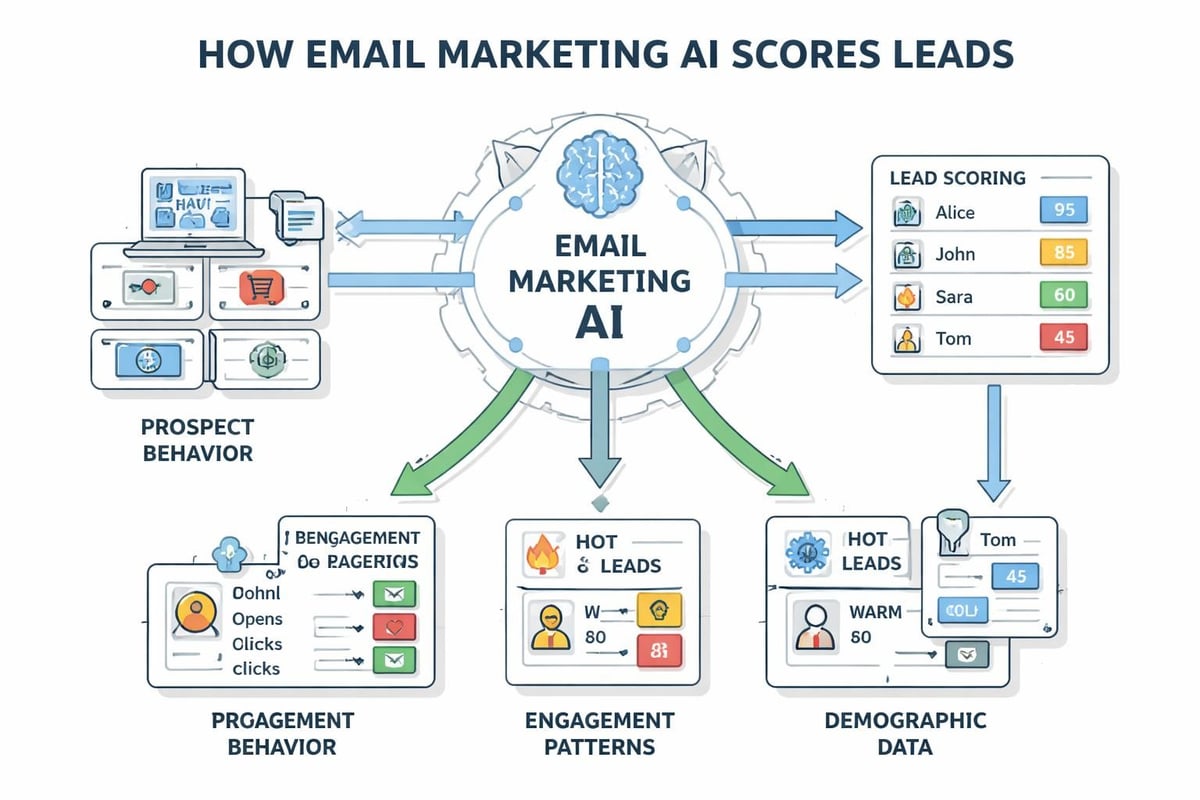
AI solves these problems by continuously learning from every interaction. Machine learning algorithms identify patterns in who responds to which messages, what content drives engagement, and which behavioral signals indicate buying intent. This intelligence compounds over time, making your campaigns progressively more effective.
Core Capabilities That Drive Results
Modern email marketing AI platforms offer an impressive array of capabilities, but not all features deliver equal value for lead generation businesses. Understanding which capabilities matter most helps you focus investments where they'll generate the highest return.
Intelligent Content Generation
AI-powered email tools can now draft entire email sequences that maintain your brand voice while adapting messaging to different audience segments. These systems analyze your best-performing historical content, learn your style preferences, and generate variations optimized for different prospect types.
The process works like this:
- Input parameters (target audience, goal, key message points)
- AI generates multiple subject line and body copy variations
- System tests variations against performance benchmarks
- Algorithm refines content based on engagement data
- Best performers automatically scale to larger audiences
This doesn't mean accepting robotic, generic copy. The best AI email marketing approaches use machine learning to enhance human creativity, not replace it. You provide strategic direction and brand guidelines; AI handles execution and optimization at scale.
Dynamic Segmentation and Personalization
Traditional segmentation divides your list into static groups based on fixed criteria. Email marketing AI creates dynamic segments that automatically update as prospects exhibit new behaviors or characteristics. Someone who downloads a pricing guide moves into a higher-intent segment. A lead who hasn't engaged in 30 days shifts to a re-engagement workflow.
| Traditional Segmentation | AI-Powered Segmentation |
|---|---|
| Manual list division | Automatic behavioral grouping |
| Static membership | Dynamic, real-time updates |
| Broad categories | Micro-segments of one |
| Periodic updates | Continuous refinement |
| Limited data points | Hundreds of signals analyzed |
This granularity enables true one-to-one personalization. Instead of "Dear [First Name]" tokenization, AI personalizes entire message structures, content recommendations, and offers based on individual prospect profiles and behaviors.
Predictive Send-Time Optimization
When should you send an email to maximize open rates? The answer varies by recipient, day of week, season, and dozens of other factors. Email marketing AI analyzes each subscriber's historical engagement patterns to predict their optimal send time, then automatically schedules delivery for maximum visibility.
Klaviyo’s AI capabilities demonstrate this power by examining when each person typically opens emails, what devices they use, and how engagement correlates with sending patterns. The result: substantially higher open rates without any additional effort from your team.
For businesses focused on leads in digital marketing, this optimization compounds across your entire funnel. Higher open rates mean more people see your value proposition, more clicks to landing pages, and ultimately more qualified conversations with your sales team.
Practical Applications for Lead Generation
Theory is interesting, but results matter. Let's examine how email marketing AI translates into measurable improvements in lead generation performance, with specific applications you can implement immediately.
Automated Lead Scoring and Qualification
Not all leads are created equal, and your follow-up strategy should reflect this reality. AI analyzes dozens of engagement signals to assign predictive lead scores that indicate conversion probability:
- Email open and click patterns
- Website visit frequency and page views
- Content download history
- Social media engagement
- Company size and industry fit
- Job title and seniority level
- Technology stack and tool usage
These scores update in real-time as new data arrives, ensuring your team always focuses on the highest-value opportunities. When a lead crosses a threshold score, AI can automatically trigger personalized outreach sequences, notify sales reps, or route prospects to specialized nurture tracks.
This automated qualification process dramatically improves efficiency. Instead of sales teams manually researching and prioritizing hundreds of leads, AI surfaces the prospects most likely to convert, complete with context about their interests and engagement history.
Intelligent Nurture Sequences
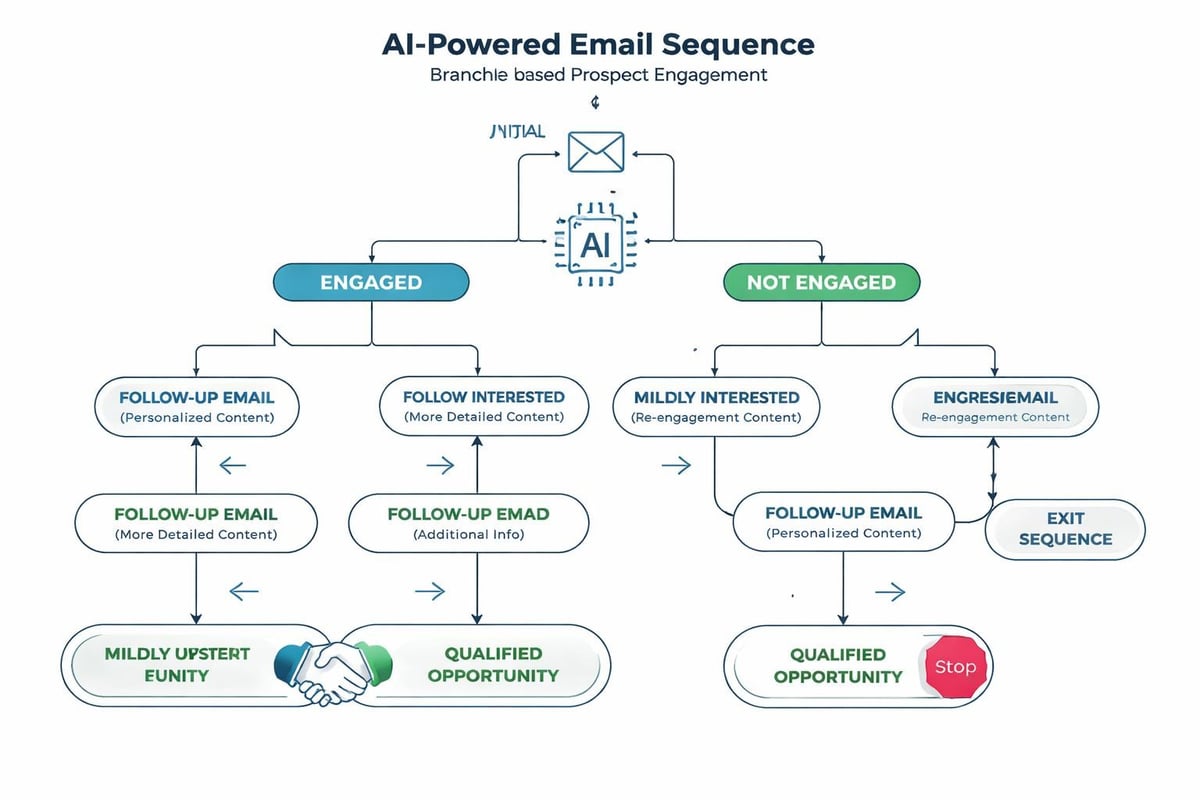
Traditional email sequences follow linear paths: everyone who downloads an ebook receives the same five-email series over two weeks. Email marketing AI creates adaptive sequences that branch based on recipient behavior, creating unique journeys for each prospect.
Here's how an AI-powered nurture sequence might work:
Email 1: Educational content about a common pain point
- Opens but doesn't click: Send case study next
- Clicks specific link: Deliver related deep-dive content
- Doesn't open: Resend with different subject line, then try alternate content angle
Email 2: Adapts based on Email 1 engagement
- High engagement: Move to solution-focused content faster
- Medium engagement: Continue educational nurturing
- Low engagement: Shift to re-engagement or qualification check
This adaptive approach ensures prospects receive relevant content aligned with their demonstrated interests, dramatically improving conversion rates compared to static sequences.
Campaign Performance Optimization
Every email campaign generates valuable data, but most marketers lack time to extract actionable insights from the noise. Email marketing AI continuously analyzes campaign performance across hundreds of variables, identifying optimization opportunities humans would miss.
The system might discover that:
- Prospects from manufacturing companies respond better to ROI-focused messaging
- Tuesday sends outperform Thursdays by 23% for specific segments
- Subject lines under 40 characters generate 15% higher open rates
- Including video thumbnails doubles click-through rates
- Follow-up emails sent 3 days after initial contact convert better than 2 or 4 days
These insights automatically feed back into campaign optimization, creating a virtuous cycle of continuous improvement without manual intervention.
Integration with Your Growth Stack
Email marketing AI delivers maximum value when integrated with your broader marketing and sales technology ecosystem. Isolated tools create data silos; connected systems amplify each signal across your entire operation.
CRM Synchronization
Bidirectional sync between your email platform and CRM ensures every interaction informs the complete prospect record. When someone clicks a link in your email, this engagement data flows to your CRM, updating their lead score and triggering appropriate sales actions.
AI email marketing automation platforms like Zapier enable sophisticated workflows that connect email engagement to dozens of other tools and processes. A high-engagement prospect might automatically be added to a retargeting audience, assigned to a sales rep, and sent a calendar link-all without manual intervention.
This integration is particularly valuable for businesses using strategies like lead gen campaigns on Facebook, where prospects enter your funnel through one channel but require multi-touch nurturing across email, social, and direct outreach.
Analytics and Attribution
Understanding which email touches contribute to conversions is critical for optimizing spend and strategy. Modern email marketing AI platforms offer sophisticated attribution modeling that tracks the entire customer journey, not just last-touch interactions.
You can see:
- Which email sequences generate the most qualified leads
- How email engagement correlates with deal size and close rate
- What content topics drive progression through your funnel
- Which segments deliver the highest lifetime value
- How email contributes to pipeline alongside other channels
This visibility enables data-driven decisions about content creation, segment prioritization, and resource allocation.
Content Management Systems
Connecting your email platform to your content library allows AI to automatically recommend relevant articles, guides, and resources based on prospect behavior and interests. When someone demonstrates interest in a specific topic, the system can pull appropriate content without requiring you to manually map every possible scenario.
Tools for lead generation work best when they communicate seamlessly, creating unified experiences that guide prospects smoothly from awareness to conversion.
Choosing the Right Email Marketing AI Platform
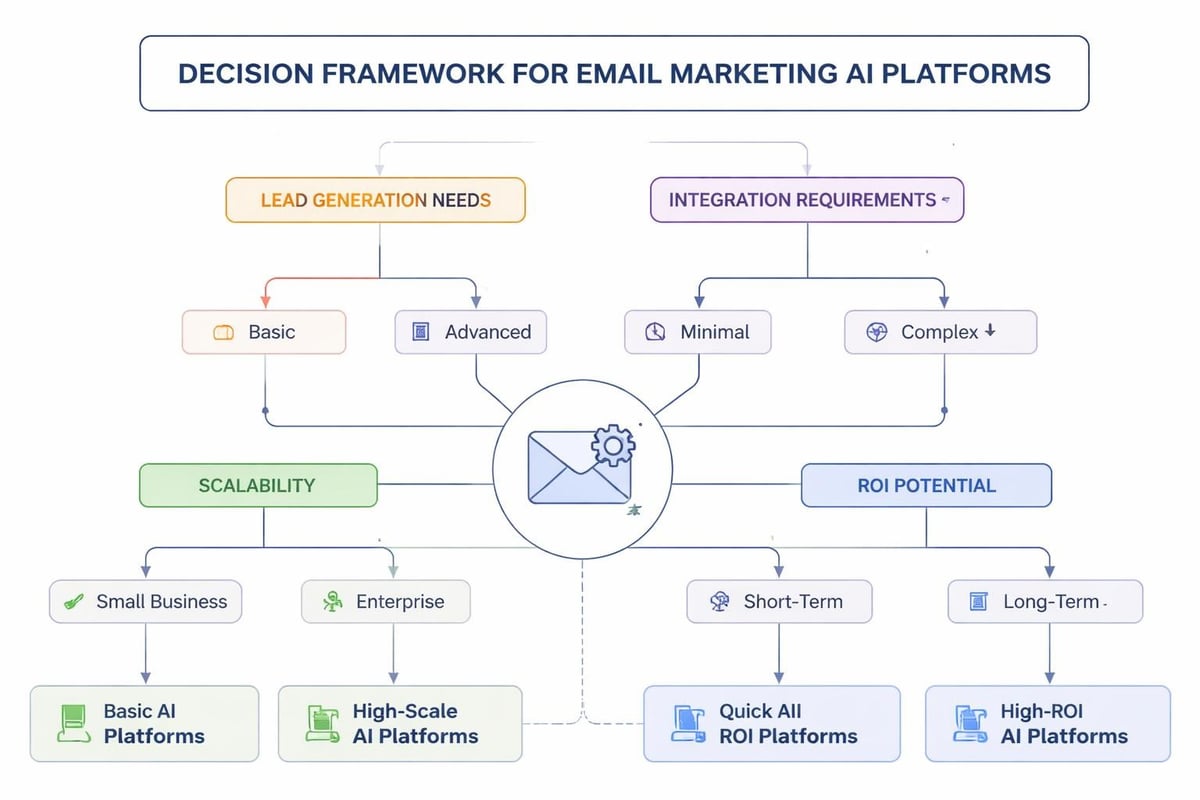
The market offers dozens of platforms claiming AI capabilities, but feature lists don't tell the whole story. Selecting the right solution requires evaluating both technical capabilities and strategic fit with your business model.
Essential Features Checklist
When evaluating email marketing AI platforms, prioritize these capabilities:
Core AI Functionality:
- Predictive send-time optimization
- Automated content generation and testing
- Dynamic segmentation based on behavior
- Lead scoring and qualification
- Natural language processing for response analysis
Integration Capabilities:
- Native CRM connections (Salesforce, HubSpot, etc.)
- API access for custom workflows
- Webhook support for real-time data sync
- Marketing automation platform compatibility
Analytics and Reporting:
- Multi-touch attribution modeling
- Segment performance comparisons
- A/B testing automation
- Predictive analytics for campaign planning
- Custom reporting and dashboards
Scalability Considerations:
- Deliverability infrastructure and reputation
- List size limits and pricing structure
- API rate limits for high-volume operations
- Support for multiple brands or business units
Platform Comparison
Different platforms excel in different areas. AWeber’s AI tools focus on small business accessibility, while Mailjet’s AI features emphasize template optimization and collaborative workflows. Generative AI platforms like Typeface are pushing boundaries in content creation across entire campaigns.
The right choice depends on your specific needs. Businesses focused on B2B lead generation may prioritize account-based marketing features and CRM integration, while local service businesses might value mobile optimization and appointment booking capabilities.
Implementation Strategy for Maximum Impact
Technology alone doesn't drive results. Successful email marketing AI implementation requires thoughtful strategy, proper data foundation, and ongoing optimization. Here's how to maximize your investment.
Data Hygiene and Preparation
AI algorithms are only as good as the data they analyze. Before implementing advanced email marketing AI features, ensure your foundation is solid:
- Clean your email list (remove bounces, complaints, inactive subscribers)
- Standardize data fields (consistent formatting, complete records)
- Enrich prospect profiles (add firmographic and behavioral data)
- Define clear segments (establish baseline groups for AI to refine)
- Tag historical campaigns (create training data for AI algorithms)
This preparation accelerates AI learning and improves initial performance. Systems trained on clean, comprehensive data deliver better results faster than those working with incomplete or inconsistent information.
Phased Rollout Approach
Don't activate every AI feature simultaneously. A phased approach allows you to learn, adjust, and build confidence before scaling:
Phase 1: Foundation (Weeks 1-4)
- Implement send-time optimization for existing campaigns
- Activate basic behavioral segmentation
- Begin A/B testing automation
Phase 2: Expansion (Weeks 5-8)
- Launch AI-generated content variations
- Implement predictive lead scoring
- Create adaptive nurture sequences
Phase 3: Optimization (Weeks 9-12)
- Refine segments based on performance data
- Expand personalization across campaigns
- Integrate additional data sources
Phase 4: Scale (Week 13+)
- Apply learnings across all campaigns
- Develop advanced workflows and triggers
- Continuously optimize based on AI insights
This measured approach prevents overwhelming your team while building institutional knowledge about what works for your specific audience.
Measuring Success
Define clear KPIs before implementation so you can measure actual impact:
| Metric Category | Key Indicators |
|---|---|
| Engagement | Open rate, click-through rate, time spent reading |
| Conversion | Lead-to-opportunity rate, email-attributed conversions |
| Efficiency | Time saved on campaign creation, cost per qualified lead |
| Quality | Lead score distribution, sales acceptance rate |
| Revenue | Pipeline influenced, closed-won deals, customer lifetime value |
Track these metrics weekly during initial implementation, then monthly as processes stabilize. Compare AI-powered campaigns against traditional approaches to quantify ROI and identify opportunities for further optimization.
Advanced Strategies for Competitive Advantage
Once basic email marketing AI capabilities are humming, advanced strategies can create substantial competitive advantages that compound over time.
Behavioral Trigger Campaigns
AI excels at identifying subtle behavioral patterns that indicate changing intent or needs. Advanced implementations monitor prospect activity across channels, triggering perfectly-timed emails based on complex combinations of signals.
For example, a lead who visits your pricing page three times in a week, downloads a comparison guide, and checks employee LinkedIn profiles is demonstrating high buying intent. Traditional systems might miss this pattern or respond slowly. AI identifies the signal constellation in real-time and immediately triggers appropriate outreach.
These behavioral triggers work particularly well for businesses focused on local lead generation, where timely response to intent signals can mean the difference between winning and losing deals.
Competitive Intelligence Integration
Advanced email marketing AI systems can incorporate competitive intelligence data to refine messaging and positioning. When a prospect visits competitor websites, attends their webinars, or engages with their content, your system can adapt email messaging to address likely objections and emphasize differentiators.
This requires integrating data sources like web tracking, social listening, and third-party intent data, but the payoff is substantial. You're no longer sending generic messages-you're having intelligent conversations informed by complete context about where prospects are in their evaluation process.
Content Recommendation Engines
Similar to how Netflix recommends shows based on viewing history, email marketing AI can recommend content based on each prospect's unique engagement patterns and profile characteristics. The system learns which resources resonate with different prospect types, then automatically suggests the most relevant next step.
This creates a self-reinforcing cycle: better recommendations drive higher engagement, which generates more data, which further improves recommendations. Over time, your content becomes increasingly effective at moving prospects through your funnel.
Lifecycle Marketing Automation
True marketing automation extends beyond initial lead nurturing to encompass the entire customer lifecycle. Email marketing AI can manage sophisticated programs that:
- Onboard new customers with personalized training sequences
- Identify upsell and cross-sell opportunities based on usage patterns
- Re-engage churning customers with targeted retention campaigns
- Request referrals from highly engaged advocates
- Win back lost customers with personalized offers
Each of these programs benefits from AI's ability to personalize timing, messaging, and offers at individual level, dramatically improving performance compared to one-size-fits-all approaches.
Future Trends Shaping Email Marketing AI
The email marketing AI landscape continues evolving rapidly. Understanding emerging trends helps you stay ahead of the curve and make technology investments that remain relevant as capabilities advance.
Conversational AI integration will enable emails that adapt in real-time based on recipient responses. Instead of static messages, you'll see interactive experiences where AI adjusts subsequent content based on how recipients engage with initial elements.
Multimodal content generation will expand beyond text to automatically create personalized images, videos, and interactive elements optimized for each recipient. AI content generation tools already demonstrate impressive capabilities; the next generation will create truly individualized creative assets at scale.
Privacy-first personalization will become essential as regulations tighten and consumer expectations evolve. Advanced AI will deliver personalized experiences using aggregated patterns and predictive modeling rather than individual tracking, maintaining relevance while respecting privacy.
Voice and sentiment analysis will extract deeper insights from how prospects engage with emails, not just whether they click. AI will analyze response tone, question complexity, and language patterns to better understand prospect needs and adjust accordingly.
These advances will further separate leaders from laggards. Companies that embrace email marketing AI now will accumulate data and experience advantages that become increasingly difficult for competitors to overcome.
Email marketing AI represents more than incremental improvement-it's a fundamental shift in how businesses nurture relationships and convert prospects into customers. By automating personalization, predicting behavior, and continuously optimizing performance, AI enables lead generation results that were simply impossible with manual approaches. Ready to transform your email marketing from a cost center into a predictable revenue driver? Adstra leverages advanced AI systems to generate qualified sales leads and automate the entire journey from cold prospect to booked appointment, delivering guaranteed growth through strategies proven across thousands of campaigns.