


The traditional marketing playbook is broken. Businesses spend thousands on campaigns that attract tire-kickers while their ideal customers scroll past. The disconnect happens when marketing messages fail to resonate with what prospects actually need, creating a wasteful cycle of unqualified leads and disappointed sales teams. Alignment marketing offers a radical alternative: building campaigns around genuine value alignment between your business and your customers. This approach transforms how companies generate leads, turning cold prospects into eager buyers who already understand and appreciate what you offer.
Understanding Alignment Marketing Fundamentals
Alignment marketing represents a strategic shift from volume-based lead generation to value-based customer acquisition. Rather than casting the widest possible net, this methodology focuses on attracting prospects whose needs, values, and goals naturally align with your business offerings.
The core principle revolves around authentic messaging that speaks directly to your ideal customer's pain points while demonstrating how your solution fits their specific situation. This authentic messaging approach creates magnetic attraction rather than pushy persuasion.
Traditional marketing focuses on:
- Maximum reach and impressions
- Generic messaging for broad appeal
- Volume of leads over quality
- One-size-fits-all campaigns
Alignment marketing prioritizes:
- Targeted messaging for ideal customers
- Value proposition clarity
- Quality conversations over quantity
- Customized experiences at scale
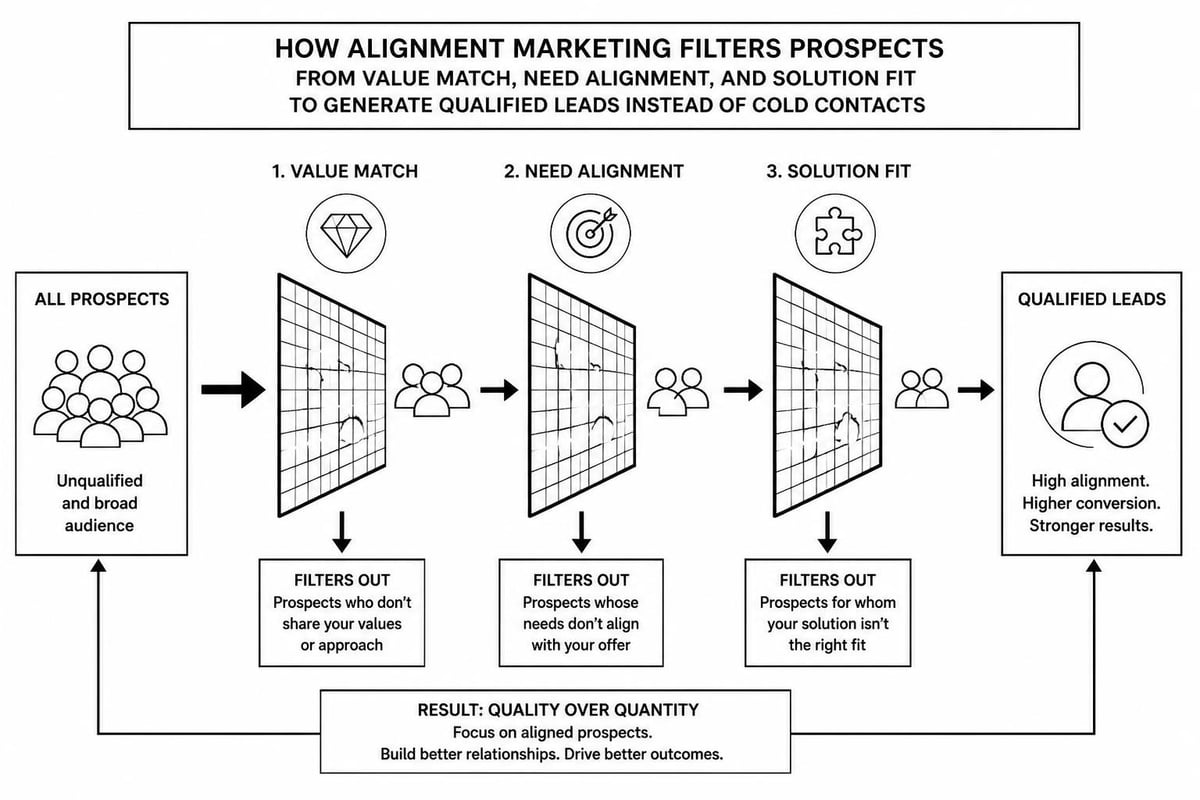
When you implement alignment marketing strategies, you're essentially pre-qualifying your leads before they ever reach your sales team. The messaging itself acts as a filter, attracting those who resonate while naturally repelling poor-fit prospects.
The Psychology Behind Alignment
People buy from businesses they trust and understand. Alignment marketing leverages this fundamental truth by ensuring every touchpoint reinforces the connection between customer needs and your solution.
Research shows that when prospects perceive genuine alignment between their goals and your offerings, conversion rates increase dramatically. This isn't manipulation; it's clarity. You're simply making it easier for the right people to recognize you as their solution.
The transparency required for alignment marketing builds credibility from the first interaction. Rather than hiding behind vague promises, you clearly articulate who you help, how you help them, and what results they can expect. This approach mirrors successful strategies used by digital product creators who build sustainable businesses by aligning their expertise with customer transformation goals.
Building Your Alignment Marketing Framework
Creating an effective alignment marketing system requires methodical planning and deep customer understanding. The framework consists of three interconnected pillars that work together to attract and convert qualified prospects.
| Framework Component | Purpose | Implementation |
|---|---|---|
| Ideal Customer Clarity | Define who you serve best | Detailed persona research and analysis |
| Value Proposition Alignment | Articulate unique fit | Message mapping to customer journey |
| System Integration | Ensure consistent experience | Technology stack and process design |
Identifying Your Ideal Customer Profile
The foundation of alignment marketing starts with radical specificity about who you serve. Generic targeting produces generic results. Instead, develop detailed profiles of customers who receive maximum value from your offerings.
Consider factors beyond basic demographics:
- Business challenges they face daily
- Goals they're actively pursuing
- Previous solutions they've tried
- Decision-making criteria they prioritize
- Success metrics they measure
This specificity allows you to craft messages that feel personally relevant to prospects. When someone reads your content and thinks "This company understands my exact situation," you've achieved alignment.
For businesses in lead generation, this means understanding not just that prospects need more customers, but why their current lead generation strategies aren't working and what would make a new approach compelling.
Crafting Aligned Messaging
Once you understand your ideal customer deeply, translate those insights into messaging that demonstrates alignment at every touchpoint. Your content should answer the unspoken question every prospect has: "Is this for me?"
Effective aligned messaging includes specific details that resonate with your target audience. Rather than claiming you "help businesses grow," you might say you "help service-based businesses struggling with inconsistent lead flow generate 15-20 qualified appointments monthly through AI-powered prospecting systems."
The specificity accomplishes two goals simultaneously: it attracts ideal prospects who recognize their situation in your description, and it repels poor-fit leads who know they don't match that profile.
Sales and marketing alignment becomes significantly easier when your messaging attracts pre-qualified prospects who already understand what you offer and why it matters to them.
Implementing Alignment Marketing Systems
Theory transforms into results through systematic implementation. Alignment marketing requires coordinated systems that deliver consistent experiences across every customer interaction.
Technology Infrastructure
Modern alignment marketing leverages AI and automation to personalize at scale. The right technology stack enables you to deliver tailored experiences without manual intervention for every prospect.
Essential technology components:
- CRM systems that track prospect engagement and behavior patterns
- AI-powered chatbots that qualify leads through conversational interactions
- Email automation that adapts messaging based on prospect actions
- Analytics platforms that measure alignment effectiveness
Companies like Aletto demonstrate how AI systems enhance marketing by automating lead qualification while maintaining the personal touch that creates genuine connections. The technology handles repetitive tasks, freeing human team members to focus on high-value relationship building.
Content Strategy for Alignment
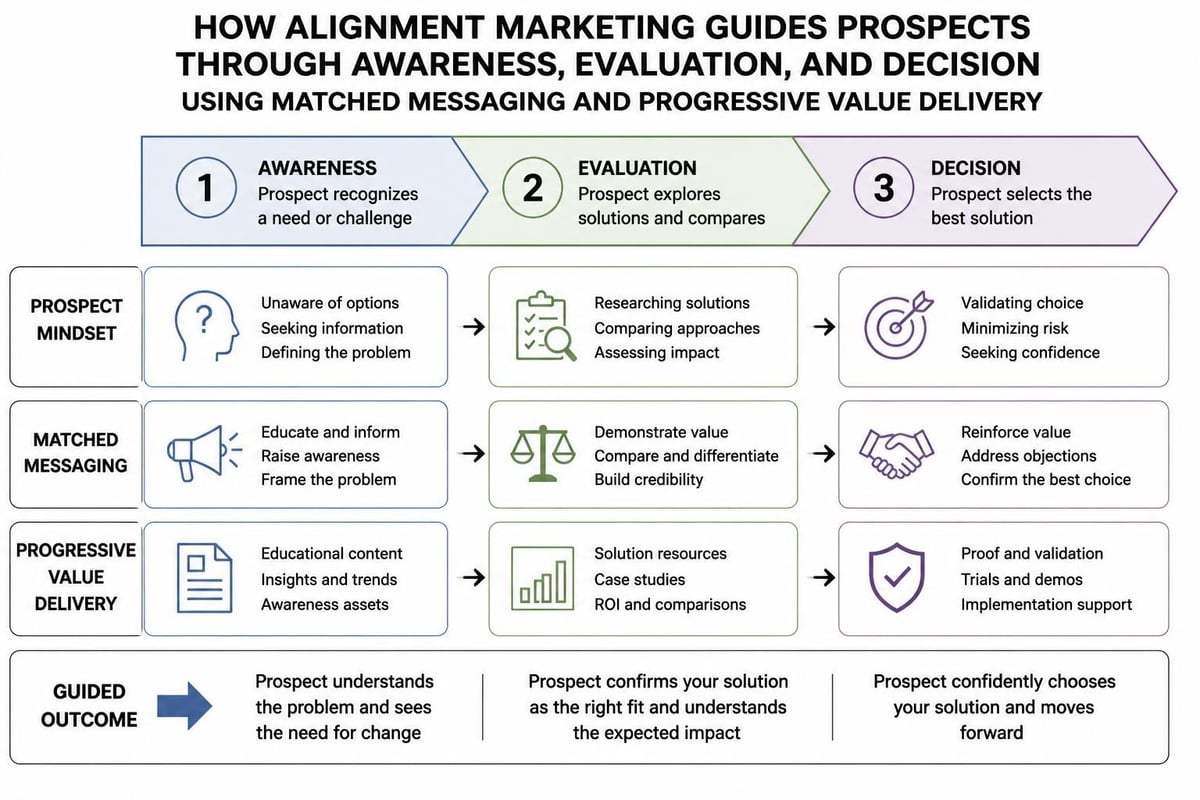
Your content marketing becomes significantly more effective when aligned with specific prospect needs at different journey stages. Each piece of content should serve a clear purpose in attracting, educating, or converting ideal customers.
Early-stage content addresses broad challenges and positions your expertise without heavy selling. Middle-stage content educates prospects on solution approaches and evaluation criteria. Late-stage content provides proof points and addresses specific objections.
This strategic approach to marketing content funnels ensures prospects receive relevant information exactly when they need it, accelerating their decision-making process.
Consider how digital entrepreneurs use alignment in their content strategy. Platforms like CreateSell attract aspiring product creators by addressing specific challenges around transitioning from service-based to product-based income, demonstrating perfect alignment between content topics and audience needs.
Measuring Alignment Marketing Success
What gets measured gets improved. Alignment marketing requires different metrics than traditional volume-based approaches. Success isn't about reaching more people; it's about reaching the right people more effectively.
Key Performance Indicators
| Metric | What It Measures | Target Benchmark |
|---|---|---|
| Lead Quality Score | Fit between prospect and ideal customer profile | 80%+ match rate |
| Sales Cycle Length | Time from first contact to closed deal | 30-50% reduction |
| Customer Lifetime Value | Long-term revenue from aligned customers | 2-3x industry average |
| Conversion Rate | Qualified leads to customers | 25-40% for aligned prospects |
| Customer Satisfaction | Post-purchase alignment verification | 90%+ satisfaction scores |
These metrics reveal whether your alignment marketing efforts actually attract better-fit prospects. A high volume of low-quality leads indicates misalignment between messaging and ideal customer profile.
Continuous Optimization Process
Alignment marketing isn't set-and-forget. Markets evolve, customer needs shift, and competitive landscapes change. Regular optimization ensures your alignment remains accurate and effective.
Implement quarterly alignment audits that review:
- Customer feedback and satisfaction data
- Lead quality trends over time
- Conversion rate patterns by source
- Message resonance testing results
- Competitive positioning shifts
Use this data to refine your ideal customer profile, adjust messaging, and improve system performance. The businesses that win with alignment marketing treat it as an ongoing practice rather than a one-time project.
Advanced Alignment Marketing Strategies
Once foundational alignment systems are functioning, advanced strategies amplify results through deeper personalization and strategic partnerships.
Multi-Channel Alignment
Prospects interact with your brand across multiple channels before making purchase decisions. Alignment marketing extends beyond individual touchpoints to create consistent experiences across every platform.
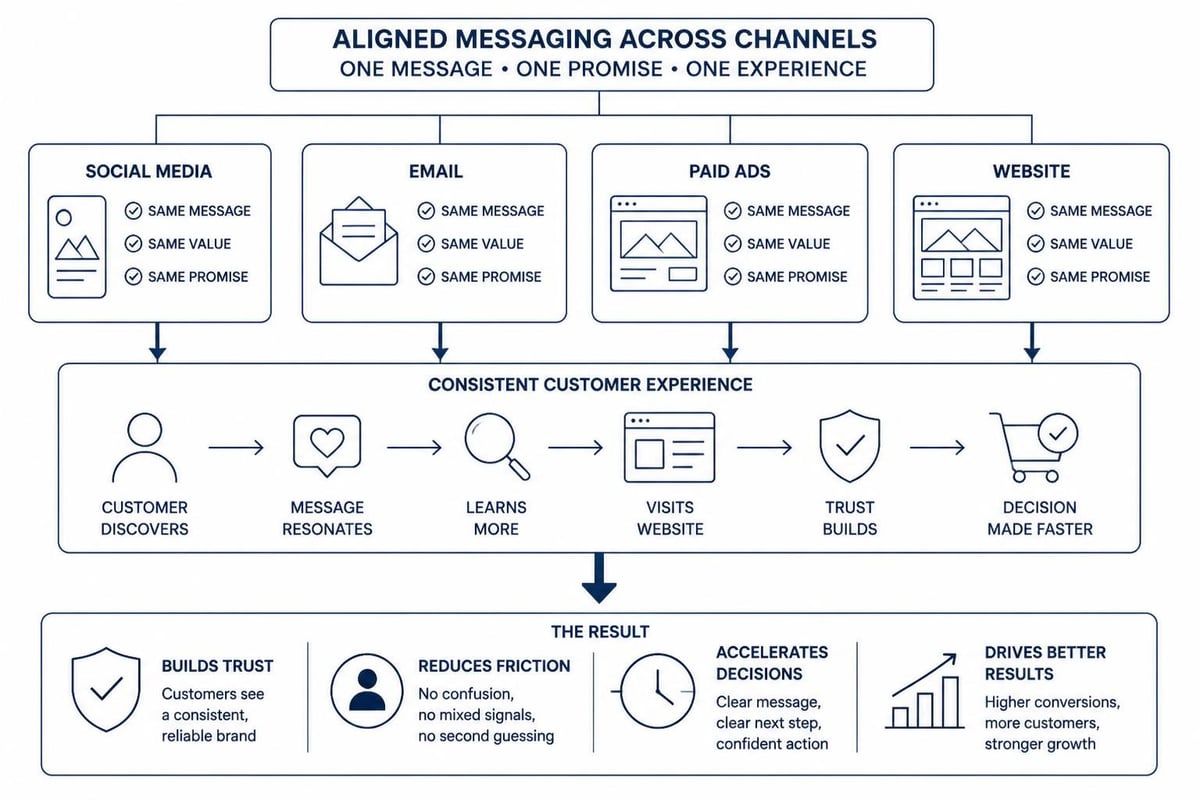
Your social media funnel should reinforce the same aligned messaging as your email campaigns, website content, and advertising. This consistency builds trust through repetition and removes friction from the customer journey.
Different channels serve different purposes in the alignment process:
- Paid advertising attracts attention with problem-focused messaging
- Social media builds familiarity through value-driven content sharing
- Email marketing nurtures relationships with personalized communication
- Website content educates and converts through comprehensive information
Partnership-Based Alignment
Strategic partnerships extend your alignment reach by connecting with audiences that already trust complementary brands. When you partner with businesses serving similar customer profiles with non-competing offers, both parties benefit from expanded qualified lead flow.
Evaluate potential partnerships through an alignment lens. The best partnerships share customer values, target similar demographics, and maintain complementary service offerings. This creates natural referral opportunities that feel authentic rather than transactional.
Lead generation agencies increasingly recognize that partnership-based strategies outperform isolated campaigns because they leverage pre-established trust relationships.
The ROI of Alignment Marketing
Investment in alignment marketing delivers returns across multiple business dimensions beyond immediate lead generation. Understanding these comprehensive benefits helps justify resource allocation and strategic commitment.
Financial returns:
- Higher conversion rates reduce customer acquisition costs
- Better customer fit increases lifetime value
- Reduced sales cycle length improves cash flow velocity
- Lower refund and cancellation rates protect revenue
Operational benefits:
- Sales teams spend less time qualifying poor-fit leads
- Customer success requires fewer resources with aligned clients
- Marketing efficiency improves through focused targeting
- Team morale increases with better quality interactions
Strategic advantages:
- Market positioning becomes clearer and more defensible
- Brand reputation strengthens through customer success stories
- Competitive differentiation emerges through authentic positioning
- Scalability improves with systematized alignment processes
Companies implementing alignment marketing consistently report that initial implementation effort pays dividends through sustainable growth. Rather than constantly seeking new lead sources, aligned businesses benefit from referrals, repeat purchases, and expanded relationships with ideal customers.
The transparency inherent in alignment marketing also protects against regulatory scrutiny and customer dissatisfaction. When you clearly communicate who you serve and what you deliver, expectations align with reality from the start.
Overcoming Alignment Marketing Challenges
Despite clear benefits, businesses face predictable obstacles when implementing alignment marketing strategies. Anticipating these challenges enables proactive solutions.
Common Implementation Barriers
Fear of narrow targeting: Many businesses worry that focusing on ideal customers means leaving money on the table. In reality, trying to serve everyone means serving no one particularly well. Narrow targeting produces higher conversion rates that more than compensate for reduced reach.
Organizational resistance: Sales teams accustomed to high lead volumes may initially resist quality-focused approaches. Education about improved conversion rates and shorter sales cycles helps overcome this resistance. Demonstrate early wins to build buy-in.
Message development difficulty: Crafting truly aligned messaging requires deep customer understanding that many businesses lack. Invest time in customer research, interviews, and feedback analysis. The insights you gain become competitive advantages.
System integration complexity: Implementing alignment marketing often requires connecting multiple technology platforms and ensuring data flows correctly. Start with simplified systems and expand functionality as you prove concept value.
Patience during transition: Results may not appear immediately as you shift from volume to value-based approaches. Set realistic expectations about the 3-6 month timeline for seeing meaningful traction.
Solutions and Best Practices
Begin with pilot programs that test alignment marketing principles on a small scale before full organizational commitment. This reduces risk while generating proof points that justify broader implementation.
Invest in team training so everyone understands alignment principles and their role in executing the strategy. When entire organizations embrace alignment thinking, it permeates every customer interaction.
Use proven marketing platforms that support personalization and segmentation rather than fighting against technology limitations. The right tools make alignment marketing significantly easier to execute.
Document your ideal customer profile in detail and share it across teams. When sales, marketing, and customer success all understand who you serve best, alignment becomes self-reinforcing.
Alignment Marketing in Practice
Real-world examples illustrate how alignment marketing transforms business results across industries and company sizes.
Service-based businesses struggling with feast-or-famine revenue cycles find particular value in alignment marketing. By attracting prospects who already understand their service value and pricing structure, they eliminate lengthy education periods and price objections.
B2B companies with complex sales processes use alignment marketing to ensure only qualified prospects enter their pipeline. This dramatically improves sales team productivity and forecast accuracy while reducing wasted effort on dead-end opportunities.
The principles apply regardless of whether you're generating leads for specific industries or building broad market presence. Alignment thinking improves every customer acquisition strategy.
Even established businesses benefit from alignment marketing refinement. Many discover they're attracting customers who aren't ideal fits, creating unnecessary service complications and limiting growth potential. Realigning messaging to attract better-fit prospects transforms business economics.
Alignment marketing fundamentally changes how businesses approach customer acquisition, replacing volume-focused tactics with value-based attraction strategies that generate qualified leads and lasting partnerships. When you're ready to transform your lead generation from quantity-focused to quality-driven, Aletto provides the AI-powered systems and guaranteed growth partnership model that turns alignment principles into predictable revenue growth. Our transparent, value-driven approach ensures we only succeed when you succeed, perfectly aligning our interests with your business outcomes.