
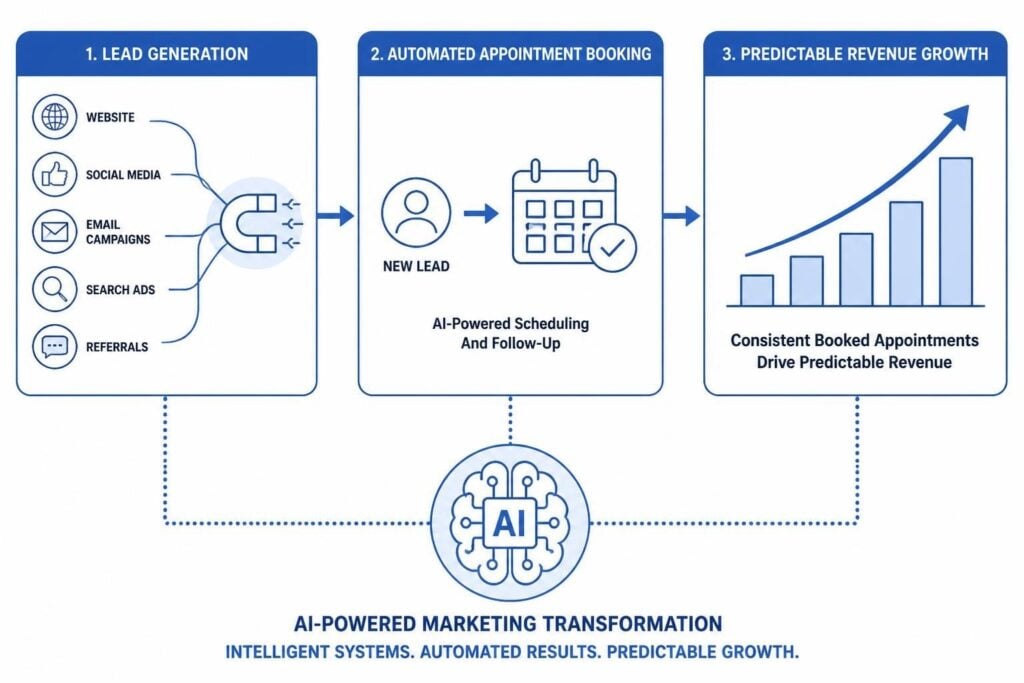
The landscape of customer acquisition has fundamentally shifted. While traditional marketing agencies continue to chase vanity metrics and bill by the hour, a revolutionary approach powered by artificial intelligence is delivering what businesses actually need: qualified leads that convert into paying customers. Understanding ai in marketing isn't just about staying current with technology trends anymore. It's about survival in an increasingly competitive marketplace where companies demand measurable ROI and guaranteed results from their marketing investments.
The Fundamental Shift in Marketing Technology
Artificial intelligence has moved beyond experimental technology into the core infrastructure of successful marketing operations. The transformation isn't theoretical anymore. According to Nielsen’s research on AI redefining marketing, companies leveraging AI systems are seeing dramatic improvements in customer engagement and conversion rates. This shift represents more than incremental improvement. We're witnessing a complete restructuring of how businesses identify, reach, and convert potential customers.
The old marketing playbook assumed humans would manually qualify leads, craft individual messages, and schedule follow-ups. That approach simply cannot scale in 2026. AI in marketing enables businesses to process thousands of potential customer interactions simultaneously while maintaining personalization that actually resonates. The technology identifies patterns in customer behavior that human analysts would never spot, predicting which prospects are most likely to convert and exactly when they're ready to buy.
How AI Systems Qualify Leads at Scale
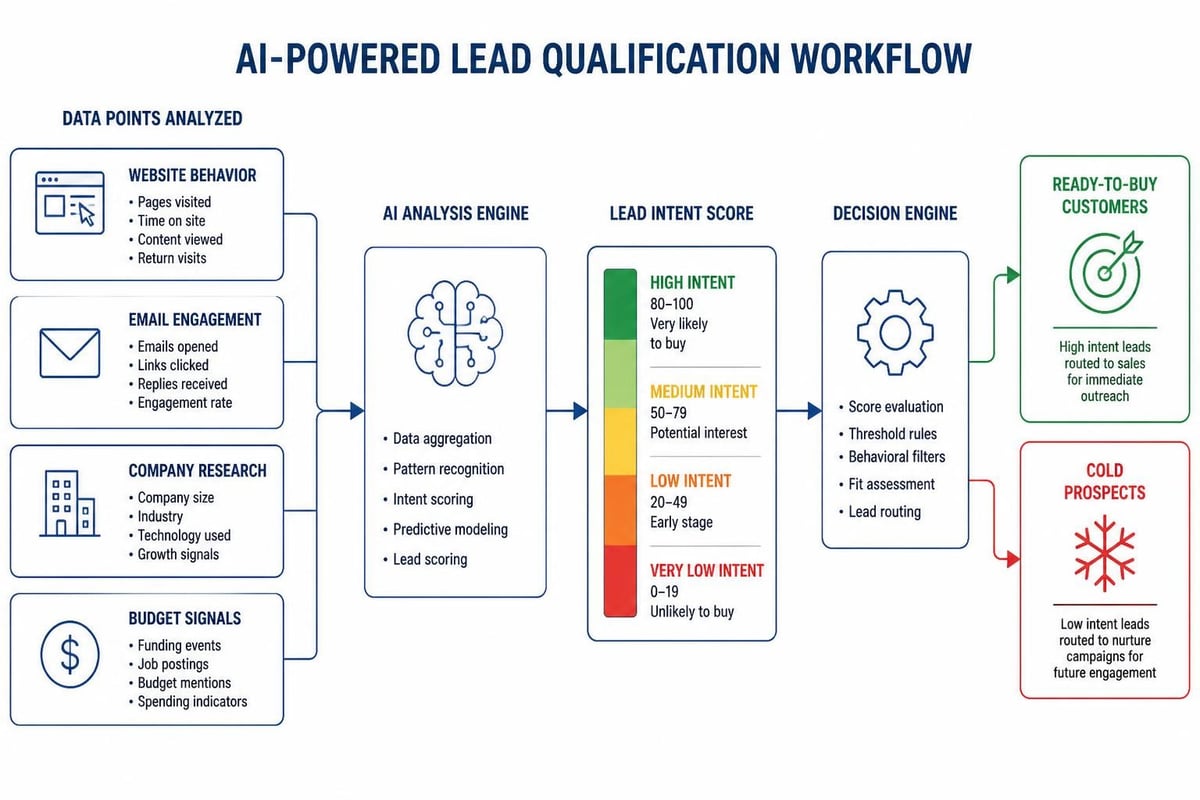
Traditional lead qualification required sales teams to manually review every inquiry, ask qualifying questions, and determine fit. This process was slow, inconsistent, and expensive. Modern AI systems analyze dozens of data points instantly:
- Previous website interactions and content consumption patterns
- Email engagement metrics and response timing
- Social media activity and professional background
- Company size, industry, and growth trajectory
- Budget indicators and decision-making authority
- Competitor research and comparison shopping behavior
The system doesn't just score leads numerically. It understands context. An AI-powered qualification engine recognizes when a prospect is researching solutions versus actively evaluating vendors. This distinction allows lead generation companies to focus human attention where it matters most: closing deals with ready-to-buy customers rather than nurturing cold prospects.
Automating Appointment Booking Without Losing the Human Touch
One of the most valuable applications of ai in marketing is automated appointment scheduling. The technology has evolved far beyond simple calendar integrations. Today's systems conduct intelligent conversations with prospects, understanding their needs, qualifying their fit, and booking meetings without human intervention. This capability fundamentally changes the economics of customer acquisition.
Consider the typical manual process. A prospect submits a contact form. Someone from sales receives a notification, reviews the lead, crafts a response, sends availability options, and waits for the prospect to reply. Multiple back-and-forth exchanges occur before an appointment finally gets scheduled, often days or weeks after initial contact. By that time, the prospect has likely engaged with three or four competitors.
| Manual Scheduling | AI-Powered Scheduling |
|---|---|
| 3-5 days to first contact | Instant engagement |
| 4-7 touchpoints to book | Single conversation |
| 40-60% no-show rate | 15-25% no-show rate |
| Inconsistent qualification | Standardized screening |
| Limited availability coverage | 24/7 responsiveness |
AI systems engage prospects immediately, while interest is highest. They ask qualifying questions conversationally, determine fit in real-time, and present available time slots based on both calendar availability and optimal conversion windows. The technology even handles rescheduling requests and sends automated reminders that reduce no-show rates significantly.
The Technical Architecture Behind Intelligent Automation
The sophistication of modern marketing AI extends well beyond chatbots with pre-programmed responses. These systems integrate multiple technologies working in concert. Natural language processing understands prospect questions and responds contextually. Machine learning algorithms improve conversation quality based on thousands of previous interactions. Predictive analytics determine the best times to reach out and which messaging resonates with specific prospect segments.
IBM’s exploration of generative AI in marketing demonstrates how these systems don't just follow scripts, they generate unique, personalized content for each interaction. The AI analyzes a prospect's industry, company size, specific challenges mentioned in previous communications, and even the tone of their messages to craft responses that feel genuinely human and relevant.
This level of personalization at scale was impossible just two years ago. Now it's becoming the baseline expectation for businesses serious about demand generation. Companies that continue relying on manual processes simply cannot compete with the speed, consistency, and personalization that AI-powered systems deliver.
Transforming Cold Leads Into Ready-to-Buy Customers
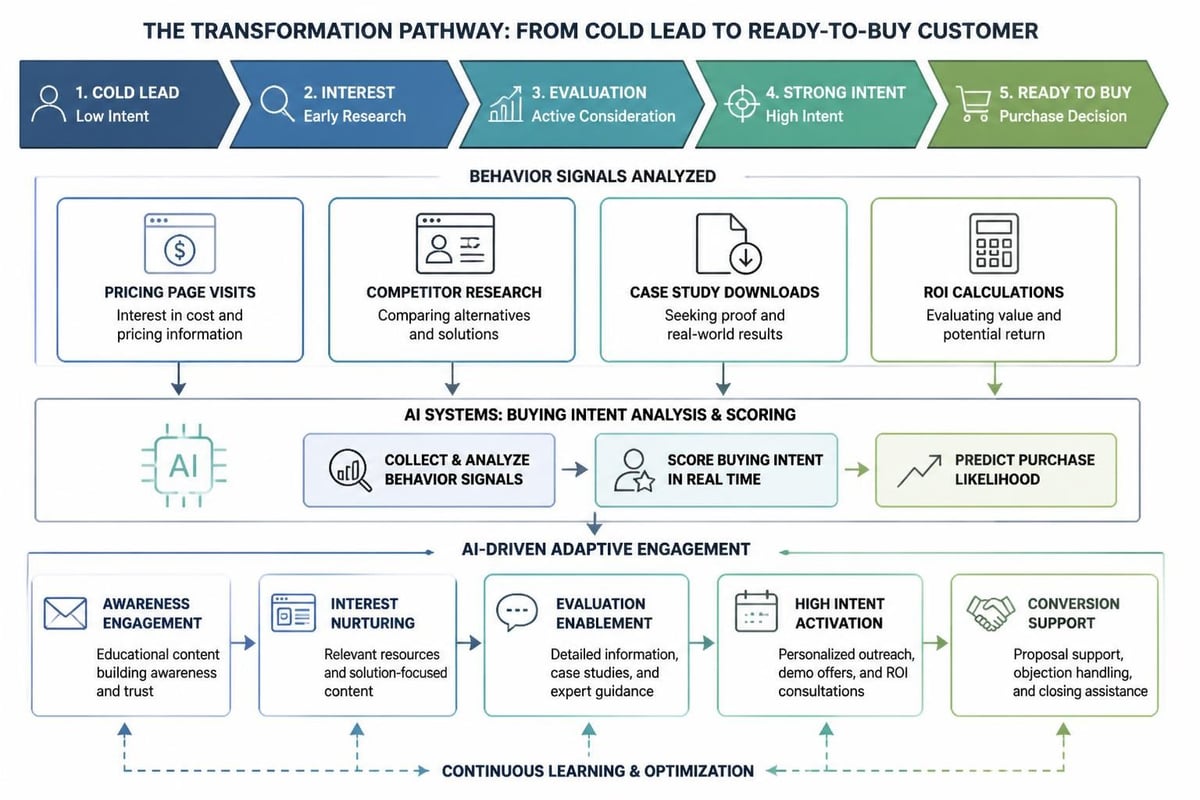
The most impressive capability of ai in marketing isn't just efficiency. It's the ability to nurture cold prospects through the entire buying journey without constant human oversight. Traditional nurture campaigns sent the same email sequence to everyone. Modern AI systems create dynamic journeys that adapt based on individual prospect behavior.
When a prospect downloads a whitepaper, the AI doesn't just add them to a generic drip campaign. It analyzes which specific sections they spent time reading, what follow-up questions they asked, whether they shared the content with colleagues, and dozens of other signals. Based on this analysis, it determines where the prospect sits in their buying journey and what information they need next.
The system might identify that a prospect:
- Has visited pricing pages multiple times
- Researched competitor alternatives
- Downloaded case studies in their specific industry
- Engaged with ROI calculator tools
- Added decision-makers from their company to email threads
These behaviors signal buying intent far more accurately than simple demographic data. The AI recognizes these patterns and accelerates engagement accordingly, routing high-intent prospects directly to sales while continuing to nurture earlier-stage contacts with relevant educational content.
Real Revenue Impact from AI-Powered Marketing
The financial implications of implementing ai in marketing systems extend beyond operational efficiency. Companies are seeing fundamental improvements in their revenue metrics. Research highlighted by TechRadar shows staggering ROI improvements when AI powers the entire marketing funnel from initial contact through conversion.
Businesses implementing comprehensive AI marketing systems report:
- Lead quality improvements of 40-65% as AI accurately identifies and prioritizes high-intent prospects
- Conversion rate increases of 25-45% through personalized engagement at optimal moments
- Sales cycle reduction of 30-50% as automated systems move prospects through the funnel faster
- Cost per acquisition drops of 35-60% due to improved targeting and reduced manual labor
- Customer lifetime value growth of 20-40% from better qualification and fit analysis
These aren't marginal improvements. They represent fundamental business transformation. A company spending $50,000 monthly on lead generation with a 2% conversion rate suddenly achieving 3.5% conversion through AI implementation doesn't just see better metrics. They see an additional 75% more customers from the same marketing spend.
For businesses focused on predictable revenue growth, this predictability is perhaps the most valuable benefit. AI-powered marketing agency tools provide unprecedented visibility into the pipeline, forecasting which opportunities will close and when with remarkable accuracy. This transforms budgeting, hiring, and strategic planning from educated guesswork into data-driven decision making.
Building Trust Through Transparency and Guaranteed Outcomes
One significant challenge facing ai in marketing adoption is the skepticism created by traditional agency relationships. Businesses have been burned by agencies that overpromised and underdelivered, hiding behind complex attribution models and vanity metrics. The solution isn't better sales pitches. It's structural alignment of interests through guaranteed outcome models.
The most progressive marketing companies are moving beyond retainer-based billing toward performance guarantees. This model only works when AI systems provide the efficiency and predictability to deliver consistent results. Manual marketing operations have too much variability and human error to confidently guarantee specific outcomes. AI-powered systems generate the consistency and data visibility that make performance guarantees viable.
The Guaranteed Growth Partnership Model
Traditional agencies get paid regardless of results. They bill for hours worked, campaigns launched, and content created, whether or not those activities generate revenue. This misalignment creates inevitable tension. The agency wants to maximize billable hours. The client wants maximum results from minimum investment.
Guaranteed growth partnerships flip this model:
- Revenue-based pricing where agencies share in the upside they create
- Minimum performance commitments with penalties if targets aren't met
- Complete transparency with clients accessing the same dashboards and data
- Joint investment where the agency funds initial setup and optimization
- Aligned incentives ensuring the agency only wins when the client grows
This approach only becomes feasible with AI systems providing the intelligence layer that predicts and delivers consistent outcomes. The technology enables agencies to model expected results accurately, identify optimization opportunities quickly, and scale successful approaches automatically. Without AI, the variability in marketing performance makes guarantees too risky to offer profitably.
Companies evaluating lead generation agency partnerships should demand this level of transparency and alignment. The technology exists to deliver guaranteed results. Agencies still hiding behind activity metrics rather than outcome guarantees are either technically behind or deliberately avoiding accountability.
Integration with Existing Business Systems
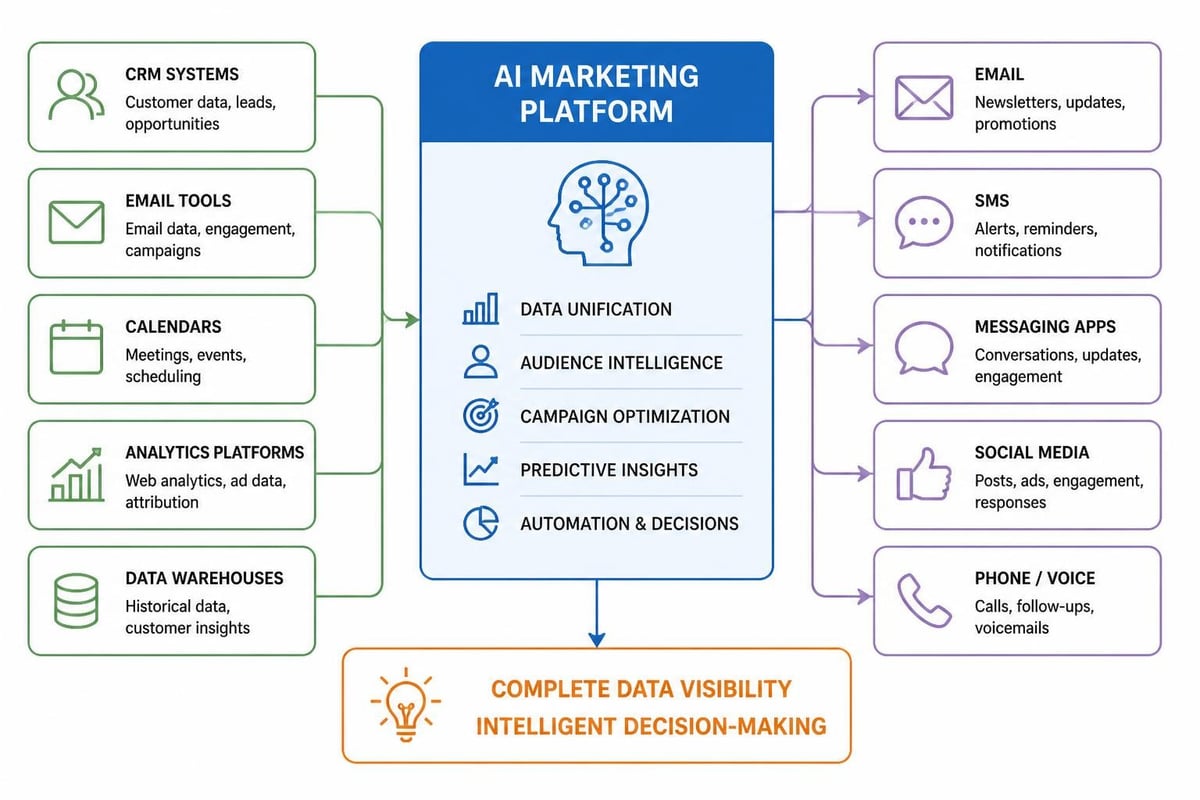
Implementing ai in marketing doesn't require ripping out existing technology stacks and starting over. Modern AI platforms integrate seamlessly with CRM systems, marketing automation tools, communication platforms, and analytics software. The key is ensuring data flows freely between systems so the AI has complete context for decision-making.
The integration architecture typically connects:
| System Type | Integration Purpose | Data Exchange |
|---|---|---|
| CRM Platform | Lead tracking and management | Bidirectional sync of contact data, interactions, deal stages |
| Email Marketing | Automated campaigns and sequences | Send triggers, engagement metrics, content preferences |
| Calendar Tools | Appointment scheduling | Availability windows, booking confirmations, reminders |
| Analytics Platforms | Performance measurement | Conversion events, attribution data, ROI calculations |
| Communication Channels | Multi-channel engagement | Message content, response timing, channel preferences |
The sophistication of these integrations determines how intelligent the AI system can be. Surface-level connections that only share basic contact information limit the AI's ability to personalize and optimize. Deep integrations that share behavioral data, engagement history, and business outcomes enable the AI to make increasingly smart decisions about prospect engagement.
Professional web design and development partners, like those at Rocket Website, understand the technical requirements for these integrations and can ensure your digital infrastructure supports advanced AI marketing capabilities. The foundation of effective AI implementation is clean, well-structured data architecture.
The Human Element in AI-Powered Marketing
Despite all this automation, successful ai in marketing implementations don't eliminate human involvement. They elevate it. Instead of spending time on repetitive tasks like data entry, lead qualification, and appointment scheduling, marketing and sales teams focus on high-value activities that genuinely require human judgment and creativity.
The most effective approach combines AI efficiency with human expertise. AI systems handle volume, consistency, and pattern recognition. Humans provide strategic direction, creative problem-solving, and relationship building with high-value prospects. This division of labor maximizes the strengths of both.
Consider the typical B2B lead generation scenario. AI systems can process thousands of website visitors, identify the small percentage showing genuine buying intent, qualify them through automated conversations, and book discovery calls. But when a qualified prospect with $500,000 annual contract potential joins that discovery call, you want your best human closer leading that conversation, not a chatbot.
Strategic Oversight and Continuous Optimization
AI systems require strategic guidance. They excel at executing within defined parameters but need humans to set those parameters intelligently. Marketing leaders must define:
- Target customer profiles including ideal company size, industries, and buyer personas
- Value proposition messaging that resonates with different prospect segments
- Qualification criteria determining which leads get routed to sales immediately
- Nurture strategies for prospects at different stages of the buying journey
- Content strategies addressing common questions and objections
- Budget allocation across different channels and campaign types
The AI then optimizes execution within these strategic frameworks. It tests variations, identifies top performers, and scales what works. But the strategic framework itself requires human judgment informed by market knowledge, competitive positioning, and business objectives.
Organizations developing strong corporate coaching capabilities for their leadership teams find they're better equipped to provide this strategic direction while letting AI handle tactical execution. Leaders who understand how to set clear objectives, measure outcomes, and adapt strategy based on data create the environment where AI marketing systems deliver maximum value.
Future Developments and Emerging Capabilities
The current state of ai in marketing is impressive, but we're still in early innings. The technology continues advancing rapidly, with several emerging capabilities that will further transform marketing effectiveness over the next 12-24 months.
Generative AI for video advertising represents one significant frontier. According to IAB research, 86% of advertisers are already using or planning to use generative AI for video ad creation. This technology enables rapid testing of different creative approaches, personalized video content for different audience segments, and dramatic cost reductions in content production.
Predictive customer modeling is becoming increasingly sophisticated. AI systems can now predict not just which prospects will convert, but their likely lifetime value, expansion potential, and even churn risk before they even become customers. This enables much more intelligent decisions about which prospects deserve maximum investment in custom acquisition approaches.
Voice and conversational AI continues improving to the point where many prospects cannot distinguish AI-powered conversations from human interactions. This enables 24/7 engagement across phone, messaging apps, and web chat without requiring large customer service teams.
Cross-channel orchestration allows AI to manage prospect experiences across email, social media, search advertising, website personalization, and direct outreach simultaneously. The system ensures consistent messaging while optimizing which channels receive emphasis based on individual prospect preferences and engagement patterns.
These advances make the gap between AI-powered marketing and traditional approaches even wider. Companies that delay implementation thinking they'll wait for the technology to mature will find themselves increasingly unable to compete with early adopters who have already optimized their systems and processes.
Measuring Success and ROI
Implementing ai in marketing requires investment, and business leaders rightfully demand evidence of return. The beauty of AI-powered systems is they generate unprecedented measurement capability. Every interaction, every decision, every outcome gets tracked and analyzed.
The metrics that matter most for evaluating AI marketing effectiveness include:
- Lead quality score – What percentage of AI-qualified leads meet sales team standards
- Conversion rate – How many qualified leads become paying customers
- Time to conversion – How quickly prospects move through the funnel
- Cost per acquisition – Total marketing spend divided by new customers acquired
- Customer acquisition cost payback period – How quickly new customers generate profit exceeding acquisition costs
- Attribution accuracy – How precisely you can track which marketing activities drove specific conversions
Traditional marketing struggled with attribution because customer journeys involved numerous touchpoints across channels over extended periods. AI systems track every interaction and use sophisticated modeling to understand which activities actually influenced purchase decisions versus which were merely correlated.
This measurement capability enables continuous optimization. You can identify exactly which lead sources generate the highest quality prospects, which messaging resonates with different segments, which objection-handling approaches close deals most effectively, and where prospects drop out of your funnel. Coursera’s overview of AI in marketing emphasizes how these analytical capabilities transform marketing from creative guesswork into engineering discipline with measurable inputs and predictable outputs.
Selecting the Right AI Marketing Partner
Not all AI marketing implementations deliver equal results. The technology is only as effective as the strategy guiding it and the expertise implementing it. When evaluating potential partners, business leaders should look beyond impressive technology demos to assess actual capability and alignment.
Critical evaluation criteria include:
- Proven track record with documented case studies in your industry showing actual revenue impact
- Transparent reporting with real-time access to performance data and attribution models
- Technical sophistication including proprietary AI models trained on relevant data
- Strategic capabilities beyond just technology implementation, including positioning and messaging expertise
- Integration experience successfully connecting AI systems with your existing technology stack
- Performance guarantees demonstrating confidence in their ability to deliver specific outcomes
- Cultural alignment with your values around transparency, partnership, and long-term thinking
The rise of AI-powered advertising approaches has created a crowded marketplace of vendors making similar claims. Distinguishing genuine capability from marketing hype requires asking detailed questions about their technology, reviewing their actual client results, and understanding their business model.
Partners operating on guaranteed outcome models have strong incentive to deliver real results. Those billing primarily for setup fees and monthly retainers regardless of performance may talk about AI but lack the sophisticated implementation required to generate guaranteed results. The business model reveals a lot about actual capability and confidence.
The integration of artificial intelligence into marketing operations has moved from experimental to essential for businesses serious about predictable revenue growth in 2026. Companies that effectively leverage AI in marketing see dramatic improvements in lead quality, conversion rates, and customer acquisition costs while reducing the manual effort required to generate those results. If you're ready to transform your lead generation from unpredictable expense into guaranteed growth engine, Aletto combines advanced AI systems with transparent partnership models that align our success with yours, ensuring you only invest in marketing that delivers measurable ROI.