
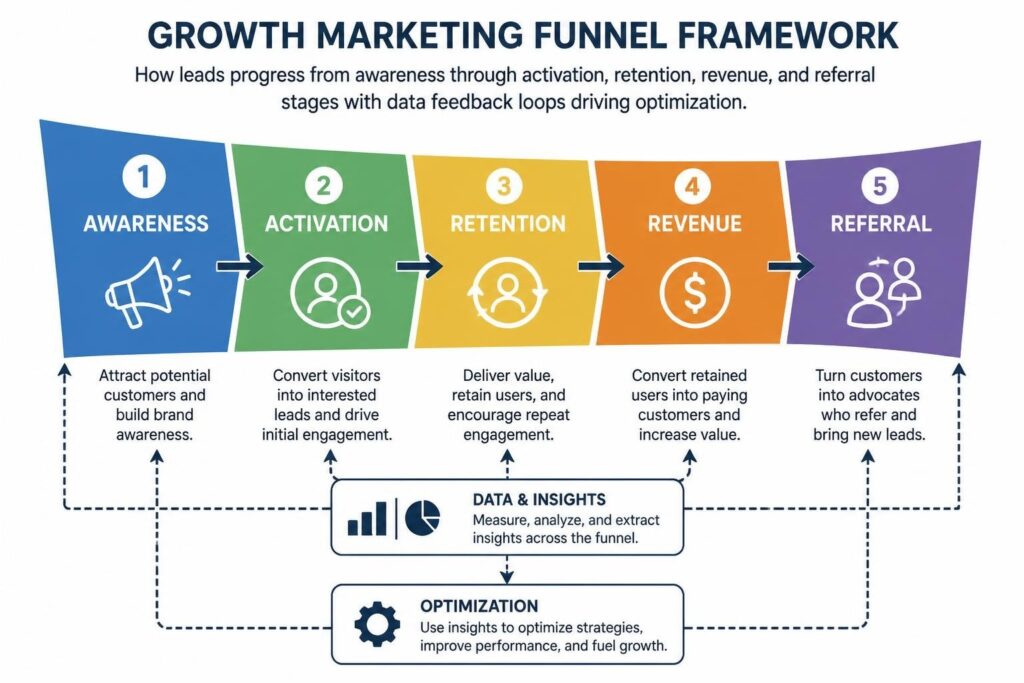
The difference between businesses that scale predictably and those that struggle with inconsistent revenue often comes down to one critical system: a well-optimized growth marketing funnel. Unlike traditional marketing funnels that end at conversion, a growth marketing funnel treats every customer interaction as an opportunity to compound results, turning buyers into advocates who fuel your next wave of qualified leads. For businesses focused on lead generation, this approach transforms how you attract, nurture, and convert prospects while building a sustainable engine for long-term growth.
Understanding the Growth Marketing Funnel Framework
A growth marketing funnel represents the complete customer journey from first contact to brand advocacy, but with a critical difference from conventional funnels. This framework emphasizes continuous optimization, experimentation, and feedback loops at every stage.
The modern growth marketing funnel explained operates on the pirate metrics framework: Acquisition, Activation, Retention, Revenue, and Referral (AARRR). Each stage requires specific strategies, metrics, and optimization tactics to maximize conversion rates and minimize leakage.
Traditional funnels focus on moving prospects from awareness to purchase. Growth marketing funnels go further by prioritizing customer lifetime value, retention mechanics, and referral systems that create compounding returns. This distinction matters enormously when you're building systems for predictable revenue growth rather than one-time transactions.
Why Traditional Marketing Funnels Fall Short
Most businesses lose 90% of their potential revenue by treating customer acquisition as a linear path. They invest heavily in top-of-funnel activities but fail to optimize the complete customer experience.
Consider these common failure points:
- Awareness without activation: Generating traffic that never converts into qualified leads
- Conversion without retention: Acquiring customers who churn before delivering ROI
- Revenue without referrals: Missing opportunities to leverage satisfied customers as growth channels
- Data silos: Failing to connect insights across funnel stages for optimization
The growth marketing funnel addresses these gaps by creating feedback mechanisms between stages. When you understand why customers activate, retain, and refer, you can optimize acquisition channels to attract more prospects with those characteristics.
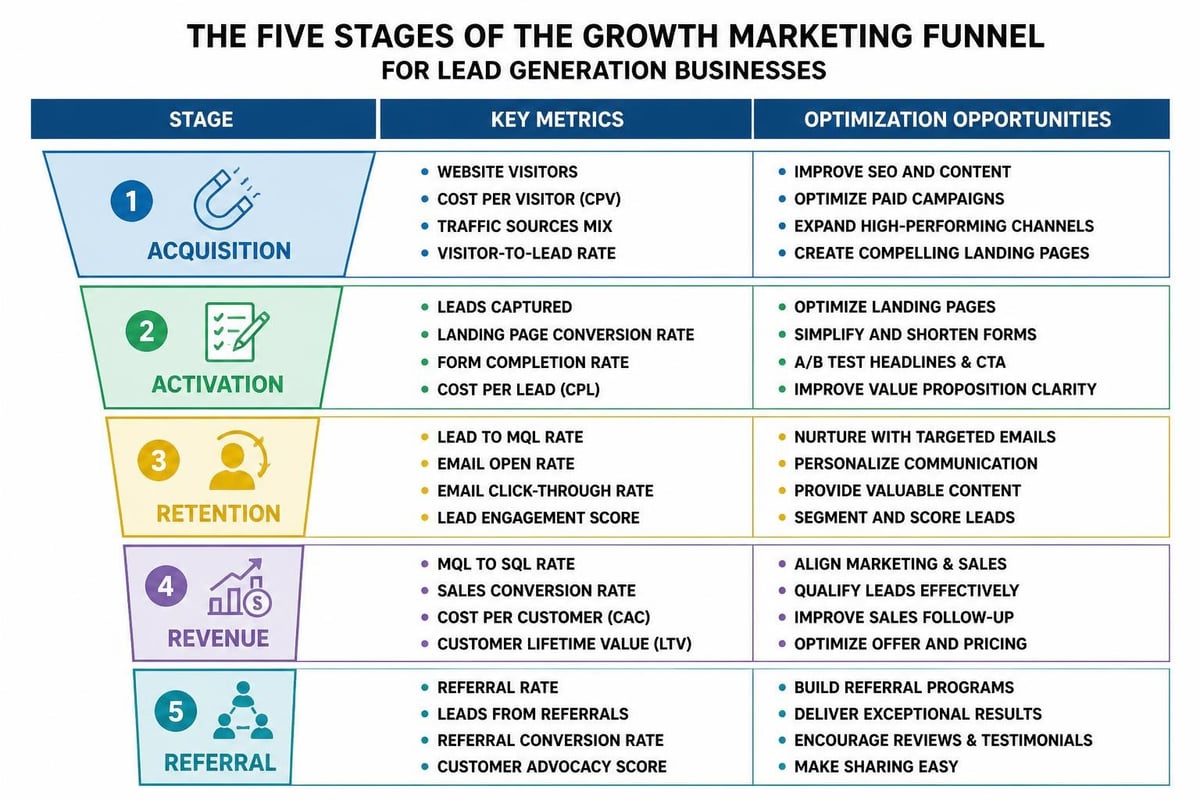
Building Your Acquisition Stage for Maximum Impact
Acquisition represents the top of your growth marketing funnel where prospects first discover your brand. For lead generation businesses, this stage requires precision targeting to attract ideal customer profiles rather than vanity metrics like raw traffic volume.
Effective acquisition strategies in 2026 combine multiple channels working in concert. Your goal isn't just visibility but qualified awareness among decision-makers actively seeking solutions.
Channel Selection and Optimization
Not all acquisition channels deliver equal results for B2B lead generation. Focus your efforts where your ideal customers actually spend time researching solutions.
| Channel Type | Best For | Key Metrics |
|---|---|---|
| Paid Search | High-intent leads actively searching | Cost per qualified lead, conversion rate |
| LinkedIn Ads | B2B decision-makers | Engagement rate, lead quality score |
| Content Marketing | Long-term authority building | Organic traffic, time on page, backlinks |
| Referral Programs | Leveraging existing network | Referral conversion rate, CAC reduction |
Strategic content distribution amplifies acquisition efforts. Rather than creating content in isolation, successful growth marketers map content assets to specific customer pain points and search intent. This approach, detailed in effective marketing agency strategy frameworks, ensures every piece of content serves your funnel objectives.
The most sophisticated acquisition programs use attribution modeling to understand which touchpoints truly drive qualified leads. Multi-touch attribution reveals that most B2B buyers interact with 7-13 touchpoints before conversion, making it essential to coordinate messaging across channels.
Activation: Converting Awareness into Engagement
Activation occurs when prospects take meaningful action that indicates genuine interest. For lead generation businesses, activation might mean scheduling a consultation, requesting a demo, or engaging with your qualification process.
This stage determines whether your acquisition efforts translate into pipeline opportunities. The B2B SaaS growth funnel approach emphasizes creating friction-free activation experiences that demonstrate value immediately.
Your activation strategy should answer one question: What's the fastest path to your "aha moment"? This represents the point where prospects clearly understand how your solution solves their specific problem.
Consider these activation optimization tactics:
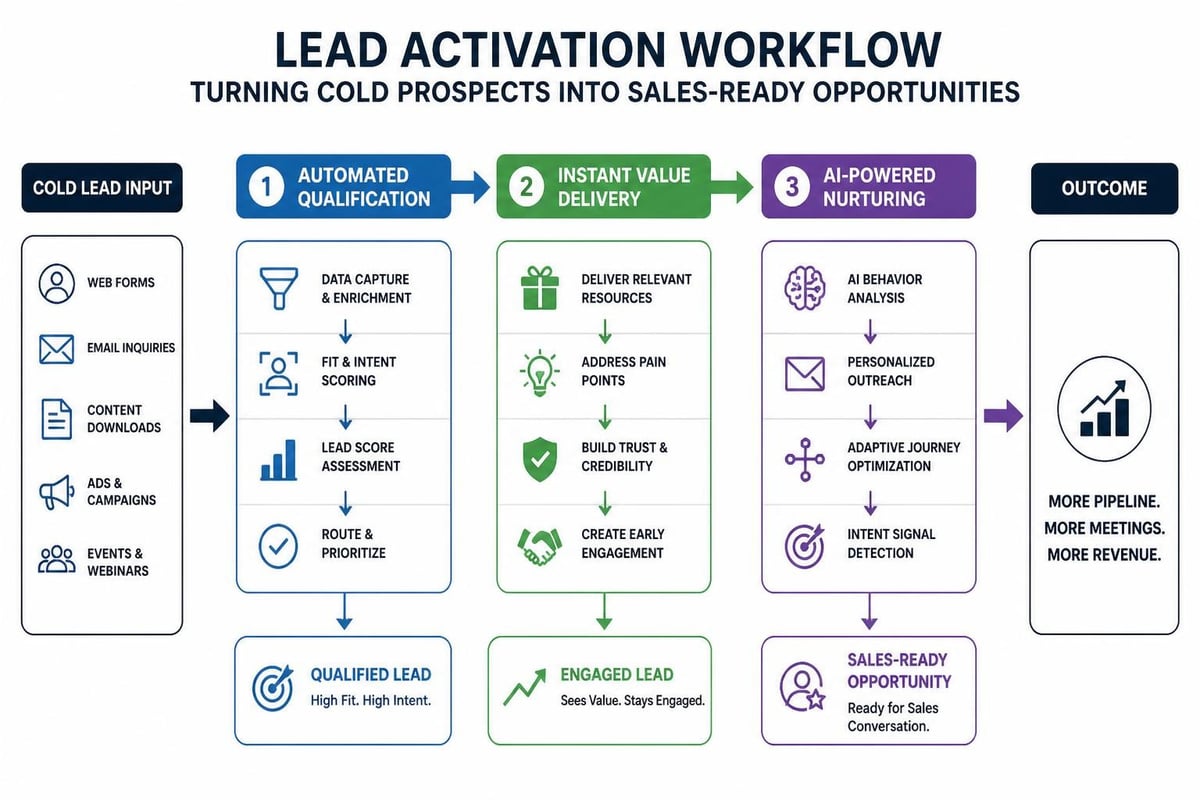
- Qualification frameworks: Implement intelligent forms that gather necessary information without creating abandonment
- Immediate value delivery: Provide instant insights, assessments, or resources upon initial engagement
- Automated nurture sequences: Deploy AI-powered follow-up that personalizes based on prospect behavior
- Conversation acceleration: Use chatbots and automated scheduling to eliminate delays between interest and consultation
Measuring Activation Success
Activation rate represents the percentage of acquired prospects who complete your defined activation event. Industry benchmarks vary, but B2B lead generation businesses should target 25-40% activation rates from cold traffic and 50-70% from warm referrals.
Track these metrics to optimize activation:
- Time to activation (how quickly prospects engage after first contact)
- Activation drop-off points (where prospects abandon the process)
- Activation source quality (which channels produce highest activation rates)
- Activated-to-qualified conversion (percentage of activated leads that meet sales criteria)
Retention Strategies That Build Predictable Revenue
Retention represents the ongoing relationship phase where customers realize continued value from your solution. In lead generation contexts, retention manifests as repeat engagements, contract renewals, or expanding service utilization.
The economics of retention dramatically outperform acquisition. Research consistently shows that increasing retention rates by just 5% can boost profits by 25-95%. Despite this, most businesses invest disproportionately in new customer acquisition while neglecting retention optimization.
A growth marketing funnel prioritizes retention through systematic value reinforcement and proactive engagement. This approach, fundamental to what is growth marketing principles, treats retention as a revenue multiplier rather than a passive outcome.
Building Your Retention Engine
Effective retention requires understanding why customers stay and systematically reinforcing those factors. Start by identifying retention indicators specific to your business model.
For lead generation services, retention drivers typically include:
- Consistent delivery of qualified appointments
- Transparent reporting on campaign performance
- Responsive support and strategic consultation
- Demonstrated ROI through closed business
- Continuous optimization and improvement
Implement these retention mechanisms:
- Regular value demonstrations: Quarterly business reviews showing impact metrics and growth trends
- Proactive optimization: Identify performance dips before clients notice and present solutions
- Educational content: Ongoing training and insights that help clients maximize results
- Success milestones: Celebrate achievements and reinforce the partnership value
The most successful retention programs use predictive analytics to identify at-risk accounts before churn occurs. By monitoring engagement patterns, satisfaction scores, and performance metrics, you can intervene with targeted retention offers or service adjustments.
Revenue Optimization Across the Customer Lifecycle
Revenue in the growth marketing funnel extends beyond initial transactions to encompass expansion opportunities, upsells, and contract value optimization. This stage focuses on maximizing customer lifetime value through strategic revenue expansion.
Traditional funnels treat revenue as the endpoint. Growth funnels recognize that retained customers represent your highest-probability revenue opportunities. The cost to sell additional services to existing clients is 5-25 times lower than acquiring new customers.
Revenue Expansion Strategies
| Strategy | Application | Expected Impact |
|---|---|---|
| Tiered service packages | Offer premium tiers with enhanced features | 15-30% ARPU increase |
| Performance-based expansion | Scale services as client results improve | 25-50% revenue growth |
| Cross-selling complementary services | Add related offerings to existing clients | 10-20% wallet share increase |
| Contract value optimization | Annual vs. monthly pricing, volume discounts | 20-35% LTV improvement |
Identifying expansion opportunities requires close monitoring of client success metrics. When clients achieve strong results, they're primed for conversations about scaling their investment. This is where new business leads strategies intersect with customer success to create mutual growth opportunities.
Revenue optimization also involves pricing strategy refinement based on value delivered. Moving from fixed-fee models to performance-based pricing aligns incentives and typically increases average contract values by 30-50% while improving retention simultaneously.
Referral Systems That Compound Your Growth
Referral represents the most overlooked stage in most marketing funnels, yet it delivers the highest-quality leads at the lowest acquisition cost. A well-designed referral system transforms satisfied customers into active growth partners.
Referrals convert at 3-5 times higher rates than other acquisition channels because they come pre-qualified with social proof and established trust. For B2B lead generation businesses, referral-sourced clients also tend to have 16% higher lifetime values and 37% better retention rates.
The challenge isn't convincing customers to refer but creating systems that make referrals easy, rewarding, and natural. Growth marketing funnel examples demonstrate how leading companies engineer referral mechanisms into their customer experience.
Engineering Your Referral Engine
Successful referral programs combine three elements: motivation, ease, and timing. You must give customers compelling reasons to refer, make the process friction-free, and ask at moments when satisfaction peaks.
Implement these referral acceleration tactics:
- Automated referral triggers: Send requests after major wins or positive feedback
- Incentive alignment: Offer rewards valuable to your customer base (service credits, revenue shares, exclusive access)
- Templated outreach: Provide pre-written messages customers can personalize and share
- Closed-loop tracking: Monitor referral sources and outcomes to optimize the program
- Recognition systems: Publicly acknowledge top referrers to encourage ongoing advocacy
The most sophisticated approach involves creating tiered partner programs where your best customers become formal referral partners with recurring commissions. This transforms occasional referrals into systematic lead generation channels.
Measuring Referral Performance
Track these metrics to optimize your referral system:
- Referral participation rate (percentage of customers who refer)
- Referrals per referring customer (average volume from active referrers)
- Referral conversion rate (percentage of referred leads who become customers)
- Referral source LTV (lifetime value of referred customers vs. other channels)
- Net Promoter Score (leading indicator of referral potential)
Data-Driven Optimization Across Your Funnel
The defining characteristic of a growth marketing funnel versus traditional approaches is continuous experimentation and optimization based on data insights. Every stage should have clear metrics, benchmarks, and systematic testing protocols.
Data-driven growth marketing treats the funnel as a living system where small improvements compound into significant results. A 10% improvement at each of five funnel stages doesn't yield 50% better results but 61% improvement due to compounding effects.
Establish baseline metrics for each funnel stage:
- Acquisition: Cost per lead, lead volume, channel distribution
- Activation: Activation rate, time to activation, activation quality
- Retention: Churn rate, engagement frequency, satisfaction scores
- Revenue: ARPU, LTV, expansion rate, payment terms
- Referral: Referral rate, referral quality, advocate NPS
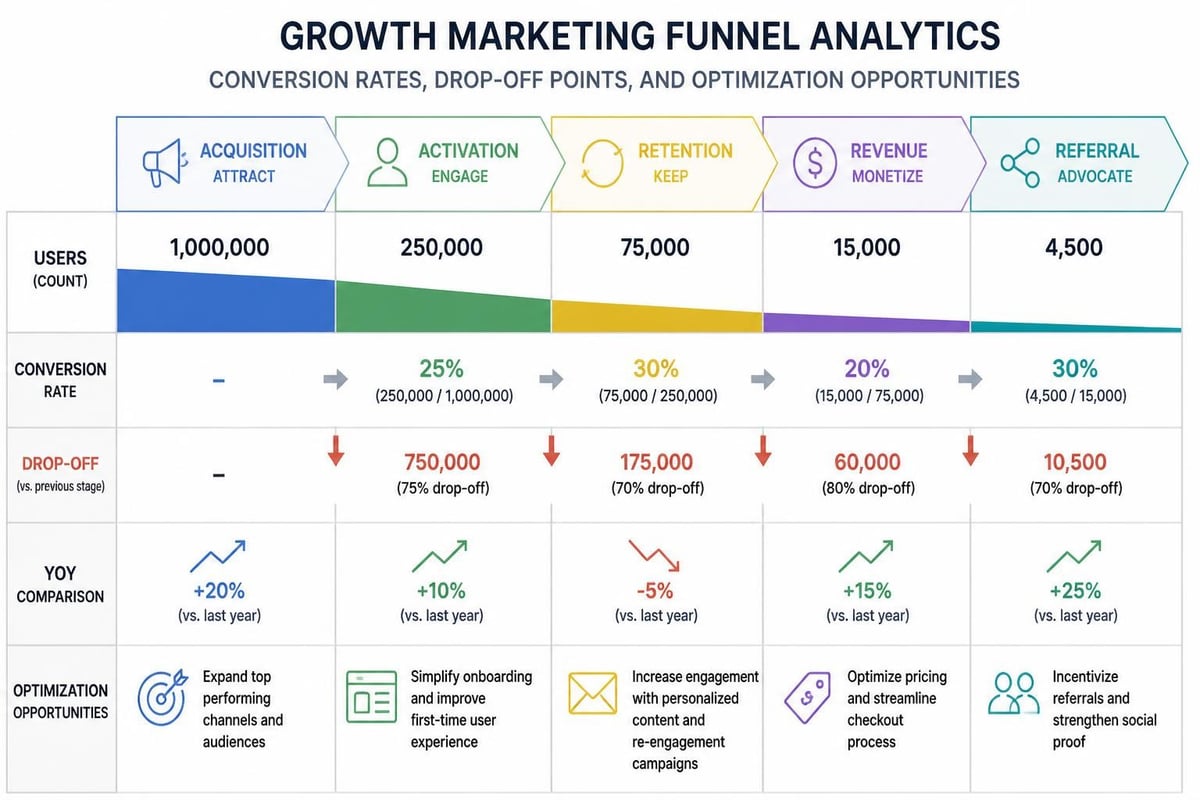
Creating Your Testing Framework
Systematic testing identifies high-impact improvements across your growth marketing funnel. Prioritize tests based on potential impact, implementation effort, and statistical significance requirements.
A robust testing framework includes:
- Hypothesis development: Clear predictions about what will improve specific metrics
- Test design: Controlled experiments with proper sample sizes and duration
- Implementation protocols: Standardized deployment and monitoring processes
- Analysis methods: Statistical rigor to distinguish signal from noise
- Documentation systems: Centralized knowledge base of test results and learnings
Focus testing efforts on conversion bottlenecks where small improvements yield disproportionate results. For most B2B funnels, activation and retention represent the highest-leverage optimization opportunities because they affect all downstream metrics.
Integration and Automation for Scalable Growth
Manual funnel management breaks down at scale. Building a sustainable growth marketing funnel requires integrated technology systems and intelligent automation that maintains personalization while handling increasing volume.
The modern marketing technology stack should connect customer data across all touchpoints, enabling coordinated messaging and seamless handoffs between funnel stages. This integration allows for sophisticated tactics like free lead generation programs that leverage content and organic channels while maintaining tracking and attribution.
Essential integration points include:
- CRM systems that track complete customer journey from first contact through referral
- Marketing automation platforms that orchestrate multi-channel campaigns
- Analytics tools that provide funnel visibility and attribution insights
- AI systems that personalize experiences and predict customer behavior
- Communication platforms that enable timely, relevant outreach at scale
AI-Powered Funnel Optimization
Artificial intelligence transforms growth marketing funnels from static processes into adaptive systems that improve automatically. AI applications span every funnel stage from predictive lead scoring to churn prevention to referral opportunity identification.
The most impactful AI implementations focus on pattern recognition humans can't match at scale. Machine learning models analyze thousands of data points to identify which prospects are most likely to activate, which customers face churn risk, and which moments present optimal upsell opportunities.
Deploy AI strategically across your funnel:
- Acquisition: Predictive audience targeting and bid optimization
- Activation: Personalized content recommendations and conversation routing
- Retention: Early warning systems for engagement drops and satisfaction changes
- Revenue: Optimal pricing recommendations and expansion opportunity identification
- Referral: Advocate identification and timing optimization for referral requests
The key to successful AI implementation is starting with clean data and clear objectives. Begin with high-impact use cases where automation can immediately improve results, then expand as you build capabilities and confidence.
Building Your Growth Marketing Funnel: Implementation Roadmap
Creating an effective growth marketing funnel requires systematic planning and phased implementation. Most businesses fail not from poor strategy but from attempting too much simultaneously without proper foundations.
Start by auditing your current funnel to identify the biggest gaps and opportunities. Use structured growth funnel frameworks to map existing customer journeys and quantify performance at each stage.
Follow this implementation sequence:
- Foundation building (Weeks 1-4): Establish tracking infrastructure, define key metrics, set baselines
- Quick wins (Weeks 5-8): Implement high-impact, low-effort optimizations across funnel stages
- Strategic initiatives (Weeks 9-16): Deploy major improvements to activation and retention systems
- Advanced optimization (Weeks 17+): Build sophisticated testing programs and AI capabilities
Common Implementation Pitfalls
Avoid these mistakes that derail growth marketing funnel projects:
- Optimizing vanity metrics: Focusing on traffic or raw leads rather than qualified opportunities
- Neglecting bottom-funnel stages: Over-investing in acquisition while retention and referral languish
- Technology before strategy: Buying tools without clear use cases or adoption plans
- Testing without discipline: Running experiments without proper controls or statistical rigor
- Siloed optimization: Improving individual stages without considering funnel-wide impact
The most successful implementations maintain focus on business outcomes rather than marketing activities. Every funnel optimization should connect directly to revenue impact, customer lifetime value improvement, or cost reduction.
Aligning Your Team Around Funnel Metrics
A growth marketing funnel requires organizational alignment around shared metrics and collaborative optimization. Traditional departmental silos where marketing owns acquisition, sales handles conversion, and customer success manages retention create gaps that leak revenue.
Establish cross-functional ownership of funnel performance where marketing, sales, and customer success share accountability for complete customer journey outcomes. This alignment typically requires structural changes including unified dashboards, joint planning sessions, and compensation tied to funnel-wide metrics.
Create regular funnel review meetings where teams analyze performance across all stages, share insights, and coordinate optimization efforts. These sessions should focus on identifying bottlenecks, testing hypotheses, and allocating resources to highest-impact opportunities.
The most effective structure designates a growth leader with authority over the complete funnel rather than fragmenting ownership across departments. This role ensures strategic coherence and prevents local optimization that suboptimizes overall results.
Building a high-performing growth marketing funnel transforms how businesses generate and convert leads by creating systematic, data-driven processes across the complete customer lifecycle. By optimizing each stage from acquisition through referral while maintaining focus on compounding improvements, you create sustainable competitive advantages that traditional marketing approaches simply can't match. Aletto specializes in building these exact systems for businesses ready to scale, combining advanced AI technology with proven growth frameworks to generate qualified sales leads and automate appointment bookings that deliver predictable revenue growth. Let's build your growth engine together.