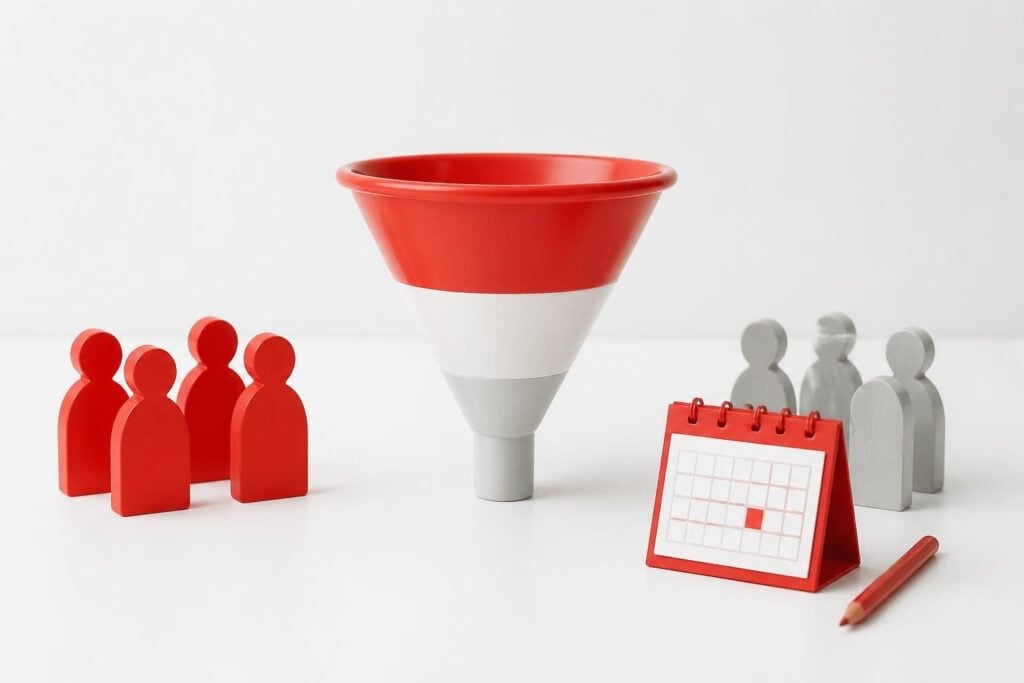
A b2b marketing funnel is a structured framework that guides potential buyers from initial awareness through to a booked sales conversation, using targeted touchpoints at each stage to qualify interest and accelerate decisions. In 2026, effective B2B funnels combine paid acquisition, intelligent follow-up systems, and frictionless booking to fill sales calendars without relying on cold outreach or in-person events.
The traditional funnel metaphor-wide at the top, narrow at the bottom-still holds, but the execution has changed dramatically. B2B buyers now complete 70% of their purchase journey before engaging a salesperson, meaning your funnel must educate, qualify, and build trust long before a human conversation happens. Modern B2B marketing funnels aren't just content libraries; they're integrated systems where every stage has measurable conversion triggers and automated handoffs.
What are the core stages of a b2b marketing funnel?
Every b2b marketing funnel has three essential stages: awareness (strangers discover your solution), consideration (prospects evaluate fit and value), and decision (qualified buyers book a conversation). Each stage requires different content types, conversion goals, and measurement approaches.
At the awareness stage, your goal is reach and relevance. Prospects don't know they have a problem you solve, or they're researching solutions generally. Tactics include paid search, social ads, SEO-optimized content, and thought leadership. According to LinkedIn’s 2024 B2B Marketing Benchmark, 68% of B2B marketers cite brand awareness as their top objective, yet only 22% have a reliable way to measure it beyond impressions.
The consideration stage is where most funnels leak. Prospects understand their problem and are comparing approaches. Your content must demonstrate specific outcomes, not generic benefits. Case studies, comparison guides, ROI calculators, and educational webinars work here. The average B2B buyer consumes 13 pieces of content before making a decision, so your funnel must systematically deliver value and capture intent signals.
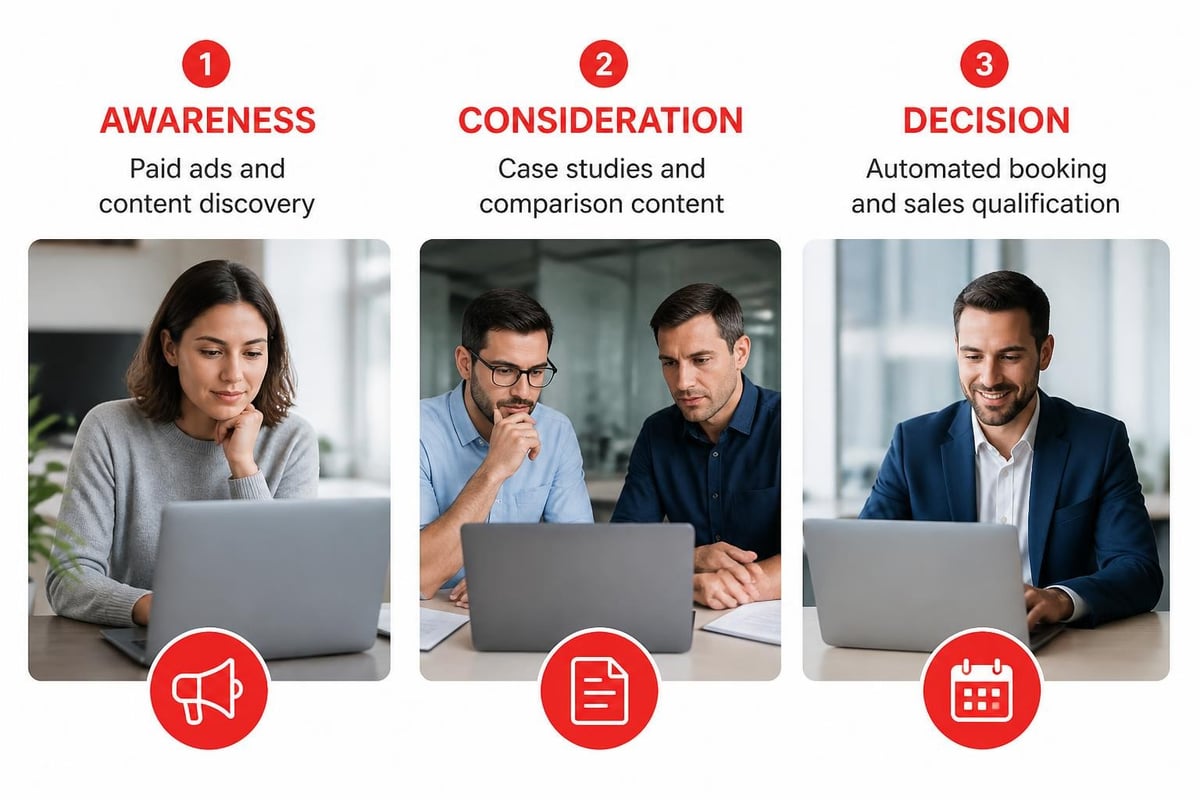
At the decision stage, friction kills conversions. Buyers are ready to talk but won't tolerate multi-step form fills, delayed responses, or "contact us" dead ends. Automated booking, instant confirmation, and calendar integration are non-negotiable. Aletto's internal data shows that switching from manual follow-up to AI-triggered booking increased show rates by 34% and cut sales cycle length by 19 days.
How long should each funnel stage take?
There's no universal timeline-B2B purchase cycles range from 3 weeks for low-cost SaaS to 18 months for enterprise infrastructure. Track stage velocity (days in each stage) and conversion rates between stages instead of fixating on total funnel length.
For mid-market B2B SaaS, typical benchmarks are:
- Awareness to consideration: 7-14 days
- Consideration to decision: 21-45 days
- Decision to booked call: 1-3 days
If your decision stage drags beyond 5 days, your booking process has too much friction.
Why do most B2B marketing funnels fail to deliver qualified pipeline?
Most b2b marketing funnel failures stem from three root causes: misalignment between marketing and sales on what "qualified" means, over-reliance on volume metrics instead of velocity and conversion rate, and manual handoff processes that introduce delays and drop-offs.
Misalignment is the silent killer. Marketing optimizes for MQLs (marketing qualified leads) while sales cares about SQLs (sales qualified leads) and booked meetings. When these definitions diverge, marketing celebrates lead volume while sales complains about quality. The fix isn't better communication-it's shared metrics. Track qualified conversations booked as the joint success metric, not leads generated or MQLs passed.
Harvard Business Review research on linking sales and marketing found that companies with tightly aligned revenue teams grow 19% faster and achieve 15% higher profitability. Alignment starts with agreeing on the Ideal Customer Profile (ICP) using firmographic, technographic, and behavioral criteria, then scoring leads against that profile consistently.
Vanity metrics distract from funnel health. Impressions, clicks, and raw lead counts feel productive but don't predict revenue. What matters:
| Metric | Why It Matters | Good Benchmark |
|---|---|---|
| MQL to SQL conversion rate | Measures targeting accuracy | 25-35% |
| SQL to booked call rate | Reveals booking friction | 60-75% |
| Show rate | Indicates qualification quality | 70-80% |
| Opportunity creation rate | Links funnel to pipeline | 30-40% |
If your MQL-to-SQL rate sits below 20%, you're generating awareness in the wrong audiences or your content isn't filtering intent effectively. When researching how to build a complete sales funnel, understanding these conversion thresholds helps diagnose where your system breaks down.
Manual handoffs introduce a 24-48 hour lag between form submission and human follow-up, during which 78% of buyers engage a competitor. Automation isn't optional-it's table stakes. AI-powered follow-up that routes qualified leads to booking flows and nurtures unqualified prospects until they hit threshold scores has become the standard in high-performing B2B funnels.

How does paid acquisition fit into a modern b2b marketing funnel?
Paid acquisition is the primary top-of-funnel engine for B2B companies that need predictable, scalable lead flow. Organic strategies (SEO, social, referrals) build over quarters and years; paid channels generate qualified traffic in days when executed against a clear ICP and supported by conversion-optimized landing experiences.
The best-performing B2B paid strategies in 2026 use platform triangulation: Google Search captures active intent, LinkedIn targets job titles and company attributes, and retargeting (via Google Display, Facebook, or specialized B2B platforms) re-engages website visitors across the consideration journey. Relying on a single channel creates fragility; diversified acquisition spreads risk and captures buyers at different research stages.
Think with Google research on AI and marketing shows that B2B search behavior has shifted-buyers use longer, more specific queries and expect immediate, precise answers. Your paid search strategy must target problem-aware keywords (e.g., "reduce sales cycle length B2B SaaS") and solution-aware keywords (e.g., "automated booking for sales teams"), not just brand terms.
Example scenario: A B2B sales enablement platform targeting VP Sales at 50-500 employee SaaS companies would run:
- Google Search ads on "sales team not hitting quota," "automate sales follow-up," "book more qualified demos"
- LinkedIn Sponsored Content targeting VP Sales, CRO titles at companies using Salesforce, HubSpot
- Retargeting ads on Google Display and LinkedIn showing case study headlines to site visitors who spent 90+ seconds on product pages
Budget allocation for B2B funnels typically follows a 50/30/20 split: 50% to channels driving SQLs (usually search and LinkedIn), 30% to awareness and retargeting, 20% to testing new platforms and creative approaches. Adjust based on CAC payback period and LTV, but always reserve budget for experimentation.
Paid acquisition ROI lives or dies on landing page conversion rate. Industry average B2B landing page conversion is 2.3-5%; high performers hit 8-12%. The difference is message match (ad promise = page headline), single clear CTA, social proof specific to the visitor's industry, and low-friction form fields.
What role does AI play in b2b marketing funnel optimization?
AI has fundamentally changed how B2B funnels operate, moving from periodic batch-and-blast campaigns to continuous, personalized engagement based on behavioral signals and predictive scoring. The most impactful AI applications in 2026 are intelligent lead scoring, conversational follow-up, and dynamic content personalization.
Intelligent lead scoring replaces static point systems (e.g., "opened 3 emails = 10 points") with machine learning models that analyze hundreds of variables-email engagement, website behavior, firmographic fit, content consumption patterns, and time-based decay. Forrester research on AI adoption in B2B marketing found that predictive lead scoring improves MQL-to-opportunity conversion rates by 22-31% compared to rules-based approaches.
The key is training data quality. Your model learns from historical won/lost deals, so if your CRM is full of poorly qualified opportunities or missing close reasons, your AI will replicate those mistakes at scale. Clean data beats fancy algorithms.
Conversational AI follow-up bridges the gap between form submission and sales contact. Modern systems send personalized SMS or email sequences triggered by specific actions (downloaded a case study, visited pricing three times, watched a demo video), ask qualifying questions conversationally, and route ready buyers to instant booking. This isn't a chatbot-it's an intelligent engagement layer that accelerates qualified prospects and nurtures everyone else.
Aletto's approach to advertising and AI demonstrates this integration: paid ads drive traffic to targeted landing pages, qualified visitors enter an AI follow-up sequence that asks budget/timeline/authority questions via SMS, and prospects who meet thresholds get an instant booking link. Unqualified leads receive educational content until their behavior signals readiness.
| AI Application | Funnel Stage | Impact |
|---|---|---|
| Predictive scoring | Awareness → Consideration | Prioritize high-intent prospects |
| Conversational follow-up | Consideration → Decision | Reduce response time, qualify 24/7 |
| Dynamic personalization | All stages | Increase relevance, engagement |
| Chatbot qualification | Decision | Instant answers, capture intent |
Dynamic personalization adjusts messaging, content recommendations, and CTAs based on visitor firmographics, referral source, and on-site behavior. A visitor from a 50-person company sees different ROI examples than someone from a 5,000-person enterprise. This goes beyond inserting a first name-it's tailoring the entire value proposition to match the buyer's context.
The challenge with AI in B2B funnels isn't capability-it's implementation discipline. Too many companies deploy AI tools without clear success metrics, clean training data, or alignment on how AI fits the buyer journey. Start with one high-impact use case (typically intelligent routing or conversational qualification), measure lift against your baseline, then expand.

How do you measure b2b marketing funnel performance effectively?
Measuring a b2b marketing funnel requires tracking both flow metrics (how quickly prospects move between stages) and conversion metrics (what percentage advance at each transition). Effective measurement connects marketing activity to revenue outcomes, not just engagement proxies.
Start with funnel cohort analysis. Group all leads that entered your funnel in a specific week, then track what percentage reach each subsequent stage and how long each transition takes. This reveals stage-specific bottlenecks. If 40% of MQLs become SQLs but only 15% of SQLs book a call, your decision-stage experience needs work-not your top-of-funnel acquisition.
The Content Marketing Institute’s B2B content marketing research shows that 72% of B2B marketers track content engagement metrics (downloads, views), but only 31% connect content consumption to pipeline and revenue. Bridge this gap by implementing UTM parameters, multi-touch attribution, and content-to-opportunity reporting in your CRM.
Velocity matters as much as volume. A funnel that generates 100 MQLs per month with a 90-day sales cycle is often less valuable than one producing 60 MQLs with a 30-day cycle. Calculate deal velocity by stage:
- Awareness → Consideration velocity = (number of MQLs) / (days to become MQL from first touch)
- Consideration → Decision velocity = (number of SQLs) / (days from MQL to SQL)
- Decision → Booked call velocity = (number of booked calls) / (days from SQL to booked)
Fast velocity indicates strong message-market fit and low friction. Slowing velocity signals content gaps, qualification mismatches, or process bottlenecks.
Attribution modeling answers which channels and content drive revenue, not just leads. First-touch attribution credits the initial touchpoint, last-touch credits the final conversion source, and multi-touch distributes credit across the journey. For B2B funnels with 60-90 day cycles and 8-15 touchpoints, use time-decay attribution-recent interactions get more weight, but early touchpoints receive credit for starting the journey.
Example: A prospect discovers you through a paid LinkedIn ad (first touch), reads three blog posts over two weeks, downloads a case study via organic search, attends a webinar, then books a call via an email nurture sequence (last touch). Time-decay attribution might assign 10% to LinkedIn, 15% to organic search, 20% to email nurture, and 25% to the webinar, recognizing that later touchpoints had more influence but earlier ones created awareness.
What benchmarks should you track?
Industry benchmarks vary by product complexity, deal size, and sales cycle, but these ranges apply to mid-market B2B SaaS:
- Website visitor to lead: 2-5%
- Lead to MQL: 20-30%
- MQL to SQL: 25-35%
- SQL to booked call: 60-75%
- Booked call to opportunity: 40-55%
- Opportunity to closed-won: 25-35%
If your funnel underperforms these ranges by more than 30%, you have a structural problem, not a volume problem. Fix conversion before scaling spend.
What common mistakes break B2B marketing funnels?
The most destructive mistake is optimizing for the wrong goal. When marketing gets measured on MQLs and sales gets measured on closed revenue, the funnel becomes a battleground instead of a system. Marketing inflates lead counts with loose qualification criteria, and sales ignores "low-quality" leads. Revenue stalls despite growing lead volume.
Ignoring qualification until too late wastes everyone's time. If your funnel lets anyone book a sales call regardless of budget, authority, need, or timeline, your sales team spends 60% of their calendar on unwinnable conversations. Qualification must happen at the consideration stage through progressive profiling, gated content with qualifying questions, and AI-driven scoring that routes ready buyers to sales and everyone else to nurture tracks.
Example: A B2B marketing automation platform requires a minimum of $5,000 annual spend and 10+ person marketing teams. Instead of a generic "Book a Demo" CTA, their funnel asks "How many people are on your marketing team?" and "What's your approximate marketing tech budget?" before showing a calendar. Prospects outside the ICP get directed to self-service content and a waitlist for future product tiers.
Over-complicating the buying journey adds friction at every transition. Multi-page forms, "contact us" buttons that trigger 48-hour email delays, and forced phone qualification calls all reduce conversion. The best B2B funnels minimize steps between interest and conversation. One-click booking with automated qualification built into follow-up sequences outperforms multi-step qualification gates.
Many B2B companies treat their funnel as a one-way broadcast channel instead of a conversation. Prospects ask questions via chatbot or email and wait days for generic responses. Modern buyers expect instant, specific answers. AI-powered conversational interfaces that can answer product questions, share relevant case studies, and surface pricing guidance in real-time dramatically increase decision-stage conversion. If you're interested in understanding the foundational elements that drive modern B2B performance, reviewing growth marketing funnel frameworks can help you structure these conversational touchpoints strategically.
Finally, neglecting the post-booking experience undermines everything upstream. If prospects book a call and receive a generic confirmation email with no context about what to prepare or who they're meeting, show rates drop. Send a personalized video from the account executive, an agenda with discussion topics, and a calendar reminder 24 hours before. This turns a booked call into a qualified conversation.
How should B2B SaaS companies structure their marketing funnel differently?
B2B SaaS funnels require product-led education at the awareness and consideration stages because buyers are comparing feature sets, integration capabilities, and user experience-not just brand reputation. Your funnel must demonstrate product value before a sales conversation, through interactive demos, free trials with intelligent onboarding, or freemium tiers that showcase core functionality.
The challenge is balancing self-service exploration with sales-assisted conversion. High-velocity SaaS products (sub-$10k annual contracts, short implementation) can use fully automated funnels: paid acquisition → educational content → free trial → in-app conversion prompts → automated booking for expansion conversations. Enterprise SaaS (multi-year contracts, complex implementation) needs human touchpoints earlier: paid acquisition → qualification → personalized demo → proposal → negotiation.
Most mid-market B2B SaaS lands in between. The optimal funnel uses automation for qualification and booking but preserves human expertise for the actual sales conversation. Aletto's methodology exemplifies this: paid ads drive qualified traffic, AI follow-up sequences ask qualifying questions and share relevant case studies, and prospects who meet threshold criteria instantly book a live strategy call. For teams looking to implement similar systems, our Free AI Call Booking Report breaks down the exact paid acquisition, AI nurture, and automated booking framework that generated 1,122 qualified sales calls in 11 months without cold outreach.
Retention and expansion are funnel stages for SaaS, not just acquisition and conversion. Your marketing funnel should include onboarding sequences that drive feature adoption, usage-based triggers that surface upsell opportunities, and renewal campaigns that reinforce ROI. Customer marketing is funnel marketing-it follows the same principles of targeted messaging, measurable conversions, and automated progression.
SaaS funnels must also account for buying committee dynamics. The person who discovers your product (often a manager or individual contributor) rarely has authority to sign the contract. Your funnel needs content and workflows for each stakeholder: ROI calculators for economic buyers, security and compliance documentation for IT, implementation timelines for operations, and user experience demos for end users. Multi-threading-engaging multiple stakeholders simultaneously-shortens sales cycles and increases close rates.
Frequently Asked Questions
What is the difference between a B2B marketing funnel and a sales funnel?
A B2B marketing funnel covers awareness through to marketing-qualified leads (MQLs), focusing on education and demand generation. A sales funnel starts when a qualified lead enters sales conversations and tracks opportunities through close. Modern B2B organizations integrate these into one revenue funnel with shared metrics and automated handoffs.
How long does it take to build an effective B2B marketing funnel?
Building the initial funnel structure (landing pages, email sequences, tracking) takes 4-6 weeks. Optimizing conversion rates across stages requires 90-120 days of traffic volume and testing. Expect 6 months before your funnel becomes a predictable revenue engine with stable conversion rates and reliable CAC payback periods.
Should B2B companies focus on funnel volume or conversion rate first?
Always fix conversion rate before scaling volume. Pouring budget into a leaky funnel just wastes money faster. Establish baseline conversion rates at each stage, identify the biggest drop-off point, optimize that transition until it hits benchmark performance, then scale acquisition. A 3% improvement in SQL-to-booked conversion rate delivers more pipeline than a 20% increase in top-of-funnel traffic.
What CRM and marketing automation platforms work best for B2B funnels?
HubSpot offers the most integrated marketing and sales platform for companies under 200 employees. Salesforce plus Pardot or Marketo suits enterprise organizations with complex requirements. For high-velocity B2B SaaS, consider Apollo.io or Outreach for sales engagement combined with Customer.io or ActiveCampaign for marketing automation. Choose based on your team's technical capability and integration needs, not feature lists.
How do you prevent qualified leads from going cold in the funnel?
Implement time-based triggers that automatically re-engage stalled prospects. If an SQL doesn't book a call within 72 hours, send a personalized video addressing common objections. If a booked call doesn't show, immediately offer alternative times with a scheduling link. If an opportunity goes silent for 14 days, route it to a dedicated nurture track with case studies and ROI content. Automation prevents leads from becoming orphaned by manual process failures.
Building a high-converting b2b marketing funnel requires aligning acquisition, qualification, and booking into one integrated system that moves prospects from awareness to scheduled conversations without manual handoffs or qualification delays. Most B2B teams struggle because they optimize individual funnel stages in isolation instead of measuring end-to-end conversion from first touch to revenue. Aletto solves this by combining paid acquisition targeting your ideal customer profile, AI-powered follow-up that qualifies and nurtures 24/7, and automated booking that puts qualified prospects directly on your sales calendar-giving B2B SaaS and service teams a predictable path to hitting targets without relying on cold outreach, events, or hoping leads convert themselves.