
A lead gen marketing agency is a specialized firm that builds and operates demand generation systems to deliver sales-qualified leads to B2B companies. These agencies own the entire funnel from paid media to qualified call, replacing the need for internal cold outreach teams. If your sales team spends more time prospecting than closing, or if you've hired reps who sit idle waiting for pipeline, a lead gen marketing agency solves that problem by guaranteeing a predictable flow of booked meetings with decision-makers in your target accounts.
Most B2B teams treat lead generation as a marketing task. They hire a content person, run some LinkedIn ads, maybe attend a conference, then wonder why pipeline is inconsistent. A lead gen marketing agency treats it as a system engineering problem, where each component from targeting to follow-up to booking is measured, optimized, and guaranteed.
What does a lead gen marketing agency actually do?
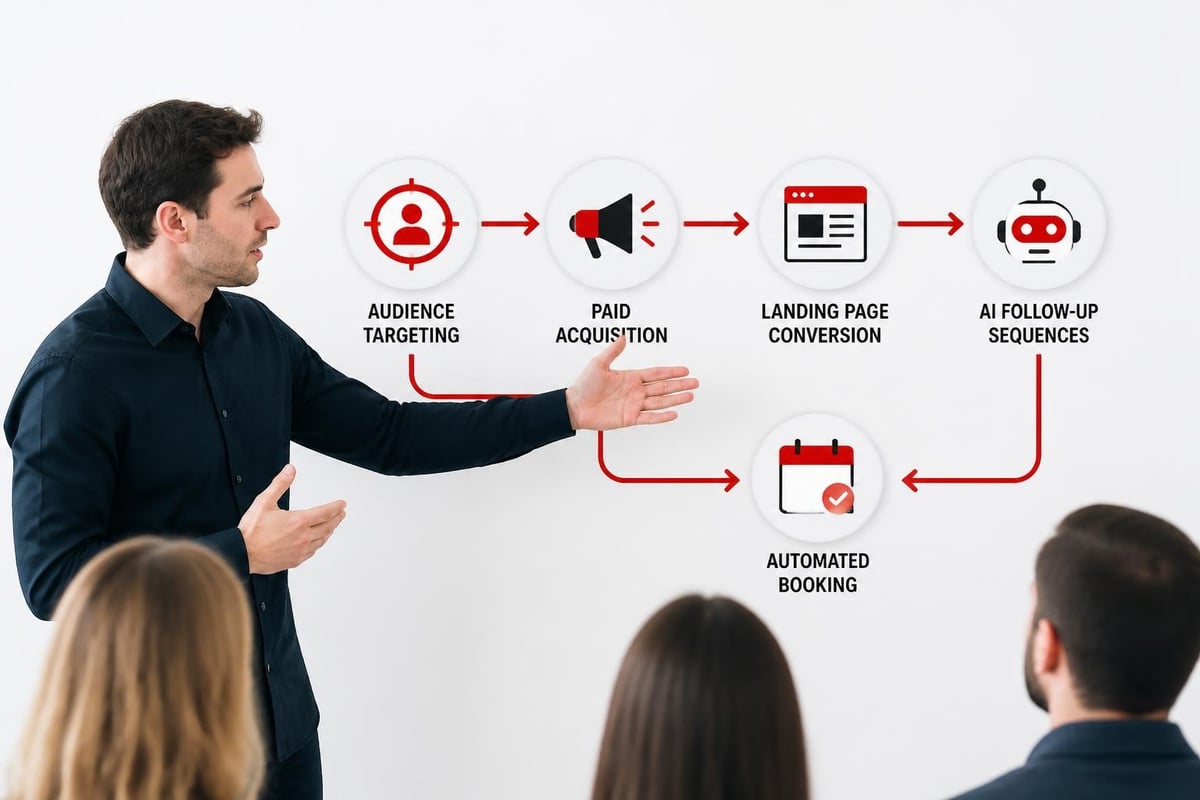
A lead gen marketing agency designs, builds, and operates the entire demand capture system for B2B companies. They start by identifying your ideal customer profile, then deploy paid acquisition channels to attract those prospects, nurture them through automated sequences, and book qualified meetings directly onto your sales calendar.
The best agencies do not hand you a spreadsheet of cold emails. They own the outcome, which is booked calls with decision-makers who have budget, authority, need, and timeline. This means they integrate media buying, conversion optimization, AI-powered follow-up, and sales development into one accountable system.
Core functions of a modern lead gen marketing agency
- Audience research and segmentation: Building buyer personas backed by actual search, intent, and firmographic data
- Paid acquisition: Running and optimizing campaigns across LinkedIn, Google, YouTube, and niche B2B channels
- Conversion architecture: Designing landing pages, forms, and qualification flows that separate tire-kickers from buyers
- Automated follow-up: Using AI and CRM workflows to nurture leads until they book or disqualify
- Sales handoff: Delivering pre-qualified, booked meetings with context so your reps can close
Agencies that skip any of these steps are not lead gen partners. They are vendors. A vendor delivers a service; a partner delivers a result. If the agency contract does not include a minimum number of qualified calls booked, you are hiring a vendor.
How is a lead gen marketing agency different from a traditional marketing agency?
Traditional marketing agencies focus on brand, awareness, and content. Lead gen marketing agencies focus on pipeline and revenue. A traditional agency measures impressions, engagement, and traffic; a lead gen agency measures cost per qualified call, close rate, and customer acquisition cost.
The deliverables are completely different. A brand agency gives you a new website, a content calendar, and maybe some SEO work. A lead gen marketing agency gives you 20 booked sales calls this month with VP-level buyers in your ICP, and they guarantee the volume or you do not pay.
Key differences in approach and accountability
| Traditional Marketing Agency | Lead Gen Marketing Agency |
|---|---|
| Measures traffic, impressions, engagement | Measures booked calls, pipeline, closed revenue |
| Deliverables are assets (ads, content, campaigns) | Deliverables are outcomes (qualified meetings) |
| Paid on retainer for effort | Often paid on performance or hybrid model |
| Success defined by marketing metrics | Success defined by sales metrics |
| Optimizes for awareness and reach | Optimizes for conversion and qualification |
Most agencies will not sign a performance contract because they do not control the full funnel. They run ads but do not own follow-up. They drive traffic but do not own qualification. A real lead gen marketing agency builds the entire system and is accountable for the output, which is why performance pricing models are becoming standard in 2026.
What should you look for when hiring a lead gen marketing agency?
Hire an agency that can show you their system, not just their portfolio. Ask to see the funnel map, the qualification criteria, the follow-up sequences, and the handoff process. If they cannot diagram their process in 10 minutes on a whiteboard, they do not have a system.
The second thing you should demand is performance data from current clients. Not case studies written by their marketing team, but live dashboards showing cost per lead, lead-to-call conversion rate, and call-to-close rate for accounts similar to yours. According to Forrester research on adaptive demand programs, real-time lead engagement and buyer signal integration are what separate high-performing demand engines from legacy lead gen tactics.
Critical evaluation criteria
- Do they own the full funnel or just one piece? If they only run ads and hand you a list, that is not lead gen, that is media buying.
- What is their average cost per qualified call? Agencies that cannot answer this in the first meeting do not track it, which means they do not optimize for it.
- How do they define a qualified lead? If the answer is vague or based only on form fills, walk away.
- What does their follow-up system look like? AI, human SDRs, or a mix? How many touchpoints before disqualification?
- Do they integrate with your CRM and calendar? Seamless handoff to sales is where most agencies fail.
Ask for a pilot or test period with clear KPIs. A competent lead gen marketing agency will propose a 60- or 90-day sprint with a minimum number of qualified calls as the success metric, and they will tie a portion of their fee to hitting that number.
Understanding how lead generation fits into your broader demand strategy helps you set realistic expectations for what an agency can and cannot control. They can control top-of-funnel volume and lead quality, but your sales team still has to close the deal.
What are the common pricing models for a lead gen marketing agency?
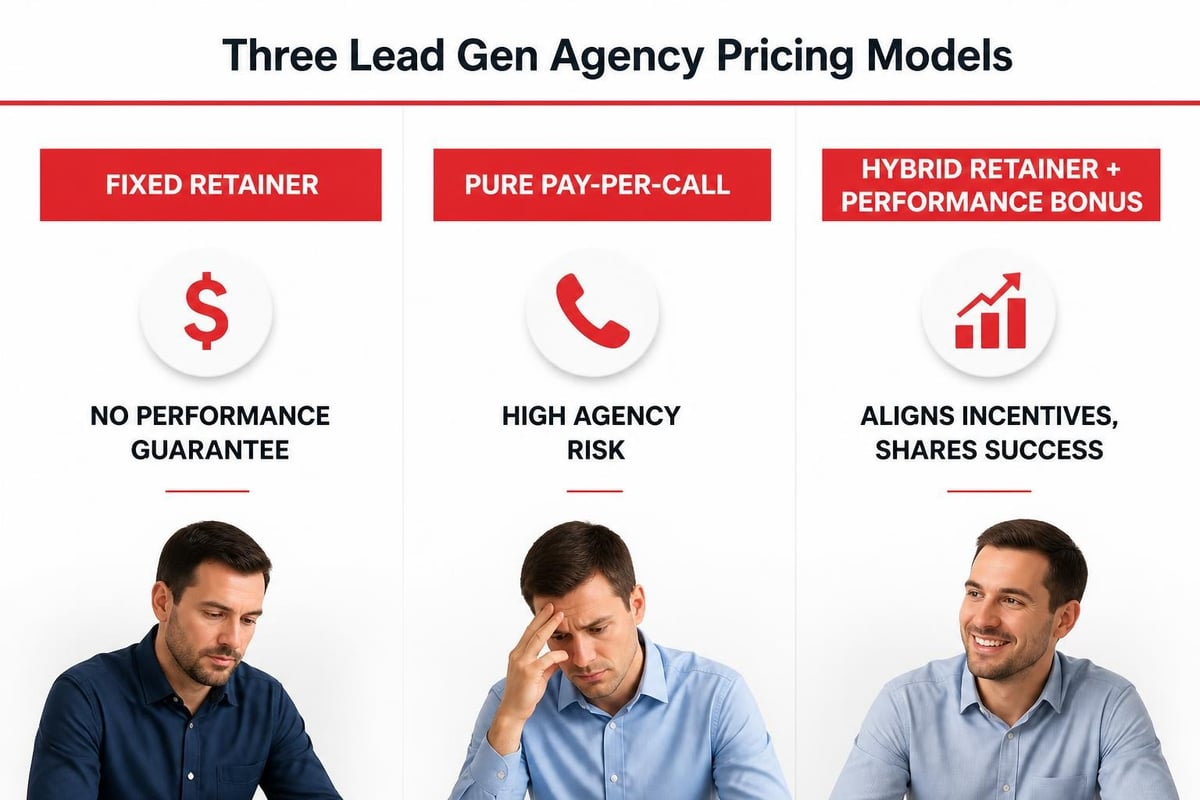
Most agencies in 2026 use one of three models: retainer, pay-per-lead, or hybrid. Retainer means you pay a fixed monthly fee for effort and access, regardless of results. Pay-per-lead means you pay a fixed price for each qualified lead or booked call delivered. Hybrid combines a smaller retainer with a performance bonus or per-lead fee.
Retainer models range from $5,000 to $25,000 per month depending on the agency's reputation and the complexity of your ICP. Pay-per-lead pricing typically ranges from $150 to $800 per qualified call, with enterprise or niche markets at the higher end. Hybrid models usually feature a $3,000 to $10,000 base retainer plus $200 to $400 per booked meeting.
Pricing model comparison
| Model | Typical Cost | Agency Risk | Client Risk | Best For |
|---|---|---|---|---|
| Retainer | $5k–$25k/mo | Low | High | Established brands with long sales cycles |
| Pay-per-lead | $150–$800/call | High | Low | Companies that need predictable CAC |
| Hybrid | $3k–$10k + $200–$400/call | Medium | Medium | Fast-growth B2B SaaS and services |
The best agencies are moving toward hybrid and performance models because they have confidence in their systems. If an agency insists on retainer-only and refuses to tie any compensation to results, they are either risk-averse or their systems do not work.
Aletto uses a hybrid approach, combining a base system fee with performance incentives tied to qualified call volume. This aligns agency and client interests and ensures the agency is optimizing for the metric that actually matters: filled calendars, not vanity metrics. Generating consistent pipeline is not about hope; it is about having a repeatable system that integrates acquisition, AI follow-up, and automated booking.

How long does it take for a lead gen marketing agency to deliver results?
A competent lead gen marketing agency should deliver your first qualified calls within 30 to 45 days. The first two weeks are spent on setup: audience research, campaign build, landing page creation, and CRM integration. Weeks three and four are testing and optimization, where the agency is learning which messages, offers, and channels convert. By week five, you should see a predictable flow of booked meetings.
Agencies that promise results in the first week are lying. Agencies that ask for six months before you see a single call are stalling. The realistic timeline for a mature, scalable system is 90 days, but you should see proof of concept by day 30.
Typical lead gen agency timeline
- Week 1–2: Research, ICP validation, campaign setup, landing page and funnel build
- Week 3–4: Campaign launch, initial traffic, A/B testing, optimization based on early data
- Week 5–8: First qualified calls booked, refinement of targeting and messaging
- Week 9–12: Predictable weekly call volume, handoff process locked in, scale-up begins
If you are three months in and the agency is still "testing" or "gathering data," fire them. A lead gen marketing agency with a proven system knows what works and can adapt it to your ICP quickly. Testing is part of the process, but it should not be the entire engagement.
Aletto's clients typically see their first batch of qualified calls within 21 to 30 days because the core system-paid acquisition, AI-powered follow-up, and automated booking-is already built and battle-tested. The only variable is adapting the messaging and offer to the specific ICP, which is a matter of iteration, not invention.
What industries benefit most from hiring a lead gen marketing agency?
B2B SaaS, professional services, and high-ticket consulting firms get the most value from a lead gen marketing agency. These businesses have long sales cycles, high customer lifetime value, and complex buying committees, which makes traditional outbound and inbound tactics inefficient.
SaaS companies with annual contract values above $10,000 can justify paying $300 to $500 per qualified call because one closed deal covers the cost of 20 to 50 meetings. Similarly, agencies, consultancies, and managed service providers with project values in the six figures can afford performance-based lead gen because the ROI is immediate and measurable.
Industries that struggle with lead gen agencies are low-margin, transactional businesses or companies with very long sales cycles (12+ months) where attribution becomes murky. If your average deal size is under $5,000 or your sales cycle is longer than a year, you need a different model.
High-fit industries for lead gen agencies
- B2B SaaS: Especially companies with ACV above $10k and sales cycles of 30 to 90 days
- IT services and MSPs: Managed services with recurring revenue and enterprise clients
- Marketing and creative agencies: Agencies selling to other businesses, high project values
- Financial services and fintech: Wealth management, lending platforms, B2B payment solutions
- HR tech and recruiting: Platforms selling to HR teams and talent acquisition leaders
When you review your current lead generation strategy, the question is whether your internal team has the expertise, technology, and time to build and run a demand engine at the same level as a specialized agency. Most do not, which is why outsourcing to a performance-driven partner makes sense.
What metrics should you track when working with a lead gen marketing agency?
Track only the metrics that tie directly to revenue. The most important number is cost per qualified call, which is total agency spend divided by the number of booked meetings with prospects who meet your ICP criteria. The second most important metric is call-to-close rate, which tells you if the agency is delivering actual buyers or just people willing to take a free meeting.
Vanity metrics like impressions, clicks, and form fills are irrelevant. You do not get paid for clicks. You get paid when a deal closes. A good lead gen marketing agency will report on leading indicators (cost per lead, lead-to-call conversion rate, call show rate) and lagging indicators (pipeline generated, revenue closed, customer acquisition cost).
Essential lead gen agency KPIs
| Metric | Definition | Target Benchmark |
|---|---|---|
| Cost per qualified call | Total spend ÷ booked calls with ICP match | $200–$500 for most B2B |
| Lead-to-call conversion | Leads converted to booked calls ÷ total leads | 15–30% for strong qualification |
| Call show rate | Calls attended ÷ calls booked | 60–75% with good confirmation flows |
| Call-to-opportunity rate | Calls that enter pipeline ÷ total calls | 30–50% if qualification is tight |
| Opportunity-to-close rate | Closed deals ÷ opportunities created | Varies by sales process, often 20–40% |
Aletto tracks all of these metrics in real time and provides clients with a live dashboard that shows not just lead volume but qualified call volume and pipeline contribution. This transparency is critical because it allows you to make fast decisions about budget allocation and targeting adjustments.
According to the Salesforce State of Marketing report, 78% of marketers say proving ROI is their top challenge, which is why working with an agency that ties every dollar spent to a pipeline outcome is the only defensible model in 2026.
How do lead gen marketing agencies use AI to improve results?
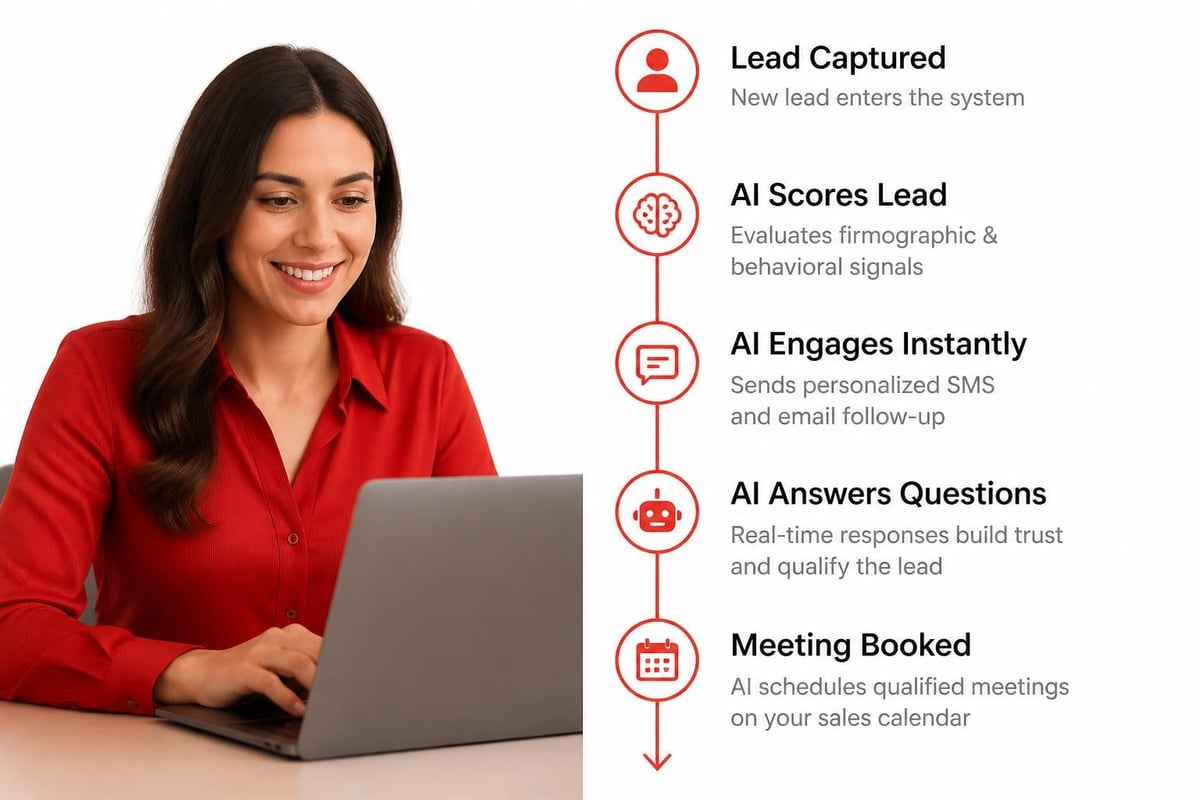
AI is no longer optional in lead generation. The best agencies use AI for three critical functions: prospect qualification, personalized follow-up, and predictive analytics. AI can analyze thousands of firmographic and behavioral signals in real time to score leads, then trigger the right message at the right time based on intent and engagement history.
Aletto uses AI to automate follow-up sequences after a prospect engages with an ad or landing page. Instead of waiting for a human SDR to manually send an email three days later, the AI sends a personalized SMS or email within minutes, books the call automatically, and hands the confirmed meeting to a sales rep with full context. This cuts the lead-to-call time from days to hours, which dramatically improves conversion rates.
AI applications in modern lead gen
- Lead scoring and qualification: Analyzing demographic, firmographic, and behavioral data to predict which leads are most likely to close
- Dynamic follow-up: Sending the right message via the right channel based on prospect behavior and engagement stage
- Conversational booking: AI chatbots and SMS bots that answer questions and book meetings 24/7 without human intervention
- Predictive analytics: Forecasting pipeline and identifying which campaigns and segments will hit revenue targets
Agencies that are still using static email sequences and manual SDR outreach are leaving 40% to 60% of potential pipeline on the table. The data on this is clear: AI-powered follow-up and real-time engagement increase lead-to-call conversion by 2x to 3x compared to traditional methods.
What are the biggest mistakes companies make when hiring a lead gen marketing agency?
The biggest mistake is hiring an agency that does not own the full funnel. If they only run ads and hand you a CSV file of email addresses, you still have to build the follow-up, qualification, and booking system yourself. That is not a lead gen agency, that is a media buyer.
The second mistake is optimizing for cost per lead instead of cost per qualified call. Cheap leads are worthless if they do not book meetings or if they book meetings but never close. Agencies that brag about $20 cost per lead are usually delivering junk traffic that your sales team will ignore.
Common hiring mistakes to avoid
- Not defining what "qualified" means upfront: If you and the agency have different definitions of a qualified lead, you will argue about results every month.
- Choosing the cheapest option: Low price usually means low quality, outsourced labor, and no accountability.
- Ignoring the follow-up system: Ads are easy. Follow-up and qualification are hard. Make sure the agency has a real system for nurturing and booking.
- No clear SLA or performance guarantee: If the contract does not specify a minimum number of qualified calls, you have no leverage.
- Failing to align on ICP and offer: The agency needs to know exactly who you sell to and what offer will convert them. Vague briefs produce vague results.
When evaluating agencies, ask to see their follow-up workflows and qualification criteria in detail. If they cannot show you the exact sequence of messages, triggers, and disqualification rules, they are guessing.
Understanding the tools and systems that power modern lead generation will help you ask better questions and spot agencies that are using outdated tactics.
Frequently Asked Questions
How much does a lead gen marketing agency cost per month?
Most agencies charge between $5,000 and $25,000 per month on retainer, or $150 to $800 per qualified call on performance pricing. Hybrid models combine a smaller retainer ($3,000 to $10,000) with a per-call fee ($200 to $400). Cost depends on your ICP complexity, deal size, and the agency's track record.
What is the difference between a lead gen agency and a demand gen agency?
A lead gen marketing agency focuses on filling your sales calendar with qualified calls right now. A demand gen agency focuses on building long-term brand awareness and nurturing prospects over months. Lead gen is bottom-of-funnel and performance-driven; demand gen is top-of-funnel and brand-driven. Most B2B companies need both, but lead gen delivers faster ROI.
How many qualified calls should I expect per month from a lead gen agency?
A good agency should deliver 15 to 40 qualified calls per month for a mid-market B2B SaaS company spending $10,000 to $15,000 on the engagement. Enterprise or niche markets may see 8 to 20 calls. Volume depends on budget, ICP size, and offer strength. Anything less than 10 calls per month is usually a sign of targeting or messaging problems.
Can a lead gen marketing agency work with my existing sales team?
Yes, and they should integrate directly with your CRM and sales calendar. The best agencies book meetings directly onto your reps' calendars and provide full context (lead source, qualification notes, engagement history) so your team can show up prepared. The handoff process is where most agencies fail, so make sure this is defined in the contract.
How do I know if a lead gen agency is delivering high-quality leads?
Track call-to-opportunity rate and opportunity-to-close rate. If fewer than 30% of booked calls turn into pipeline opportunities, the leads are not qualified. If fewer than 20% of opportunities close, either the leads are weak or your sales process needs work. A high-quality lead gen marketing agency will hit 40% to 60% call-to-opportunity and should match or exceed your historical close rate on opportunities.
A lead gen marketing agency is only valuable if it owns the full system from targeting to booked call and is accountable for results, not activity. Most agencies fail because they optimize for the wrong metrics or do not control the follow-up and qualification steps that actually convert prospects into pipeline. If your current approach is inconsistent or requires too much manual effort from your sales team, it is time to move to a performance-driven model that guarantees calendar fills. Aletto specializes in building these systems for B2B SaaS and service companies, integrating paid acquisition, AI-powered follow-up, and automated booking into one accountable engine. Download the free AI call booking report to see the exact process we used to book 1,122 qualified sales calls in 11 months without cold emails, cold calls, or begging for referrals.