A lead generation site is a web property purpose-built to capture visitor contact information and convert traffic into sales opportunities. Unlike a traditional website that serves multiple purposes, a lead generation site focuses exclusively on moving prospects from awareness to a booked call or demo, typically through optimized landing pages, forms, and automated follow-up systems.
Most B2B companies waste traffic by sending visitors to generic homepages that confuse rather than convert. The solution is a dedicated lead generation site that removes friction, answers one specific question, and makes booking a call the easiest next step. This is particularly critical in 2026, when B2B buyers expect self-serve digital experiences and resist traditional cold outreach.
What makes a lead generation site different from a regular website?
A standard corporate website tries to serve everyone: investors, job seekers, existing customers, press, and prospects. A lead generation site serves one audience with one goal.
The difference shows up in three ways. First, navigation is stripped down or removed entirely. Second, every element on the page supports a single conversion action. Third, the content answers the specific question that brought the visitor to the page, then immediately offers the next step.
Key characteristics of effective lead generation sites:
- Single, clear call-to-action above the fold
- Minimal navigation to prevent exits
- Form fields that ask only for essential information
- Speed-optimized pages that load in under 2 seconds
- Mobile-first design since 60% of B2B research happens on phones
- Social proof positioned immediately before the conversion point
Traditional websites measure engagement metrics like time on site and pages per session. Lead generation sites measure one thing: conversion rate from visitor to qualified lead. Aletto has found that sites optimized for conversion outperform general websites by 300-400% when the same traffic volume is applied.
The architecture that drives conversions
Most lead generation sites fail because they're built backward. Companies start with what they want to say rather than what the prospect needs to hear.
The winning structure starts with the visitor's search intent. If someone searches "how to book more sales demos," they don't want your company history. They want a specific answer, proof it works, and a way to get started.
Here's the architecture that converts:
- Headline that matches search intent – Repeat the exact problem the visitor searched for
- Subheadline with the specific outcome – "Book 40+ qualified calls per month without cold email"
- Proof section – Numbers, client logos, or case study snippet
- How it works – Three-step process, maximum
- Objection handling – Address the two biggest concerns
- Final CTA – Book a call or access a free resource
This structure applies whether you're driving traffic from paid ads, SEO, or referrals. The key is matching the message on the ad or link to the headline on the landing page. Message match determines whether someone stays or bounces.
How do you build a lead generation site that actually books calls?
Start with the form. This sounds backward, but the form determines everything else about your site. If you need ten fields of information to qualify a lead, your page needs more trust-building content. If you only need an email address, your page can be shorter and more direct.
Web form design principles show that every additional form field reduces conversions by 5-10%. The math is simple: ask for less, get more leads. Then qualify them through conversation or automated follow-up.
Form optimization checklist
| Element | Best Practice | Why It Matters |
|---|---|---|
| Number of fields | 3-5 maximum | Each field adds friction |
| Field labels | Above the field, not placeholder text | Improves accessibility and completion rates |
| Button text | Specific action ("Get My Free Report") | Outperforms generic "Submit" by 20%+ |
| Privacy statement | Visible near submit button | Reduces abandonment from security concerns |
| Mobile layout | Single column, large tap targets | 60% of traffic comes from mobile devices |
The most effective lead generation sites use multi-step forms. Instead of showing five fields at once, show two fields, then three more after the first submission. This approach increases completion rates by 30-40% because the first step feels easy, and once someone starts, they're committed to finishing.
Design elements that increase trust
Conversion optimization is 20% layout and 80% trust. Visitors need to believe three things before they'll give you their information: you understand their problem, you've solved it before, and the next step is safe.
Trust-building elements ranked by impact:
- Customer logos from recognizable companies (40% lift)
- Specific metrics from case studies (35% lift)
- Video testimonials with full names and titles (30% lift)
- Security badges and compliance certifications (15% lift)
- Money-back guarantees or risk reversal (25% lift)
Don't use stock photography. Aletto tested this across 200+ landing pages and found that stock images reduced conversions by 15-20% compared to authentic screenshots, real customer photos, or no images at all. Visitors can spot fake imagery instantly, and it destroys credibility.

What technical requirements affect lead generation site performance?
Page speed is a conversion factor, not just an SEO metric. Google data shows that as page load time increases from 1 to 3 seconds, bounce probability increases 32%. For every additional second of load time, conversions drop another 7%.
The fastest lead generation sites share these technical characteristics:
- Hosted on edge networks (Cloudflare, Fastly) for global speed
- Images compressed to WebP format at 80% quality
- JavaScript deferred or eliminated entirely
- CSS inlined for above-the-fold content
- Forms that submit without page reload
- Structured data markup for better search appearance
Accessibility compliance is non-negotiable in 2026. Beyond the legal requirement, accessible forms convert better because they're easier for everyone to use. This means proper label associations, keyboard navigation, clear error messages, and sufficient color contrast.
Integration and automation requirements
A lead generation site without automation is just an expensive contact form. The site must connect to three systems: your CRM, your email/SMS platform, and your calendar.
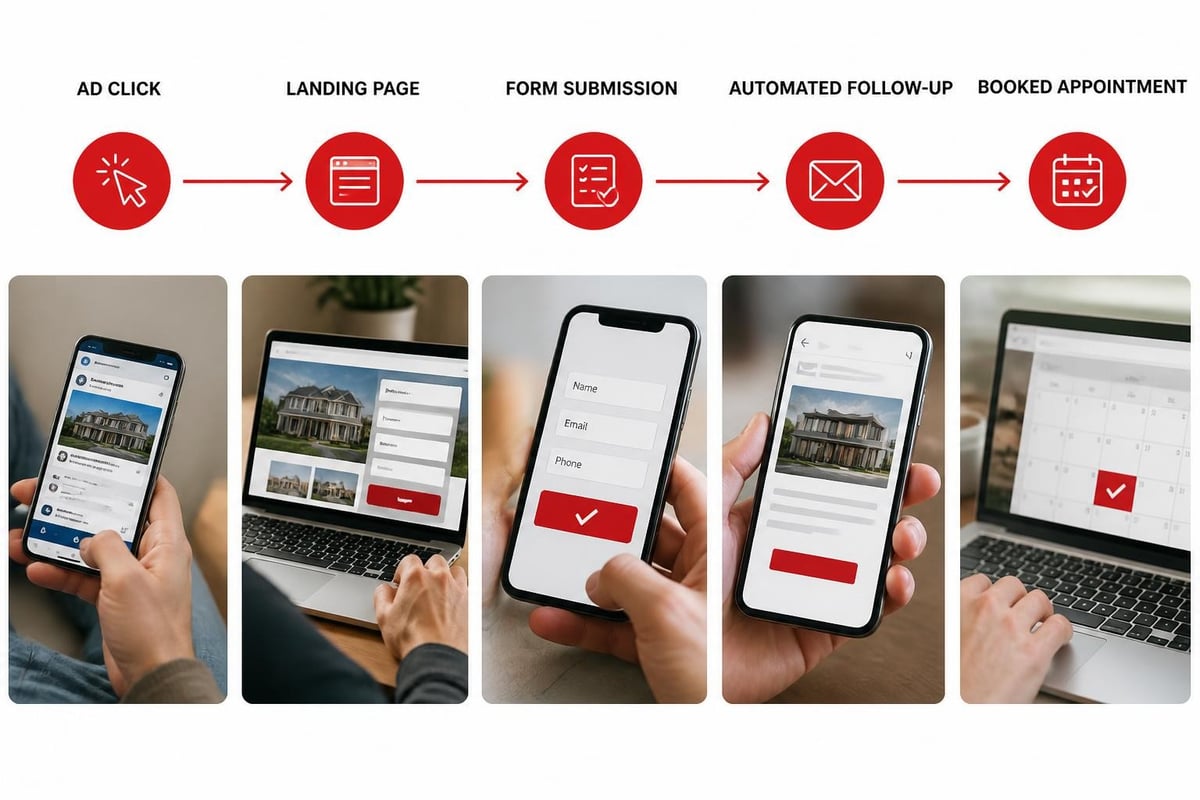
Here's what happens when a visitor submits a form on a properly integrated lead generation site:
- Contact information flows to CRM and gets tagged with source/campaign data
- Automated email or SMS sequence begins immediately
- Calendar link appears on thank-you page and in follow-up messages
- Lead score updates based on form responses and behavior
- Sales team receives notification if lead meets qualification criteria
Aletto's system adds an AI follow-up layer between form submission and human contact. The AI handles objections, answers questions, and nurtures leads until they're ready to book. This approach books 3-5x more calls from the same traffic volume because it removes the delay between interest and conversation.
How do you drive qualified traffic to a lead generation site?
The best converting lead generation site in the world is worthless without traffic. But not just any traffic: you need visitors who match your ideal customer profile and have active buying intent.
Traffic sources ranked by conversion rate for B2B lead generation:
| Source | Typical Conversion Rate | Cost per Lead | Qualification Rate |
|---|---|---|---|
| Intent-based paid search | 8-12% | $80-150 | 60-70% |
| Retargeting to engaged visitors | 6-10% | $40-90 | 50-60% |
| LinkedIn targeted ads | 3-6% | $100-200 | 55-65% |
| SEO organic traffic | 4-8% | $30-80 | 40-50% |
| Cold traffic display ads | 1-2% | $150-300 | 20-30% |
The numbers reveal an uncomfortable truth: most companies waste budget on awareness-level traffic that never converts. Cold display ads and broad social campaigns generate clicks but rarely generate qualified leads.
The better approach focuses on intent signals. Someone searching "how to fill sales pipeline without cold calling" is ready to buy. Someone who sees a brand awareness ad on their news feed is not.
SEO strategy for lead generation sites
SEO for lead generation requires a different approach than content marketing. You're not trying to rank for broad educational terms. You're targeting bottom-of-funnel keywords that indicate buying intent.
Target keywords should include terms like "software," "tool," "service," "solution," "how to," "best," and comparison phrases. These terms indicate someone actively researching solutions, not just learning about problems.
Create dedicated landing pages for each high-value keyword. Don't try to rank your homepage for 50 different terms. Build 50 pages, each optimized for one specific query. This approach to lead acquisition delivers 4-6x better results than trying to be everything on one page.
Include schema markup for local businesses if relevant, and FAQ schema for pages targeting question-based keywords. This markup helps your pages appear in featured snippets and People Also Ask boxes, which drive high-intent traffic.
What conversion rate should you expect from a lead generation site?
Industry benchmarks are mostly useless because conversion rates depend entirely on traffic quality and offer strength. A site converting cold social traffic at 1% might be performing well, while a site converting intent-based search traffic at 3% is underperforming.
Realistic conversion rate ranges by traffic source and offer type:
- Free report or guide download: 15-30% from warm traffic
- Book a demo or consultation: 3-8% from qualified search traffic
- Free trial signup: 8-15% from retargeted visitors
- Get a quote or pricing: 5-10% from bottom-funnel keywords
- Newsletter subscription: 2-5% from cold traffic
These numbers assume your site follows best practices: fast load time, clear value proposition, minimal form fields, and strong social proof. A poorly designed site will convert at half these rates. An exceptional site with a compelling offer can exceed them.
Aletto has found that lead volume matters less than lead quality. A site generating 200 leads per month at 2% conversion with 40% qualification rate produces more revenue than a site generating 400 leads at 4% conversion with 15% qualification rate. The math: 80 qualified leads beats 60 qualified leads, but the second scenario wastes twice as much traffic.
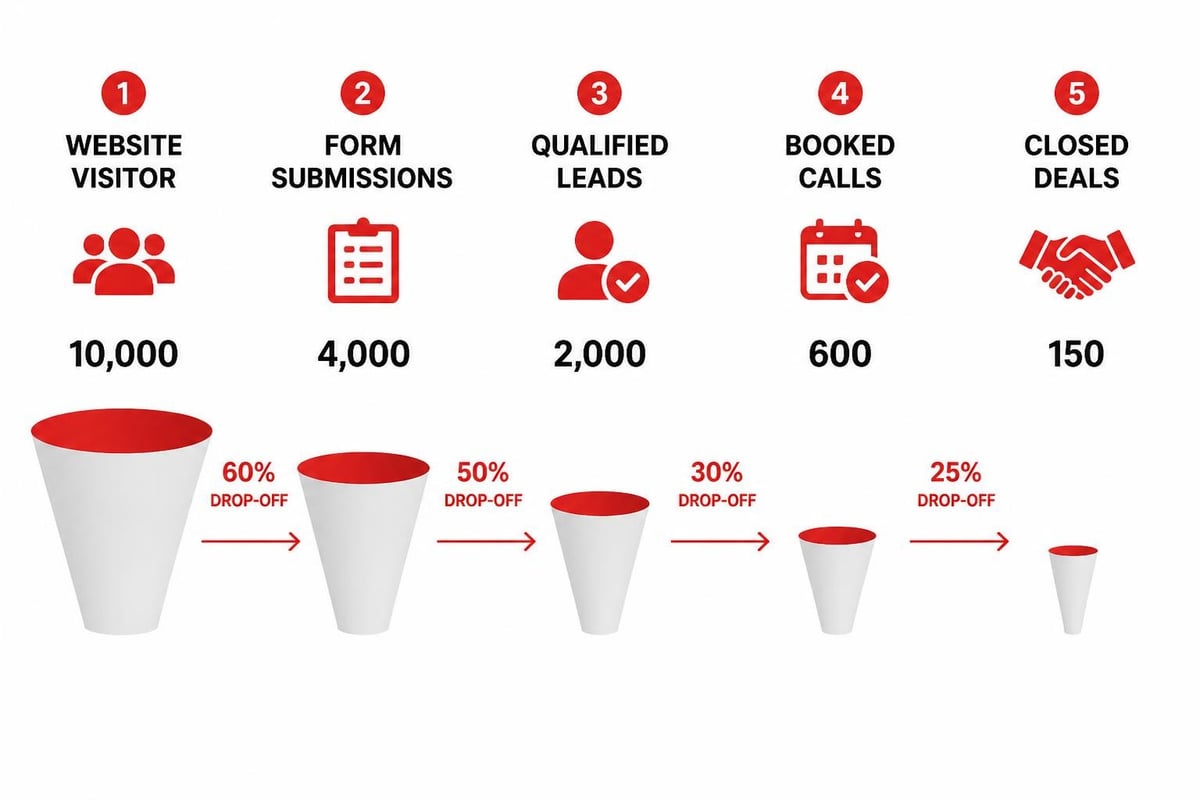
When analyzing your lead generation site performance, measure these metrics:
- Visitor-to-lead conversion rate – Percentage who submit the form
- Lead-to-qualified conversion rate – Percentage who meet buying criteria
- Qualified-to-booked conversion rate – Percentage who schedule calls
- Booked-to-show conversion rate – Percentage who actually attend
- Show-to-close conversion rate – Percentage who become customers
Multiply these percentages together and you get your visitor-to-customer conversion rate. This is the only number that matters. A 5% form conversion rate means nothing if only 10% of those leads are qualified.
What mistakes kill lead generation site performance?
The most common mistake is asking for too much information too soon. Companies want to qualify leads before talking to them, so they add fields for company size, budget, timeline, current solution, and pain points. Each field cuts conversions.
The alternative is qualification through conversation. Capture minimal information (name, email, company), then use automated or AI-driven follow-up to qualify before booking the call. This approach generates 3x more leads and the qualification rate stays the same because you're asking the same questions, just at a different point in the process.
Lead generation site mistakes ranked by frequency:
- Generic value propositions – "Industry-leading solutions" says nothing
- Multiple calls-to-action – Visitors need one clear next step, not five options
- No mobile optimization – 60% of traffic is mobile but sites are designed for desktop
- Slow page speed – Every second of load time costs 7% of conversions
- Weak or missing social proof – Claims without evidence don't persuade
- Form placed below the fold – CTA should be visible without scrolling
- No follow-up automation – 80% of leads need 5+ touchpoints before they book
Another fatal mistake is treating all traffic the same. A visitor from a "best CRM software" search needs different messaging than someone clicking a retargeting ad for a specific case study. Build different landing pages for different traffic segments and match the message to the source.
Testing and optimization process
Launch your lead generation site with your best hypothesis, then improve through testing. Don't wait for perfection. A live site generating data beats a perfect site that launches in six months.
Elements to test in priority order:
- Headline and value proposition (30-40% impact on conversions)
- Form length and field labels (20-30% impact)
- CTA button text and color (10-15% impact)
- Social proof type and placement (15-20% impact)
- Page length and content structure (10-15% impact)
Run one test at a time and wait for statistical significance before declaring a winner. With typical B2B traffic volumes (500-2000 visitors per week), you need to run each test for 2-3 weeks minimum. Testing multiple elements simultaneously makes it impossible to know what caused the change.
Aletto's testing data across client sites shows that most improvements come from message clarity, not design tricks. A clear headline that states exactly what you do for whom beats a clever headline 95% of the time. Specificity beats creativity in lead generation.
Frequently Asked Questions
What's the ideal length for a lead generation site landing page?
The page should be exactly as long as needed to overcome objections and build sufficient trust for the visitor to convert. For complex B2B services with $50,000+ deal sizes, this typically means 1,500-2,500 words. For simple offers or warm retargeting traffic, 300-500 words often performs better. Test shorter versus longer versions with your specific audience rather than following a universal rule.
How many form fields should a lead generation site include?
Three to five fields is optimal for most B2B lead generation. Name and email are mandatory. Add company name if you need to qualify by company size or industry. Phone number increases qualification but reduces submissions by 10-15%. Never ask for information you can find through enrichment tools after the lead submits. Every field you eliminate increases conversion rate by 5-10%.
Should a lead generation site have a navigation menu?
Remove navigation or minimize it to one or two essential links. Every navigation option is an exit opportunity. Your goal is to move visitors toward one action: form submission. The exception is if you need to include legal pages (privacy policy, terms) for compliance. Put these in a footer with small text rather than prominent navigation.
How long does it take to see results from a lead generation site?
With paid traffic, you'll see initial results within 48-72 hours. Sufficient data to optimize typically requires 100-200 form submissions, which might take 2-4 weeks depending on your traffic volume. For organic SEO traffic, expect 3-6 months before pages rank and generate consistent leads. The inbound lead generation process requires patience but delivers better-qualified leads long-term than paid-only strategies.
Can one lead generation site work for multiple products or services?
No. Build separate landing pages for each distinct offering. A visitor searching for email marketing software has different needs than one searching for marketing automation platforms. Even if you offer both, create dedicated pages with specific messaging, benefits, and proof points for each. Use your main website for general positioning and individual lead generation pages for conversion-focused traffic.
A lead generation site works when it removes friction between interest and action. The best sites answer one question clearly, prove the solution works with specific numbers, and make booking the next conversation effortless. For B2B teams tired of cold outreach that doesn't work and events that waste time, Aletto's system combines paid acquisition with AI-powered follow-up to fill your calendar with qualified demos. See exactly how we book 1,122 qualified sales calls in 11 months through our Free AI Call Booking Report, which shows the complete system including ad strategy, landing page structure, and automated booking process.