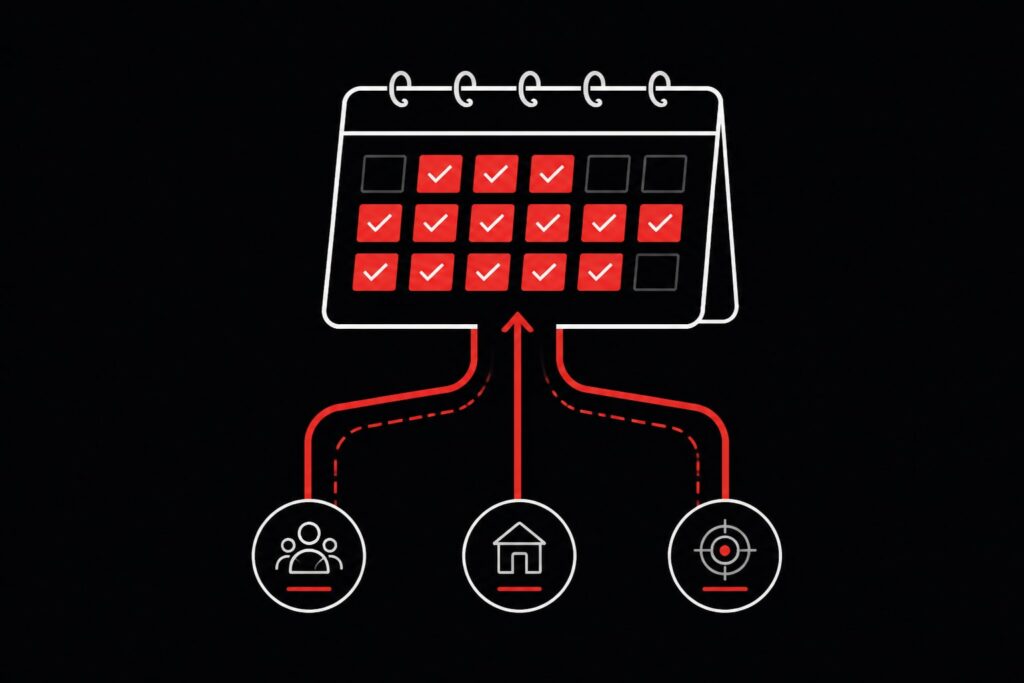
An appointment setting company books meetings between your sales team and prospects who match your ideal customer profile, so your reps spend their time selling instead of prospecting. The right one depends on how it finds those prospects, who qualifies them, and whether you pay for meetings that actually happen or for activity that merely looks busy.
Most buyers compare providers on price per meeting. That is the wrong first filter. The method behind the meeting determines quality, cost, and how well the model holds up as buyers get harder to reach. This guide covers how these companies work, what each model costs you in practice, and how to pick one that fits a B2B SaaS or service business.
What does an appointment setting company actually do?
An appointment setting company is an outsourced team that finds, contacts, qualifies, and books prospects onto your reps' calendars, then hands them off for the sales conversation.
The scope varies, but most providers cover four jobs:
- Targeting: building or buying lists that match your buyer profile
- Outreach: contacting those prospects through calls, email, LinkedIn, or ads
- Qualification: confirming fit, budget, authority, and timing before a meeting is booked
- Scheduling and handoff: placing the meeting on a rep's calendar with notes attached
A B2B appointment is a scheduled conversation between a seller and a business buyer who has confirmed enough interest and fit to justify a sales call. Note the second half of that definition. A meeting with someone who was talked into a calendar slot is not an appointment in any useful sense. It is a no-show waiting to happen.
Consider a SaaS founder selling a $15,000 annual contract. A provider books 20 meetings in a month. If 12 of those prospects have no budget authority, the founder has paid for 12 wasted hours of rep time and a distorted pipeline forecast. The count looked healthy. The outcome was not.
What are the main models for B2B appointment setting?
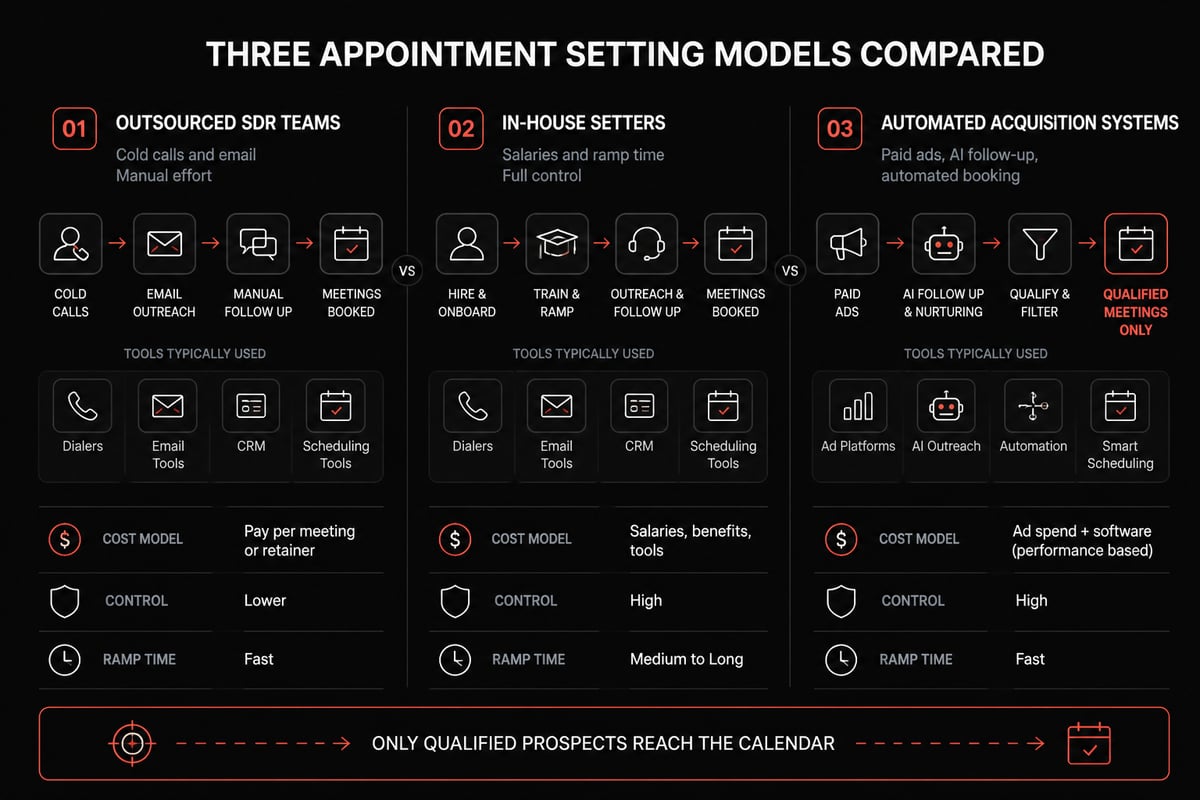
There are three main models: outsourced human SDR teams, in-house setters, and automated systems that combine paid acquisition with AI follow-up and booking.
Outsourced SDR teams run cold calling and email sequences on your behalf. They are the traditional answer, and they work best when your buyers still answer phones and your average deal is large enough to justify heavy manual effort.
In-house setters give you control and product knowledge. They also give you salaries, management time, turnover, and a ramp period of several months before output stabilizes.
Automated acquisition systems attract buyers who raise their hands, follow up with them instantly, and book them without a human chasing. This is the model Aletto runs. Paid acquisition, AI follow-up, and automated booking operate as one machine, and only qualified prospects reach the calendar.
The position here is direct: for most B2B SaaS teams in 2026, a model built on cold outreach alone is the weakest option. A Gartner survey of 632 B2B buyers conducted in August and September 2024 found that most buyers prefer a rep-free buying experience and many actively avoid suppliers that send irrelevant outreach. Providers that depend on interrupting strangers are fighting that preference. Providers that let buyers self-select and book on their own terms are working with it.
How much does an appointment setting company cost?
Cost depends on the pricing structure more than the headline number, and the three common structures are retainer, pay per appointment, and performance tied to ad spend or results.
| Pricing structure | How you pay | Main risk |
|---|---|---|
| Monthly retainer | Flat fee for a team or campaign | You pay regardless of meetings booked |
| Pay per appointment | Fee per meeting that meets a stated definition | Weak definitions inflate the count |
| Ad spend plus management | Media budget plus a management fee | Opaque reporting hides waste |
Retainers reward activity. Per-appointment pricing rewards meetings but only as strictly as the contract defines a qualified one. Ad-based models reward whoever controls the budget, which is why transparency matters so much. Aletto shows every dollar of ad spend with no black box, and its ad accounts run on a kill-switch discipline: underperforming creative is cut, not monitored.
Ask any provider for cost per held meeting, not cost per booked meeting. The gap between the two is where budgets disappear.
How do you choose a B2B appointment setting company?
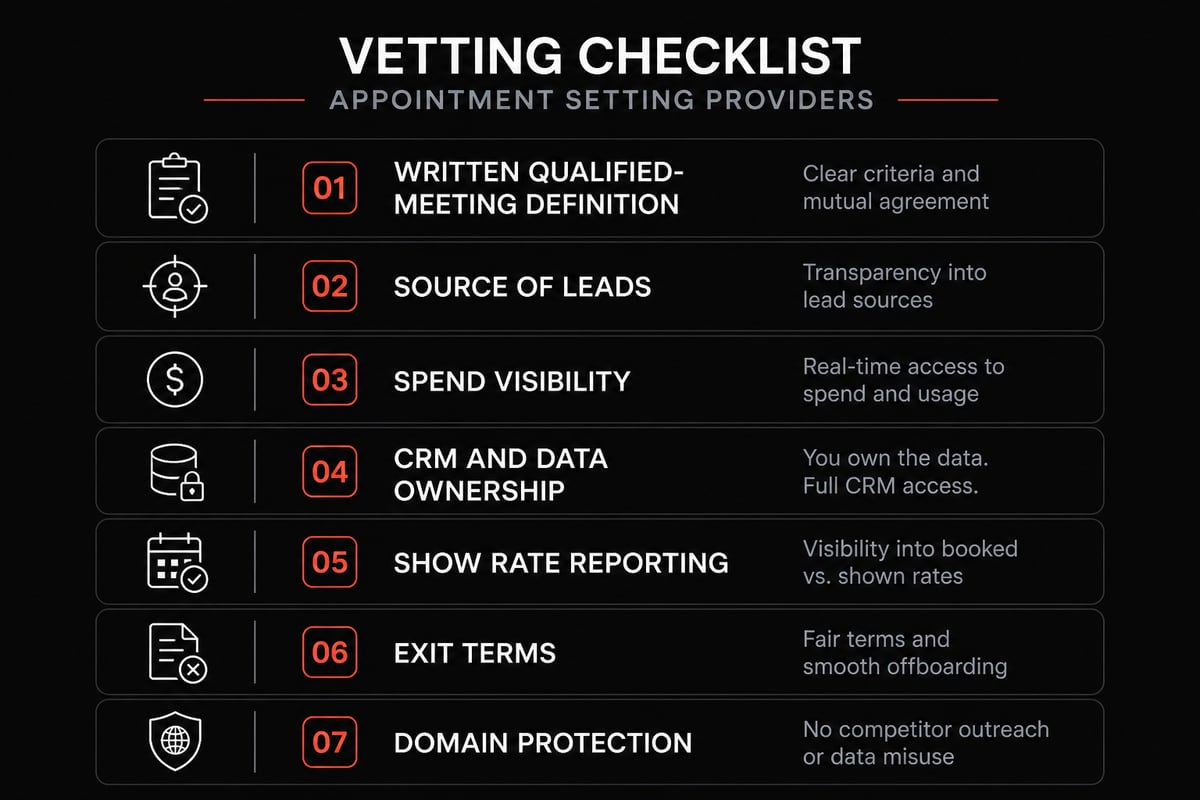
Choose by testing five things in order: the qualification definition, the source of leads, the reporting, the contract terms, and the proof.
- Get the qualified-meeting definition in writing. It should name role, company size, budget signal, and need. If the provider cannot write it down, they cannot deliver it consistently.
- Ask where the prospects come from. Rented lists, scraped data, and inbound ad traffic produce very different buyers.
- Demand visibility. You should see activity, spend, and outcomes in your own CRM or dashboard, with attribution you can verify independently.
- Read the exit terms. Long lock-ins with no performance clause shift all the risk to you.
- Ask for results from a business like yours. A cybersecurity vendor and a coaching platform need different approaches.
A short scenario shows why order matters. A services firm hires a provider because the per-meeting price is 30% lower than the alternative. The definition of "qualified" is a prospect who said "sure, send a calendar link." Show rates sit near half. The effective price per held, qualified meeting ends up higher than the expensive option the firm rejected.
For deeper context on separating lead sources from lead quality, Aletto's breakdown of how a lead marketing company should be evaluated covers the questions to put to any vendor.
What results should a good provider deliver?
A good provider produces a measurable pipeline, not just a meeting count, and you should hold them to show rate, qualification rate, and cost per closed opportunity.
Benchmarks help you judge whether a claim is realistic. The HubSpot 2025 State of Sales survey of 1,000 sales professionals found that a majority of sales teams were on track to meet or exceed revenue targets, and most reported improved lead quality year over year. If your own lead quality is flat while the market is improving, your sourcing method is probably the problem, not your reps.
Aletto's own figures show what a managed system can look like at scale:
- Over 1,500 calendars packed for clients in 100+ countries
- Over $50M in ad spend managed and over 100,000 leads generated
- Many client campaigns reaching 10x ROI or more
- Average customer acquisition cost reduced, with attribution verified by Hyros
One concrete example is documented in a case where a SaaS company booked 38 qualified sales calls in 48 hours using a single AI SMS bot while competitors burned budget on dead email sequences. The lesson is speed. Follow-up within minutes beats follow-up within days, and automation is the only way to hold that standard at volume.

Why does AI follow-up matter in appointment setting?
AI follow-up matters because response speed and consistency decide whether an interested prospect becomes a booked meeting, and humans cannot sustain either at scale.
A Gartner survey of 1,026 B2B sellers conducted from January to March 2024 found that sellers who effectively partner with AI tools are considerably more likely to meet quota than those who do not. The operative word is "partner." AI that blasts generic messages fails. AI that responds to a specific inquiry, answers questions, and books a time works.
Here is a practical picture. A prospect fills out a form at 9:40 p.m. A human-staffed setter reaches them the next afternoon, if at all. An automated system texts within a minute, handles the first objection, and offers three time slots. The meeting is booked before the competitor's rep has opened their inbox.
This is also why the creative layer matters. Aletto builds ad creative from the actual language buyers use and tests it weekly, so the prospects entering the system arrive already interested in the problem you solve.
Which appointment setting approach fits your business?
The best fit depends on your deal size, buyer behavior, and how much control you want over the process.
- B2B SaaS with a clear ICP and a $10K+ deal size: an automated acquisition system usually produces the best cost per held meeting, because buyers self-qualify before booking.
- Appointment-based service businesses: speed to lead and automated booking matter most. Aletto has documented how a simple appointment-based business can reach $100K a month when the booking system is built correctly.
- Enterprise sales with a handful of named accounts: a specialist human SDR team doing account-based outreach can still make sense.
If you want a one-off fix, such as a short burst of meetings with no ongoing system, a managed model is the wrong tool. Likewise, if your plan depends on cold emails and cold calls, Aletto will not be the right partner. It is built for teams that want a repeatable acquisition engine.
Aletto's free AI call booking report breaks down how qualified sales calls were booked over 11 months without cold emails, cold calls, LinkedIn, events, or referral begging. It is a useful benchmark to hold any provider's pitch against, because it shows the mechanics, not just the outcome.

What red flags should you watch for in an appointment setting company?
The clearest red flags are vague qualification, hidden spend, and any promise of guaranteed meeting volumes before the provider has seen your market.
Watch for these specifically:
- A "qualified" definition that amounts to "agreed to a call"
- No access to raw data, recordings, or CRM entries
- Reporting that stops at "meetings booked" with no show or opportunity data
- Long contracts without a performance exit
- Case studies that name no metrics or come from unrelated industries
- Reliance on a single channel, usually cold email, with no plan for deliverability or compliance
Deliverability deserves its own mention. Inbox providers have tightened rules, and a campaign built on purchased lists can damage your sending domain. The harm outlasts the contract. If a provider cannot explain how they protect your domain reputation, assume they do not.
Is it hard to become an appointment setter?
Becoming an appointment setter is not hard to start, but it is hard to do well, because the role demands fast qualification, resilience, and clear communication.
Entry barriers are low. Most companies hire for communication skill and train on product and process. The difficulty sits in the work itself: high rejection rates, strict scripts to balance against natural conversation, and quotas tied to meetings held rather than meetings booked. This is also why setter turnover is high in many in-house teams, and why that turnover is a hidden cost when you compare building a team against outsourcing.
For a business owner, the practical takeaway is that a good setter is a trained, retained asset. Replacing one every six months resets your ramp time every time.
How do you prepare your sales team for provider-booked meetings?
Prepare your reps by defining handoff rules, sharing the conversation context, and setting a response standard before the first meeting lands.
Meetings fail after the booking more often than before it. Three habits prevent that:
- Share the context. Reps should see what the prospect asked, which ad or message they responded to, and what was qualified.
- Set a confirmation sequence. Reminders sent the day before and the hour before reduce no-shows.
- Track the outcome by source. Tag every meeting so you can tell which channel produces closed revenue, not just calendar activity.
An appointment setting company can only improve what you measure together. If the provider never learns which meetings closed, the targeting never gets better.
Frequently Asked Questions
What is the best appointment app for small businesses?
The best choice depends on whether you need simple scheduling or a full booking funnel. Tools such as Calendly and Acuity handle calendar links well, but they only convert prospects you already have. For businesses that also need new qualified prospects, a managed system that combines acquisition, follow-up, and booking is the more complete answer.
Which B2B appointment setting services are the best?
The best provider is the one whose model matches your deal size and buyer behavior, and who will define a qualified meeting in writing. Compare cost per held meeting, show rate, spend transparency, and contract terms rather than ranking on price per booked meeting alone.
How long does it take an appointment setting company to deliver results?
Human outreach teams typically need several weeks to build lists, test messaging, and ramp. Automated paid-acquisition systems can produce meetings faster once creative is live, because follow-up and booking run automatically. Ask any provider for a written ramp plan with milestones before you sign.
Should I hire in-house setters or outsource?
Hire in-house if you have a narrow, high-value account list and the management capacity to coach and retain staff. Outsource or use a managed system if you want predictable output without payroll, turnover, and ramp time. Many teams find the outsourced route cheaper per held meeting once all costs are counted.
Your next step is to pull your last 20 booked meetings and mark how many were held, how many were qualified, and how many reached a real opportunity, because that ratio is the standard any provider has to beat. If the numbers show you are paying for activity rather than pipeline, start with the Free AI Call Booking Report to see how a qualified calendar gets built without cold outreach. When you are ready to see how that system would run for your team, Aletto offers a way to start free training and learn how paid acquisition, AI follow-up, and automated booking fill a sales calendar.