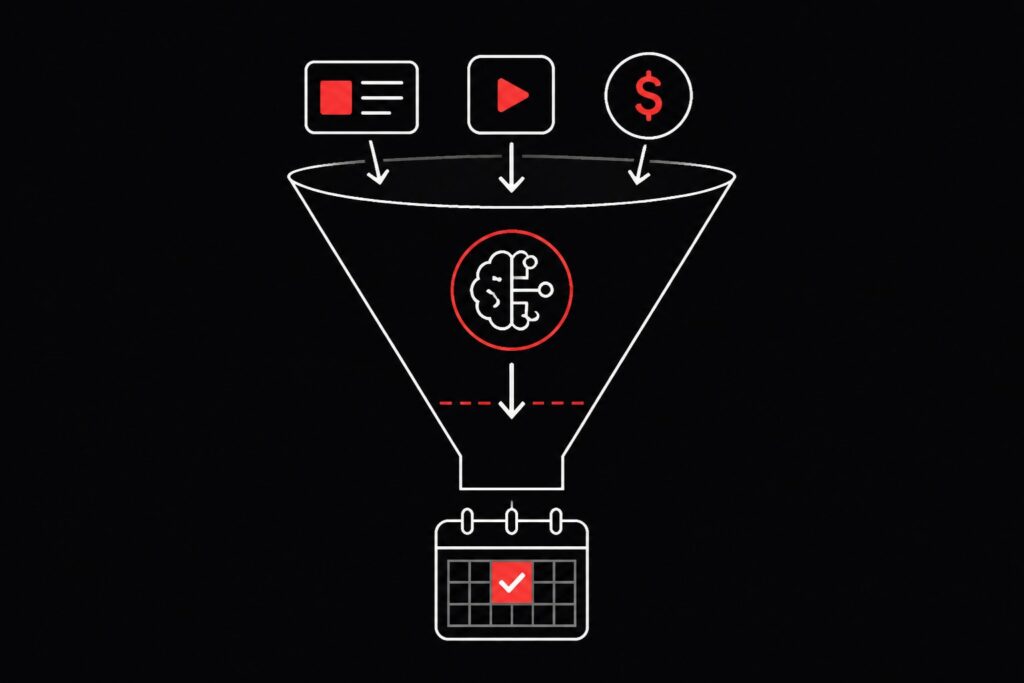
A B2B funnel is the path a business buyer takes from first learning your company exists to signing a contract, and you build one by defining each stage, measuring the drop-off between stages, and routing only qualified prospects to a sales rep. For B2B SaaS and service teams, the practical goal is simple: turn paid attention into booked meetings, and turn those meetings into revenue.
Most funnels fail at the handoff. Traffic arrives, leads pile up, and nobody follows up fast enough or filters well enough for reps to trust the calendar. This guide covers the stages, the metrics, and a build process that prioritizes booked, qualified meetings over lead volume.
What Is a B2B Funnel?
A B2B funnel is a model of the buying journey that tracks how many prospects enter, how many advance at each stage, and how many become customers.
It differs from a sales pipeline in one useful way. Salesforce describes the funnel as buyer-focused, tracking the customer journey and where people convert or drop off, while the pipeline is seller-focused and tracks deal stages and rep actions. In practice, marketing owns the top of the funnel and sales owns the pipeline, and the meeting on the calendar is the seam between them.
Example scenario: A SaaS company with a $15,000 annual contract value gets 4,000 site visitors a month. Eighty become leads, 20 become booked demos, and 5 become customers. The funnel shows that the biggest leak sits between lead and demo, so fixing follow-up speed will do more than buying more traffic.
If you want a broader view of how funnels connect to demand, the Aletto guide to the B2B marketing funnel goes deeper on the marketing side.
Why Is a B2B Funnel Harder to Run Than a B2C One?
B2B is harder than B2C because more people are involved, the purchase is larger, and the cycle is longer, so every stage has more places to stall.
A 2024 Gartner buyer survey found that most B2B buyers described their most recent purchase as very complex or difficult. That complexity comes from buying committees, security reviews, budget approval, and internal politics. A B2C shopper decides alone in minutes. A B2B buyer often needs to convince four or five colleagues.
Three differences shape how you design the funnel:
- Multiple stakeholders. Your champion is rarely the signer, so content and follow-up must serve several roles.
- Longer cycles. Weeks or months pass between first touch and decision, which means retargeting and nurture matter.
- Higher stakes. Buyers want proof, so case studies and specific numbers beat slogans.
There is also a shift in preference worth taking seriously. A Gartner survey of B2B buyers conducted in August and September 2024 found that most buyers prefer an overall rep-free buying experience. That does not mean reps are obsolete. It means buyers want to self-educate first and talk to a human only when they are ready. A funnel that forces a call too early loses them.
What Are the Stages of a B2B Funnel?
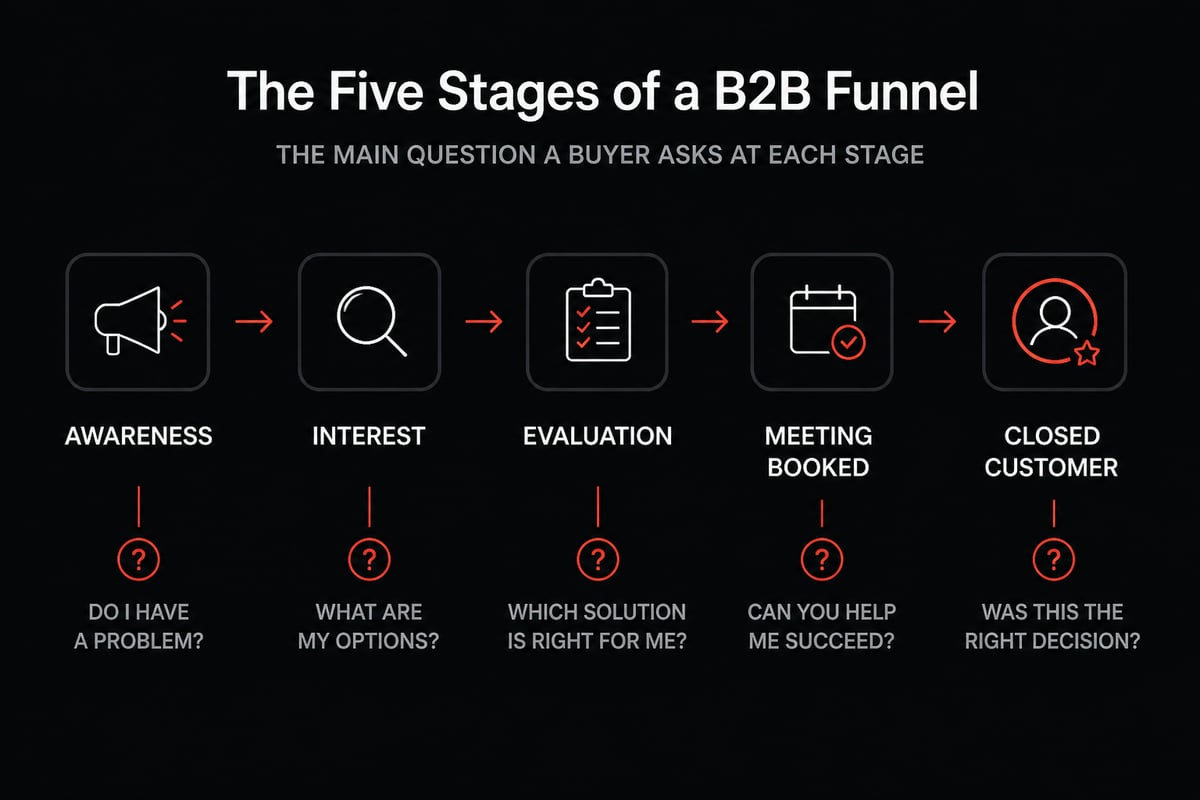
The stages of a B2B funnel are awareness, interest, evaluation, decision, and retention, and each one needs a different message and a different success measure.
Different companies name these differently, but the logic is consistent. Here is how each stage works for a SaaS or service business.
- Awareness. The buyer has a problem and is not yet looking for you. Paid ads, search, and short-form content earn the first click. Success here is qualified reach, not raw impressions.
- Interest. The buyer engages with a page, a video, or a lead form. Your job is to capture contact details and context, such as company size and role.
- Evaluation. The buyer compares options and tests whether you fit. Case studies, pricing clarity, and fast responses decide this stage.
- Decision. A rep runs a call, handles objections, and brings in other stakeholders. This is where qualified meetings pay off.
- Retention. Onboarding, renewals, and expansion. A funnel that ends at signature leaves money behind.
Example scenario: A managed IT services firm runs ads to IT directors at mid-size companies (awareness), offers a security checklist in exchange for an email (interest), sends a short comparison and three client results (evaluation), and books a 30-minute scoping call (decision). Each stage has one clear next action, and nothing else competes for attention.
You can see how these stages translate into a working system in Aletto's breakdown of a sales conversion funnel.
Which B2B Funnel Metrics Should You Track?
Track the conversion rate between each pair of stages, cost per qualified meeting, speed to lead, and customer acquisition cost, because these show exactly where money and prospects leak.
Vanity numbers like impressions and page views tell you little. The metrics below tie directly to revenue.
| Metric | What it tells you | Where to look |
|---|---|---|
| Lead-to-meeting rate | How well follow-up and qualification work | Between interest and decision |
| Cost per qualified meeting | The real price of a sales conversation | Ad spend divided by qualified bookings |
| Speed to lead | How fast a new lead gets a response | Minutes from form fill to first touch |
| Meeting show rate | Whether booked calls actually happen | Held calls divided by booked calls |
| Customer acquisition cost (CAC) | Total cost to win a customer | All acquisition spend divided by new customers |
For context on realistic rates, a 2025 benchmark compilation from Gradient Works reports average B2B funnel conversion of 13 to 21% from marketing qualified lead to sales qualified lead, and 30 to 59% from sales qualified lead to opportunity, with rates varying by sector and lead source. Treat those as ranges, not targets. Your own baseline matters more than any industry average.
A position worth stating plainly: cost per lead is a misleading number. A $40 lead that never books is more expensive than a $200 lead that shows up and closes. Optimize for cost per qualified meeting and for CAC.
Aletto's first-party results illustrate the effect of measuring the right thing. Across its client work, attribution is verified by Hyros so spend can be traced to outcomes.
How Do You Build a B2B Funnel Step by Step?
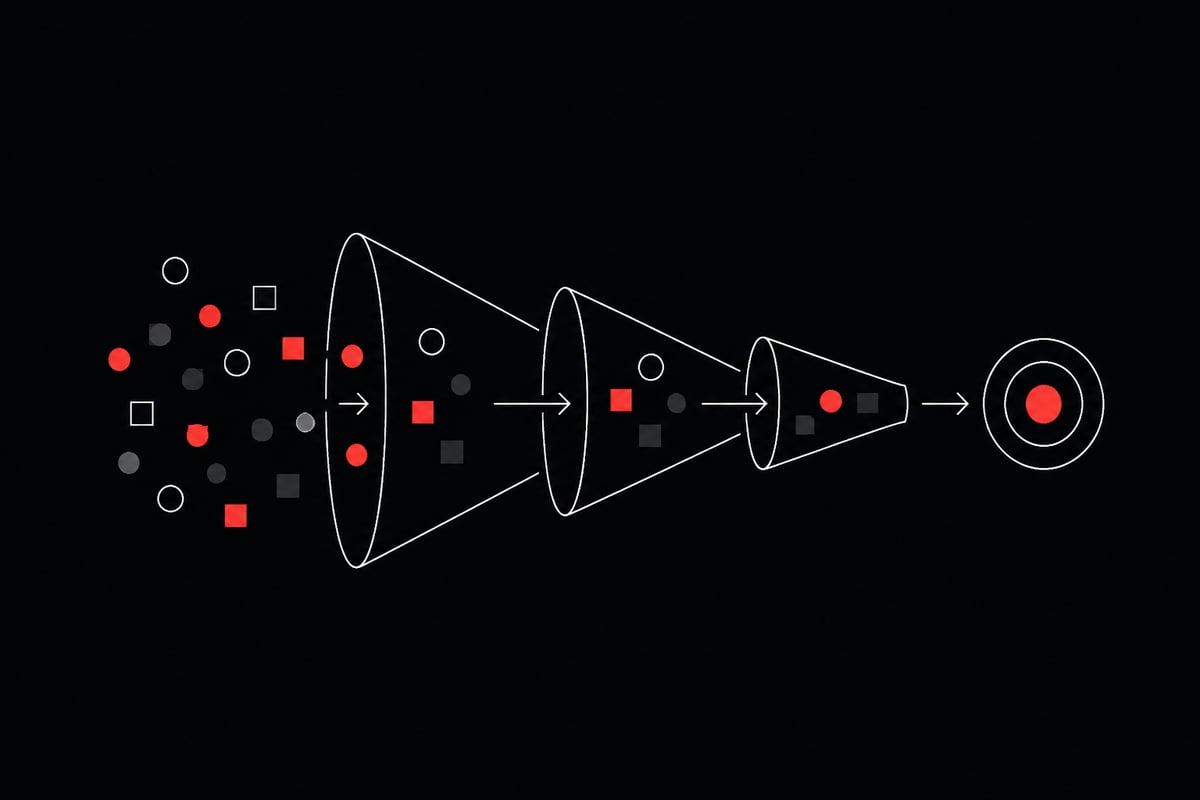
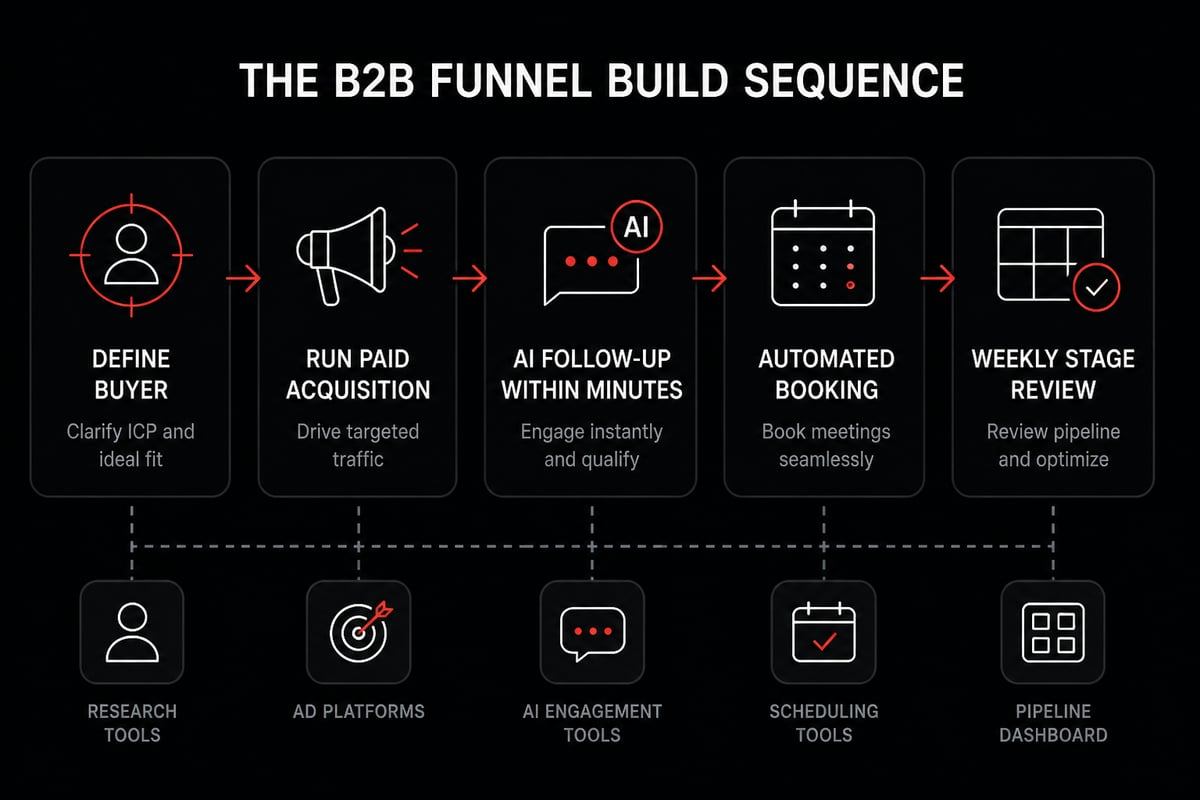
You build a B2B funnel by defining your buyer, choosing one acquisition channel, capturing and qualifying leads automatically, booking meetings without human delay, and then reviewing stage conversion weekly.
Here is a build sequence that works for teams without a large marketing staff.
Step 1: Define the buyer and the offer
Write down the job title, company size, trigger event, and the one problem you solve. A narrow buyer definition lowers wasted spend more than any ad tweak can.
Step 2: Pick a primary acquisition channel
Start with one channel and run it properly. Paid social and paid search give you control over volume and targeting, which matters when you need a predictable number of meetings per month. Spreading thin across six channels produces six weak signals.
Step 3: Build creative from buyer language
Use the exact phrases your buyers use in sales calls, reviews, and support tickets. Test new angles weekly and cut losers fast. Aletto runs ad accounts with a kill-switch discipline: underperforming creative is removed, not monitored for another month.
Step 4: Capture, qualify, and respond in minutes
A lead that waits a day is a lead that has already talked to a competitor. Automate the first response, ask two or three qualifying questions, and offer a booking link in the same exchange. This is where AI follow-up earns its keep, because it responds at 2 a.m. and on weekends without losing tone.
Step 5: Book automatically and protect rep time
Only prospects who meet your criteria should reach the calendar. Reps who walk into well-qualified calls close more and burn out less. Aletto's approach sends only qualified prospects to a rep's calendar so the team arrives ready to close.
Step 6: Review weekly and fix the biggest leak
Pull the stage-by-stage rates every week. Fix the single largest drop first. Do not rebuild the funnel when one stage is the problem.
For a worked example of this sequence in practice, see how one funnel books 172 qualified calls per month.
What Does a Working B2B Funnel Look Like for a SaaS Team?
A working SaaS funnel pairs paid acquisition with instant follow-up and automated booking, so the calendar fills without anyone cold calling or waiting for an event.
Consider a founder-led SaaS company selling workflow software at $12,000 a year. Before the rebuild, the team relied on outbound emails and one conference per quarter. Meetings were inconsistent: some months 20, some months 4. The founder could not forecast revenue.
After moving to a paid-acquisition funnel, the structure looked like this:
- Ads target operations leaders using language pulled from lost-deal notes.
- A short form captures role, team size, and the problem they want solved.
- AI follow-up replies within minutes, answers common questions, and offers booking.
- Qualified prospects land directly on the sales calendar.
- The founder reviews cost per qualified meeting every Monday.
The result is predictability. When you know your cost per meeting and your close rate, you can calculate how much spend produces a target number of customers. That is the real value of a funnel: it turns revenue into an equation you can adjust.
This is the model Aletto runs for clients. Every client uses the same system, with paid acquisition, AI follow-up, and automated booking working as one machine, and you see every dollar of ad spend with no black box. Aletto reports calendars filled for clients across 100+ countries, with attribution verified by Hyros so spend can be traced to outcomes.
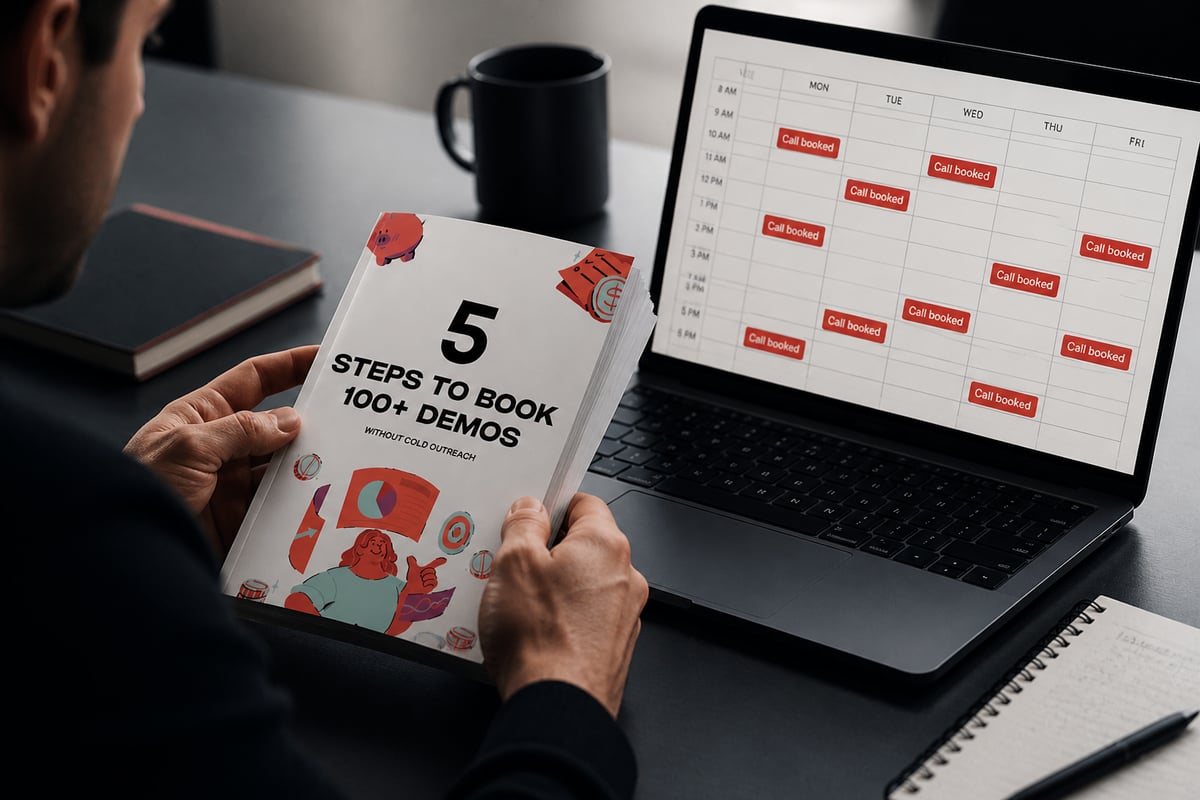
If you want to see the numbers behind a booking system like this, Aletto's Free AI Call Booking Report shows how qualified sales calls were booked without cold emails, cold calls, LinkedIn outreach, or events.
What Doesn't Work in a B2B Funnel?
Four habits reliably break a B2B funnel: chasing lead volume, slow follow-up, vague qualification, and relying on cold outreach as the only engine.
Chasing lead volume. Marketing hits its lead target, sales complains about quality, and both sides lose trust. Set the target in qualified meetings instead.
Slow follow-up. Speed to lead is one of the cheapest improvements available, and most teams ignore it. If your first response takes hours, automate it.
Vague qualification. If any form fill can reach the calendar, reps waste time and stop believing the data. Set clear criteria and enforce them upstream.
Cold outreach as the only engine. Buyers increasingly avoid unsolicited contact, and the Gartner finding on rep-free preferences supports that. Cold email and calling still produce some meetings, but they are hard to scale predictably and they depend on rep hours. Aletto is built for teams that want to move past that dependence, and it is not the right fit for businesses that plan to stay on cold emails or cold calls.
For a longer look at what has stopped working, read Aletto's notes on what actually works in B2B lead generation.
What Are the Types of B2B Funnels?
The common types of B2B funnels are paid-acquisition, content-led, account-based, webinar, and free-trial funnels, and the right choice depends on your deal size and sales motion.
- Paid-acquisition funnel: Ads drive traffic to a form or booking page. Best when you need predictable volume.
- Content-led funnel: Articles and videos build search traffic over time. Slower, but compounding.
- Account-based funnel: Sales and marketing target a short list of named accounts. Suits very high contract values.
- Webinar funnel: A live or recorded session captures leads and pre-sells the product.
- Free-trial funnel: Users experience the product first, then sales follows up on activity.
Most teams that need meetings now should start with paid acquisition and add content as a second layer. The HubSpot conversion funnel overview is a useful reference for how these stages map to the buyer journey.
Frequently Asked Questions
What is a funnel system in marketing?
A funnel system in marketing is a connected set of steps that moves a prospect from first contact to purchase, with measurement at each step. It combines acquisition, lead capture, follow-up, and conversion so that every stage hands off cleanly to the next one.
Is B2B harder than B2C?
Generally yes. B2B involves multiple decision makers, longer cycles, and larger contracts, so more can go wrong before a deal closes. Gartner's 2024 survey found that most B2B buyers called their latest purchase very complex or difficult, which explains why structured follow-up matters.
How risky is B2B sales?
B2B sales carries real risk because deals are large, cycles are long, and revenue can swing month to month. The main way to reduce that risk is to build a predictable pipeline of qualified meetings, so that results do not depend on one big deal or one conference.
What are the four types of B2B?
A common breakdown splits B2B into manufacturers selling to other businesses, wholesalers and distributors, service providers, and software or technology vendors. For the readers of this guide, the relevant types are B2B SaaS and service firms, where meetings are the main conversion event.
Start by pulling your own numbers this week: count your qualified meetings last month and divide your total acquisition spend by that count, because that single figure shows how healthy your B2B funnel really is. If the result is higher than you want, the Free AI Call Booking Report shows how a paid-acquisition and AI follow-up system books qualified calls without cold outreach. Aletto builds and runs that system for B2B SaaS and service teams, and you can start free training to see how it would fit your calendar.