
In today’s digital world, CEOs constantly grapple with the challenge of proving marketing ROI. The landscape is shifting faster than ever, making it tough to connect campaigns to real revenue. For 2026, the answer is clear: successful businesses need end to end marketing to thrive.
This guide is your roadmap to mastering end to end marketing. We’ll break down what it means, why it matters, and how you can build a strategy that delivers measurable growth and keeps you ahead of your competition.
Ready to move beyond guesswork and fragmented tactics? Dive in and discover how a holistic, revenue-focused approach to end to end marketing can transform your results.
Understanding End-to-End Marketing in 2026
In 2026, businesses can no longer afford to treat marketing as a set of isolated tactics. The digital landscape has evolved, demanding a seamless, data-driven approach. End to end marketing is now the gold standard for organizations aiming to maximize ROI and outpace the competition.
Defining End-to-End Marketing
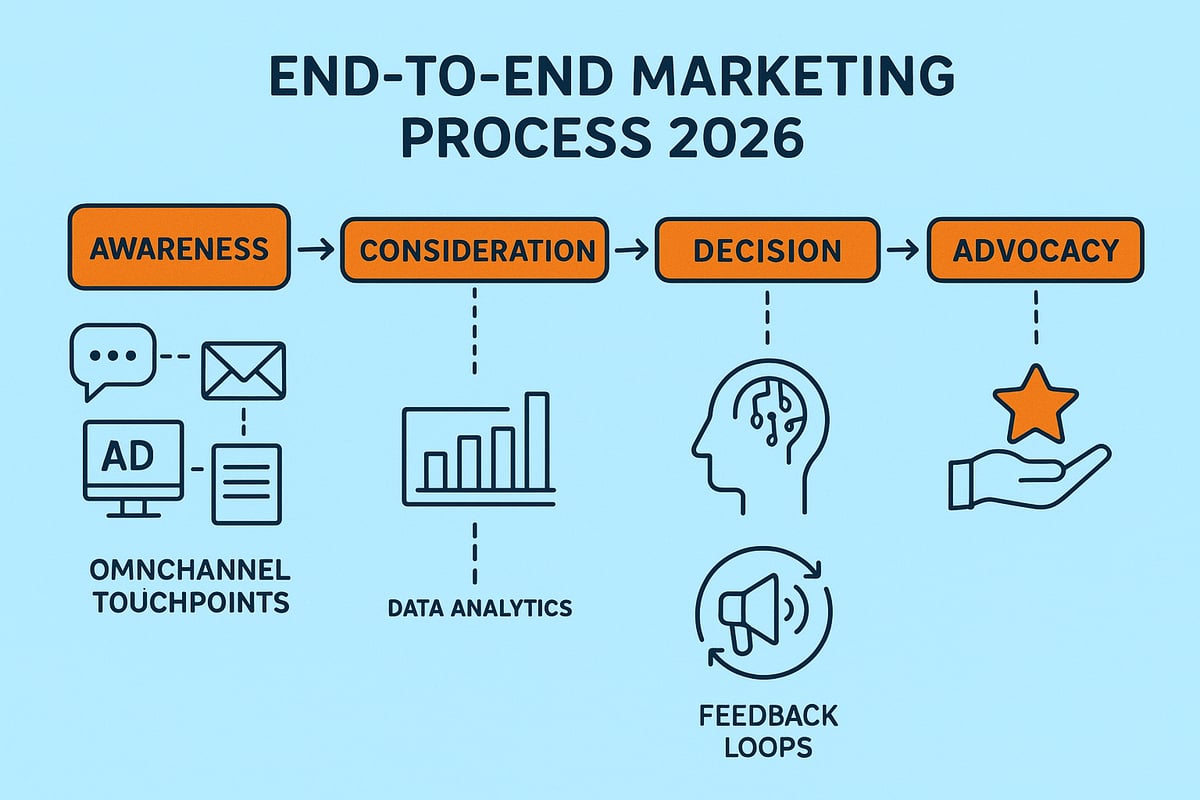
End to end marketing is the practice of managing the complete customer journey, from initial awareness to loyal advocacy. Unlike traditional marketing, which often operates in silos, this approach connects every touchpoint, both online and offline.
The shift to omnichannel engagement, combined with AI-powered personalization, means brands must track and optimize every interaction. Transparency and data-driven decision-making are essential, especially as 64% of CEOs struggle to connect marketing activity to real revenue. According to Full-funnel attribution strategies, companies that master comprehensive tracking see measurable gains.
By embracing end to end marketing, organizations gain a holistic view of performance. This empowers teams to identify what works, eliminate waste, and prove impact at every stage.
Key Components of an End-to-End Strategy
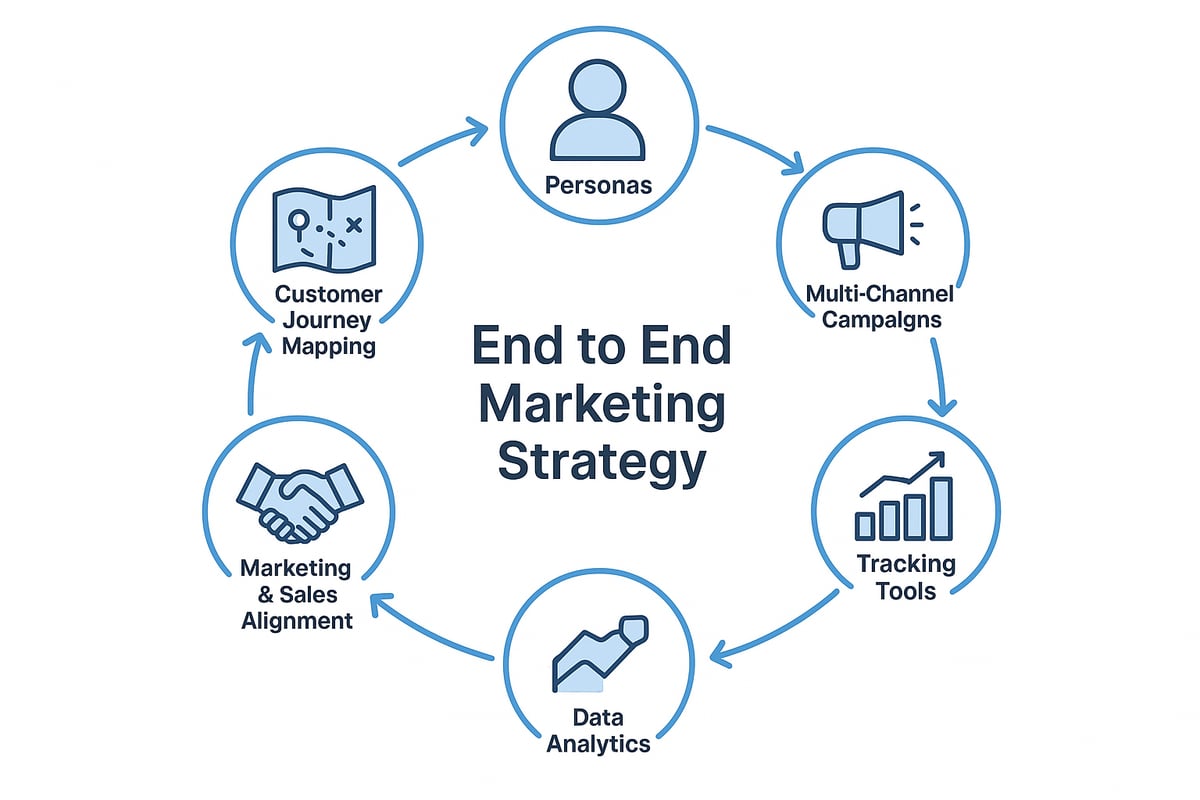
A successful end to end marketing strategy relies on several interconnected elements:
| Component | Description |
|---|---|
| Customer Journey Mapping | Visualize each stage from awareness to advocacy |
| Persona Development | Define target audiences and their motivations |
| Integrated Multi-Channel Campaigns | Coordinate messaging across all platforms |
| Real-Time Analytics | Collect data and insights at every interaction |
| Automated Lead Nurturing | Guide prospects with timely, relevant content |
| Sales-Marketing Alignment | Ensure seamless handoffs and shared KPIs |
| Continuous Feedback Loops | Optimize based on customer and performance data |
When these components are aligned, end to end marketing delivers a unified experience that maximizes engagement and conversion.
Why End-to-End Marketing Matters in 2026
Buyer journeys are more complex than ever, especially in B2B and SaaS sectors. Customers expect personalized, relevant experiences at every stage.
End to end marketing enables organizations to meet these demands. It provides the tools to demonstrate ROI, satisfy C-suite scrutiny, and adapt to shifting market dynamics. For example, industry leaders using full-funnel strategies have seen 38% more leads.
AI and automation now play a pivotal role. They help scale engagement, predict customer needs, and optimize campaigns in real time. As a result, end to end marketing has become mission-critical for growth.
Common Misconceptions and Pitfalls
Despite its benefits, several myths surround end to end marketing:
- It is only for large enterprises.
- Aggregate data is enough, so individual insights can be ignored.
- A collection of fragmented tools counts as a complete system.
- Post-purchase and retention stages are not important.
- Ongoing optimization is optional.
Avoiding these pitfalls is essential. End to end marketing works for businesses of all sizes, provided there is a commitment to ongoing improvement and a focus on the entire customer lifecycle.
Challenges Solved by End-to-End Marketing
In today's hyper-competitive landscape, businesses face mounting pressure to prove marketing's impact on revenue, unify scattered data, and guide buyers through increasingly complex journeys. End to end marketing directly addresses these pain points, transforming fragmented efforts into streamlined, revenue-focused strategies that drive real growth.
Bridging the Gap Between Marketing and Revenue
For years, the disconnect between marketing activity and actual sales outcomes has frustrated both marketers and executives. Traditional methods often stop at lead generation, leaving revenue attribution murky.
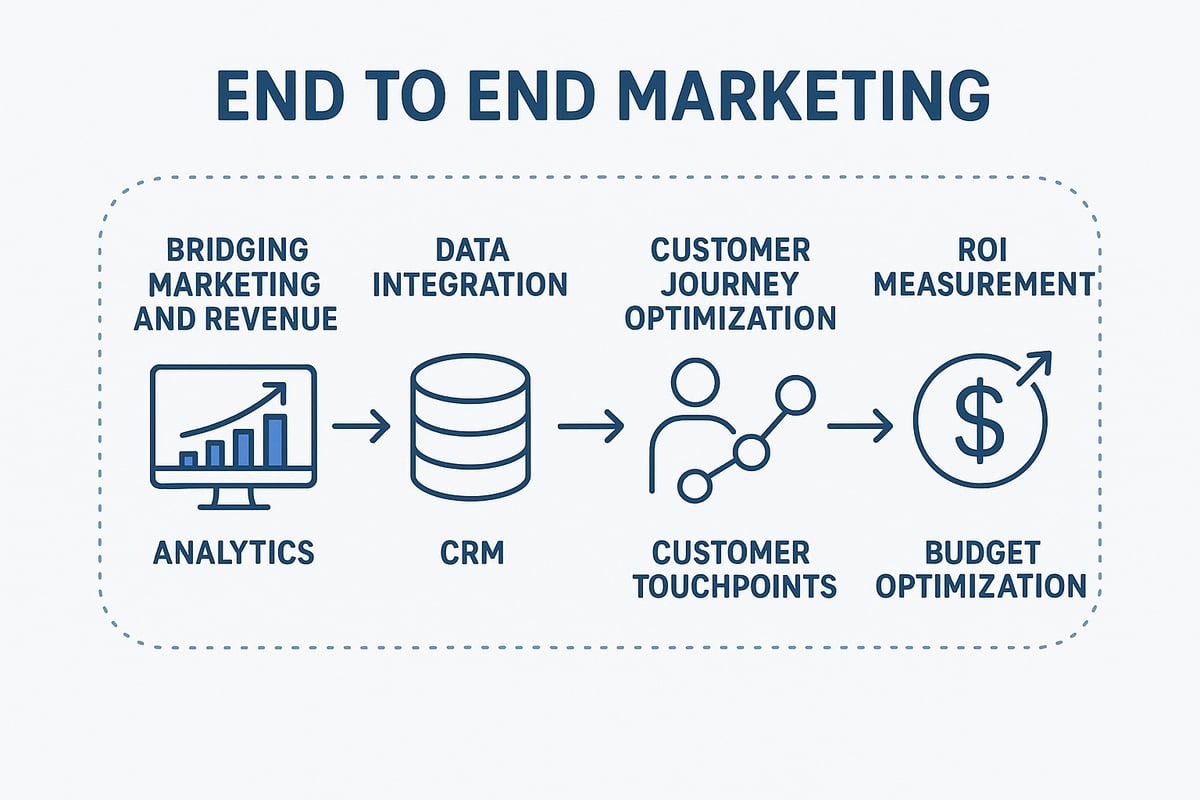
End to end marketing creates a closed-loop system, tracking every interaction from the first ad impression to the final sale. This approach ensures that marketing teams can clearly demonstrate how their efforts influence pipeline and revenue.
Teams using end to end marketing tie campaigns directly to closed deals and can confidently report on revenue impact, making marketing an accountable growth driver.
Overcoming Data Silos and Weak Tracking
Data silos are a top barrier to effective marketing. Information often lives separately in CRMs, analytics platforms, and ad systems, making it hard to see the full picture.
End to end marketing solves this by integrating data across all platforms, creating a single source of truth. With unified tracking frameworks, marketers can analyze the customer journey holistically, not just in pieces.
This is especially vital for B2B companies with long sales cycles, where multi-touch attribution is needed to understand which efforts actually move prospects forward. Breaking down silos allows for actionable insights and smarter decisions.
Navigating Long, Complex Customer Journeys
Modern buyer journeys are rarely linear. Multiple stakeholders, channels, and touchpoints create complexity and increase the risk of losing prospects along the way.
End to end marketing enables teams to map every stage of the journey, identify friction points, and address drop-offs before they impact results. By tracking engagement signals and behavior, marketers can spot disengagement early and take corrective action.
This proactive approach reduces churn and ensures that each prospect receives relevant, timely interactions throughout their path to purchase.
Proving Marketing Value and Optimizing Spend
Justifying marketing budgets is challenging without clear proof of ROI. End to end marketing empowers organizations to allocate resources based on real performance, not guesswork.
Through robust attribution models and full-funnel visibility, teams can pinpoint which channels and tactics deliver the best results. As highlighted in Optimizing your sales funnel, companies adopting end to end marketing often see significant improvements in efficiency and return on investment.
With these insights, marketing leaders can confidently optimize spend, double down on high-impact activities, and drive sustainable business growth.
Step-by-Step Guide to Building an End-to-End Marketing Strategy
Building a winning end to end marketing strategy in 2026 means following a clear, actionable process. Each step empowers your business to break down silos, drive personalized engagement, and deliver measurable growth. Let’s walk through the exact blueprint top-performing teams use to outpace their competition.
Step 1: Develop Detailed Buyer Personas
Start by researching and analyzing your ideal customers. Go beyond basic demographics, and uncover pain points, motivations, behaviors, and decision drivers. This foundational step in end to end marketing ensures every touchpoint resonates with your audience.
Gather data from surveys, interviews, CRM records, and social media. Identify key traits and segment your personas by job title, industry, goals, and challenges.
For example, Salespanel’s persona-driven campaigns have shown higher conversion rates because their messaging speaks directly to each buyer’s needs. Well-crafted personas lead to sharper targeting, increased engagement, and ultimately, better ROI.
Step 2: Map the Entire Customer Journey
Next, visualize every interaction a prospect has with your brand, from the first touch to loyal advocacy. Mapping the customer journey is essential in end to end marketing, as it uncovers every stage and highlights where prospects advance or drop off.
List out each phase:
- Awareness
- Consideration
- Decision
- Retention
- Advocacy
Include both online and offline touchpoints, such as events, meetings, and digital interactions. For B2B, journey maps often involve multiple stakeholders and longer cycles. By documenting these paths, you can spot friction points, personalize outreach, and optimize the journey for every persona.
Step 3: Implement Multi-Touchpoint Campaigns
Integrate your channels to deliver a consistent, personalized experience. End to end marketing thrives when social, email, content, search, paid ads, and events all work together. Use automation to time and tailor messages across platforms.
Here’s a quick checklist:
- Sync messaging across channels
- Use automation for drip campaigns
- Retarget based on user behavior
- Analyze engagement per touchpoint
For practical tips on executing this, check out these multi-channel campaign integration tips. Coordinated campaigns increase engagement, boost conversion rates, and move leads smoothly through your funnel.
Step 4: Establish Robust Tracking and Attribution Frameworks
Tracking every action is crucial for end to end marketing success. Deploy tools like CRM systems, analytics platforms, and attribution software to capture data at each stage. Set up UTM parameters, conversion tracking, and automated lead scoring for precise measurement.
Key tracking components:
- Cross-channel analytics
- Cross-device tracking
- Multi-touch attribution
- Real-time reporting
For instance, Salespanel’s attribution features help teams see exactly which channels and content drive conversions. With these insights, you can prove ROI, optimize spend, and make smarter decisions.
Step 5: Leverage Data for Personalization and Optimization
Analyze the wealth of data collected from every touchpoint. End to end marketing allows you to use AI and machine learning to segment audiences, predict intent, and personalize experiences in real time.
Optimization tactics:
- Dynamic content based on user behavior
- Automated recommendations
- Real-time campaign adjustments
- Personalized offers and follow-ups
By continuously refining your messaging and creative, you boost engagement and conversions. Data-driven personalization helps you stay relevant and competitive in 2026’s crowded digital landscape.
Step 6: Align Marketing and Sales Teams
Siloed teams miss opportunities. In end to end marketing, alignment between marketing and sales is vital for seamless lead handoffs and consistent messaging. Start by defining shared KPIs and goals to ensure everyone is working toward the same targets.
Alignment checklist:
- Agree on lead definitions and scoring
- Automate lead routing and notifications
- Hold regular feedback sessions
- Share pipeline data and insights
When teams collaborate, prospects enjoy a smoother journey, and your business benefits from higher conversion rates and revenue growth.
Step 7: Continuously Refine and Iterate
The final piece of end to end marketing is relentless improvement. Regularly review campaign performance, customer feedback, and conversion data to uncover what works and what needs adjustment.
Continuous improvement steps:
- Run A/B tests on messaging and creative
- Experiment with new channels or tactics
- Analyze drop-off points and bottlenecks
- Implement feedback from sales and customers
Fostering a culture of testing and learning keeps your strategy agile and effective. The brands that iterate quickly are the ones that lead their markets and sustain long-term growth.
Leveraging Technology and Tools for End-to-End Marketing Success
Staying ahead in end to end marketing means harnessing the right technologies and tools. As the digital landscape evolves, the right stack can turn your marketing engine into a growth powerhouse. Let’s break down the must-have solutions, how to integrate them, and the best ways to choose your toolkit for 2026.
Essential Technologies for 2026
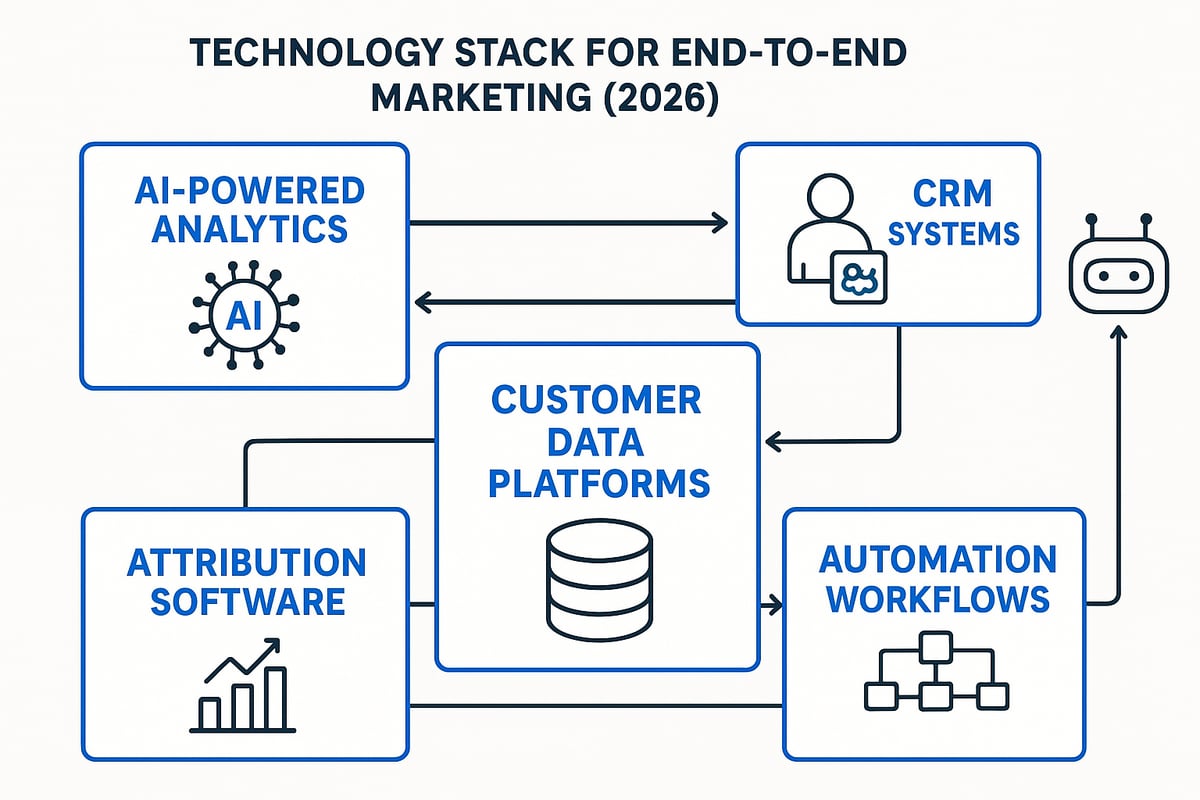
The backbone of end to end marketing in 2026 is a robust, interconnected tech stack. Leading businesses deploy AI-driven analytics to uncover actionable insights and automate campaigns with precision. CRM platforms now offer advanced segmentation, workflow automation, and real-time updates, making every customer touchpoint trackable.
Customer data platforms (CDPs) unify data from every source, creating a single view of the customer for personalized engagement. Modern attribution and conversion tracking tools reveal which channels actually drive results. Chatbots and conversational AI deliver instant, tailored responses to prospects 24/7. For a deeper dive into how AI is reshaping strategies and tools, check out AI’s impact on marketing strategies.
Integrating Data Across Platforms
The true power of end to end marketing emerges when platforms and data streams are fully integrated. Seamless APIs and data connectors break down silos, ensuring marketers have a unified view of every customer interaction. Imagine combining website analytics, CRM records, and ad data for a holistic perspective.
This integration makes it easier to spot trends, personalize campaigns, and attribute revenue accurately. A single customer view means no touchpoint is missed, and every engagement is measured. Industry data shows that 80 percent of top marketers rely on integrated tech stacks to fuel their success. Building this foundation is non-negotiable for any brand committed to end to end marketing.
Automation for Lead Nurturing and Qualification
Automation is revolutionizing lead nurturing and qualification for end to end marketing. AI-powered nurture engines deliver targeted email sequences, retargeting ads, and dynamic content based on real-time behavior. Chatbots engage prospects instantly, answer questions, and qualify leads before sending them to sales.
Workflow automation eliminates manual tasks, reducing response times and increasing productivity. Companies leveraging these tools see significant improvements, such as a 34 percent reduction in customer acquisition costs. Automation ensures every lead is followed up, every opportunity is maximized, and your end to end marketing strategy runs smoothly.
Choosing the Right Toolset for Your Business
Selecting the perfect stack for end to end marketing starts with understanding your business’s size, complexity, and growth goals. Look for scalable solutions that offer robust integration, analytics, and support. Prioritize platforms that seamlessly connect with your existing systems to avoid data fragmentation.
Evaluate tools based on ease of use and flexibility, not just flashy features. Review real-world case studies to see which solutions deliver a proven return on investment—leaders using advanced tech have reported up to 10x ROI. The right toolkit empowers your team to execute, measure, and optimize every stage of the customer journey.
Measuring, Analyzing, and Optimizing Your End-to-End Marketing Performance
In the world of end to end marketing, success depends on your ability to measure, analyze, and optimize every step of the customer journey. Without clear metrics and ongoing analysis, even the most creative campaigns can miss the mark. This section breaks down the essentials, so you can drive results that actually move the needle.
Setting KPIs and Defining Success Metrics
For end to end marketing, it’s crucial to set KPIs that align with your business goals. Start by identifying the metrics that matter most:
- Lead quality and conversion rates
- Customer acquisition cost (CAC)
- Customer lifetime value (CLV)
- Retention and churn rates
Align these KPIs with revenue targets, not just vanity metrics. For example, track how leads progress from first touch to closed deal. Use competitor benchmarks to set realistic expectations. According to recent reports, companies seeing strong ROI from generative AI have redefined their KPIs based on Generative AI adoption in marketing. This data-driven approach is key for end to end marketing in 2026.
Attribution Models and Multi-Touch Analysis
Understanding which channels and campaigns drive results is the backbone of end to end marketing. Attribution models help assign value to each touchpoint:
- First touch: credits the initial interaction
- Last touch: values the final conversion point
- Multi-touch: distributes credit across the journey
- Data-driven: uses algorithmic weighting
Multi-touch models provide a holistic view, revealing the real impact of early-stage campaigns. Industry data shows that using multi-touch attribution boosts budget efficiency by over 20 percent. By capturing the full journey, end to end marketing teams can justify spend and optimize resource allocation.
Continuous Optimization Through Data Insights
Continuous improvement is at the heart of end to end marketing. Regularly analyze performance across all channels and funnel stages. Look for bottlenecks, drop-off points, and areas for improvement.
Use A/B testing and real-time analytics to refine messaging, creative, and channel mix. AI-powered tools help surface trends and predict what your audience wants next. Businesses that embrace this approach are constantly adapting, staying ahead of competitors, and maximizing ROI.
To keep your strategy agile, focus on rapid iteration and feedback loops. This ensures your end to end marketing efforts stay aligned with evolving customer needs.
Case Studies and Real-World Results
Let’s look at what happens when end to end marketing is executed well. A B2B SaaS company used advanced tracking and automation to increase qualified demos by 37 percent. They tracked lead volume, conversion rates, and CAC before and after implementation.
These results echo findings from End-to-end reinvention with GenAI, where businesses leveraging AI and holistic strategies transformed their marketing performance. The takeaway? With the right data and tools, end to end marketing delivers measurable growth and real-world impact.
Future Trends and Innovations in End-to-End Marketing
Staying ahead in end to end marketing means understanding the forces shaping tomorrow’s strategies. As technology advances and customer expectations shift, marketers must adapt quickly or risk falling behind. Let’s explore the most influential trends set to redefine end to end marketing in the coming years.
AI and Predictive Analytics
Artificial intelligence is rapidly transforming end to end marketing. AI now powers everything from hyper-personalized content to real-time campaign optimization. Predictive analytics helps teams score leads, forecast demand, and segment audiences with pinpoint accuracy.
Chatbots and virtual assistants handle customer queries instantly, nurturing prospects around the clock. Imagine AI systems that not only identify intent but also resolve objections and move leads down the funnel automatically. According to AI-powered marketing innovations, the coming years will see AI take over even more sophisticated marketing tasks.
With end to end marketing, businesses can harness these tools to deliver truly individualized experiences and maximize ROI.
Omnichannel and Cross-Device Experiences
Today’s buyers expect a seamless journey across every touchpoint. End to end marketing in 2026 means unifying online and offline channels, from social media to in-person events and phone calls. Consistent messaging, branding, and offers are now essential across devices and platforms.
Brands using unified messaging have seen major boosts in customer retention and advocacy. For example, integrating web, email, and mobile ensures that every interaction feels personalized and relevant. Industry data shows that 90 percent of customers demand this level of consistent experience.
By prioritizing omnichannel strategies, marketers can increase engagement and build deeper loyalty.
Data Privacy and Compliance
As regulations evolve, data privacy is now front and center in end to end marketing. Companies must comply with frameworks like GDPR and CCPA, making transparency and trust critical. Customers want to know how their data is used and expect brands to honor their preferences.
Marketing teams are adopting privacy-first tools and consent management systems to ensure compliance. Those who embrace these changes not only avoid penalties but also see higher engagement rates. For example, businesses with transparent data practices foster stronger, long-term relationships.
Prioritizing privacy in end to end marketing builds credibility and sets the stage for sustainable growth.
The Evolving Role of Marketing Teams
The structure of marketing teams is changing fast. End to end marketing demands cross-functional collaboration between marketing, sales, product, and customer success. Siloed roles are giving way to integrated, data-driven teams.
Upskilling is essential, with marketers learning analytics, automation, and AI to stay competitive. Collaboration tools and shared KPIs help teams align efforts and drive results. Organizations investing in these changes are future-proofing their growth and innovation.
In the era of end to end marketing, adaptability and teamwork are the keys to outperforming competitors.
Now that you’ve seen how end to end marketing can transform your business in 2026, why not take the next step and put these strategies into action? If you’re serious about driving real, measurable growth—turning cold leads into loyal customers and finally connecting your marketing to revenue—it pays to get expert guidance tailored to your unique goals. Let’s make your marketing work harder and smarter for you. I invite you to Book a FREE Strategy Call with Adstra’s team and discover how AI driven systems and a transparent growth partnership can fuel your success.