


The landscape of marketing sales leads has transformed dramatically in 2026. Gone are the days when businesses could rely solely on cold outreach, purchased lists, or generic ad campaigns to drive revenue. Today's successful companies understand that marketing sales leads requires a sophisticated blend of AI automation, data-driven insights, and personalized engagement strategies that transform casual prospects into ready-to-buy customers. The businesses winning in this new era are those that view lead marketing not as a volume game, but as a precision science where quality, timing, and relevance determine success.
The Evolution of Marketing Sales Leads in 2026
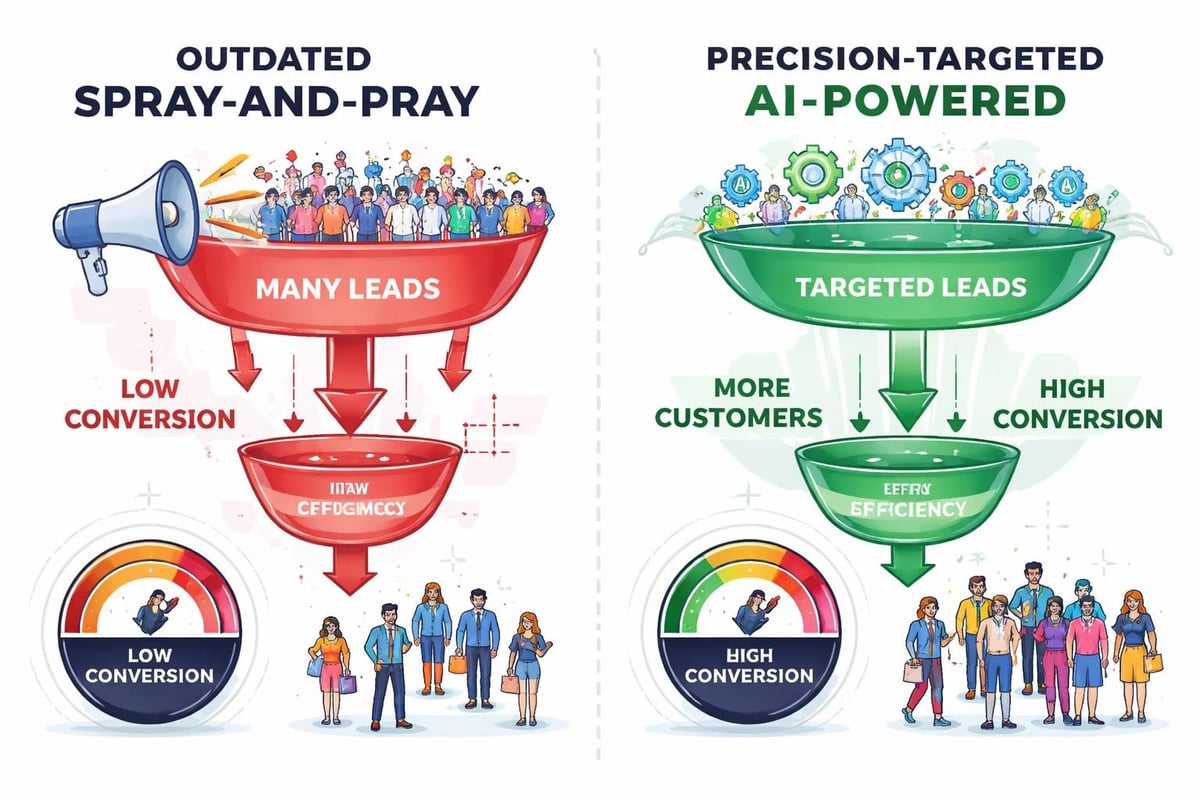
The traditional approach to marketing sales leads has become obsolete. Companies that continue relying on spray-and-pray tactics are hemorrhaging marketing budgets while watching conversion rates plummet. The statistics paint a clear picture: 61% of marketers cite lead generation as their biggest challenge, yet those who adopt modern methodologies are seeing unprecedented returns.
What's changed? Consumer behavior has evolved faster than most marketing departments can adapt. Your prospects are inundated with over 10,000 marketing messages daily, making it exponentially harder to capture attention through conventional means. This reality demands a fundamental shift in how we approach marketing sales leads.
Why Traditional Lead Marketing Methods Are Failing
The old playbook looked something like this: cast the widest possible net, collect as many contacts as possible, and push them through a generic funnel. This approach has three fatal flaws in 2026.
First, quality has definitively beaten quantity. Modern buyers can smell generic outreach from miles away. When you're marketing sales leads without personalization, you're essentially shouting into a void. Your prospects have learned to tune out anything that doesn't speak directly to their specific pain points and circumstances.
Second, the sales cycle has become significantly more complex. B2B buyers now involve an average of 6-10 stakeholders in purchasing decisions, each with their own priorities and concerns. Marketing sales leads effectively means addressing multiple decision-makers with tailored messaging at precisely the right moments.
Third, privacy regulations and data protection laws have fundamentally altered the playing field. GDPR, CCPA, and similar regulations have made it both legally risky and ethically questionable to pursue many traditional lead generation tactics. Best practices now emphasize ethical data collection and explicit consent, forcing a complete rethink of lead acquisition strategies.
Building a Modern System for Marketing Sales Leads
Success in marketing sales leads today requires a systematic approach that combines technology, psychology, and strategic thinking. Let's break down the essential components of a high-performing lead marketing system.
Strategic Lead Generation Channels
Not all lead sources are created equal. Your marketing sales leads strategy should prioritize channels that deliver prospects who are already problem-aware and solution-seeking.
| Channel Type | Average Conversion Rate | Cost Per Lead | Quality Score |
|---|---|---|---|
| AI-Powered Targeting | 18-25% | $85-150 | High |
| Content Marketing | 12-18% | $45-90 | High |
| Paid Social Media | 8-12% | $30-80 | Medium |
| Cold Email Outreach | 2-5% | $15-40 | Low |
| Purchased Lists | 0.5-2% | $5-20 | Very Low |
The data clearly shows that effective lead generation strategies require moving beyond volume-based approaches. Instead, focus on channels that allow for precise targeting and meaningful engagement.
Content-driven lead generation remains one of the most powerful tools for marketing sales leads in 2026. When you create valuable resources that solve specific problems for your ideal customers, you're not just generating leads-you're pre-qualifying them. Someone who downloads your comprehensive guide or attends your educational webinar has already demonstrated interest and engagement.
AI-powered targeting systems have revolutionized how we identify and reach potential customers. By analyzing thousands of data points across behavioral patterns, firmographic information, and intent signals, modern AI systems can predict which prospects are most likely to convert with remarkable accuracy. This is exactly how lead generation with AI is transforming the industry.
The Lead Qualification Framework That Actually Works
Marketing sales leads without proper qualification is like fishing with a net full of holes-you might catch something, but you're losing most of your potential value. A robust qualification framework separates tire-kickers from genuine opportunities.
The modern qualification process operates on three levels:
- Fit Qualification: Does this prospect match your ideal customer profile?
- Interest Qualification: Has the prospect demonstrated genuine interest in solving their problem?
- Timing Qualification: Is the prospect ready to make a decision in the near term?
Understanding qualified leads means recognizing that not every contact deserves equal attention. In fact, 67% of lost sales result from inadequate lead qualification. This staggering statistic underscores why proper qualification isn't optional-it's essential.
Lead Scoring: Prioritizing Your Marketing Efforts
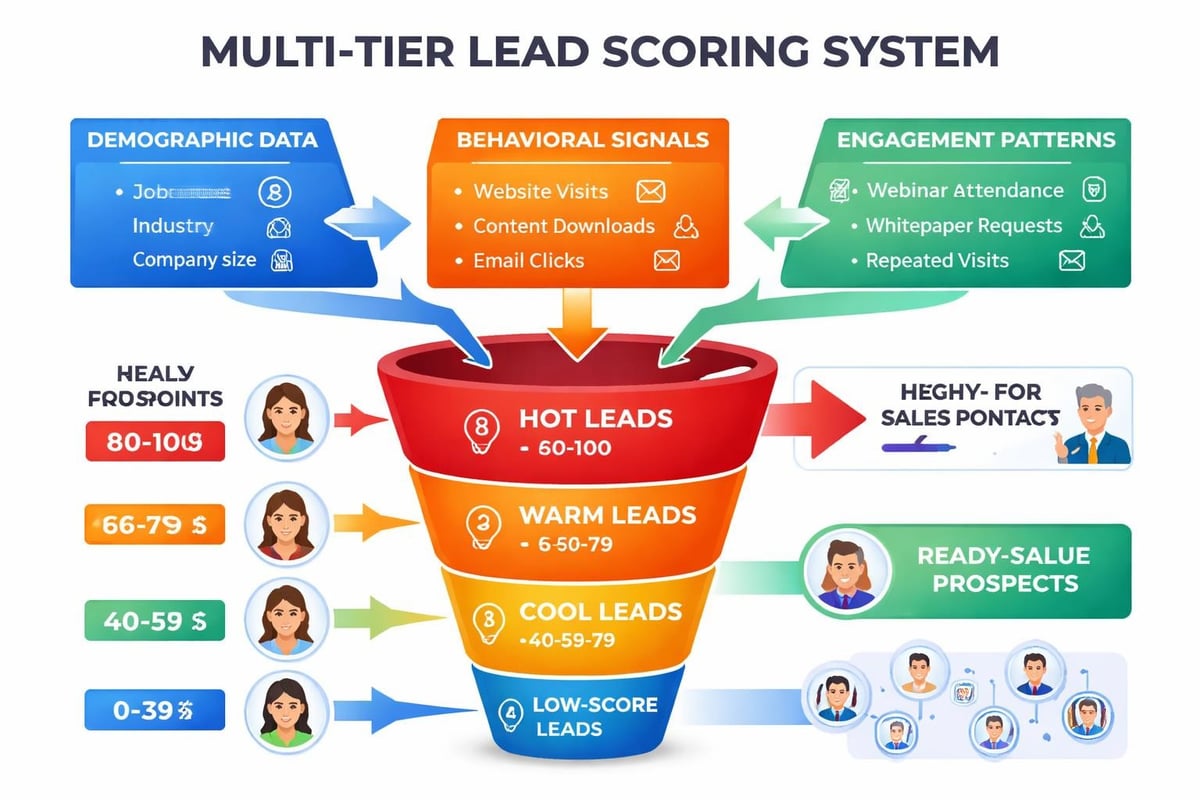
Lead scoring assigns numerical values to prospects based on their characteristics and behaviors. This allows you to focus your marketing and sales resources on the leads most likely to convert.
Demographic scoring factors include:
- Company size and revenue
- Industry and market segment
- Job title and decision-making authority
- Geographic location
Behavioral scoring factors include:
- Website pages visited and time spent
- Content downloaded and consumed
- Email engagement rates
- Social media interactions
Implementing effective lead scoring models requires alignment between marketing and sales teams on what constitutes a quality lead. Without this alignment, you'll waste resources marketing sales leads that your sales team can't or won't close.
Nurturing Strategies That Convert Marketing Sales Leads
Generating leads is only the beginning. The real magic happens in the nurturing phase, where you transform curious prospects into convinced buyers. Most businesses fail at this critical stage because they either move too fast or give up too soon.
The Psychology of Lead Nurturing
Effective nurturing recognizes that buying decisions are emotional, not logical. Your prospects aren't looking for more features or specifications-they're looking for confidence that you understand their challenges and can solve them.
The nurturing sequence should follow this psychological progression:
- Awareness: Help prospects recognize they have a problem
- Consideration: Present your solution as the optimal path forward
- Evaluation: Provide proof through case studies and testimonials
- Decision: Remove final objections and create urgency
Each stage requires different content types and engagement strategies. A prospect in the awareness stage needs educational content, not sales pitches. Someone in the decision stage needs concrete proof points and compelling offers.
Automation That Feels Personal
The paradox of modern marketing sales leads is that automation has become essential, yet personalization is more important than ever. The solution? Intelligent automation that leverages data to create genuinely personalized experiences at scale.
Your automated nurturing sequences should:
- Segment leads by industry, company size, and specific pain points
- Deliver content that addresses their unique situation
- Adjust timing and frequency based on engagement patterns
- Trigger human follow-up when leads show high-intent signals
Effective lead management combines the efficiency of automation with the authenticity of human connection. The best systems know when to automate and when to insert personal touchpoints.
Aligning Sales and Marketing for Maximum Impact
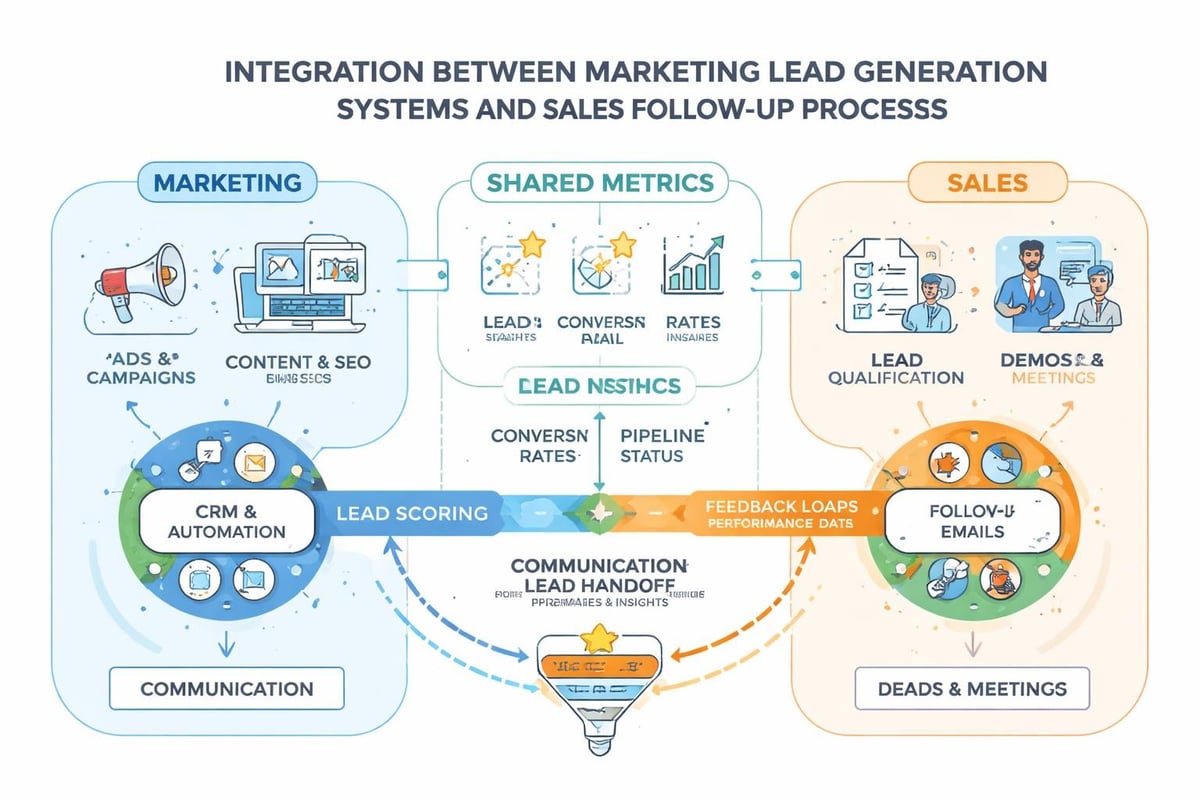
The traditional divide between marketing and sales teams has sabotaged countless lead generation efforts. Marketing generates leads, tosses them over the wall to sales, and then blames sales when conversion rates disappoint. Meanwhile, sales complains about lead quality and ignores half the prospects marketing delivers.
This dysfunction must end. In 2026, the most successful companies have aligned their sales and marketing teams around shared definitions, metrics, and goals.
Creating a Service Level Agreement (SLA)
A marketing-sales SLA establishes clear expectations for both teams:
Marketing commits to:
- Deliver a specific quantity of qualified leads monthly
- Maintain minimum lead quality standards
- Provide complete lead intelligence and context
- Track and report on lead source performance
Sales commits to:
- Contact qualified leads within defined timeframes
- Follow prescribed nurturing sequences
- Provide feedback on lead quality
- Update CRM records with outcome data
This mutual accountability transforms marketing sales leads from a blame game into a collaborative growth engine.
The Feedback Loop That Drives Improvement
Your sales team interacts with leads at the point of highest intent. They hear objections, understand pain points, and discover what actually motivates buying decisions. This intelligence is gold for refining your marketing approach.
Establish regular feedback sessions where sales shares insights on:
- Common objections and concerns
- Messaging that resonates versus messaging that falls flat
- Lead quality by source and campaign
- Competitive dynamics in the market
Use this information to continuously optimize your marketing sales leads strategy. The companies that iterate fastest win.
Measuring What Matters in Lead Marketing
You can't improve what you don't measure. Yet many businesses track vanity metrics that tell them nothing about actual business impact. The key is focusing on metrics that directly correlate with revenue growth.
Essential Marketing Sales Leads Metrics
| Metric | Why It Matters | Target Benchmark |
|---|---|---|
| Cost Per Qualified Lead | Determines campaign profitability | Varies by industry, typically $85-200 for B2B |
| Lead-to-Opportunity Rate | Measures qualification effectiveness | 13-25% for well-qualified leads |
| Opportunity-to-Customer Rate | Indicates sales process efficiency | 20-30% for B2B |
| Time to Conversion | Shows sales cycle length | Industry dependent, 30-90 days typical |
| Customer Acquisition Cost | Total cost to acquire new customer | Should be 1/3 or less of LTV |
| Lead Source ROI | Identifies most profitable channels | Minimum 3:1 return |
These metrics create a complete picture of your marketing sales leads performance. Track them consistently and you'll quickly identify which strategies drive growth and which drain resources.
Attribution: Understanding the True Lead Journey
Modern buyers rarely convert on their first interaction. They might discover you through a social media post, visit your website three times, download a resource, attend a webinar, and then finally book a meeting. Which touchpoint deserves credit?
Attribution models to consider:
- First-touch: Credits the initial interaction
- Last-touch: Credits the final conversion point
- Multi-touch: Distributes credit across all interactions
- Time-decay: Weights recent interactions more heavily
Most sophisticated marketers use multi-touch attribution to understand the complete journey. This reveals which channels work best at different stages and helps optimize your entire funnel.
Advanced Strategies for 2026 and Beyond
The basics of marketing sales leads remain important, but cutting-edge strategies separate market leaders from everyone else. Here's what's working at the highest levels right now.
Account-Based Marketing at Scale
ABM has traditionally been resource-intensive, limiting it to targeting only the largest accounts. AI-powered tools have changed this equation, making it possible to deliver personalized experiences to hundreds or thousands of target accounts simultaneously.
The ABM approach to marketing sales leads flips traditional funnel logic:
- Identify ideal target accounts first
- Research key stakeholders and decision-makers
- Create customized content and messaging
- Orchestrate multi-channel campaigns
- Engage accounts with coordinated sales outreach
This precision approach delivers dramatically higher conversion rates because you're investing maximum resources in prospects with the highest potential value.
Conversational Marketing and Real-Time Engagement
Static forms and delayed follow-up kill momentum. When a prospect is hot, you have minutes-not hours or days-to capitalize on their interest.
Conversational marketing uses:
- AI chatbots that qualify leads through natural dialogue
- Live chat that connects high-intent prospects with sales immediately
- Video messaging that adds personality to automated communications
- SMS campaigns that reach prospects on their most-used device
The goal is meeting prospects in their moment of interest, not forcing them to wait for your convenience. B2B corporate lead generation increasingly relies on these real-time engagement strategies.
Predictive Analytics and Intent Data
Why wait for prospects to raise their hands when you can identify them before they even know they need you? Predictive analytics analyzes thousands of signals to identify companies showing buying intent.
Intent data sources include:
- Content consumption patterns across the web
- Technology stack changes and additions
- Hiring trends and job postings
- Social media discussions and engagement
- Website visitor behavior and research patterns
By identifying companies actively researching solutions like yours, you can prioritize outreach to prospects already in buying mode. This transforms marketing sales leads from interruption to invitation.
Creating Urgency Without Manipulation
The final piece of effective lead marketing is converting interested prospects into committed customers. This requires creating genuine urgency while maintaining trust and transparency.
Legitimate urgency drivers include:
- Limited-time offers with real deadlines
- Seasonal business needs and timing pressures
- Competitive threats and market changes
- Regulatory requirements and compliance deadlines
What doesn't work? Fake scarcity, manufactured deadlines that get extended, and high-pressure tactics that damage relationships. Modern buyers see through manipulation instantly.
Instead, focus on helping prospects understand the cost of inaction. What are they losing by waiting? How does delay impact their business outcomes? When you frame urgency around their success rather than your commission, you build trust while accelerating decisions.
The Power of Social Proof
Nothing converts marketing sales leads like proof that you've successfully solved similar problems for similar companies. Case studies, testimonials, and specific results create the confidence prospects need to move forward.
Your social proof should:
- Feature companies similar to your prospect
- Include specific, quantifiable results
- Tell a compelling transformation story
- Address common objections proactively
The more your prospect can see themselves in your success stories, the easier their decision becomes. This is why understanding how to get new customers requires developing a library of diverse proof points.
Technology Stack for Modern Lead Marketing
Your technology choices directly impact your ability to execute sophisticated marketing sales leads strategies. The right stack multiplies your team's effectiveness; the wrong one creates friction and inefficiency.
Essential Tools and Platforms
CRM System: The foundation of all lead marketing efforts. Must integrate seamlessly with other tools and provide complete visibility into lead status and history.
Marketing Automation Platform: Enables sophisticated nurturing sequences, segmentation, and personalization at scale. Look for platforms with strong AI capabilities.
Analytics and Attribution Tools: Provide visibility into what's working and where to invest resources. Should track the complete customer journey across channels.
Conversational Marketing Tools: Enable real-time engagement and qualification. AI chatbots, live chat, and video messaging platforms fall into this category.
Intent Data Providers: Identify prospects actively researching solutions in your category, allowing proactive outreach at optimal timing.
The key is integration. Disconnected tools create data silos and blind spots. Your ideal stack should function as a unified system where data flows seamlessly between platforms.
The ROI of Getting Your Stack Right
Statistics show that companies with aligned technology and processes see 36% higher customer retention and 38% higher sales win rates. The investment in proper tools pays for itself many times over through improved efficiency and conversion rates.
When evaluating platforms, prioritize those that offer:
- Native integrations with your existing systems
- Robust API capabilities for custom connections
- AI-powered features that improve over time
- Transparent pricing with clear ROI potential
- Excellent customer support and training resources
Marketing sales leads in 2026 demands strategic precision, technological sophistication, and relentless focus on quality over quantity. The businesses that master this discipline don't just generate more leads-they transform their entire growth trajectory by converting the right prospects at the right time with the right message. If you're ready to revolutionize how you generate and convert leads, Adstra combines advanced AI systems with proven strategies to deliver qualified prospects and automated bookings that drive predictable revenue growth. Our guaranteed growth partnership model means we succeed only when you succeed.