
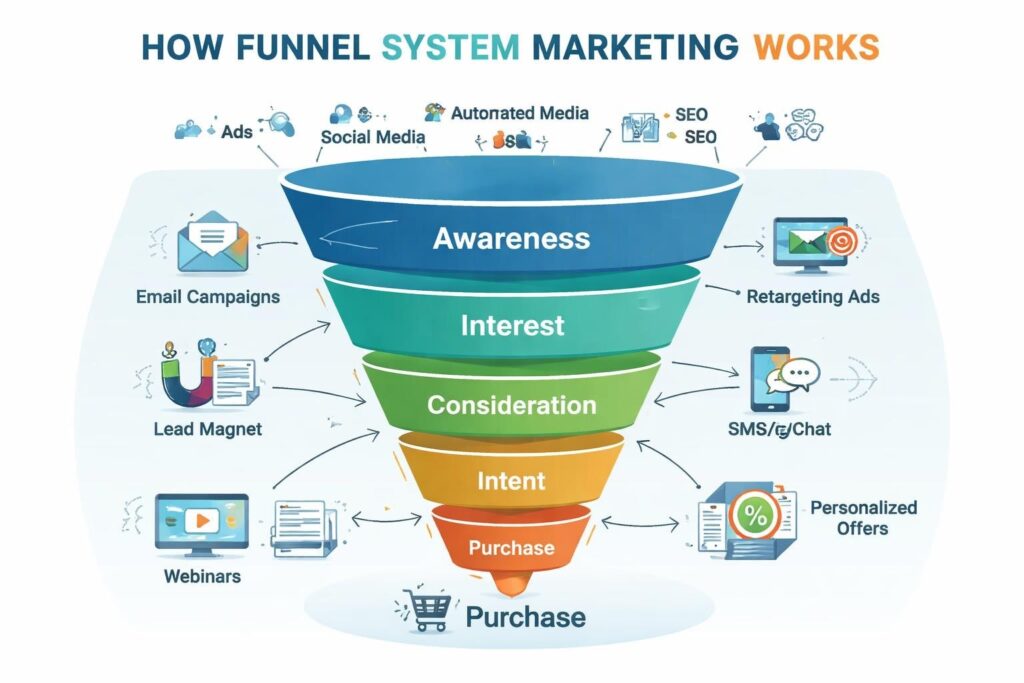
The difference between businesses that struggle to find customers and those with predictable revenue often comes down to one critical factor: a well-engineered funnel system marketing approach. Instead of hoping prospects magically convert, successful companies in 2026 are deploying systematic frameworks that guide potential buyers through precisely calibrated stages, transforming casual browsers into committed customers. This strategic methodology isn't just about collecting email addresses or running ads-it's about creating an intelligent, automated pathway that nurtures relationships, builds trust, and drives conversions at scale.
Understanding the Core Components of Funnel System Marketing
Funnel system marketing represents a strategic approach to customer acquisition that maps the entire buyer journey from initial awareness to final purchase. Unlike traditional marketing tactics that cast wide nets hoping to catch a few fish, understanding what marketing funnels are and how to create them allows businesses to systematically guide prospects through tailored experiences designed to address specific pain points at each stage.
The fundamental principle behind this approach is simple yet powerful: not every prospect is ready to buy immediately. Some need education, others require social proof, and many simply need time to understand how your solution solves their specific problem. By creating a structured system that delivers the right message at the right time, businesses can dramatically increase conversion rates while reducing wasted marketing spend.
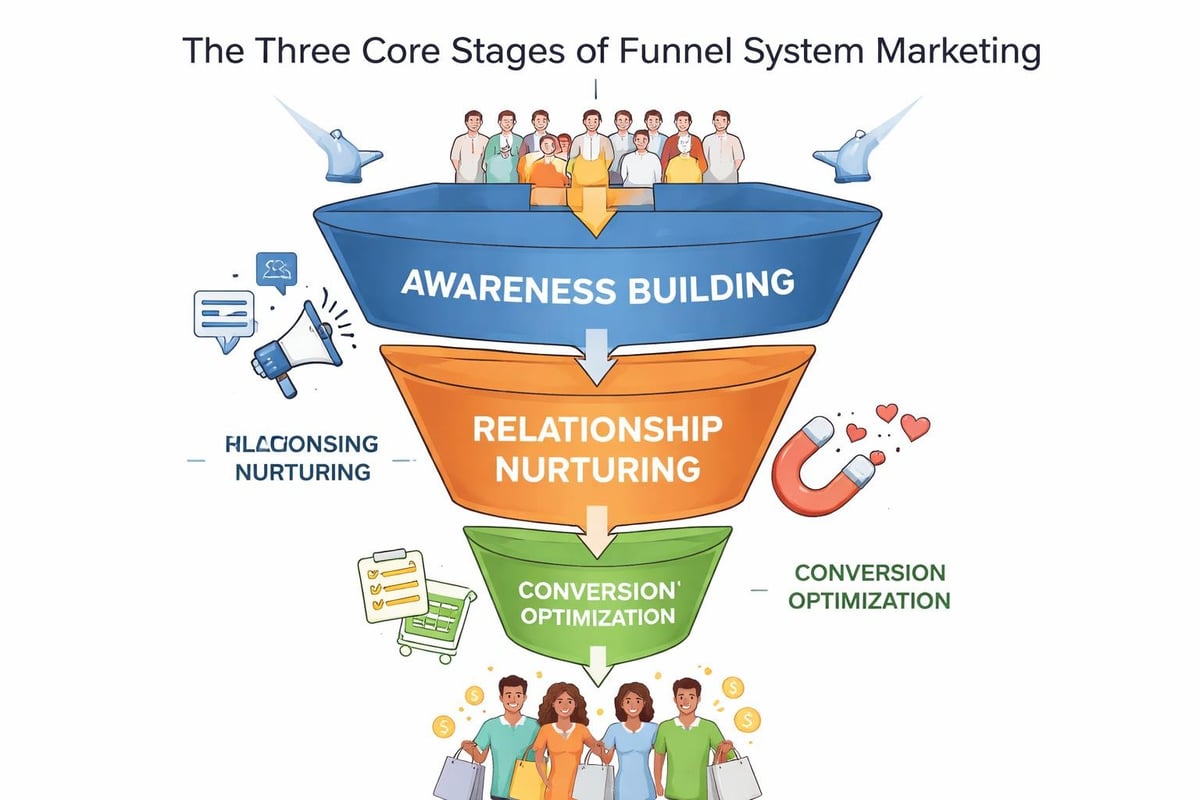
The Three Essential Stages Every System Must Include
Top of Funnel: Awareness and Attraction
This initial stage focuses on capturing attention and generating interest among your target audience. The goal isn't to sell-it's to provide value, establish credibility, and position your business as a trusted resource. Effective strategies include content marketing, social media engagement, search engine optimization, and paid advertising campaigns designed to reach people actively searching for solutions.
Middle of Funnel: Engagement and Education
Once prospects enter your ecosystem, the nurturing phase begins. This critical stage involves delivering targeted content that addresses specific objections, demonstrates expertise, and builds genuine relationships. Email sequences, educational webinars, case studies, and retargeting campaigns all play crucial roles in moving prospects closer to purchase decisions. Generating qualified leads at this stage requires sophisticated segmentation and personalization strategies.
Bottom of Funnel: Conversion and Retention
The final stage transforms interested prospects into paying customers. This involves clear calls-to-action, limited-time offers, one-on-one consultations, and removing any remaining barriers to purchase. However, the funnel doesn't end at conversion-retention strategies ensure customers remain engaged, become repeat buyers, and evolve into brand advocates who refer new prospects into your system.
Why Traditional Marketing Approaches Fail Without Systems
Most businesses approach marketing tactically rather than systematically. They run disconnected campaigns, post sporadically on social media, and wonder why results remain unpredictable. The problem isn't effort-it's the absence of an integrated framework that connects every marketing touchpoint into a cohesive journey.
Consider the typical scenario: a business invests thousands in advertising to drive traffic to their website. Visitors arrive, browse for a few seconds, then leave forever. No follow-up mechanism exists. No relationship gets established. No value exchange occurs. That's not marketing-that's money incineration.
Funnel system marketing solves this by ensuring every prospect who shows interest enters a systematic process designed to maximize conversion probability. Instead of one-shot attempts at selling, businesses create multiple touchpoints that gradually build trust and demonstrate value.
| Traditional Marketing | Funnel System Marketing |
|---|---|
| One-off campaigns | Integrated, multi-stage journeys |
| Hope-based conversion | Data-driven optimization |
| Manual follow-up | Automated nurturing sequences |
| Inconsistent messaging | Coherent narrative arc |
| Difficult to scale | Infinitely scalable |
The shift from traditional to systematic approaches represents a fundamental evolution in how businesses acquire customers. Modern lead generation tools enable companies to implement sophisticated funnels that would have required massive teams just a few years ago.
Building Your First High-Converting Funnel System
Creating an effective funnel system marketing infrastructure doesn't require massive budgets or technical expertise. What it demands is strategic thinking, customer understanding, and commitment to continuous improvement. Here's how to construct a system that generates predictable results.
Step 1: Map Your Customer Journey
Before building any funnel, you must understand how your ideal customers currently discover, evaluate, and purchase solutions in your market. Interview existing customers, analyze competitor approaches, and identify the specific questions, concerns, and objections prospects experience at each stage.
This research phase separates amateur marketers from professionals. The more precisely you understand your buyer's journey, the more effectively you can design touchpoints that guide them toward conversion. Why traditional cold outreach is failing becomes obvious when you realize modern buyers demand relevant, personalized experiences.
Step 2: Create Compelling Lead Magnets
Your funnel needs an attractive entry point-something valuable enough that prospects willingly exchange contact information to receive it. The most effective lead magnets solve specific, immediate problems your target audience faces:
- Comprehensive guides addressing common pain points
- Templates and frameworks that save time
- Exclusive research or data insights
- Free tools or calculators providing instant value
- Video training series delivering actionable strategies
The key is ensuring your lead magnet directly relates to your core offering. If you sell appointment-setting services, a guide on "7 Proven Scripts for Booking High-Value Consultations" attracts far more qualified prospects than generic business advice.
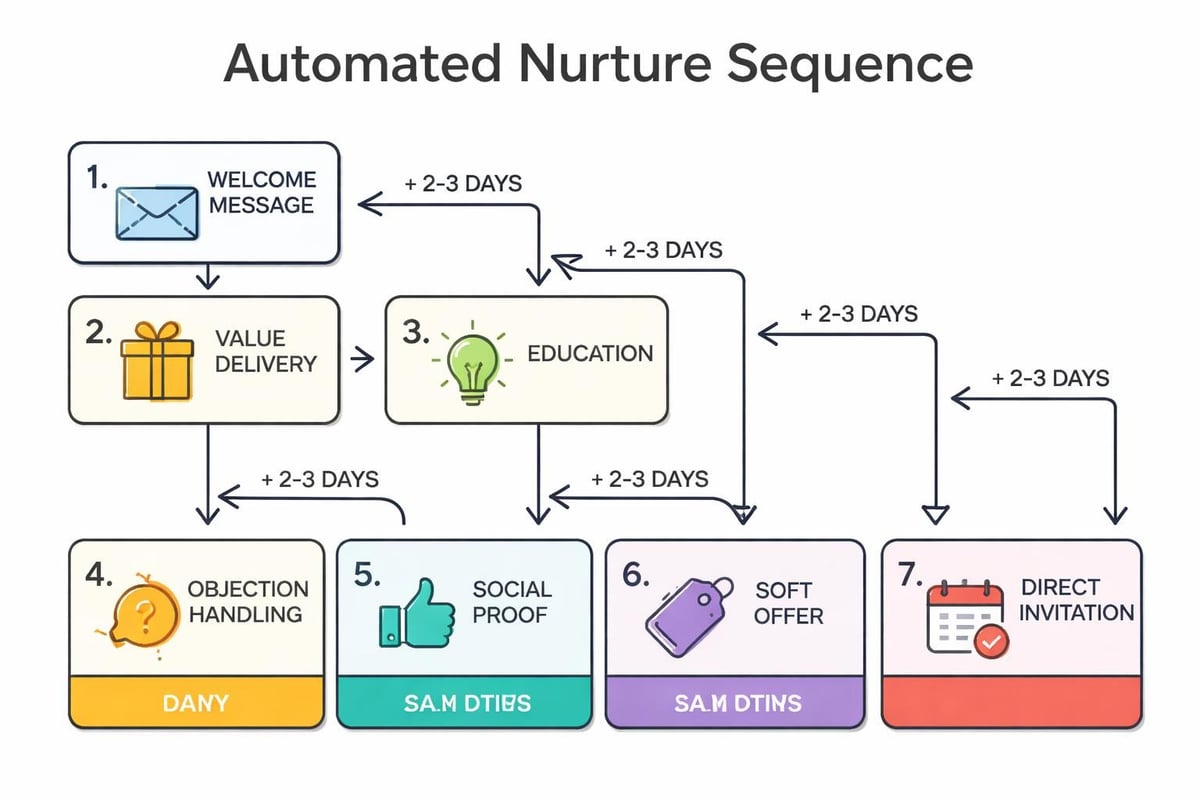
Step 3: Design Automated Nurture Sequences
Once prospects enter your system, automated email sequences do the heavy lifting of education and relationship building. These sequences should follow a strategic arc:
- Immediate delivery of the promised lead magnet
- Quick win content that generates early results
- Educational material addressing common objections
- Social proof through case studies and testimonials
- Clear invitation to take the next step
Each email should provide standalone value while subtly moving prospects closer to conversion. The goal isn't aggressive selling-it's demonstrating expertise, building trust, and making the eventual purchase decision feel natural and obvious.
Leveraging AI and Automation for Scalable Growth
The most significant advancement in funnel system marketing over the past few years has been the integration of artificial intelligence and advanced automation. These technologies enable businesses to deliver personalized experiences at scale-something previously impossible without massive teams.
Modern AI-powered campaign systems analyze prospect behavior in real-time, dynamically adjusting messaging, timing, and offers based on individual engagement patterns. If a prospect opens three emails about case studies but ignores pricing information, the system recognizes this pattern and delivers more social proof before presenting offers.
Key Automation Capabilities Transforming Funnels
Behavioral Trigger Systems
Instead of sending emails on fixed schedules, intelligent funnels respond to specific actions. When a prospect downloads a resource, visits a pricing page, or watches a demo video, the system automatically triggers relevant follow-up sequences. This ensures messaging always aligns with current interest levels.
Dynamic Content Personalization
Advanced systems customize email content, landing pages, and offers based on demographic data, behavioral signals, and engagement history. A prospect who spent ten minutes reading about a specific feature receives different messaging than someone who barely scrolled your homepage.
Predictive Lead Scoring
AI algorithms analyze thousands of data points to predict which prospects are most likely to convert, allowing sales teams to focus energy on high-probability opportunities while automated systems continue nurturing everyone else. This combination of human expertise and machine efficiency maximizes conversion rates while minimizing wasted effort.
The integration of best marketing platforms with AI capabilities creates funnel systems that continuously learn and optimize, improving performance over time without manual intervention.
Optimizing Conversion Rates at Every Stage
Building a funnel represents just the beginning. The most successful implementations of funnel system marketing involve relentless testing, measurement, and optimization. Small improvements at each stage compound into dramatic overall results.
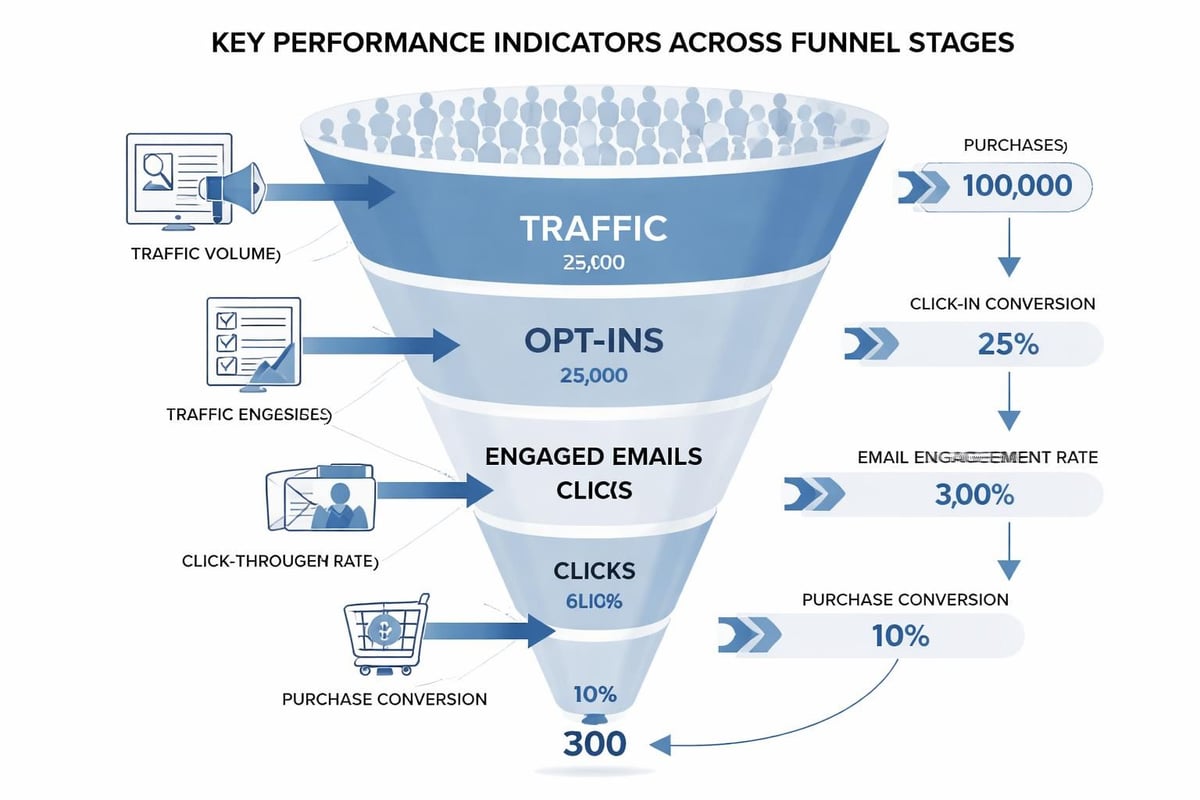
Consider the mathematics: if your current funnel attracts 1,000 visitors monthly with a 2% opt-in rate, 40% email engagement, and 5% conversion rate, you generate four customers per month. Improve each metric by just 20%-to 2.4% opt-in, 48% engagement, and 6% conversion-and monthly customers jump to 6.9, a 73% increase in revenue without spending another dollar on traffic.
Critical Metrics to Monitor
| Metric | What It Measures | Target Benchmark |
|---|---|---|
| Traffic Volume | Prospects entering top of funnel | Depends on industry |
| Opt-in Rate | Percentage who provide contact info | 2-5% |
| Email Open Rate | Engagement with nurture sequences | 20-30% |
| Click-through Rate | Interest in specific content/offers | 3-8% |
| Conversion Rate | Percentage who become customers | 1-5% |
| Customer Lifetime Value | Long-term revenue per customer | 3x+ acquisition cost |
Regular analysis of these metrics reveals exactly where your funnel needs improvement. Low opt-in rates suggest weak lead magnets or targeting issues. High email opens but low clicks indicate content misalignment. Understanding how to get new customers systematically requires this data-driven approach.
Advanced Strategies for Multi-Channel Funnel Systems
While email remains the backbone of most funnel system marketing approaches, the most sophisticated implementations leverage multiple channels to create omnipresent experiences that surround prospects with relevant touchpoints.
Retargeting and Social Proof Integration
Prospects who enter your funnel but don't immediately convert shouldn't disappear. Strategic retargeting campaigns on platforms like Facebook, Instagram, and LinkedIn keep your brand visible while they consider options. These ads should align with funnel stage-awareness content for new prospects, case studies for those evaluating solutions, and special offers for those close to purchasing.
Facebook lead generation strategies demonstrate how paid social integrates with broader funnel systems to accelerate results.
SMS and Direct Mail Amplification
For high-value offers, integrating SMS messaging and even physical mail creates pattern interrupts that capture attention in crowded digital landscapes. A personalized postcard arriving between automated emails stands out, reminding prospects of your solution when they might otherwise forget.
Webinar and Video Sequences
Live and automated webinars serve as powerful middle-funnel conversion mechanisms. They allow businesses to deliver concentrated value, address objections in real-time, and create urgency through limited-time offers. Recording these sessions and integrating them into automated sequences extends their value indefinitely.
The key principle underlying multi-channel approaches is consistency and coordination. Every touchpoint should reinforce the same core message while providing unique value appropriate to the medium and funnel stage. Understanding how marketing funnels work across multiple channels separates amateur implementations from professional systems.
Common Mistakes That Destroy Funnel Performance
Even well-designed funnels fail when businesses make critical implementation errors. Avoiding these common pitfalls dramatically improves your chances of success.
Mistake 1: Selling Too Early
The fastest way to kill a funnel is demanding purchase decisions before establishing trust and demonstrating value. Prospects need time to understand their problems, explore solutions, and build confidence in your expertise. Premature sales pressure triggers resistance and unsubscribes.
Mistake 2: Inconsistent Follow-Through
Building a funnel then abandoning it ensures failure. Successful funnel system marketing requires ongoing attention-monitoring metrics, testing variations, updating content, and refining messaging based on results. Funnel systems work only when businesses commit to continuous improvement.
Mistake 3: Ignoring Mobile Experience
Over 60% of email opens and 70% of social media engagement occurs on mobile devices in 2026. Funnels optimized only for desktop create friction, abandonment, and lost revenue. Every element-landing pages, emails, forms, and checkout processes-must deliver seamless mobile experiences.
Mistake 4: Lack of Clear Differentiation
Generic funnels that could promote any business in your industry fail to convert. Your funnel must communicate what makes your solution uniquely valuable. Specific benefits, distinctive approaches, and clear positioning separate you from competitors and give prospects compelling reasons to choose you.
Mistake 5: Neglecting Existing Customers
The most profitable marketing targets people who already trust you. Funnels shouldn't end at initial purchase-they should continue nurturing customers toward repeat purchases, upgrades, and referrals. Marketing funnel components extend far beyond first-time conversions.
Measuring ROI and Proving Funnel System Value
Executive teams and business owners demand evidence that funnel system marketing investments generate positive returns. Fortunately, properly implemented systems provide unprecedented visibility into exactly how marketing dollars translate into revenue.
The fundamental ROI calculation is straightforward: compare total funnel investment (setup costs, tools, advertising, content creation) against revenue generated from customers who entered through the system. However, sophisticated businesses track additional metrics that reveal deeper insights:
- Customer Acquisition Cost (CAC): Total marketing spend divided by new customers acquired
- Lifetime Value to CAC Ratio: How much revenue each customer generates compared to acquisition cost
- Payback Period: How long it takes for customer revenue to exceed acquisition investment
- Attribution Analysis: Which specific funnel elements drive the most conversions
These metrics enable data-driven optimization decisions. If certain lead magnets consistently attract higher-quality prospects who convert at better rates, you double down on similar approaches. If particular email sequences underperform, you test alternatives.
Modern analytics platforms integrate with various types of funnel systems, providing real-time dashboards that track every metric that matters. This transparency eliminates the guesswork that plagued traditional marketing approaches.
Creating Sustainable Competitive Advantages Through Systems
The most valuable aspect of funnel system marketing isn't immediate revenue-it's the compounding competitive advantage that emerges over time. While competitors chase individual tactics and temporary trends, businesses with sophisticated funnel systems build permanent assets that generate increasing returns.
Every prospect who enters your system, whether they immediately convert or not, becomes a long-term asset. They've raised their hand indicating interest in your solution category. With proper nurturing, they may convert months or even years later when circumstances change. Meanwhile, the data they generate through interactions helps refine targeting, messaging, and offers for everyone who follows.
This creates a virtuous cycle: better funnels attract more prospects, more prospects generate more data, more data enables better optimization, and better optimization improves results. Companies that started building funnel systems years ago now possess enormous advantages over those just beginning-advantages that grow more insurmountable with each passing month.
The strategic question isn't whether to implement funnel system marketing-it's how quickly you can deploy effective systems before competitors establish unassailable positions. In markets where customers have many options, the business that provides the best systematic experience wins, regardless of who has the best product or lowest price.
Understanding the evolution of marketing funnels reveals how these systems continue adapting to changing buyer behaviors and technological capabilities. Businesses that view funnels as dynamic, evolving systems rather than static campaigns position themselves for long-term dominance.
Funnel system marketing transforms unpredictable lead generation into systematic, scalable customer acquisition that drives consistent revenue growth. By implementing strategic frameworks that guide prospects through precisely designed journeys, businesses eliminate the guesswork and inefficiency that plague traditional marketing approaches. If you're ready to stop hoping for customers and start systematically generating them, Adstra leverages advanced AI systems to build, optimize, and manage complete funnel infrastructures that convert cold leads into ready-to-buy customers, backed by our guaranteed growth partnership model that ensures your success is our success.