
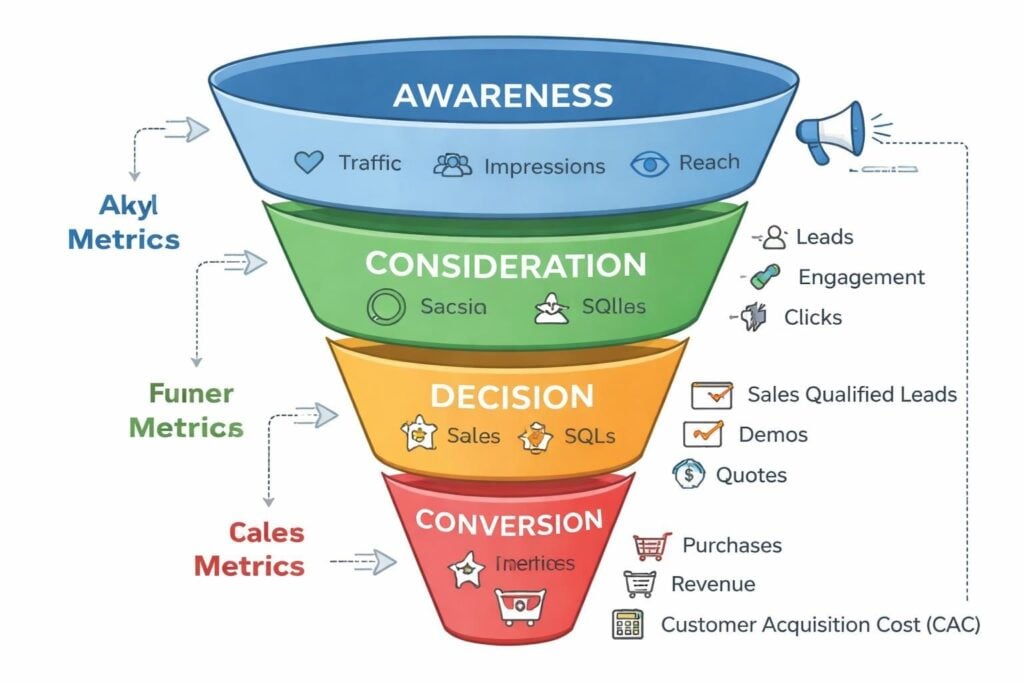
The difference between businesses that thrive and those that barely survive often comes down to one critical system: a well-optimized sales conversion funnel. In 2026, with advanced AI capabilities and unprecedented data accessibility, companies can no longer afford to treat their funnel as an afterthought. Every interaction, every touchpoint, and every piece of content must strategically guide prospects toward becoming paying customers. For businesses focused on lead generation, understanding and mastering the sales conversion funnel isn't just important, it's the foundation of predictable, scalable revenue growth.
Understanding the Sales Conversion Funnel Framework
A sales conversion funnel represents the entire journey a prospect takes from first becoming aware of your solution to making a purchase decision. Unlike the outdated notion of a simple linear path, modern funnels in 2026 acknowledge that buyers move fluidly between stages, influenced by multiple touchpoints across various channels.
The traditional funnel consists of four primary stages: awareness, interest, decision, and action. However, the most successful companies have expanded this framework to include nurture sequences, re-engagement campaigns, and post-purchase optimization. Creating high-converting sales funnels requires understanding not just these stages, but the specific behaviors and motivations that drive prospects from one phase to the next.
Why Traditional Funnels Fail in 2026
Most businesses approach their sales conversion funnel with outdated assumptions. They build complex systems without understanding their audience, create generic content that appeals to no one, and wonder why conversion rates remain stubbornly low.
The reality? Your funnel is only as effective as your understanding of your ideal customer. Generic messaging fails because today's buyers demand personalization, relevance, and value at every interaction. They research independently, compare alternatives thoroughly, and make decisions based on trust and demonstrated expertise.
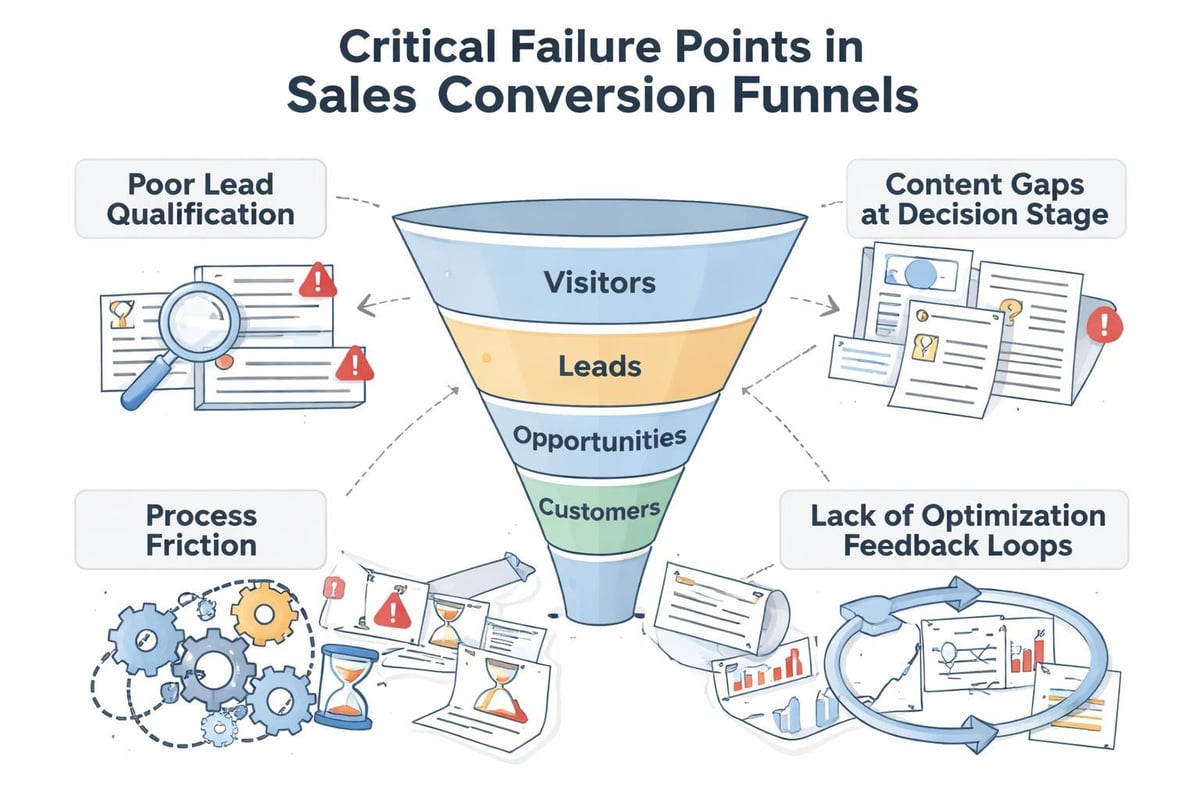
Here's where most funnels break down:
- Lack of segmentation: Treating all leads identically regardless of source, behavior, or readiness to buy
- Poor qualification: Allowing unqualified prospects to consume sales resources
- Content gaps: Missing critical information at key decision-making moments
- Friction points: Unnecessary steps, confusing processes, or unclear calls-to-action
- No feedback loop: Failing to analyze drop-off points and optimize systematically
Building a Revenue-Generating Sales Conversion Funnel
The most powerful sales conversion funnel starts with exceptional clarity about who you're serving and what specific problem you're solving. This clarity informs every subsequent decision, from content creation to channel selection to automation sequences.
Stage One: Awareness and Attraction
Your funnel begins the moment a potential customer discovers your existence. In 2026, this discovery happens across countless channels: search engines, social media, paid advertising, referrals, and content platforms. The critical question isn't just generating awareness, it's generating qualified awareness.
Effective lead generation strategies focus on attracting prospects who match your ideal customer profile rather than maximizing raw traffic numbers. This strategic approach yields higher conversion rates and reduces wasted resources on unqualified leads.
Key elements of effective awareness campaigns:
- Precise targeting based on demographic, firmographic, and behavioral data
- Value-driven messaging that addresses specific pain points
- Multiple touchpoint strategy across complementary channels
- Clear differentiation from competitive alternatives
- Compelling offers that motivate immediate action
Stage Two: Interest and Engagement
Once prospects enter your funnel, your priority shifts to building trust and demonstrating expertise. This stage separates amateur operations from professional revenue-generating machines. The businesses winning in 2026 understand that engagement isn't about frequency, it's about relevance and value.
Your content at this stage should educate, inspire, and guide prospects toward recognizing they have a problem worth solving. Case studies, educational webinars, diagnostic tools, and comparison guides perform exceptionally well because they provide genuine value while subtly positioning your solution.
| Content Type | Purpose | Conversion Impact |
|---|---|---|
| Educational Blog Posts | Build authority and trust | Medium |
| Case Studies | Provide social proof | High |
| Comparison Guides | Address objections | High |
| Diagnostic Tools | Increase engagement | Very High |
| Video Demonstrations | Clarify value proposition | Very High |
The most effective B2B sales funnel strategies recognize that business buyers require different engagement than consumers. They need detailed information, clear ROI calculations, and evidence of results with similar companies.
Optimizing Conversion at Each Funnel Stage
Understanding what constitutes strong performance at each stage enables data-driven optimization. Benchmarking your funnel conversion rate against industry standards reveals where you're excelling and where opportunities exist for improvement.
Decision Stage Optimization
This critical phase determines whether prospects become customers or competitors' clients. Everything in your sales conversion funnel has prepared prospects for this moment. Your job now is removing every possible obstacle to saying yes.
Effective decision-stage tactics include:
- Personalized demonstrations tailored to specific use cases
- Risk-reversal guarantees that eliminate purchase anxiety
- Social proof from recognizable brands or similar companies
- Clear, transparent pricing without hidden costs
- Streamlined purchase or booking processes
The businesses achieving exceptional results implement AI-powered digital advertising that dynamically adjusts messaging based on prospect behavior, ensuring the right message reaches prospects at precisely the right moment.
Action Stage: Converting Intent to Revenue
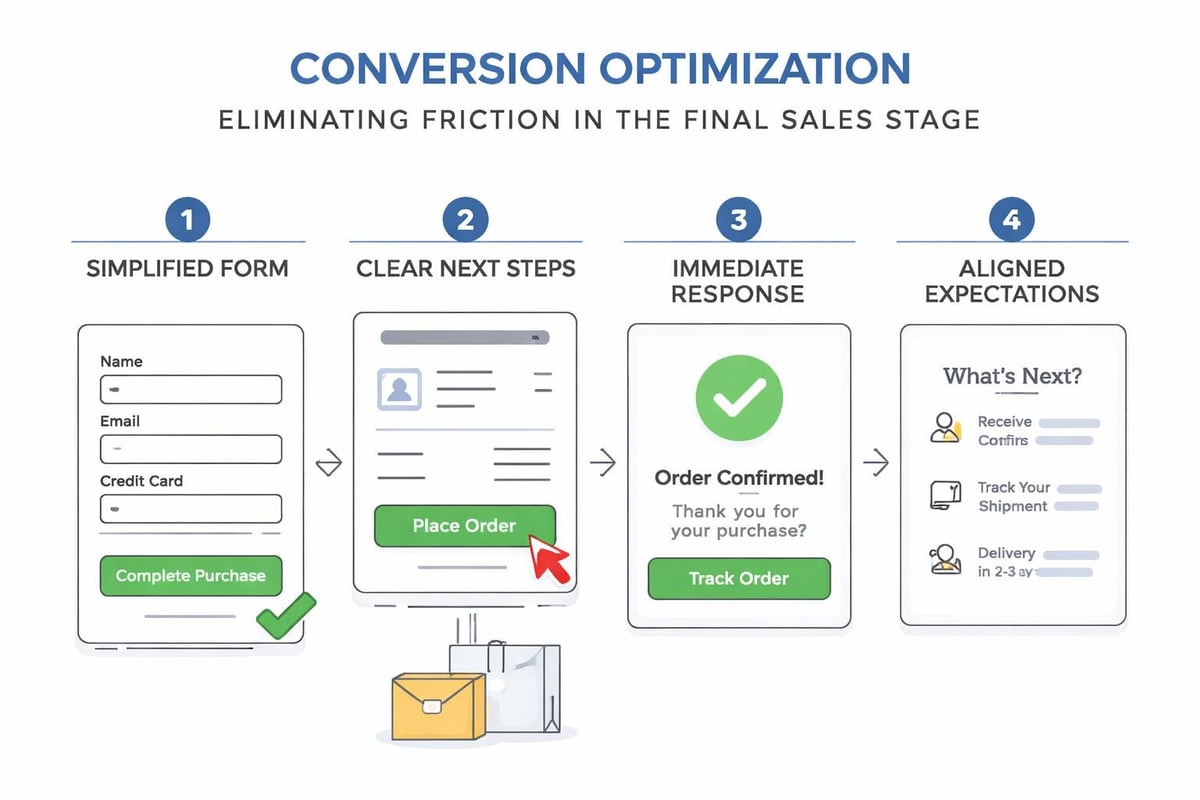
The final stage of your sales conversion funnel transforms interested prospects into paying customers. Despite having come this far, many funnels lose prospects at this critical juncture through preventable mistakes.
Common conversion killers include complicated forms, unclear next steps, multiple decision points, delayed response times, and misaligned expectations. Each friction point dramatically reduces conversion probability.
Conversion rate optimization priorities:
- Reduce form fields to absolute essentials
- Provide immediate confirmation and next steps
- Enable multiple contact methods (phone, chat, email, calendar)
- Set accurate expectations about timeline and process
- Follow up within minutes, not hours or days
Advanced Funnel Strategies for Maximum Performance
Once foundational elements perform effectively, advanced strategies amplify results. These tactics separate good funnels from exceptional revenue-generating systems.
Segmentation and Personalization
Generic funnels produce generic results. The most successful sales conversion funnel implementations in 2026 leverage sophisticated segmentation to deliver hyper-relevant experiences. Prospects from different industries, company sizes, or roles require different messaging, content, and offers.
Segmentation enables you to:
- Create industry-specific landing pages and content
- Adjust messaging based on company size or budget
- Customize offers for different buyer personas
- Prioritize high-value prospects for immediate sales attention
- Automate appropriate follow-up sequences
Retargeting and Re-engagement
Most prospects don't convert on their first interaction. A robust sales conversion funnel includes systematic strategies for re-engaging prospects who showed interest but didn't immediately convert.
| Retargeting Strategy | Best Use Case | Expected Lift |
|---|---|---|
| Content-based ads | Educational stage exits | 15-25% |
| Offer-based ads | Decision stage exits | 30-50% |
| Email sequences | Form abandonment | 20-35% |
| SMS follow-up | High-intent actions | 40-60% |
| Phone outreach | Qualified leads | 50-80% |
Implementing sales funnel best practices requires consistent testing, measurement, and refinement. What works for one audience may fail for another, making ongoing optimization essential.
Measuring and Improving Your Sales Conversion Funnel
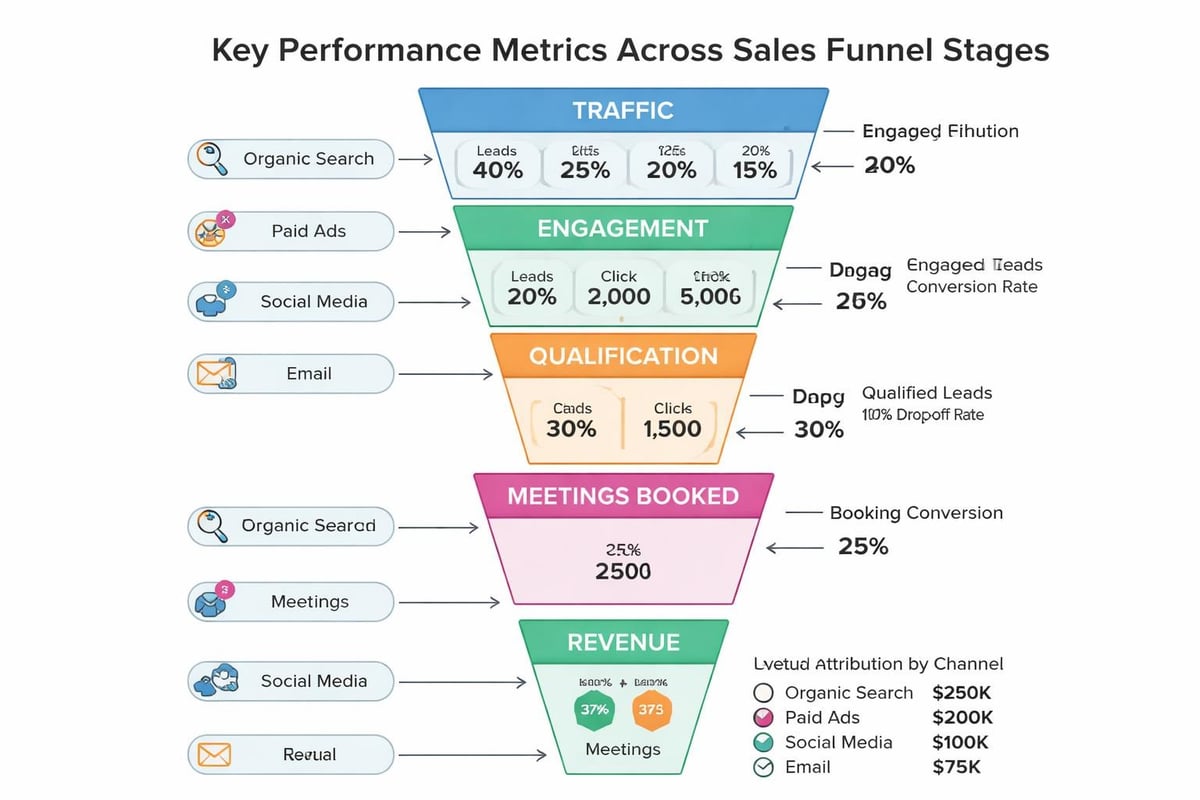
You cannot improve what you don't measure. The most valuable metric isn't vanity numbers like traffic or impressions, it's conversion rate at each funnel stage. This granular visibility reveals exactly where prospects drop off and where opportunities exist.
Essential Metrics to Track
Top-of-funnel metrics:
- Traffic sources and volume
- Cost per visitor by channel
- Bounce rate and time on page
- Initial engagement rate
Mid-funnel metrics:
- Lead magnet conversion rate
- Email open and click-through rates
- Content consumption patterns
- Qualification rate
Bottom-funnel metrics:
- Sales conversation booking rate
- Show-up rate for scheduled calls
- Close rate by source and segment
- Customer acquisition cost
- Average deal size
Understanding conversion funnel optimization at a granular level empowers you to make data-driven decisions rather than relying on intuition or generic best practices.
Testing and Iteration Framework
Continuous improvement separates high-performing funnels from stagnant ones. Implement a systematic testing framework that evaluates changes objectively and scales what works.
Effective testing priorities:
- Headlines and value propositions (highest impact)
- Calls-to-action and button copy
- Form length and field requirements
- Page layout and visual hierarchy
- Offer positioning and pricing presentation
Scaling Your Sales Conversion Funnel with Automation
Manual funnel management becomes impossible as volume increases. The solution isn't hiring more people, it's implementing intelligent automation that maintains personalization while operating at scale.
Modern automation enables you to:
- Instantly qualify leads based on behavior and firmographic data
- Route high-value prospects to sales immediately
- Nurture lower-priority leads until they're sales-ready
- Re-engage dormant prospects systematically
- Track attribution across complex multi-touch journeys
The businesses achieving exceptional growth in 2026 leverage end-to-end marketing automation that coordinates every touchpoint from initial awareness through post-purchase expansion. This integrated approach eliminates gaps, reduces response times, and ensures consistent experiences.
AI-Powered Funnel Optimization
Artificial intelligence has transformed how sophisticated companies optimize their sales conversion funnel. Rather than manually analyzing data and implementing changes, AI systems identify patterns, predict outcomes, and automatically adjust strategies in real-time.
AI applications in funnel optimization include:
- Predictive lead scoring that identifies high-conversion prospects
- Dynamic content personalization based on behavior
- Optimal timing prediction for outreach and follow-up
- Automated A/B testing across multiple variables simultaneously
- Natural language processing for chat and email automation
Common Sales Conversion Funnel Mistakes to Avoid
Even experienced marketers make critical errors that dramatically reduce funnel performance. Awareness of these common mistakes helps you avoid them proactively.
The biggest funnel mistakes:
- Focusing on volume over quality: More leads don't equal more revenue if they're unqualified
- Neglecting mobile experience: Over 60% of traffic comes from mobile devices in 2026
- Ignoring page speed: Every second of delay reduces conversions by approximately 7%
- Creating content gaps: Missing information at critical decision points loses prospects
- Failing to follow up quickly: Speed-to-lead dramatically impacts conversion probability
- Overcomplicating the process: Every additional step reduces completion rates
Effective sales funnel management requires constant vigilance against these and other conversion killers. Regular audits identify issues before they significantly impact revenue.
Funnel Strategies by Industry and Business Model
While core principles remain consistent, tactical implementation varies significantly based on your specific business model, industry, and target audience. A sales conversion funnel for enterprise software differs dramatically from one selling consumer products or professional services.
B2B Service Business Funnels
For service businesses, the funnel focuses on establishing expertise, building trust, and securing discovery calls or consultations. The conversion goal isn't an immediate purchase but rather a qualified conversation.
Effective B2B service funnels emphasize:
- Thought leadership content demonstrating deep expertise
- Case studies with measurable results and recognizable brands
- Educational resources that solve real problems
- Low-friction consultation booking processes
- Personalized outreach to high-value prospects
Generating qualified demos for B2B SaaS requires different strategies than consumer products, with longer sales cycles and multiple decision-makers influencing outcomes.
Lead Generation Business Funnels
Companies focused on lead generation face unique funnel challenges. Your sales conversion funnel must not only convert your own prospects but also demonstrate you can generate quality leads for clients.
Success requires:
- Transparent case studies showing lead quality and volume
- Clear pricing and deliverable specifications
- Proof of expertise through your own lead generation success
- Fast response times and professional communication
- Risk-reversal guarantees that align your interests with clients
Implementation Roadmap for Funnel Excellence
Building a high-performing sales conversion funnel doesn't happen overnight. Follow this systematic approach to develop, launch, and optimize your revenue-generating system.
Phase 1: Foundation (Weeks 1-2)
- Define ideal customer profile and buyer personas
- Map customer journey and identify key touchpoints
- Audit existing funnel performance and identify gaps
- Establish baseline metrics and targets
Phase 2: Development (Weeks 3-6)
- Create stage-appropriate content and offers
- Build landing pages and automation sequences
- Implement tracking and analytics systems
- Set up retargeting and re-engagement campaigns
Phase 3: Launch and Test (Weeks 7-10)
- Drive initial traffic and monitor performance
- Conduct A/B tests on critical elements
- Gather feedback from sales team and customers
- Make data-driven optimizations
Phase 4: Scale and Optimize (Ongoing)
- Expand successful channels and tactics
- Refine targeting and segmentation
- Enhance automation and personalization
- Continuously test and improve conversion rates
Your sales conversion funnel either drives predictable growth or leaves revenue on the table. In 2026, the businesses winning aren't necessarily those with the biggest budgets, they're the ones with the most optimized systems that consistently convert prospects into customers. If you're ready to transform your funnel from a leaky bucket into a revenue-generating machine, Adstra specializes in leveraging advanced AI systems to generate qualified leads and automate the entire conversion process. Our guaranteed growth partnership model means we only succeed when you do, making us invested partners in your revenue growth rather than just another agency collecting fees.