


Every business faces the same critical challenge: how do you turn strangers into paying customers consistently and predictably? The answer lies in understanding and optimizing your acquisition funnel. This systematic approach to customer acquisition transforms the chaotic process of lead generation into a measurable, repeatable system that drives revenue growth. Whether you're struggling to generate qualified leads or looking to maximize your conversion rates, mastering the acquisition funnel framework gives you the strategic advantage needed to compete in today's AI-driven marketing landscape.
Understanding the Acquisition Funnel Framework
The acquisition funnel represents the complete journey a prospect takes from first discovering your business to becoming a paying customer. Unlike traditional marketing approaches that focus on isolated tactics, a well-structured customer acquisition funnel provides a comprehensive roadmap that guides prospects through each decision-making stage with strategic precision.
Think of your acquisition funnel as a filtering system. At the top, you cast a wide net to capture attention from your target audience. As prospects move deeper into the funnel, they become increasingly qualified, engaged, and ready to make a purchase decision. The goal isn't just to attract massive traffic but to systematically convert the right people into customers who generate long-term value for your business.
The Five Critical Stages
Every effective acquisition funnel consists of five distinct stages, each requiring unique strategies and content:
- Awareness: Prospects discover your business exists and understand the problem you solve
- Interest: They actively seek information about potential solutions and engage with your content
- Consideration: Prospects evaluate your offering against alternatives and assess fit
- Decision: They're ready to commit but need final validation and assurance
- Action: The conversion moment when prospects become customers
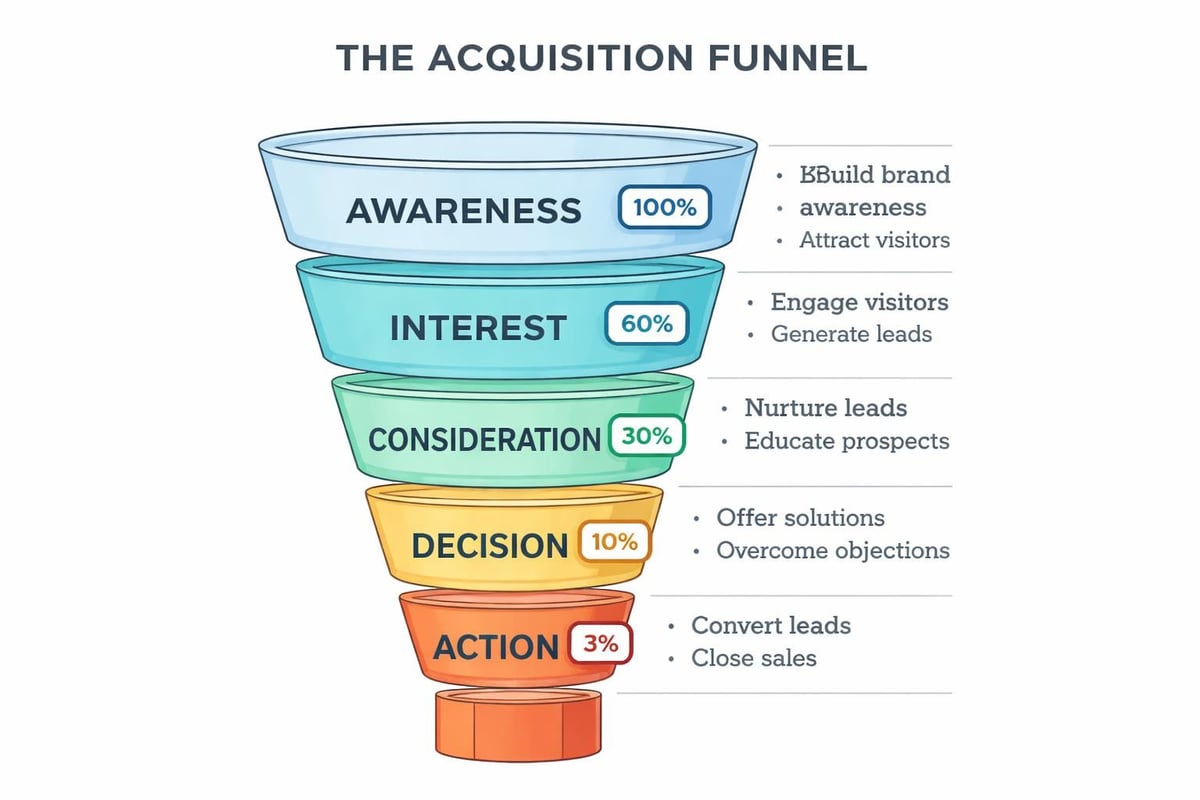
Understanding these stages helps you create targeted content and experiences that address specific concerns at exactly the right moment. When you align your marketing messages with where prospects are in their buying journey, conversion rates naturally improve.
Building Your Lead Generation Acquisition Funnel
Creating an effective acquisition funnel requires more than understanding theory. You need a systematic approach that connects each stage with concrete actions and measurable outcomes. Building a customer acquisition funnel starts with mapping your ideal customer's decision-making process and identifying the exact touchpoints that influence their choices.
The most successful lead generation companies don't rely on guesswork. They build acquisition funnels based on data, customer insights, and continuous optimization. Here's how to construct a funnel that actually converts:
Mapping the Customer Journey
Start by documenting every possible touchpoint between your business and potential customers. Where do they first hear about you? What questions arise at each stage? What objections prevent them from moving forward?
Create detailed buyer personas that capture not just demographics but psychological triggers, pain points, and decision criteria. This foundation ensures every funnel element speaks directly to your audience's needs and concerns.
Track how existing customers found you and what convinced them to buy. These insights reveal patterns you can replicate and scale across your acquisition funnel. Many businesses discover that their assumed customer journey differs significantly from reality, which explains why their marketing efforts underperform.
Designing Stage-Specific Assets
Each acquisition funnel stage demands different content formats and messaging strategies. At the awareness stage, educational content that addresses broad pain points works best. Blog posts, social media content, and videos that provide genuine value without requiring commitment build initial trust.
As prospects move into the interest and consideration stages, they need more detailed information. Case studies, comparison guides, webinars, and detailed product demonstrations help them evaluate whether your solution fits their specific situation. The complete sales funnel strategy leverages different assets at each stage to maintain momentum toward conversion.
| Funnel Stage | Content Types | Primary Goal | Key Metrics |
|---|---|---|---|
| Awareness | Blog posts, social media, podcasts | Build recognition | Reach, impressions, traffic |
| Interest | Guides, newsletters, educational videos | Establish expertise | Engagement rate, time on page |
| Consideration | Case studies, webinars, demos | Demonstrate value | Lead quality, download rate |
| Decision | Testimonials, consultations, trials | Remove friction | Conversion rate, sales velocity |
| Action | Onboarding, welcome sequences | Confirm choice | Customer acquisition cost, LTV |
Optimizing Conversion at Every Funnel Stage
Building an acquisition funnel represents just the starting point. The real power comes from systematically optimizing each stage to reduce friction and increase conversion rates. Optimizing your customer acquisition funnel requires a data-driven approach that identifies exactly where prospects drop off and why.
Most businesses lose potential customers at predictable points in the acquisition funnel. By analyzing user behavior, tracking key metrics, and testing improvements, you can dramatically increase the percentage of prospects who progress from one stage to the next.
Reducing Drop-Off Points
Every transition point in your acquisition funnel presents an opportunity for prospects to abandon the journey. Identifying these leakage points is essential for maximizing overall conversion rates.
Use analytics tools to track where prospects exit your funnel. Is your landing page converting visitors into leads? Are email subscribers engaging with your nurture sequences? Do demo requests actually convert into sales conversations?
Common drop-off points include:
- Unclear value propositions that fail to capture attention
- Complex forms requesting too much information too soon
- Slow website performance causing impatient prospects to leave
- Misaligned messaging between ad campaigns and landing pages
- Inadequate follow-up with leads who express initial interest
For lead generation businesses specifically, the gap between lead capture and sales conversation represents a critical vulnerability. Modern marketing agency strategies address this through automated appointment booking systems that eliminate delays and friction.
Leveraging AI for Funnel Optimization
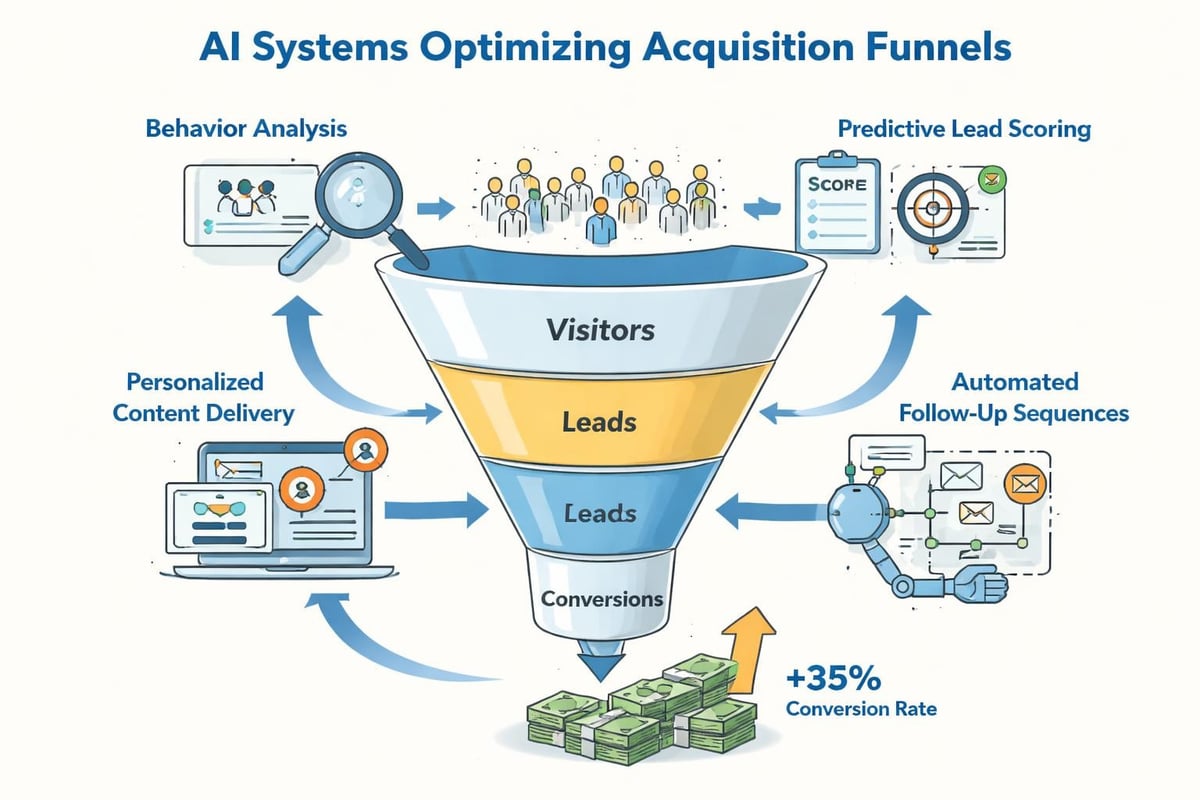
Artificial intelligence transforms acquisition funnel optimization from a manual, time-intensive process into an automated competitive advantage. AI systems analyze vast amounts of behavioral data to identify patterns humans might miss and predict which prospects are most likely to convert.
Advanced AI implementations can personalize the funnel experience for individual prospects based on their behavior, demographics, and engagement history. Instead of showing everyone the same generic content, AI-driven funnels adapt in real-time to maximize relevance and conversion probability.
Predictive lead scoring uses AI to identify which prospects warrant immediate attention from your sales team. This prevents valuable leads from going cold while ensuring your team focuses energy on the opportunities most likely to close. When you understand why cold outreach is failing, you can pivot toward more effective acquisition funnel strategies.
Measuring Acquisition Funnel Performance
You can't improve what you don't measure. Effective acquisition funnel management requires tracking specific metrics that reveal both overall funnel health and stage-specific performance. Understanding acquisition funnel metrics helps you make informed decisions about where to invest optimization efforts for maximum impact.
Different metrics matter at different stages. Top-of-funnel metrics focus on reach and awareness, while bottom-of-funnel metrics emphasize conversion quality and revenue generation. The most successful businesses track both leading indicators that predict future performance and lagging indicators that measure actual results.
Essential Metrics to Track
Start with these fundamental acquisition funnel metrics:
Traffic volume measures how many potential customers enter your funnel. While quantity matters, quality matters more. A smaller volume of highly targeted visitors often outperforms massive traffic from irrelevant sources.
Conversion rate by stage reveals exactly where your funnel performs well and where it needs improvement. Calculate the percentage of prospects who advance from awareness to interest, interest to consideration, and so forth through the entire journey.
Customer acquisition cost (CAC) determines how much you spend to acquire each new customer. This critical metric influences pricing strategy, growth projections, and overall business viability. Lower CAC means you can scale acquisition efforts more aggressively.
Time to conversion tracks how long prospects typically spend in your acquisition funnel before becoming customers. Longer cycles aren't inherently bad, but understanding typical timeframes helps you set realistic expectations and identify outliers who need different approaches.
Advanced Attribution Modeling
Most customer journeys involve multiple touchpoints across different channels. Simple attribution models that credit only the first or last interaction miss the complex reality of modern buyer behavior. Advanced attribution modeling provides a more accurate picture of which marketing activities actually drive conversions.
Multi-touch attribution considers every interaction a prospect has with your business throughout the acquisition funnel. This reveals which combinations of channels and content types work synergistically to move prospects toward conversion. You might discover that prospects who read specific blog posts are significantly more likely to convert than those who don't, even if the blog isn't the final touchpoint before purchase.
| Attribution Model | What It Measures | Best Used For | Limitations |
|---|---|---|---|
| First-Touch | Initial discovery source | Top-of-funnel awareness campaigns | Ignores nurturing impact |
| Last-Touch | Final interaction before conversion | Direct response campaigns | Misses earlier influence |
| Linear | Equal credit to all touchpoints | Understanding full journey | Oversimplifies complex paths |
| Time-Decay | More credit to recent interactions | Longer sales cycles | May undervalue early awareness |
| Position-Based | Emphasis on first and last touches | Balanced view of discovery and conversion | Customization required |
Creating Automated Acquisition Systems
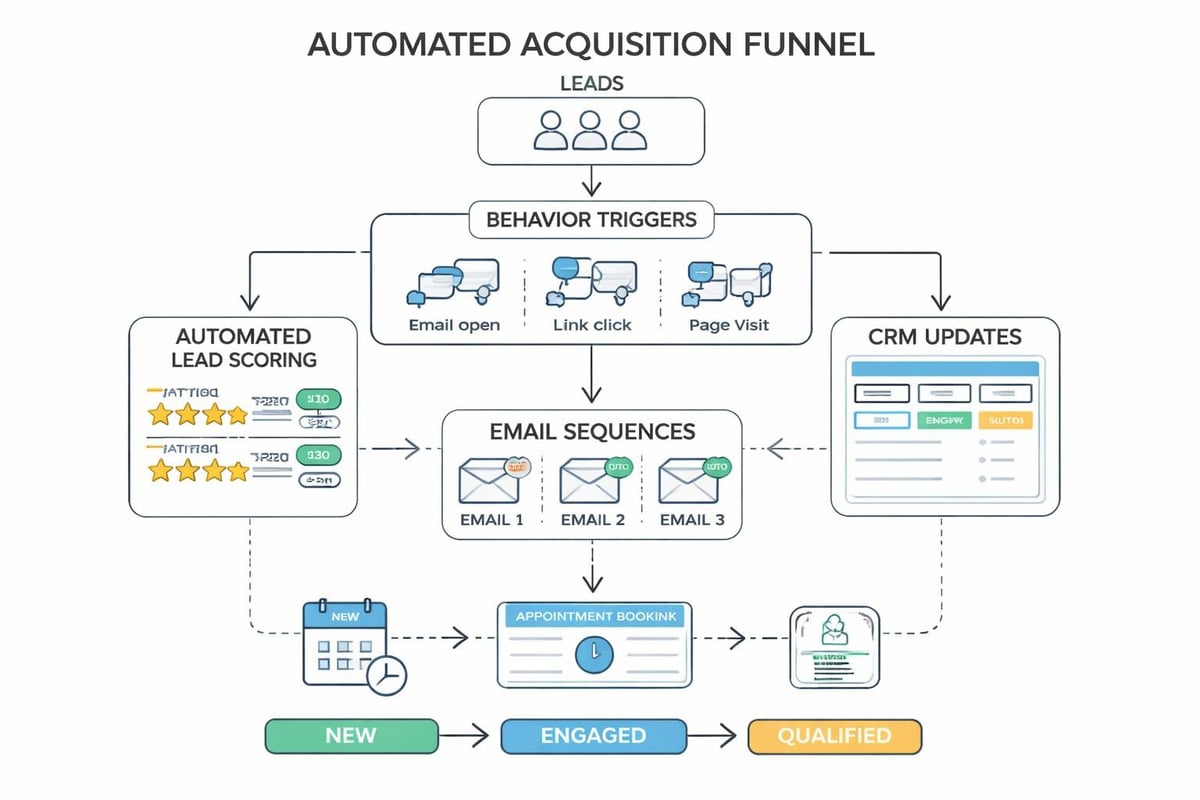
The most powerful acquisition funnels run on automation. Manual follow-up, personalized outreach at scale, and consistent lead nurturing become impossible as your business grows. Automation transforms your acquisition funnel from a labor-intensive process into a systematic lead generation engine that operates 24/7.
Modern businesses leverage automation to maintain consistent communication with prospects without overwhelming their teams. The key is strategic automation that enhances the customer experience rather than replacing genuine human connection at critical moments.
Email Nurture Sequences
Email automation remains one of the most effective tools for guiding prospects through your acquisition funnel. Well-crafted nurture sequences deliver the right message at the right time, educating prospects and addressing objections before they arise.
Segment your email lists based on prospect behavior and funnel stage. Someone who just discovered your business needs different messaging than someone actively comparing your solution to competitors. Behavioral triggers can automatically move prospects between sequences based on their actions.
Effective nurture sequences combine education, social proof, and strategic calls-to-action. Rather than immediately pushing for a sale, they build trust and demonstrate expertise. When prospects are ready to buy, your business is the obvious choice because you've already proven your value.
Appointment Booking Automation
For service-based businesses and lead generation companies, the gap between lead capture and sales conversation represents a critical failure point. Prospects who express interest but don't immediately book a call often cool off and never convert.
Automated appointment booking systems eliminate this friction by allowing prospects to schedule conversations at their convenience. Integration with your acquisition funnel means interested prospects can instantly book time with your sales team without back-and-forth email exchanges or phone tag.
The VSL strategy that generated 50,000 leads demonstrates how combining compelling content with frictionless appointment booking creates a powerful acquisition funnel that converts at high rates.
Scaling Your Acquisition Funnel
Once you've built and optimized an acquisition funnel that consistently converts, the next challenge is scaling without sacrificing performance. Growth isn't just about increasing traffic volume but maintaining or improving conversion rates as you expand your reach.
Many businesses struggle with scale because they assume tactics that worked at small volumes will perform identically at larger scales. The reality is that scaling an acquisition funnel requires strategic adjustments to handle increased volume while preserving the personalization and quality that drove initial success.
Multi-Channel Expansion
Relying on a single traffic source creates vulnerability. Algorithm changes, increased competition, or platform policy shifts can devastate businesses dependent on one acquisition channel. Understanding the best marketing platforms helps you diversify your acquisition funnel across multiple channels.
Start by identifying where your target audience spends time. Different demographics favor different platforms, and your ideal customers might be concentrated in channels you haven't explored. Test new channels systematically, measuring performance against your established benchmarks.
Successful multi-channel strategies maintain consistent messaging while adapting format and tone to each platform's unique characteristics. LinkedIn content differs from Instagram content, even when targeting the same prospects with the same core value proposition.
Team Structure and Responsibilities
Scaling your acquisition funnel eventually requires expanding your team. Clear role definition ensures accountability and prevents critical tasks from falling through the cracks. Someone needs to own funnel performance, analyze metrics, coordinate optimization efforts, and drive continuous improvement.
Consider these specialized roles:
- Funnel strategist: Oversees entire acquisition funnel architecture and optimization roadmap
- Content creators: Develop stage-specific assets that move prospects forward
- Automation specialist: Builds and maintains email sequences, workflows, and integration
- Analyst: Tracks metrics, identifies opportunities, and reports on funnel performance
- Sales team: Handles direct prospect interaction at decision stage
Even small teams can adopt this structure by having individuals wear multiple hats initially, then specializing as growth allows dedicated roles.
Advanced Funnel Strategies for Competitive Markets
In saturated markets where competitors have similar offerings, your acquisition funnel becomes your primary competitive advantage. Advanced strategies help you stand out, capture attention, and convert prospects even when facing well-established competitors with larger budgets.
These sophisticated approaches go beyond basic funnel mechanics to create memorable experiences that differentiate your business. Why traditional outbound marketing approaches struggle illustrates the need for more innovative acquisition funnel strategies.
Value-First Approaches
The most effective modern acquisition funnels prioritize delivering genuine value before asking for any commitment. This reverses the traditional sales approach where businesses gatekeep their best insights behind forms, calls, and demos.
Give away your best ideas freely. Share specific strategies, detailed case studies, and actionable frameworks that prospects can implement immediately. This counterintuitive approach builds enormous trust and positions your business as the expert solution when prospects are ready to buy.
Value-first acquisition funnels attract higher-quality leads who understand your methodology and approach. They've already experienced results from your free content, making the decision to become a paying customer much easier.
Community-Driven Growth
Building community around your acquisition funnel transforms one-way marketing into engaging conversations. Prospects who join your community interact with existing customers, ask questions, and see real-world proof of your value proposition.
Community platforms like private forums, Slack groups, or exclusive membership areas create belonging and connection. These spaces keep your business top-of-mind and accelerate the journey through your acquisition funnel by providing social proof and peer recommendations.
Active communities also generate invaluable feedback about prospect concerns, objections, and desires. This insight allows you to refine your acquisition funnel based on actual customer conversations rather than assumptions.
Guaranteeing Results Through Partnership Models
Traditional agency relationships create misaligned incentives. Agencies get paid regardless of whether their strategies generate results, while clients bear all the risk. Progressive acquisition funnel approaches address this by tying compensation directly to outcomes.
Guaranteed growth partnerships align interests completely. When your success depends on client results, you invest differently in funnel optimization, lead quality, and conversion improvement. This model transforms the client-agency dynamic from transactional to truly collaborative.
Performance-based compensation models work especially well for acquisition funnel optimization because results are measurable. You can track exactly how many leads enter the funnel, what percentage convert at each stage, and total revenue generated. This transparency makes outcome-based agreements practical and verifiable.
Mastering your acquisition funnel transforms unpredictable lead generation into a systematic growth engine that delivers consistent results. By understanding each stage, optimizing continuously, and leveraging AI-powered automation, you create competitive advantages that compound over time. Adstra specializes in building these advanced acquisition systems, combining cutting-edge AI technology with proven funnel strategies to generate qualified leads and automate appointment bookings. Our guaranteed growth partnership model ensures we're invested in your success, not just delivering reports and hoping for the best.