
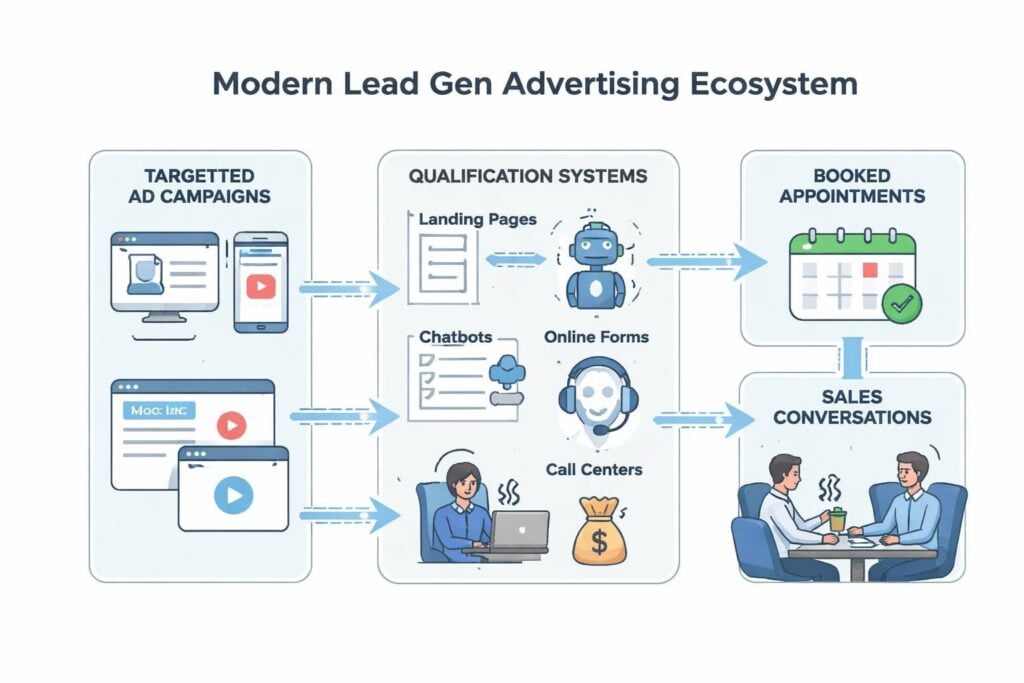
The landscape of customer acquisition has fundamentally transformed, and lead gen advertising stands at the center of this revolution. Businesses that master the art of attracting, qualifying, and converting prospects through strategic advertising campaigns consistently outperform competitors who rely on outdated marketing methods. Whether you're operating in financial services, real estate, or B2B sectors, understanding how to leverage paid advertising for lead generation determines whether you'll experience predictable growth or struggle with inconsistent revenue. In 2026, the winners aren't just running ads-they're building sophisticated systems that turn advertising spend into guaranteed returns.
Why Lead Gen Advertising Outperforms Traditional Marketing
Traditional marketing approaches cast wide nets, hoping to capture anyone remotely interested. Lead gen advertising takes the opposite approach, using precision targeting and value-driven messaging to attract people actively seeking solutions.
The difference lies in intent. When someone fills out a form after clicking your ad, they're raising their hand and expressing genuine interest. This fundamentally changes the sales conversation because you're no longer interrupting strangers-you're responding to people who've already taken action.
Key advantages of lead gen advertising include:
- Direct response measurement showing exact cost per lead
- Ability to scale campaigns based on proven metrics
- Higher conversion rates than awareness-based advertising
- Immediate feedback loops for optimization
- Qualification mechanisms built into the process
The most successful businesses treat lead gen advertising as a revenue-generating system, not a marketing expense. They understand that every dollar invested should produce measurable returns through qualified appointments and closed deals.
Building Your Lead Gen Advertising Foundation
Before launching campaigns, you need infrastructure that supports lead capture, qualification, and nurturing. Many businesses make the critical mistake of driving traffic to generic websites or unprepared sales teams, wasting advertising dollars on leads that never convert.
Your foundation starts with understanding exactly who you're targeting. Create detailed buyer personas that go beyond demographics to include pain points, objections, decision-making processes, and buying triggers. The more specific your targeting, the better your ad platforms can find qualified prospects.
Essential Infrastructure Components
| Component | Purpose | Impact on Results |
|---|---|---|
| Landing Pages | Capture lead information | 40-60% conversion rate difference |
| CRM System | Track and manage leads | 3-5x improvement in follow-up speed |
| Lead Scoring | Prioritize high-quality prospects | 25-40% sales efficiency gain |
| Automation Tools | Nurture leads at scale | 50-70% time savings |
| Analytics Dashboard | Monitor campaign performance | Real-time optimization capability |
Implementing a well-suited CRM system and proper infrastructure before launching campaigns prevents the chaos of managing leads through spreadsheets or email inboxes. Your systems should automatically capture lead data, assign scores based on qualification criteria, and trigger appropriate follow-up sequences.
The power of automation cannot be overstated. When someone submits their information at 2 AM, your automated system should immediately deliver value, confirm their request, and schedule next steps. Speed-to-lead remains one of the strongest predictors of conversion success, and automation ensures you never miss opportunities due to human limitations.
Crafting High-Converting Lead Gen Advertising Campaigns
The most effective lead gen advertising campaigns start with irresistible offers. Forget generic "contact us" or "get a quote" messaging-successful campaigns provide specific, valuable outcomes that solve immediate problems.
Your offer should feel like a no-brainer to your ideal prospect. This might be a free assessment, valuable report, exclusive training, or limited consultation. The key is making the value so obvious that requesting more information feels like the logical next step.
Winning offer characteristics:
- Specificity – "Free 30-Minute Revenue Growth Analysis" beats "Free Consultation"
- Immediacy – Deliver value quickly, not after multiple qualification calls
- Relevance – Address the exact problem your prospect faces right now
- Low friction – Minimize form fields and eliminate unnecessary barriers
- Clear value – Quantify the benefit whenever possible
When you focus on providing value to potential customers rather than immediately pushing for sales, you build trust that translates into higher conversion rates throughout your funnel. This approach transforms lead gen advertising from interruptive selling into helpful problem-solving.
Platform Selection and Budget Allocation
Different advertising platforms excel at different types of lead generation. Facebook and Instagram dominate for consumer-focused businesses and service providers, while LinkedIn delivers superior results for B2B and high-ticket offers. Google Search captures high-intent prospects actively looking for solutions.
Your platform choice should align with where your prospects spend time and what stage of awareness they occupy. For businesses in Facebook real estate lead generation or similar consumer markets, social platforms provide unmatched targeting granularity. For complex B2B sales, LinkedIn's professional targeting justifies higher costs per click.
Start with focused testing across 2-3 platforms maximum. Spreading budget too thin across multiple channels prevents you from gathering statistically significant data needed for optimization. Once you've proven a channel works, scale aggressively before expanding to new platforms.
Advanced Targeting and Audience Segmentation
Generic targeting produces generic results. The sophistication of your audience segmentation directly correlates with your cost per qualified lead and ultimate ROI from lead gen advertising campaigns.
Modern advertising platforms offer remarkable targeting capabilities. You can reach people based on behaviors, interests, job titles, company sizes, recent life events, and even purchase intent signals. The businesses winning at lead generation combine multiple targeting layers to find prospects with the highest probability of conversion.
Layered Targeting Strategy
Begin with broad demographic and firmographic criteria, then layer behavioral and intent signals. For example, a financial advisor might target individuals aged 45-65 with household incomes above $150,000 who've shown interest in retirement planning and recently visited competitor websites.
Lookalike audiences represent one of the most powerful targeting tools available. Upload your best customers' information, and platforms like Facebook will find people with similar characteristics. This approach leverages machine learning to identify prospects you might never have considered through manual targeting.
Retargeting campaigns deserve separate mention because they consistently deliver the lowest cost per lead. People who've visited your website, watched your videos, or engaged with previous content already know your brand. Retargeting keeps you top-of-mind and captures prospects when they're ready to take action.
Effective audience segments to test:
- Website visitors who spent 2+ minutes on specific pages
- Previous leads who didn't convert (re-engagement campaigns)
- Email list subscribers (for upsells or complementary services)
- Video viewers who watched 75% or more
- People who engaged with your content but haven't converted
Consider implementing the strategies outlined in our guide to generating qualified sales calls to ensure your targeting aligns with qualification criteria that predict actual sales potential, not just form submissions.
Creating Compelling Ad Creative That Converts
Your ad creative must stop the scroll, communicate value, and compel action-all within seconds. In 2026's attention economy, mediocre creative wastes advertising spend no matter how perfect your targeting.
The most effective lead gen advertising creative speaks directly to specific pain points using the language your prospects use. Avoid industry jargon and corporate-speak. Instead, address the frustrations, desires, and questions that keep your ideal customers awake at night.
Ad Format Performance Comparison
| Format | Best Use Case | Typical CTR | Conversion Strength |
|---|---|---|---|
| Video Ads | Complex offers, storytelling | 1.5-3% | High for education-first approaches |
| Carousel Ads | Multiple benefits, case studies | 1-2% | Medium-high with strong offers |
| Static Image | Direct offers, simple messages | 0.8-1.5% | High for clear value propositions |
| Lead Forms | Mobile users, low-friction leads | 2-4% | Medium (quality varies) |
Video continues dominating because it allows you to build connection and communicate complex value propositions. Even simple talking-head videos explaining how you solve problems outperform static images when properly scripted. The rise of short-form video platforms has trained audiences to consume video content, making it the default format for engagement.
Your headline determines whether people read further. Test benefit-driven headlines against question-based headlines, and always include specific outcomes. "How Financial Advisors Are Booking 15+ Qualified Appointments Weekly" outperforms "Financial Advisor Marketing Services" because it provides concrete results.
Optimizing Landing Pages for Maximum Conversion
Driving traffic to your homepage is amateur hour. Professional lead gen advertising campaigns send prospects to dedicated landing pages designed for one purpose: conversion.
Your landing page should match the message and visual style of your ad to maintain consistency. When someone clicks an ad about solving a specific problem, they should land on a page that immediately addresses that exact problem using similar language and imagery.
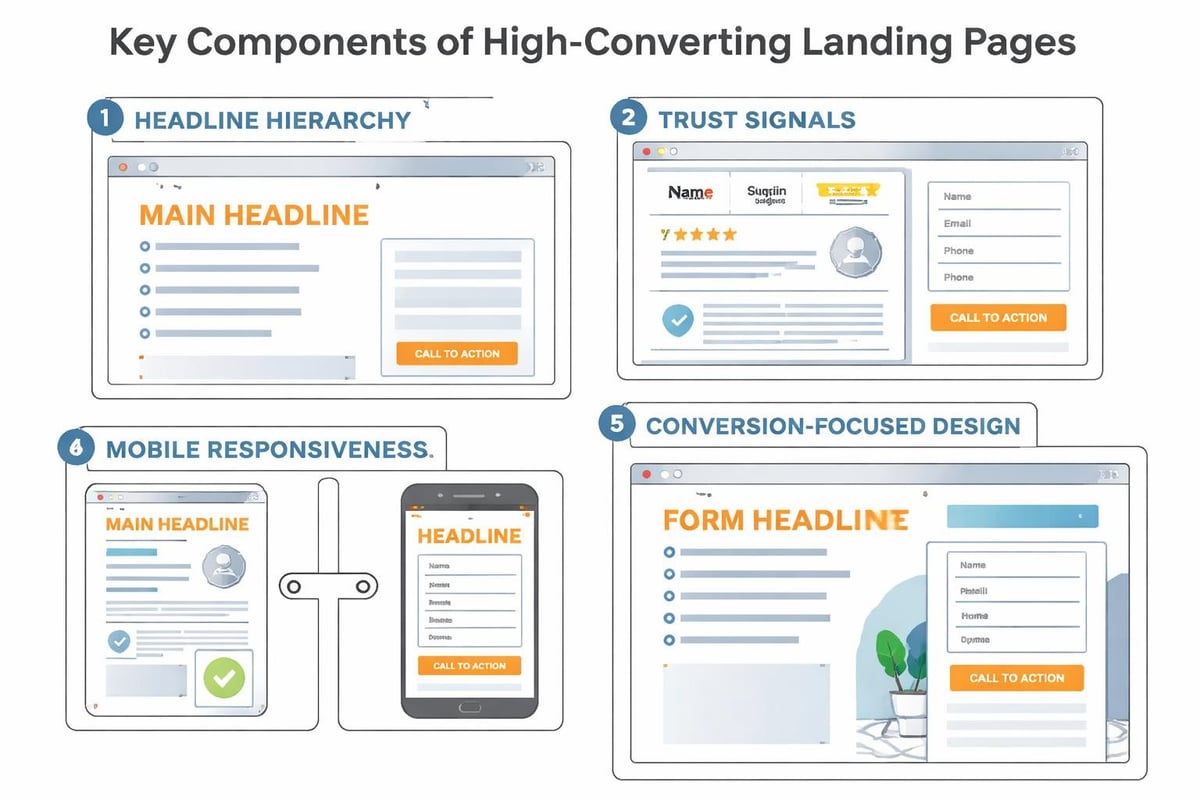
Essential landing page elements:
- Headline that reinforces the ad promise
- Clear explanation of what prospects receive
- Social proof (testimonials, logos, statistics)
- Simple form (3-5 fields maximum for cold traffic)
- Strong call-to-action button with action-oriented text
- Removal of navigation and exit opportunities
- Mobile-optimized design (60%+ of traffic is mobile)
The form length debate continues, but data consistently shows that shorter forms generate more leads while longer forms generate higher-quality leads. Test both approaches, but understand the trade-off. For high-ticket services, adding qualification questions to your form saves sales time even if submission rates drop.
Consider implementing the complete sales funnel strategy that has proven effective at converting cold traffic into qualified appointments through strategic landing page design and follow-up sequences.
Lead Qualification and Scoring Systems
Not all leads are created equal. Without proper qualification systems, your sales team wastes time on prospects who'll never buy while legitimate opportunities go cold.
Implement lead scoring that assigns point values based on demographic fit, behavioral signals, and engagement levels. Someone who matches your ideal customer profile, visited pricing pages, and submitted a form during business hours scores higher than someone with a generic email who bounced after 10 seconds.
Automated qualification questions built into your forms help segment leads before they reach your sales team. Questions about budget, timeline, decision-making authority, and specific needs separate tire-kickers from serious prospects.
Qualification Framework
Create tiers that determine follow-up priority and approach. Hot leads meeting all criteria get immediate phone calls. Warm leads enter nurture sequences with targeted content. Cold leads receive educational content designed to build interest over time.
By prioritizing quality over quantity, you build sustainable lead generation systems that deliver consistent revenue rather than overwhelming your team with unqualified contacts.
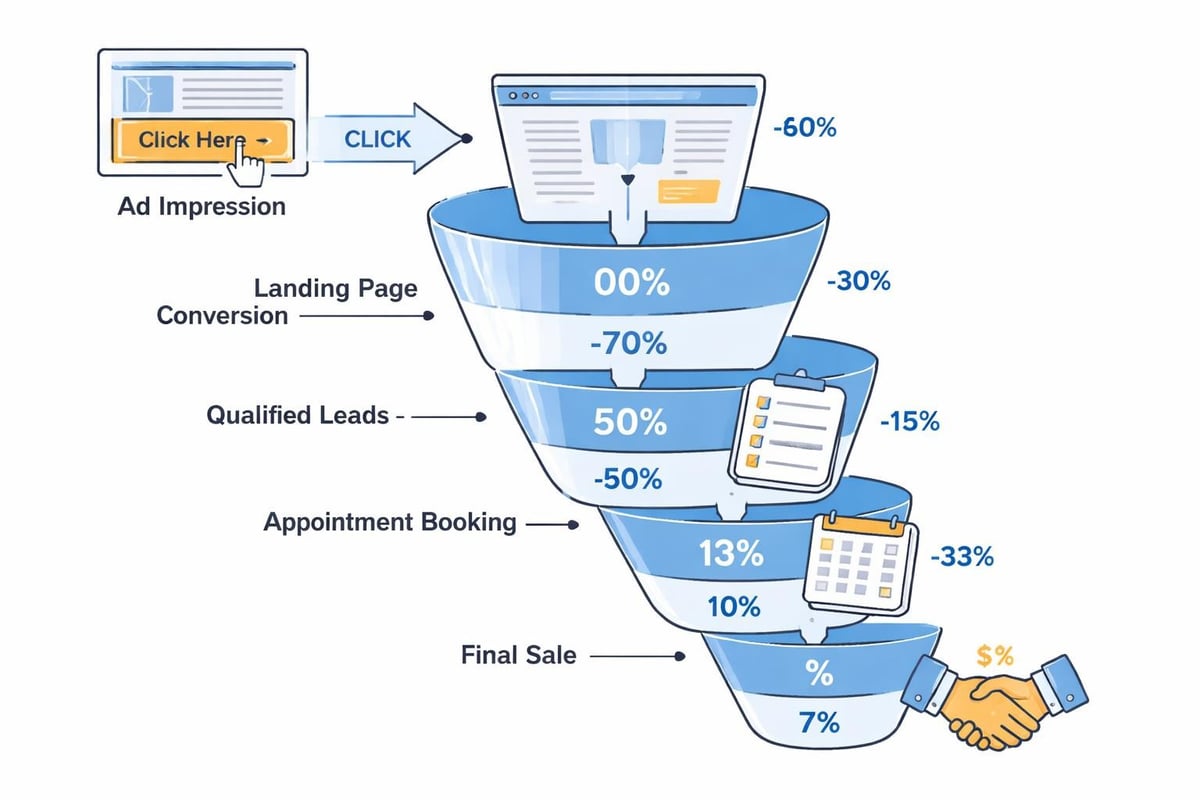
The businesses achieving the best results from lead gen advertising don't just count leads-they track progression through qualification stages, appointment show rates, proposal acceptance rates, and ultimate ROI. This data reveals where your funnel needs improvement and which campaigns deserve increased investment.
Follow-Up and Nurture Sequences That Close Deals
The fortune is in the follow-up. Studies show 80% of sales require five or more follow-up attempts, yet most businesses give up after one or two contacts. Your lead gen advertising investment only pays off when you have systematic follow-up processes.
Immediate response matters tremendously. Leads contacted within five minutes are 100 times more likely to convert than those contacted after 30 minutes. Automated confirmation emails, text messages, or even chatbots can provide instant engagement while human follow-up is prepared.
Effective multi-channel follow-up sequence:
- Instant automated email confirming submission and setting expectations
- Text message within 5 minutes (if phone number collected)
- Phone call within 15 minutes during business hours
- Video email explaining next steps if no answer (personalization increases open rates)
- Additional value-driven emails over 7-14 days
- Retargeting ads maintaining visibility for non-responders
Your nurture sequences should educate, build trust, and address objections rather than constantly pushing for sales. Share case studies, answer common questions, provide valuable insights, and demonstrate expertise. This approach follows lead generation best practices by offering high-value content that moves prospects toward buying decisions.
Different lead sources require different nurture approaches. Someone who downloaded a free guide needs more education than someone who requested a price quote. Segment your follow-up based on the action taken and information provided.
Measuring and Scaling Successful Campaigns
What gets measured gets improved. The difference between profitable lead gen advertising and money-burning campaigns often comes down to tracking the right metrics and acting on the data.
Vanity metrics like impressions and clicks don't pay bills. Focus on metrics that directly correlate with revenue: cost per lead, lead-to-appointment rate, appointment-to-sale rate, customer acquisition cost, and lifetime value.
Critical Performance Metrics
| Metric | Why It Matters | Target Benchmark |
|---|---|---|
| Cost Per Lead (CPL) | Direct advertising efficiency | Industry-dependent |
| Lead Quality Score | Predicts conversion probability | 70%+ meeting criteria |
| Lead-to-Appointment Rate | Shows qualification effectiveness | 30-50% for qualified leads |
| Appointment Show Rate | Indicates prospect engagement | 60-80% with confirmations |
| Close Rate | Ultimate campaign effectiveness | 20-40% from qualified appointments |
| Customer Lifetime Value | Long-term campaign profitability | 3-5x acquisition cost |
Track these metrics at the campaign, ad set, and individual ad level. This granular data reveals exactly which targeting, creative, and offers produce the best results. Double down on winners and ruthlessly cut losers.
Attribution becomes complex when prospects interact with multiple touchpoints before converting. Implement UTM parameters, call tracking, and form source tracking to understand the full customer journey. Many sales occur days or weeks after the initial ad click, so your attribution window needs to capture delayed conversions.
Understanding how to build a successful marketing agency strategy helps you think systematically about campaign optimization and scaling rather than making random adjustments based on gut feelings.
Budget Management and ROI Optimization
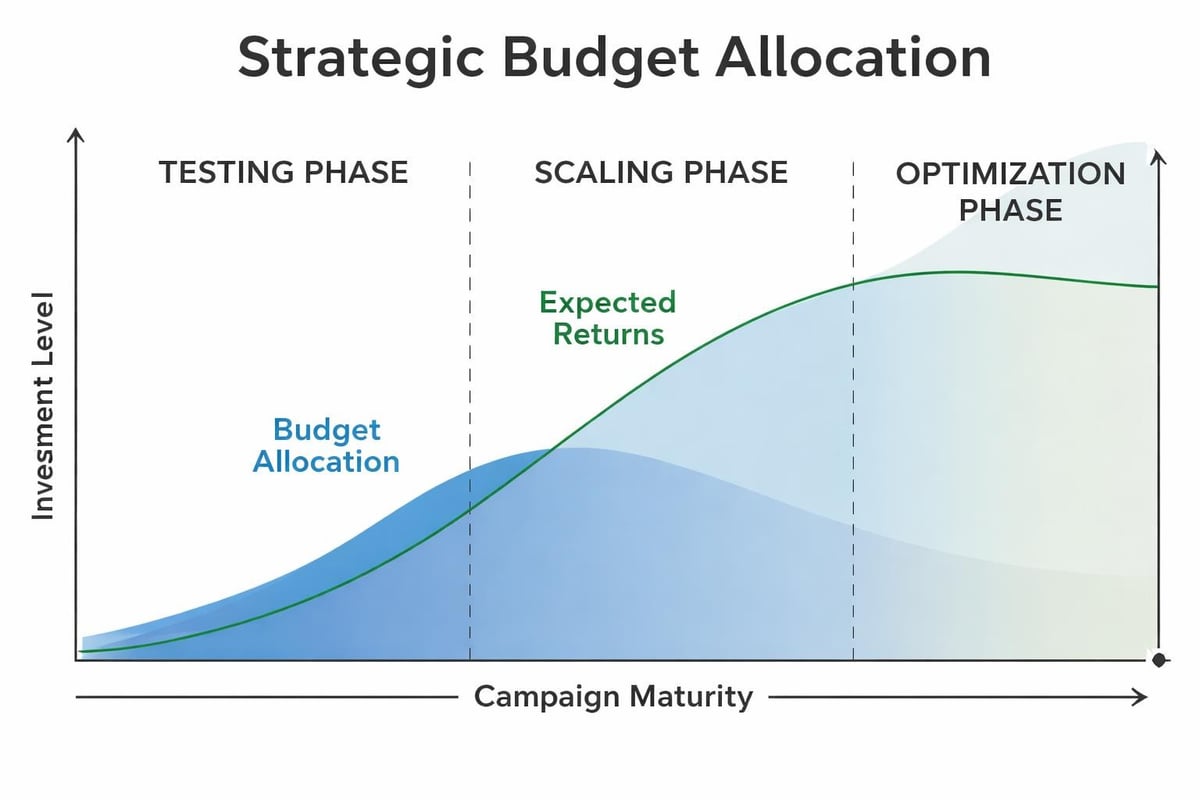
Smart budget allocation separates profitable lead gen advertising from cash-burning experiments. Start with testing budgets designed to gather statistical significance, then scale based on proven performance.
A common mistake is spreading budgets too thin across too many campaigns. Better to fully fund three campaigns with $1,000 each than underfund ten campaigns with $300 each. Adequate budgets allow algorithms to optimize and provide data needed for confident decisions.
Front-load your budget during testing phases to accelerate learning. Once you've identified winning combinations of targeting, creative, and offers, shift to consistent daily budgets that maintain optimal delivery without overspending.
Calculate your maximum allowable cost per acquisition based on customer lifetime value and desired profit margins. If your average customer generates $5,000 in profit and you want a 3:1 return, you can spend up to $1,667 to acquire each customer. Working backward from this number determines your acceptable cost per lead based on historical conversion rates.
Reserve 20-30% of your budget for ongoing testing. Markets change, audiences become saturated, and competitors enter the space. Continuous testing of new approaches prevents performance degradation and uncovers opportunities for improvement.
Common Mistakes Destroying Lead Gen Advertising ROI
Even experienced marketers make costly mistakes that tank campaign performance. Awareness of these pitfalls helps you avoid expensive lessons.
The biggest lead gen advertising mistakes:
- Sending traffic to your homepage instead of dedicated landing pages – Conversion rates drop 50-70%
- Using generic "contact us" offers instead of specific value propositions – Dramatically reduces response
- Ignoring mobile experience when 60%+ traffic comes from mobile devices – Wastes majority of ad spend
- Stopping campaigns before gathering sufficient data – Prevents proper optimization
- Failing to align sales team on lead handling – Converts fewer leads despite quality traffic
- Not tracking phone calls as conversions – Misses 30-50% of lead generation value
- Neglecting retargeting campaigns – Ignores your warmest, lowest-cost prospects
- Using the same creative for months without refreshing – Causes ad fatigue and rising costs
The sales and marketing misalignment problem deserves special attention. Your lead gen advertising can be perfect, but if sales doesn't follow up promptly or understand how to handle inbound leads, conversion rates plummet. Regular communication between teams about lead quality, timing, and expectations ensures everyone works toward the same goals.
Many businesses also make the mistake outlined in discussions about why cold outreach is failing by treating leads like cold prospects. These people already raised their hands-they deserve warm, helpful engagement, not aggressive sales pitches.
Advanced Strategies for Competitive Markets
When operating in crowded markets where everyone runs lead gen advertising, you need differentiation strategies that cut through noise.
Offer stacking creates irresistible propositions by combining multiple valuable elements. Instead of offering a free consultation, offer a free consultation plus a customized analysis plus a detailed action plan. The perceived value increases dramatically while your actual cost stays relatively low.
Guarantee-based offers reduce risk and increase conversion rates. "Book a consultation and if you don't learn at least three actionable strategies, we'll send you $100" demonstrates confidence and removes the prospect's fear of wasted time.
Exclusivity and scarcity drive action when used authentically. Limiting availability to X prospects per month or offering bonuses for immediate action creates urgency. Never manufacture false scarcity-your reputation depends on authenticity.
Consider the multichannel approach recommended in best lead generation strategies by coordinating paid advertising with content marketing, email campaigns, and strategic partnerships. This creates multiple touchpoints that reinforce your message and build trust faster than advertising alone.
Partnership opportunities multiply your reach without multiplying costs. Identify complementary businesses serving the same audience and create co-marketing campaigns where you share lead generation costs and results. A mortgage broker and real estate agent partnership, for example, benefits both parties.
Technology and AI in Modern Lead Gen Advertising
Artificial intelligence has revolutionized lead gen advertising efficiency. Machine learning algorithms optimize bidding, predict conversion probability, and identify high-value audiences with accuracy impossible through manual management.
Predictive lead scoring uses AI to analyze thousands of data points and identify which leads are most likely to convert. This technology learns from your historical data, continuously improving accuracy as it processes more information about which characteristics predict sales.
Chatbots and conversational AI provide immediate engagement 24/7, answering questions, qualifying prospects, and even booking appointments while your team sleeps. The technology has advanced beyond robotic responses to natural conversations that prospects prefer to waiting for business hours.
Dynamic creative optimization automatically tests different combinations of headlines, images, and calls-to-action, identifying winning combinations faster than manual A/B testing. Platforms like Facebook and Google use machine learning to serve the best-performing creative variations to each audience segment.
Automation platforms connect your advertising, CRM, email marketing, and appointment scheduling into seamless workflows. When someone submits a form, automation can instantly send confirmation, add them to your CRM, trigger nurture sequences, and notify your sales team-all without human intervention.
The businesses implementing B2B lead generation tools and AI-powered systems consistently outperform competitors relying on manual processes because they respond faster, personalize better, and never miss opportunities due to human limitations.
Successful lead gen advertising requires strategic thinking, systematic execution, and continuous optimization based on performance data. The businesses thriving in 2026 understand that paid advertising isn't an expense-it's an investment that should generate predictable, profitable returns when managed properly. By implementing the frameworks, strategies, and best practices outlined above, you position your business to capture market share and achieve sustainable growth. If you're ready to transform your advertising into a revenue-generating system backed by advanced AI technology and proven methodologies, Adstra provides guaranteed growth partnerships that align our success with yours, delivering qualified leads and automated appointments that drive predictable revenue growth.