


The traditional sales funnel is broken. Cold outreach gets ignored, paid ads drain budgets without delivering qualified prospects, and marketing teams struggle to prove ROI. That's where demand gen marketing enters the conversation as a transformative approach that prioritizes education over interruption, relationships over transactions, and sustainable pipeline growth over vanity metrics. Unlike outdated lead generation tactics that focus solely on volume, demand generation creates genuine interest in your solutions by delivering value first. For companies seeking predictable revenue growth in 2026, understanding and implementing strategic demand generation programs isn't optional-it's essential for survival and competitive advantage.
What Makes Demand Gen Marketing Different
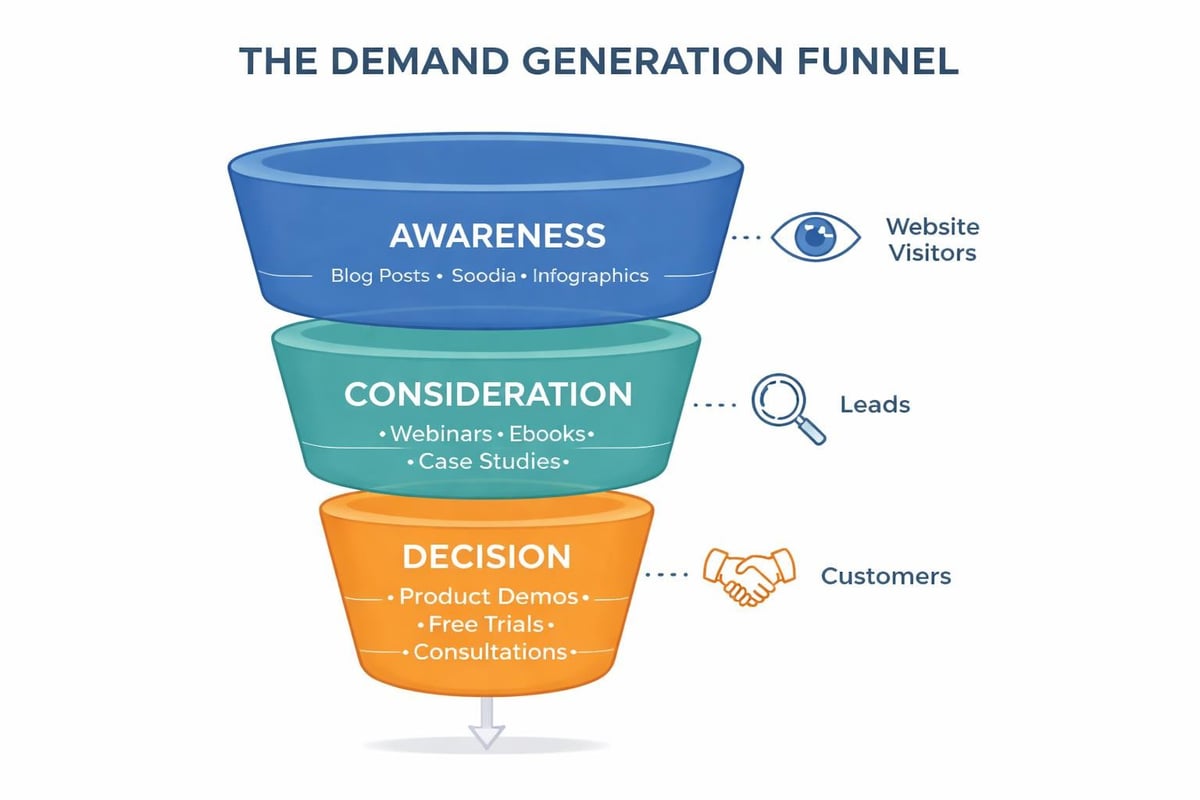
Demand gen marketing represents a fundamental shift from traditional lead generation approaches. While conventional tactics focus on capturing contact information as quickly as possible, demand generation builds awareness and nurtures interest throughout the entire buyer journey.
The distinction matters because modern buyers conduct extensive research before engaging with sales teams. They consume content, compare solutions, and form opinions long before filling out a contact form. Demand generation acknowledges this reality by creating educational resources that address pain points, demonstrate expertise, and build trust gradually.
Traditional lead generation often relies on gated content and form fills that create friction in the buyer journey. Demand gen marketing takes a different approach:
- Ungated educational content that builds brand awareness
- Multi-touch nurture sequences that educate rather than sell
- Account-based strategies targeting ideal customer profiles
- Intent signal monitoring to identify sales-ready prospects
- Revenue attribution models that track impact across touchpoints
This strategic difference transforms how marketing teams measure success. Instead of celebrating MQL counts that never convert, B2B lead generation focused on demand generation emphasizes pipeline contribution and revenue influence.
The Revenue Impact of Strategic Demand Generation
The financial case for demand gen marketing proves compelling when executed properly. Consider the results documented in this demand generation case study, where a targeted campaign transformed a $60,000 advertising investment into $3.7 million in increased revenue-a staggering 61x return.
These outcomes don't happen by accident. They result from systematic approaches that align marketing activities with buyer needs at each stage of the journey. Companies implementing robust demand generation frameworks report:
| Metric | Average Improvement | Time Frame |
|---|---|---|
| Qualified Lead Volume | 45-60% increase | 6-9 months |
| Sales Cycle Length | 20-30% reduction | 3-6 months |
| Customer Acquisition Cost | 25-40% decrease | 9-12 months |
| Pipeline Conversion Rate | 35-50% improvement | 6-12 months |
The compounding effect of these improvements creates sustainable competitive advantages. Marketing teams using AI-powered lead generation within their demand generation programs accelerate these timelines while improving targeting precision.
Building Your Demand Gen Marketing Framework
Creating an effective demand generation program requires more than scattered tactics. You need a cohesive framework that guides prospects from initial awareness through purchase decision systematically.
Audience Definition and Segmentation
Everything starts with knowing exactly who you're targeting. Generic messaging produces generic results. Demand gen marketing demands precision in audience definition through:
- Ideal Customer Profile (ICP) development based on firmographic data, behavioral patterns, and success indicators
- Buyer persona creation that captures roles, responsibilities, pain points, and decision criteria
- Account segmentation prioritizing high-value opportunities based on fit and intent signals
- Journey stage mapping understanding content needs at awareness, consideration, and decision phases
According to Informa TechTarget’s B2B demand generation guide, companies that invest time in rigorous audience definition achieve 73% higher conversion rates than those using broad targeting approaches.
This precision becomes particularly important when implementing LinkedIn B2B lead generation campaigns where targeting capabilities allow for sophisticated audience building.
Content Strategy Aligned to Buyer Stages
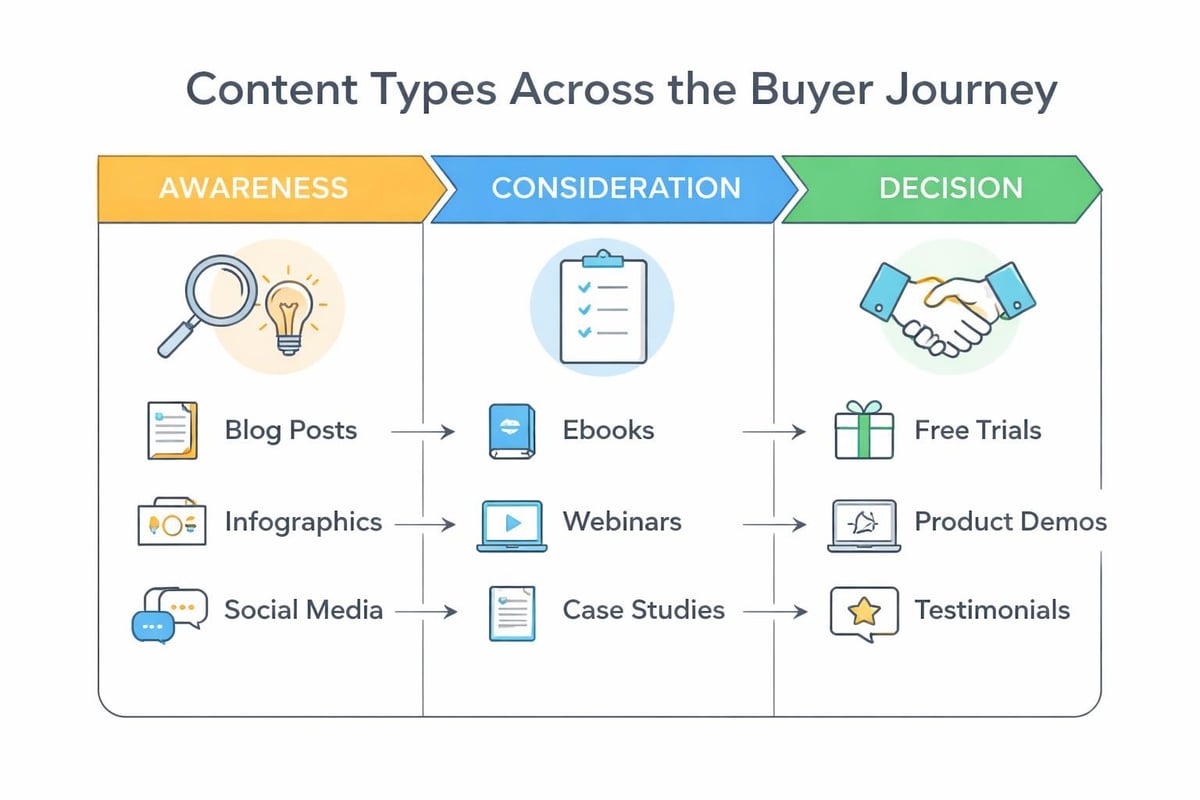
Content fuels demand generation engines, but random content creation wastes resources. Strategic demand gen marketing aligns content formats and topics to specific buyer journey stages.
Awareness stage content answers fundamental questions and establishes thought leadership:
- Industry trend reports and research
- Educational blog posts addressing common challenges
- Social media content demonstrating expertise
- Podcasts and webinars exploring relevant topics
Consideration stage content helps buyers evaluate potential solutions:
- Comparison guides explaining different approaches
- Case studies demonstrating proven results
- Product demonstrations showing capabilities
- Expert interviews providing third-party validation
Decision stage content removes final purchase obstacles:
- ROI calculators quantifying potential value
- Implementation guides reducing perceived risk
- Free trials or assessments providing hands-on experience
- Customer testimonials confirming capabilities
The Demand Metric best practices guide emphasizes creating content hubs organized around buyer questions rather than product features, making it easier for prospects to find relevant information.
Implementing Multi-Channel Distribution
Creating brilliant content means nothing if your target audience never sees it. Demand gen marketing requires strategic distribution across channels where your buyers actively engage.
Channel Selection Based on Audience Behavior
Different audiences consume content through different channels. B2B technology buyers might prefer LinkedIn and industry publications, while financial services professionals engage through email newsletters and professional associations.
High-performing demand generation programs typically leverage:
- Organic search for prospects actively researching solutions
- LinkedIn for professional B2B audience targeting
- Email nurture sequences for ongoing relationship building
- Industry partnerships for credibility transfer and reach
- Paid social for targeted awareness campaigns
- Content syndication for expanded reach in trade publications
The key isn't being everywhere-it's being where your specific audience spends time. Top lead generation companies focus resources on the 2-3 channels that deliver the highest quality engagement rather than spreading efforts thin across every platform.
Creating Integrated Campaign Experiences
Individual touchpoints matter less than cohesive campaign experiences. Demand gen marketing orchestrates multiple interactions that build on each other, creating momentum toward conversion.
Consider how an integrated campaign might flow:
- Awareness touchpoint: Target audience sees thought leadership content on LinkedIn
- Engagement touchpoint: Interested prospects visit website and consume related blog posts
- Nurture touchpoint: Visitors receive email series expanding on key concepts
- Education touchpoint: Email subscribers invited to webinar demonstrating approaches
- Qualification touchpoint: Webinar attendees offered assessment or consultation
- Sales enablement touchpoint: Qualified prospects receive personalized outreach with relevant resources
This orchestrated approach, detailed in Digitopia’s demand generation framework, creates multiple opportunities for prospects to engage at their preferred pace while consistently moving them toward sales readiness.
Leveraging Technology and Automation
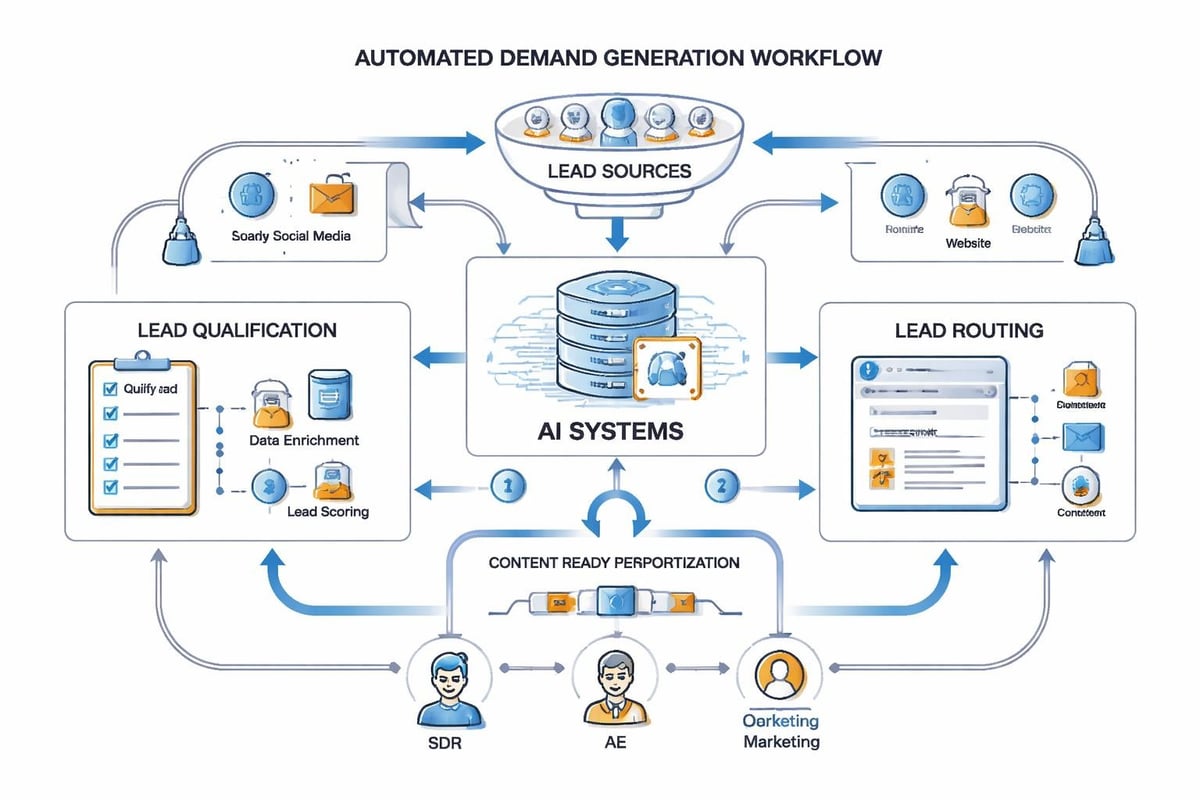
Manual demand generation doesn't scale. Modern programs require technology infrastructure that automates repetitive tasks while personalizing experiences based on prospect behavior.
Essential Technology Stack Components
Your demand gen marketing technology foundation should include:
| Technology Category | Primary Function | Key Capabilities |
|---|---|---|
| Marketing Automation Platform | Campaign execution and nurture | Email workflows, scoring, segmentation |
| CRM System | Lead management and sales handoff | Pipeline tracking, activity logging, reporting |
| Analytics Platform | Performance measurement | Attribution modeling, ROI tracking, funnel analysis |
| Content Management System | Content publishing and optimization | SEO tools, A/B testing, personalization |
| Intent Data Provider | Buyer signal identification | Account monitoring, engagement tracking |
The integration between these systems matters as much as individual capabilities. Disconnected tools create data silos that obscure the buyer journey and prevent effective optimization.
AI-Powered Demand Generation Capabilities
Artificial intelligence transforms demand generation from educated guessing to data-driven precision. AI systems enhance demand gen marketing by:
- Predicting lead quality based on historical conversion patterns
- Personalizing content recommendations matching prospect interests and journey stage
- Optimizing send times for maximum email engagement
- Identifying lookalike audiences for paid campaign targeting
- Automating lead scoring using behavioral and firmographic signals
Companies implementing social media funnel strategies powered by AI achieve 40% higher conversion rates by delivering the right content to the right prospects at precisely the right moment.
Measuring and Optimizing Performance
What you measure determines what you optimize. Demand gen marketing requires metrics that connect marketing activities to actual revenue outcomes, not just activity vanity metrics.
Revenue-Focused KPIs That Matter
Traditional marketing metrics like impressions, clicks, and even MQLs often mislead teams into celebrating activity rather than results. Revenue-focused demand generation tracks:
Pipeline Generation Metrics:
- Marketing-sourced pipeline value
- Marketing-influenced pipeline value
- Pipeline conversion rates by source
- Time-to-opportunity from first touch
Revenue Attribution Metrics:
- Marketing-sourced revenue
- Marketing-influenced revenue
- Customer acquisition cost (CAC)
- Customer lifetime value (LTV)
- Return on marketing investment (ROMI)
Efficiency Metrics:
- Cost per qualified opportunity
- Lead-to-opportunity conversion rate
- Opportunity-to-customer conversion rate
- Average sales cycle length
These metrics shift conversations from "how many leads did we generate?" to "how much pipeline and revenue did marketing contribute?" That transformation aligns marketing with business objectives and justifies continued investment in demand generation programs.
Continuous Testing and Refinement
Demand gen marketing excellence requires systematic testing across channels, messages, offers, and timing. High-performing programs implement:
- A/B testing for email subject lines, landing page designs, and CTA copy
- Multivariate testing for complex campaign variables
- Channel mix experiments comparing ROI across distribution platforms
- Audience segmentation tests identifying highest-converting personas
- Content format experiments determining preferred consumption methods
The insights from ViralBrain’s data-backed demand generation practices demonstrate that companies conducting regular testing improve campaign performance by 35% annually through incremental optimizations.
Aligning Sales and Marketing for Demand Generation Success
Even the most sophisticated demand gen marketing programs fail without tight sales and marketing alignment. Disconnected teams create friction in the buyer journey and waste qualified opportunities.
Establishing Shared Definitions and Processes
Sales and marketing must agree on fundamental definitions before executing demand generation strategies:
Lead qualification criteria including:
- Firmographic requirements (company size, industry, location)
- Behavioral signals (content consumed, engagement frequency)
- Budget availability and timeline
- Decision-making authority
Service level agreements (SLAs) specifying:
- Response time expectations for qualified leads
- Follow-up frequency and persistence requirements
- Feedback mechanisms for lead quality assessment
- Closed-loop reporting on opportunity outcomes
Handoff processes defining:
- When leads transition from marketing to sales
- What information sales receives with each lead
- How sales communicates outcomes back to marketing
- Escalation procedures for disputed lead quality
Creating these shared frameworks eliminates the finger-pointing that undermines demand generation effectiveness. When both teams operate from the same playbook, conversion rates improve dramatically.
Revenue Operations for Demand Generation
Progressive organizations implement revenue operations (RevOps) functions that unite marketing, sales, and customer success around shared revenue goals. This structural alignment ensures demand gen marketing efforts connect directly to business outcomes.
RevOps teams focus on:
- Unified data infrastructure eliminating discrepancies between marketing and sales systems
- Cross-functional process design removing handoff friction throughout the buyer journey
- Holistic performance analytics tracking customer acquisition economics from first touch through renewal
- Technology integration ensuring seamless information flow between platforms
- Revenue forecasting using marketing and sales data for predictive modeling
Organizations with mature RevOps functions achieve 19% faster revenue growth and 15% higher profitability compared to siloed operations, according to industry research.
Scaling Demand Generation Programs
Once core demand gen marketing foundations prove effective, strategic scaling amplifies results without proportionally increasing costs.
Expanding to New Markets and Segments
Successful demand generation in one market creates replicable frameworks for expansion. Apply proven approaches to new segments by:
- Adapting messaging to address segment-specific pain points while maintaining core value propositions
- Localizing content for geographic or industry variations
- Developing segment-specific case studies demonstrating relevant success stories
- Creating specialized landing pages optimized for segment search behavior
- Testing channel mix variations accounting for segment media consumption differences
Start with adjacent segments sharing similar characteristics to your proven market. This approach reduces risk while building momentum. For example, financial advisor lead generation success might expand to wealth management firms or insurance agencies using similar frameworks.
Building Content Velocity Through Repurposing
Content creation represents the largest investment in demand generation programs. Maximize ROI by systematically repurposing core assets across formats and channels.
A single webinar generates:
- Blog post summarizing key points
- Short video clips for social media
- Podcast episode audio
- Infographic visualizing main concepts
- Email nurture series expanding on themes
- SlideShare presentation for LinkedIn
- Case study template based on examples shared
This multiplicative approach builds content libraries rapidly while reinforcing key messages across touchpoints. The repetition strengthens brand recall and positions your company as the definitive expert on specific topics.
Advanced Demand Generation Tactics for 2026
As demand gen marketing matures, sophisticated tactics separate market leaders from followers. Consider implementing these advanced approaches once foundational programs demonstrate consistent performance.
Intent Data and Predictive Analytics
Intent data reveals which accounts actively research solutions in your category, even before they visit your website. This intelligence allows hyper-targeted campaigns reaching prospects at peak interest.
Intent signals include:
- Content consumption patterns across industry websites
- Search behavior indicating solution evaluation
- Technology stack changes suggesting buying cycles
- Job posting patterns revealing growth initiatives
- Leadership changes creating opportunity windows
Predictive analytics combine intent signals with firmographic and behavioral data, scoring accounts by purchase probability. This prioritization focuses expensive resources on highest-potential opportunities.
Account-Based Demand Generation
Traditional demand generation casts wide nets hoping to catch qualified fish. Account-based approaches flip this model, targeting specific high-value accounts with personalized campaigns.
Key elements include:
- Account selection identifying ideal targets worth concentrated investment
- Research and intelligence gathering deep insights into account priorities and challenges
- Personalized content creation addressing specific account situations
- Coordinated multi-channel engagement reaching multiple stakeholders simultaneously
- Sales and marketing orchestration ensuring consistent messaging across all touchpoints
Lead generation for digital agencies often benefits from account-based approaches given typically smaller total addressable markets and higher customer values justifying the investment.
Community-Led Demand Generation
Building communities around shared interests creates organic demand generation engines that compound value over time. Active communities generate awareness, education, and peer validation simultaneously.
Community formats include:
- Private Slack or Discord groups for practitioners
- LinkedIn groups focused on industry topics
- User conferences and local meetups
- Certification programs establishing standards
- Contribution platforms crowdsourcing insights
The beauty of community-led demand gen marketing lies in member-generated content and peer recommendations that carry more weight than company messaging. Community members become advocates, amplifying reach and credibility exponentially.
Demand gen marketing represents the evolution from interruptive, transactional tactics to educational, relationship-focused strategies that create sustainable competitive advantages. By implementing the frameworks, technologies, and practices outlined above, you'll build predictable pipeline that converts efficiently and scales systematically. Ready to transform your approach from scattered lead generation to strategic demand generation? Adstra leverages advanced AI systems and proven frameworks to generate qualified sales leads and automate appointment bookings, providing a guaranteed growth partnership model that aligns our success with yours.