


The marketing landscape has transformed dramatically, and agencies that cling to outdated growth models are watching their competitors sprint ahead. While traditional agencies struggle with unpredictable revenue and client churn, forward-thinking firms are leveraging AI systems, automated lead generation, and transparent partnership models to achieve exponential marketing agency growth. The difference between stagnation and success in 2026 isn't about working harder-it's about implementing the right systems that transform how you acquire, convert, and retain clients at scale.
The Foundation of Sustainable Marketing Agency Growth
Building a thriving agency requires more than just delivering great work. You need predictable systems that generate qualified leads consistently, convert prospects efficiently, and retain clients for the long term.
The three pillars of sustainable growth include:
- Systematic lead generation that operates independently of your daily efforts
- Conversion processes that qualify prospects before they reach your sales team
- Retention strategies that turn one-time clients into long-term partnerships
Many agencies make the critical mistake of focusing exclusively on acquisition while neglecting the systems that drive retention and referrals. According to research on modern agency growth strategies, agencies that prioritize the full customer journey-from first touch to advocacy-achieve 3x higher growth rates than those focused solely on new client acquisition.
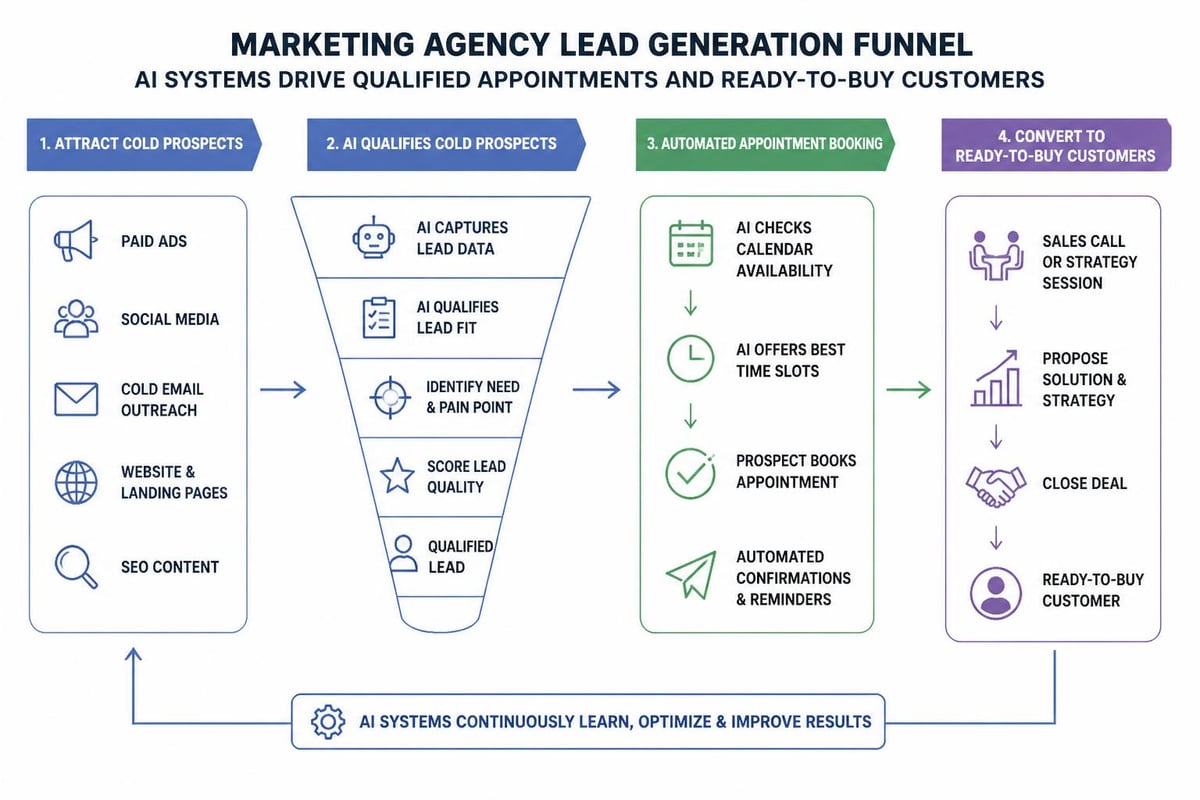
The traditional agency model creates a feast-or-famine cycle. You land a big client, deliver excellent work, then scramble to find the next opportunity. This reactive approach keeps you trapped in service delivery mode rather than strategic growth mode.
Breaking this cycle requires:
- Implementing automated lead generation systems that work 24/7
- Creating qualification frameworks that filter out tire-kickers
- Developing standardized service offerings that deliver consistent results
- Building technology stacks that reduce manual effort and increase margins
Understanding how top lead generation companies structure their operations provides valuable insights into scaling your own agency effectively.
Leveraging AI Systems for Accelerated Growth
Artificial intelligence has shifted from buzzword to business necessity. Agencies that integrate AI into their core operations are experiencing marketing agency growth rates that seemed impossible just two years ago.
The strategic application of AI transforms every stage of your agency's growth funnel. From identifying ideal prospects to personalizing outreach at scale, AI eliminates the manual bottlenecks that previously limited agency expansion.
Automated Lead Generation and Qualification
Traditional lead generation required massive time investments for uncertain returns. Modern AI systems flip this equation entirely. By analyzing millions of data points, AI identifies prospects showing genuine buying signals and automatically initiates personalized outreach sequences.
| Traditional Approach | AI-Powered Approach |
|---|---|
| Manual prospect research (2-3 hours per lead) | Automated identification (minutes) |
| Generic outreach templates | Hyper-personalized messaging |
| 2-5% response rates | 15-25% response rates |
| Unpredictable pipeline | Consistent lead flow |
The shift toward AI tools in marketing has fundamentally changed how agencies operate. Instead of hiring additional SDRs to scale outreach, agencies deploy AI systems that handle initial qualification, follow-up sequences, and appointment scheduling autonomously.
Consider the transformation when you replace manual prospecting with intelligent automation. Your team focuses on high-value activities-strategy, relationship building, and closing deals-while AI handles the repetitive tasks that previously consumed 60-80% of their time.
Key AI applications driving agency growth:
- Predictive lead scoring that identifies prospects most likely to convert
- Natural language processing for personalized outreach at scale
- Automated appointment booking that eliminates scheduling friction
- Dynamic campaign optimization based on real-time performance data
- Sentiment analysis for improved client communication
Implementing these systems isn't about replacing your team-it's about amplifying their effectiveness. One strategist supported by AI can accomplish what previously required an entire department.
Building Specialized Service Offerings That Scale
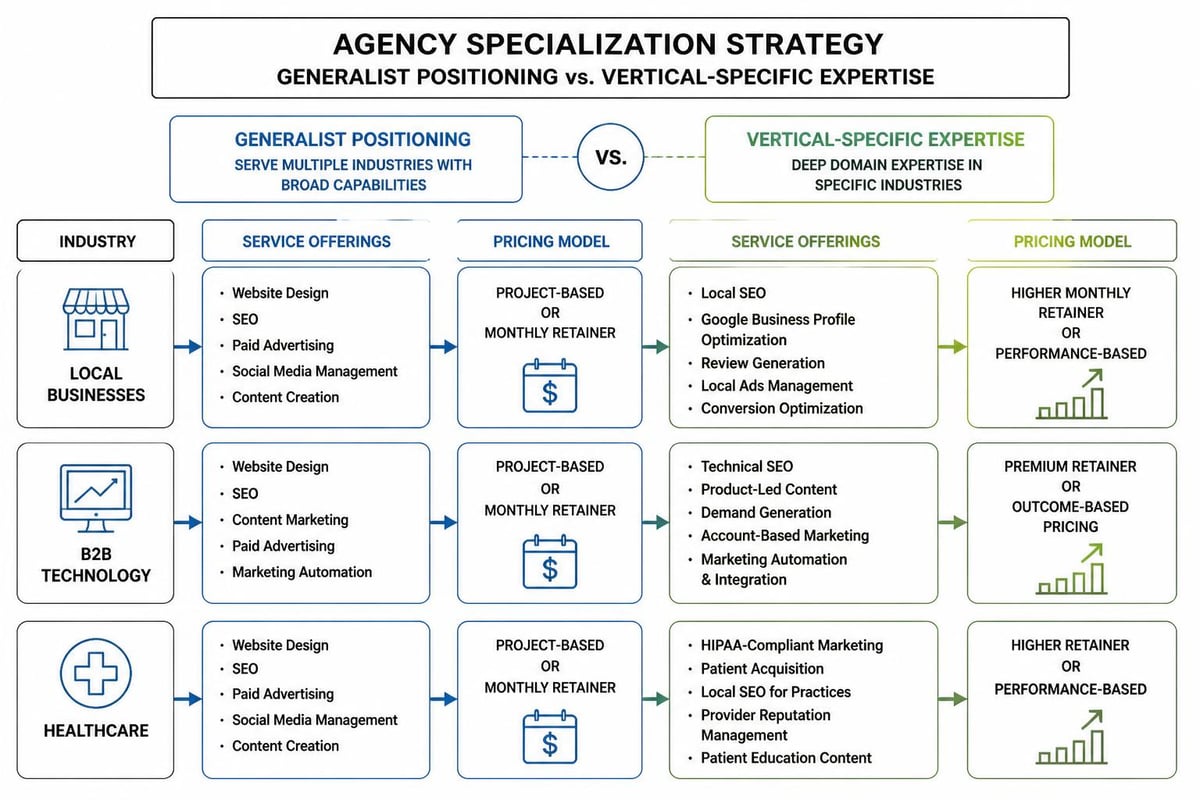
Generic "full-service" agencies face an uphill battle in 2026. Specialization drives marketing agency growth by establishing authority, commanding premium pricing, and attracting ideal clients who value expertise over commodity services.
The most successful agencies narrow their focus to specific industries or service categories where they can deliver exceptional, repeatable results. This specialization creates a flywheel effect: better results lead to stronger testimonials, which attract more qualified prospects, enabling further service refinement.
The Specialization Advantage
When you try to serve everyone, you dilute your message, complicate your operations, and compete primarily on price. Specialization allows you to develop deep expertise, create standardized processes, and build case studies that speak directly to your ideal clients' challenges.
A case study examining digital agency growth demonstrates how focusing on specific verticals and implementing AI-powered lead generation systems enabled one agency to achieve 300% growth within 18 months.
Benefits of service specialization include:
- Higher conversion rates (specialized messaging resonates deeply)
- Premium pricing (expertise commands higher fees than generalist work)
- Operational efficiency (standardized processes reduce delivery costs)
- Referral momentum (satisfied clients know exactly who to refer)
- Content authority (specialized insights attract inbound opportunities)
Consider how agencies focusing on B2B lead generation build systems and expertise that generalists simply cannot match. They understand the nuances of complex sales cycles, multi-stakeholder decisions, and relationship-driven conversions.
The visual representation of your agency's positioning matters significantly in today's digital-first world. Working with specialists like Leone Finzi, who creates tailored digital experiences that reflect each business's unique value proposition, ensures your online presence communicates your expertise effectively to attract the right clients.
Implementing Systems for Predictable Revenue
Marketing agency growth stalls when revenue remains unpredictable. Sustainable expansion requires systems that generate consistent results regardless of market conditions or team availability.
The difference between struggling agencies and thriving ones often comes down to systematization. Every client interaction, every campaign launch, every reporting cycle should follow documented processes that ensure quality while reducing dependency on individual team members.
Creating Your Growth Operating System
Your agency needs an operating system-a collection of interconnected processes, technologies, and frameworks that drive predictable outcomes. This system encompasses everything from how you attract prospects to how you deliver client results and measure success.
Core components of a growth operating system:
- Lead Generation Engine: Automated systems that consistently produce qualified prospects
- Conversion Framework: Documented sales processes that move prospects through your pipeline
- Delivery Methodology: Standardized approaches that ensure consistent client outcomes
- Technology Stack: Integrated tools that eliminate manual work and provide real-time insights
- Metrics Dashboard: Clear KPIs that indicate system health and growth trajectory
Many agencies exploring how to grow effectively discover that their biggest limitation isn't talent or market opportunity-it's the absence of scalable systems. When every project requires custom approaches and heroic individual effort, growth becomes exponentially harder.
| System Component | Without Systematization | With Systematization |
|---|---|---|
| Client Onboarding | 3-5 hours, inconsistent | 45 minutes, standardized |
| Campaign Setup | 2-3 days, error-prone | 4-6 hours, templated |
| Reporting | 4-6 hours monthly | Automated real-time |
| Team Training | 6-8 weeks per person | 2-3 weeks with SOPs |
The agencies achieving exceptional marketing agency growth in 2026 have moved beyond ad-hoc execution to systematic excellence. They've documented what works, automated the repeatable parts, and focus human creativity on strategy and optimization rather than routine tasks.
Client Retention: The Multiplier Effect
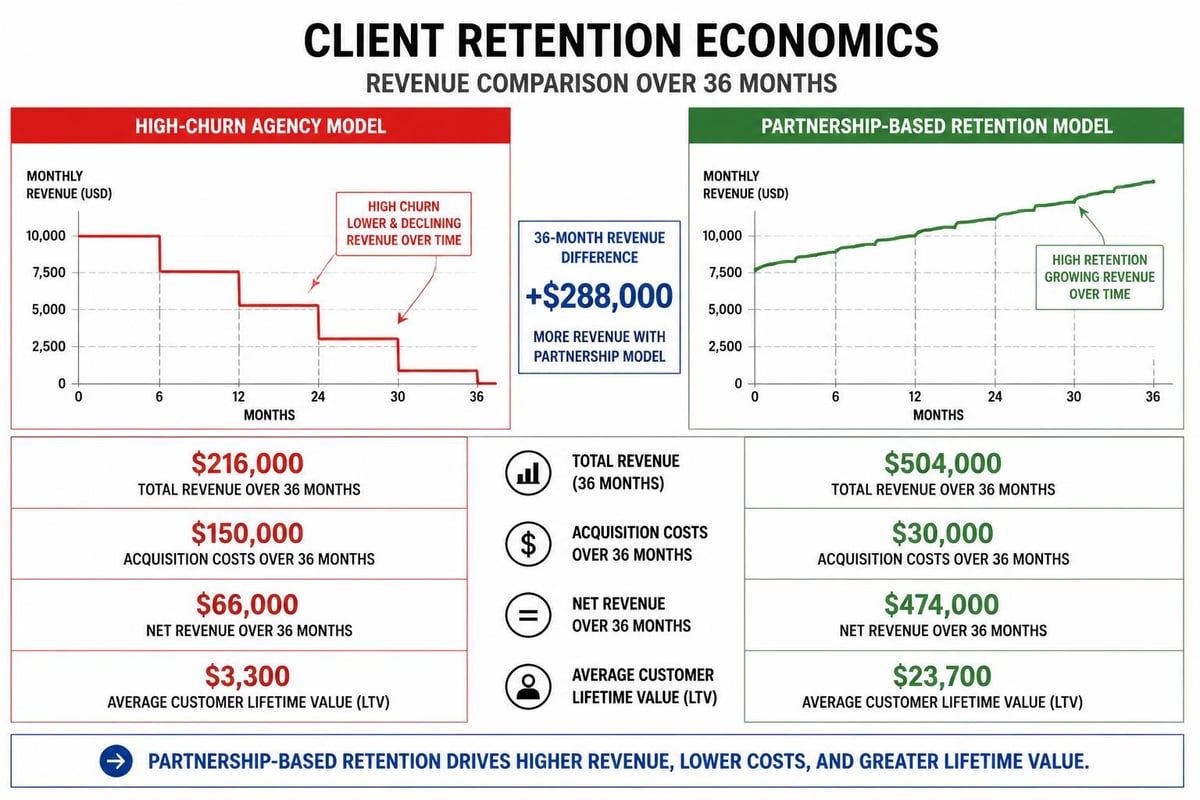
Acquiring new clients costs 5-7 times more than retaining existing ones, yet many agencies invest 80% of their growth efforts on acquisition. This misallocation creates a leaky bucket scenario where you constantly chase new business to replace churned clients.
Strategic client retention accelerates growth through:
- Predictable recurring revenue that funds expansion initiatives
- Reduced sales costs (no acquisition expense for retained clients)
- Expansion opportunities (existing clients buy additional services)
- Referral generation (satisfied long-term clients actively recommend you)
- Operational efficiency (deep client knowledge improves delivery speed)
The most successful agencies treat retention as seriously as acquisition. They implement quarterly business reviews, proactive communication systems, and continuous value addition that keeps clients engaged beyond the initial project scope.
Building Retention Into Your Service Model
Retention starts before you close the deal. The clients you attract, the expectations you set, and the value you promise all determine whether relationships last three months or three years.
Consider implementing a guaranteed growth partnership model where your agency's success directly aligns with client outcomes. This approach transforms the traditional vendor-client dynamic into a genuine partnership where both parties invest in long-term success.
Retention-focused practices include:
- Transparent reporting that demonstrates clear ROI
- Regular strategy sessions that evolve with client needs
- Proactive recommendations based on market changes
- Performance guarantees that align interests
- Value-add services that extend beyond contracted scope
When you shift from project-based thinking to partnership mentality, client lifetime value increases dramatically. One retained client worth $120,000 annually over five years ($600,000 total) provides far more value than five one-time projects at $120,000 each, considering acquisition costs and operational efficiency.
Positioning Your Agency for Market Leadership
Your market position determines which opportunities come to you versus which you must chase. Agencies positioned as thought leaders and category experts experience marketing agency growth through inbound demand rather than outbound hustle.
Building market leadership requires consistent visibility, demonstrated expertise, and strategic content that addresses your ideal clients' most pressing challenges. The top growth strategies for agencies emphasize the importance of clear positioning and differentiation in crowded markets.
Content as a Growth Engine
Strategic content serves multiple growth functions simultaneously. It attracts prospects through search and social channels, establishes credibility through demonstrated expertise, and educates potential clients about their challenges and your solutions.
Rather than generic marketing advice, focus your content on specific insights that only someone with deep expertise could provide. Share frameworks, case studies, and tactical approaches that showcase your methodology and results.
High-impact content types for agency growth:
- Detailed case studies showing measurable client outcomes
- Strategic frameworks that demonstrate your thinking process
- Industry-specific insights based on proprietary research
- Process documentation that builds trust through transparency
- Tool comparisons and recommendations based on real testing
The agencies experiencing the strongest inbound growth aren't producing more content-they're producing better, more targeted content that speaks directly to their ideal clients' situations. Understanding why traditional cold outreach is failing helps you position your content to address the real challenges your prospects face.
Scaling Operations Without Compromising Quality
Many agencies fear that growth will dilute service quality or create operational chaos. This concern is valid when scaling happens reactively without supporting infrastructure. However, strategic scaling actually improves quality by enabling better processes, superior talent, and more sophisticated technology.
The key is building scalability into your operations before you need it. When systems, documentation, and automation exist before rapid growth arrives, expansion becomes smooth rather than chaotic.
Scalability indicators include:
- Documented standard operating procedures for all key functions
- Technology automation reducing manual task loads by 60%+
- Training programs that onboard new team members efficiently
- Quality control checkpoints that maintain standards at scale
- Financial models projecting profitability at various growth stages
Consider how the most successful agencies structure their teams around specialization rather than generalization. Instead of account managers handling everything, create role-specific positions (strategist, implementation specialist, analyst, relationship manager) that allow for expertise development and easier scaling.
| Growth Stage | Team Structure | Key Focus |
|---|---|---|
| $0-500K | Founder + 2-3 generalists | Product-market fit |
| $500K-2M | Specialized roles emerge | Process documentation |
| $2M-5M | Department structure | System optimization |
| $5M+ | Leadership layer added | Strategic initiatives |
This progression allows you to maintain quality while growing because each team member operates within their zone of expertise supported by documented processes and appropriate technology.
Measuring What Matters for Growth
You can't optimize what you don't measure. Marketing agency growth requires clear metrics that indicate both current performance and future trajectory. However, many agencies track vanity metrics that look impressive but don't drive decision-making.
Essential growth metrics include:
- Customer Acquisition Cost (CAC): What you spend to acquire each new client
- Customer Lifetime Value (LTV): Average revenue per client over entire relationship
- LTV:CAC Ratio: Should be 3:1 or higher for sustainable growth
- Monthly Recurring Revenue (MRR): Predictable revenue base
- Revenue Per Employee: Efficiency indicator averaging $150K-250K for healthy agencies
- Net Revenue Retention: Measures expansion minus churn (>100% indicates growth from existing clients)
These metrics provide the intelligence needed to make smart growth decisions. When you know your CAC is $5,000 and LTV is $45,000, you can confidently invest in acquisition knowing each client generates 9x their cost. This data-driven approach removes the guesswork from scaling decisions.
Implementing proper measurement systems isn't optional for agencies serious about marketing agency growth. The difference between intuition-based decisions and data-driven strategy becomes more pronounced as your agency scales. What works at $500K may fail catastrophically at $2M without proper metrics guiding adjustments.
Sustainable marketing agency growth in 2026 requires a fundamental shift from reactive service delivery to systematic, AI-powered client acquisition and retention. By implementing automated lead generation, specialized service offerings, and transparent partnership models, agencies can achieve predictable revenue growth while delivering exceptional client outcomes. Adstra specializes in transforming traditional agencies into growth machines through advanced AI systems that generate qualified leads and automate appointment booking, ensuring you focus on strategy and client success rather than manual prospecting. Ready to accelerate your agency's growth with guaranteed results? Partner with Adstra today.