


The marketing landscape has fundamentally shifted in 2026, and traditional approaches simply don't cut it anymore. Businesses demand measurable results, predictable revenue growth, and strategies that scale efficiently. Enter the world of growth marketers: professionals who combine data science, creative experimentation, and customer psychology to drive exponential business expansion. These specialists aren't just running campaigns; they're engineering entire growth systems that transform how companies acquire, convert, and retain customers. For businesses focused on lead generation and revenue acceleration, understanding what growth marketers do and how they operate has become essential for staying competitive.
What Defines Growth Marketers in Today's Business Environment
Growth marketers operate at the intersection of data analytics, marketing creativity, and technical execution. Unlike traditional marketers who might focus solely on brand awareness or campaign launches, these professionals obsess over metrics that directly impact revenue.
The distinction matters more than ever. Growth marketing centers on optimizing the entire customer lifecycle, from initial awareness through retention and referral. This comprehensive approach means growth marketers track every touchpoint, measure every interaction, and continuously refine their strategies based on hard data.
Core responsibilities include:
- Building and optimizing conversion funnels at every stage
- Conducting rapid experimentation across channels and tactics
- Analyzing customer behavior data to identify growth opportunities
- Implementing automation systems for scalable lead generation
- Creating retention programs that maximize customer lifetime value
What makes growth marketers particularly valuable is their systematic approach to uncertainty. Rather than relying on gut instinct or creative brilliance alone, they test hypotheses rigorously. Every campaign becomes an experiment. Every channel gets measured against concrete KPIs. Every customer interaction provides data for optimization.
The AARRR Framework That Drives Results
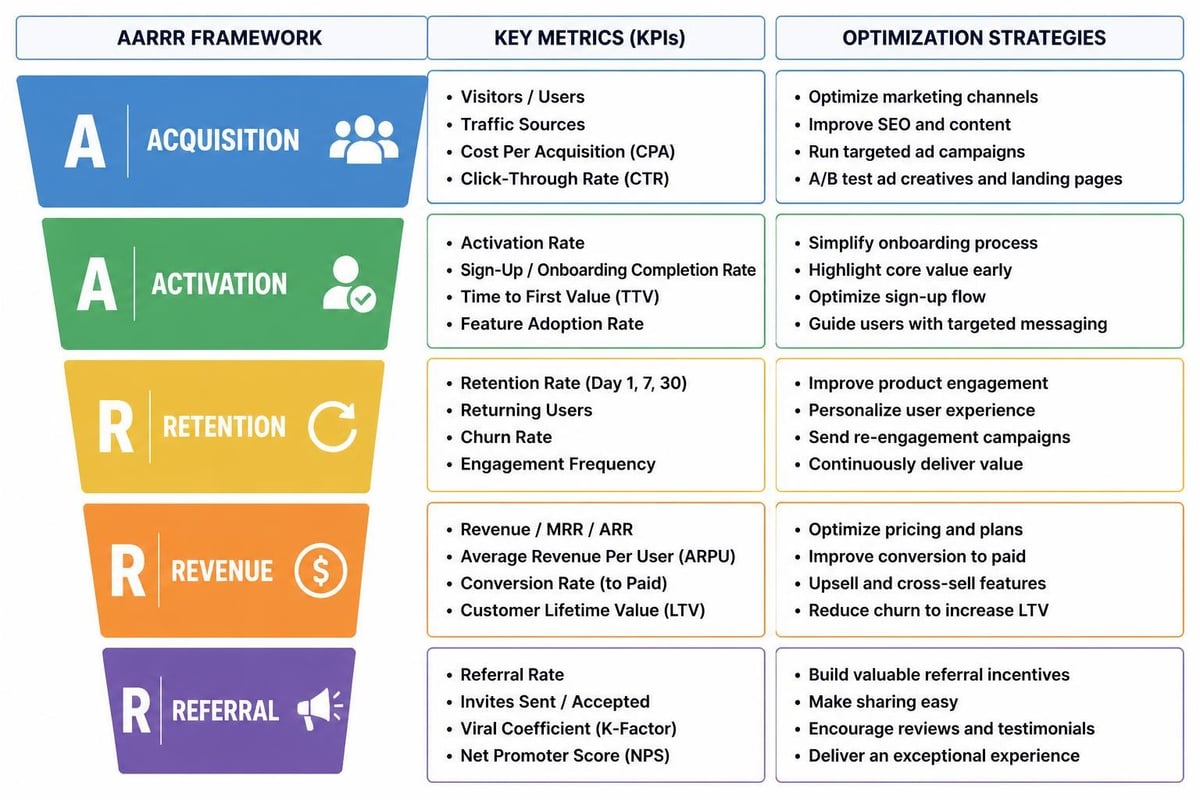
Growth marketers typically organize their work around the AARRR (Pirate Metrics) framework, which provides structure for optimizing each stage of the customer journey. This isn't just theoretical; it's the operational blueprint that separates high-performing teams from those that struggle.
Acquisition focuses on attracting potential customers through targeted channels. Growth marketers don't just drive traffic; they engineer systems that bring in qualified leads who match ideal customer profiles. They analyze which channels deliver the best ROI and double down on what works.
Activation ensures that new users experience value quickly. For lead generation businesses, this means optimizing the initial contact experience, streamlining appointment booking processes, and removing friction from the conversion path.
Retention keeps customers engaged over time. Growth marketers build systems that nurture relationships, provide ongoing value, and prevent churn before it happens.
Revenue optimization extends beyond initial conversions. These professionals identify upsell opportunities, optimize pricing strategies, and maximize customer lifetime value through strategic interventions.
Referral programs turn satisfied customers into growth engines. Growth marketers systematically encourage and reward advocacy, creating viral loops that reduce acquisition costs.
Data-Driven Strategies That Separate Top Performers
The most effective growth marketers treat data as their competitive advantage. In 2026, with advanced AI systems and analytics platforms widely available, the barrier isn't accessing data but knowing what to do with it.
Leading growth marketing strategies emphasize continuous testing and measurement. Top performers run weekly experiments, analyzing results in real-time and adjusting tactics immediately. This velocity creates compound advantages over competitors who operate on monthly or quarterly planning cycles.
| Strategy Component | Traditional Approach | Growth Marketing Approach |
|---|---|---|
| Campaign Planning | Quarterly roadmaps | Weekly sprint experiments |
| Success Metrics | Impressions, clicks | Revenue, LTV, conversion rates |
| Channel Selection | Gut instinct | Data-driven attribution modeling |
| Optimization Cycle | Post-campaign analysis | Real-time continuous improvement |
| Resource Allocation | Equal budget distribution | Dynamic reallocation to winners |
Personalization has evolved beyond basic segmentation. Growth marketers now leverage AI to deliver individualized experiences at scale. They analyze behavioral patterns, predict customer needs, and automate interventions that move prospects through the funnel efficiently.
Consider the approach that separates average from exceptional: rather than creating one campaign and hoping it works, growth marketers launch multiple variations simultaneously. They test different messaging angles, landing page designs, offer structures, and follow-up sequences. Winners get scaled. Losers get killed quickly.
The Experimentation Mindset That Drives Innovation
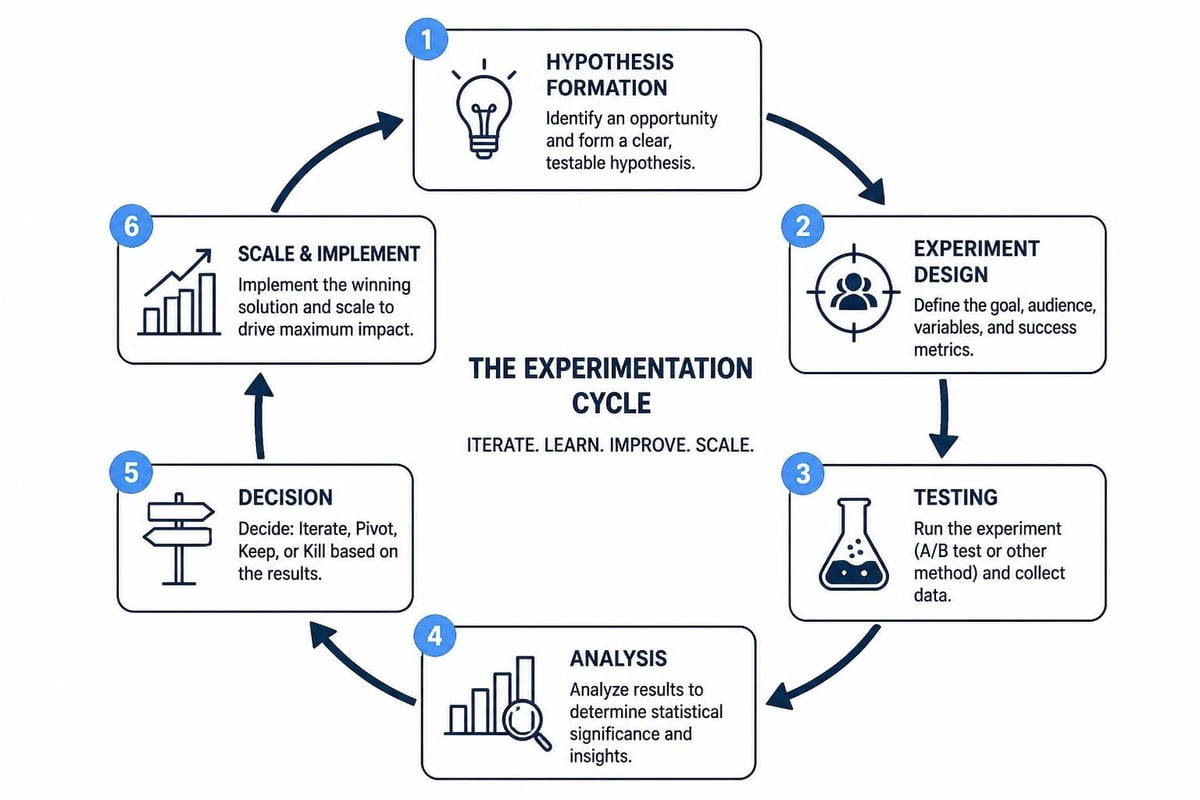
Running effective experiments requires more than just setting up A/B tests. Growth marketers develop hypotheses based on data insights, design experiments that isolate variables, and establish clear success criteria before launching.
The core principles of growth marketing emphasize rapid iteration and learning. Failed experiments aren't failures; they're valuable data points that eliminate bad options and point toward better opportunities.
Effective experimentation follows this pattern:
- Identify a growth bottleneck through data analysis
- Develop a specific, testable hypothesis
- Design an experiment with clear metrics
- Run the test with statistical significance
- Analyze results and extract insights
- Scale winners or iterate on learnings
This systematic approach compounds over time. A team running 50 experiments quarterly generates far more insights than competitors running just a handful of major campaigns annually. The velocity creates an information advantage that becomes virtually impossible to overcome.
Building Growth Systems That Scale Revenue
Growth marketers excel at creating systems rather than one-off campaigns. Systems scale. Systems compound. Systems generate predictable results even as market conditions change.
For businesses focused on lead generation, this systems thinking transforms operations. Instead of manually qualifying every lead, growth marketers build scoring models that automatically identify the most promising prospects. Instead of relying on sales teams to follow up perfectly every time, they implement automation sequences that nurture relationships systematically.
The best marketing platforms enable this systematic approach by providing integration capabilities, automation features, and analytics depth. Growth marketers select tools based on their ability to support experimentation and scale successful tactics.
Essential components of a growth system include:
- Multi-channel acquisition engines that consistently generate new leads
- Conversion optimization frameworks that maximize yield at every funnel stage
- Retention mechanisms that keep customers engaged and reduce churn
- Data infrastructure that tracks performance and enables rapid decision-making
- Automation workflows that execute proven tactics without manual intervention
The compound effect of these systems creates exponential rather than linear growth. A well-designed marketing content funnel doesn't just convert better today; it also generates insights that improve conversion tomorrow and builds audiences that reduce acquisition costs permanently.
Leveraging AI and Automation for Competitive Advantage
In 2026, growth marketers who effectively harness AI capabilities dramatically outperform those relying solely on manual tactics. Artificial intelligence excels at pattern recognition, predictive modeling, and executing repetitive tasks at scale, which aligns perfectly with growth marketing requirements.
Advanced AI systems can now analyze thousands of customer interactions, identify the characteristics of prospects most likely to convert, and automatically adjust targeting parameters in real-time. This capability transforms lead generation from an art into a science.
Smart growth marketers use AI for:
- Predictive lead scoring that identifies high-value prospects before they raise their hand
- Dynamic content personalization that adapts messaging based on individual behavior patterns
- Automated appointment scheduling that eliminates friction in the conversion process
- Churn prediction that enables proactive retention interventions
- Attribution modeling that accurately credits the channels and touchpoints driving revenue
The key insight is that AI doesn't replace growth marketers; it amplifies their effectiveness. While machines handle data processing and execution at scale, humans provide strategic direction, creative insights, and the judgment needed to interpret results in business context.
Real-World Applications Across Industries
Growth marketers adapt their core principles to specific industry contexts, creating customized approaches that address unique challenges and opportunities. The fundamental framework remains consistent, but tactical execution varies significantly.
In lead generation agencies, growth marketers focus intensely on cost per acquisition and conversion rate optimization. They build sophisticated attribution models that identify exactly which touchpoints contribute to closed deals, enabling precise budget allocation decisions.
For businesses targeting local markets, growth marketers develop geo-specific strategies that dominate particular regions before expanding. They understand that local lead generation requires different tactics than national campaigns, emphasizing local SEO, community engagement, and location-based targeting.
| Industry Application | Primary Growth Lever | Key Metric |
|---|---|---|
| SaaS Companies | Product-led growth, freemium conversion | Activation rate, trial-to-paid conversion |
| E-commerce | Cart optimization, retention programs | Average order value, repeat purchase rate |
| Lead Generation | Qualification accuracy, speed-to-contact | Cost per qualified lead, lead-to-customer rate |
| Service Businesses | Referral programs, review generation | Net promoter score, referral rate |
The proven growth marketing strategies that work across industries share common elements: obsessive metric tracking, rapid experimentation, and relentless optimization. Successful growth marketers borrow tactics from adjacent industries, adapting proven approaches to their specific context.
Case Studies That Demonstrate Impact
Examining real-world growth marketing case studies reveals patterns that separate exceptional results from mediocre performance. The best growth marketers don't just implement tactics; they engineer comprehensive systems that address multiple growth levers simultaneously.
One consistent pattern: successful growth marketers start with thorough customer research. They map the entire buyer journey, identify friction points, and prioritize experiments based on potential impact. This foundational work prevents wasted effort on tactics that address symptoms rather than root causes.
Another critical insight from small business case studies is the importance of focus. Rather than trying to optimize everything at once, top performers identify the single biggest constraint to growth and concentrate resources there. Once that bottleneck is resolved, they move to the next constraint.
Essential Skills for Modern Growth Marketers
The skill set required for effective growth marketing has expanded significantly. Today's practitioners need technical capabilities that would have been considered specialized just a few years ago.
Technical competencies include:
- Data analysis and statistical literacy to interpret experiment results
- SQL and basic programming for extracting insights from databases
- Marketing automation platform expertise for building scalable systems
- Analytics tool proficiency for tracking and attribution
- A/B testing methodology and experimental design
Beyond technical skills, growth marketers need strong business acumen. Understanding unit economics, customer lifetime value calculations, and financial modeling enables them to make investment decisions that maximize ROI rather than vanity metrics.
Creative problem-solving remains essential despite the heavy emphasis on data. The most valuable growth marketers combine analytical rigor with creative hypothesis generation, imagining possibilities that pure data analysis might never reveal.
Building Your Growth Marketing Stack
The tools growth marketers select directly impact their ability to execute strategies effectively. In 2026, the marketing agency tools landscape offers overwhelming choice, making strategic selection critical.
Top performers build integrated stacks where data flows seamlessly between platforms, enabling comprehensive analysis and automation. They prioritize tools that support experimentation, provide granular analytics, and integrate with their existing infrastructure.
Essential stack components typically include:
- Analytics platforms that track user behavior across all touchpoints
- CRM systems that manage customer relationships and pipeline
- Marketing automation tools that execute campaigns at scale
- A/B testing software that enables rapid experimentation
- Data visualization platforms that communicate insights effectively
The specific tools matter less than the overall architecture. Growth marketers design stacks that eliminate data silos, automate repetitive tasks, and provide the insights needed for rapid decision-making.
The Future Landscape for Growth Professionals
As we progress through 2026, the growth marketing discipline continues evolving rapidly. Computational studies in influencer marketing and other emerging areas demonstrate how data-driven approaches are expanding into previously qualitative domains.
Several trends are reshaping how growth marketers operate:
Privacy-first marketing requires new approaches as third-party cookies disappear and regulations tighten. Growth marketers are developing first-party data strategies and building direct relationships with customers.
AI-powered personalization has moved beyond basic segmentation to true individualization at scale. Modern systems can predict customer needs and automatically deliver relevant experiences without manual intervention.
Community-driven growth leverages network effects and peer influence more systematically. Growth marketers are building communities that generate organic growth through member engagement and advocacy.
Cross-functional integration breaks down traditional silos between marketing, product, and sales. Leading growth marketers work across departments to optimize the entire customer experience, not just isolated touchpoints.
The guiding principles for world-class growth strategies emphasize sustainable, long-term thinking rather than short-term hacks. As the discipline matures, successful practitioners balance aggressive experimentation with ethical practices and customer-centric values.
Implementing Growth Marketing in Your Organization
Organizations looking to adopt growth marketing approaches often struggle with where to start. The transition from traditional marketing requires cultural shifts alongside tactical changes.
Begin by establishing clear metrics that tie marketing activities directly to revenue outcomes. Growth marketers can't optimize what they don't measure, and measurement requires infrastructure, agreement on definitions, and commitment to data-driven decision-making.
Next, create space for experimentation. Top growth marketing strategies for 2026 all emphasize rapid testing, which requires tolerance for failure and resources dedicated to learning rather than just execution.
Build cross-functional alignment early. Growth marketing touches product development, sales processes, customer success, and technology infrastructure. Success requires collaboration across all these functions, not just within the marketing department.
Implementation roadmap:
- Month 1-2: Establish baseline metrics and analytics infrastructure
- Month 3-4: Identify primary growth constraints through data analysis
- Month 5-6: Launch initial experiments targeting top constraints
- Month 7-8: Scale winning experiments and expand testing velocity
- Month 9-12: Build automation systems around proven tactics
The most common mistake is expecting immediate transformation. Growth marketing delivers compounding returns over time, not overnight miracles. Organizations that commit to the methodology for 12-18 months typically see dramatic results, while those expecting quick wins often abandon the approach prematurely.
Measuring Success and Optimizing Performance
Growth marketers distinguish themselves through rigorous performance measurement. They don't just track metrics; they establish clear causal relationships between actions and outcomes.
The shift from correlation to causation requires sophisticated experimental design. Rather than simply observing that customers who engage with email campaigns convert better, growth marketers run controlled experiments to determine whether email engagement causes better conversion or merely correlates with other factors.
Critical metrics vary by funnel stage:
| Funnel Stage | Primary Metrics | Secondary Indicators |
|---|---|---|
| Acquisition | Cost per lead, source quality | Traffic volume, channel mix |
| Activation | Conversion rate, time to value | Onboarding completion, engagement depth |
| Retention | Churn rate, engagement frequency | Feature adoption, support contacts |
| Revenue | Customer lifetime value, average deal size | Upsell rate, payment timing |
| Referral | Net promoter score, referral rate | Advocacy actions, social mentions |
Top growth marketers establish dashboards that provide real-time visibility into these metrics, enabling rapid response to emerging trends. They set up automated alerts that flag significant changes, preventing small issues from becoming major problems.
The best practitioners also track learning velocity: how many experiments they run, how quickly they can implement changes, and how effectively they extract insights from results. These meta-metrics often predict long-term success better than any single campaign result.
Growth marketers represent the evolution of marketing from creative art to systematic science, combining data analytics, rapid experimentation, and customer-centric thinking to drive measurable revenue growth. The strategies and systems they build create sustainable competitive advantages that compound over time. If you're ready to transform your lead generation approach with proven growth marketing methodologies, Aletto leverages advanced AI systems and growth-focused strategies to generate qualified leads, automate appointment bookings, and deliver predictable revenue expansion through our guaranteed partnership model.