


Your sales team needs more than just a great pitch. In 2026's competitive marketplace, the difference between closing deals and losing prospects often comes down to one critical factor: how well your brand resonates during every sales interaction. Sales branding isn't just about logos and color schemes; it's the strategic alignment of your brand identity with your sales process to create trust, recognition, and urgency at every touchpoint. When executed correctly, it transforms your entire revenue engine into a cohesive force that turns cold prospects into enthusiastic customers.
What Makes Sales Branding Different from Traditional Branding
Sales branding operates at the intersection of brand strategy and revenue generation. While traditional branding focuses on awareness and perception, sales branding zeroes in on conversion-driven brand experiences.
Think of it this way: your marketing brand attracts attention, but your sales brand closes deals. The moment a prospect enters your sales pipeline, every interaction reinforces or diminishes their perception of your value.
The Critical Components of Effective Sales Branding
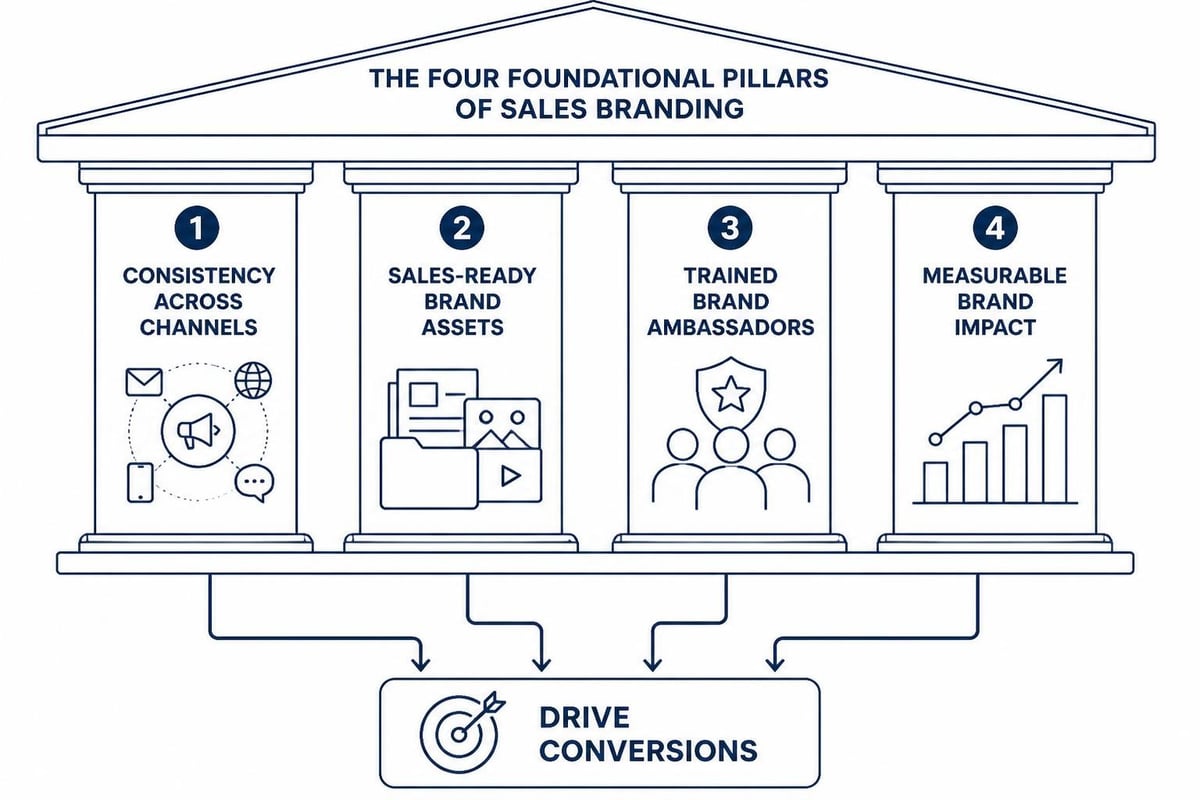
Strong sales branding requires four foundational pillars that work together:
- Consistency across channels: Your messaging must remain uniform whether prospects engage via email, phone, demo, or proposal
- Sales-ready brand assets: Collateral designed specifically to overcome objections and advance deals
- Trained brand ambassadors: Sales teams who embody your brand values in every conversation
- Measurable brand impact: Tracking how brand strength influences conversion rates and deal velocity
These elements don't exist in isolation. When your lead generation strategy brings in prospects, they should immediately recognize the same brand promise throughout their buyer journey.
Building Trust Through Strategic Brand Alignment
The seven principles of branding for sales emphasize that modern buyers make decisions based on trust more than features. Your sales branding must address this psychological reality.
Consider what happens when a prospect receives an outreach email. Within three seconds, they're evaluating whether your company seems credible, professional, and worth their time. That split-second judgment is your sales branding at work.
Creating Brand Recognition That Accelerates Sales Cycles
Recognition breeds familiarity, and familiarity reduces perceived risk. When prospects encounter your brand multiple times before a sales conversation, they arrive pre-qualified and more receptive.
Here's how brand recognition impacts your pipeline:
- Prospects require fewer touchpoints to convert
- Initial conversations start from a position of credibility
- Objections decrease because trust already exists
- Deal sizes increase as perceived value rises
Your demand generation efforts should plant these brand seeds long before sales conversations begin. Every content piece, social post, and ad impression builds the recognition that sales teams leverage to close deals faster.
Sales Collateral That Reinforces Brand Authority
Generic sales materials kill deals. Your collateral must do double duty: educating prospects while reinforcing your brand's unique position in the marketplace.
Sales collateral serves as the tangible proof of your brand promises. When a prospect reviews your case studies, proposals, or one-pagers, they should instantly recognize the same brand voice, visual identity, and value proposition they encountered initially.
| Collateral Type | Brand Function | Conversion Impact |
|---|---|---|
| Case Studies | Proves credibility through results | High – addresses "proof" objections |
| Sales Decks | Reinforces visual identity and messaging | Medium – sets professional tone |
| Proposals | Demonstrates attention to detail | Very High – final conversion tool |
| One-Pagers | Quick brand recognition and recall | Medium – maintains engagement |
| ROI Calculators | Positions brand as analytical partner | High – creates tangible value |
Personalizing Brand Experiences Without Losing Consistency
Modern buyers expect personalization, but your sales branding can't become fragmented across different prospect segments. The solution lies in modular brand assets that adapt while maintaining core identity.
Smart sales teams use sales content management systems to deliver personalized experiences that still feel unmistakably "on brand." You're not changing your brand for each prospect; you're highlighting different facets of the same diamond.
When you're working on B2B leads, this balance becomes even more critical. Enterprise buyers scrutinize brand consistency as a proxy for operational excellence.
Aligning Sales and Marketing for Cohesive Branding
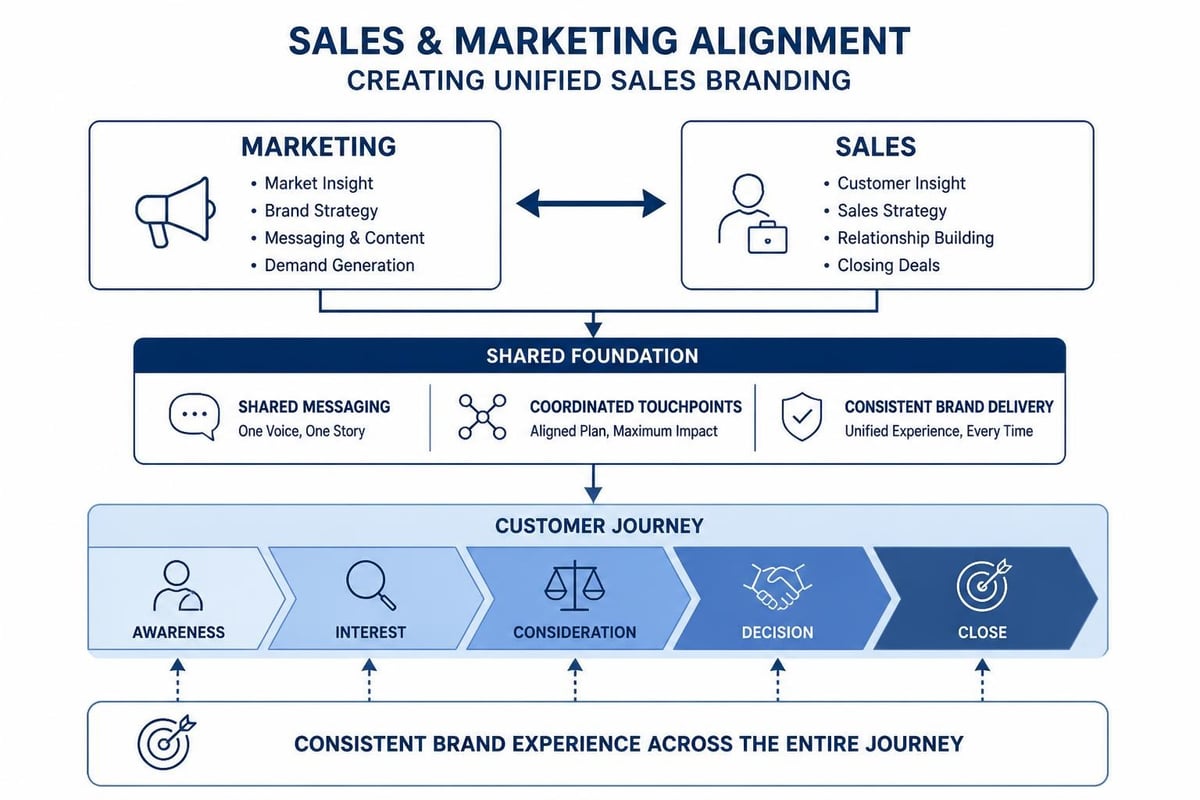
The most common sales branding failure? Disconnection between marketing's brand promises and sales' actual delivery. This misalignment creates cognitive dissonance that torpedoes conversion rates.
Sales and marketing alignment isn't just about shared goals; it's about creating a seamless brand experience from first touchpoint through customer onboarding.
Breaking down the alignment barriers:
- Marketing creates ads that make promises sales can actually fulfill
- Sales uses language that matches marketing's brand voice
- Both teams share insights about what messaging resonates
- Brand guidelines cover sales interactions, not just marketing materials
Think about your funnel system marketing approach. If marketing attracts prospects with one brand personality, then sales engages with a completely different tone, you've just introduced friction into what should be a smooth journey.
Training Your Sales Team as Brand Ambassadors
Your salespeople are your brand's most powerful channel. Every call, email, and meeting shapes how prospects perceive your company's identity and value.
Yet most organizations invest heavily in brand development while neglecting sales team brand training. This creates a dangerous gap where your carefully crafted brand identity gets diluted by inconsistent sales interactions.
Embedding Brand Values in Sales Conversations
Sales branding excellence requires your team to internalize brand values so deeply they emerge naturally in conversations. This goes far beyond memorizing talking points.
Consider these transformation strategies:
- Role-playing brand scenarios: Practice handling objections while staying true to brand voice
- Recording and reviewing calls: Identify where brand messaging shines or falters
- Creating brand conversation guides: Templates that maintain consistency while allowing personality
- Celebrating brand-aligned wins: Reinforce behaviors that exemplify your sales branding
When your sales lead generator systems deliver qualified prospects, those leads should encounter sales professionals who embody your brand at every level. The technical knowledge matters, but brand representation often proves more decisive.
Measuring Sales Branding Impact on Revenue
You can't optimize what you don't measure. Quantifying sales branding effectiveness transforms it from subjective art into strategic science.
Key metrics that reveal sales branding performance:
- Brand-attributed pipeline: Deals influenced by brand recognition
- Competitive win rate: How often your brand beats alternatives
- Sales cycle length: Time from first contact to close
- Deal size variation: Price premium your brand commands
- Referral rates: How often customers become brand advocates
| Metric | What It Reveals | Target Benchmark |
|---|---|---|
| Brand recall in discovery calls | Initial brand impact | >60% unprompted recognition |
| Proposal acceptance rate | Trust and authority | >40% accepted without renegotiation |
| Customer acquisition cost | Brand efficiency | 20-30% lower than industry average |
| Net promoter score | Long-term brand strength | >50 for B2B services |
Advanced organizations use AI-powered analytics to track how brand elements influence conversion rates. By analyzing thousands of sales interactions, you can identify which brand messages, visual assets, and value propositions drive the highest close rates.
Digital Sales Branding in an AI-Driven World
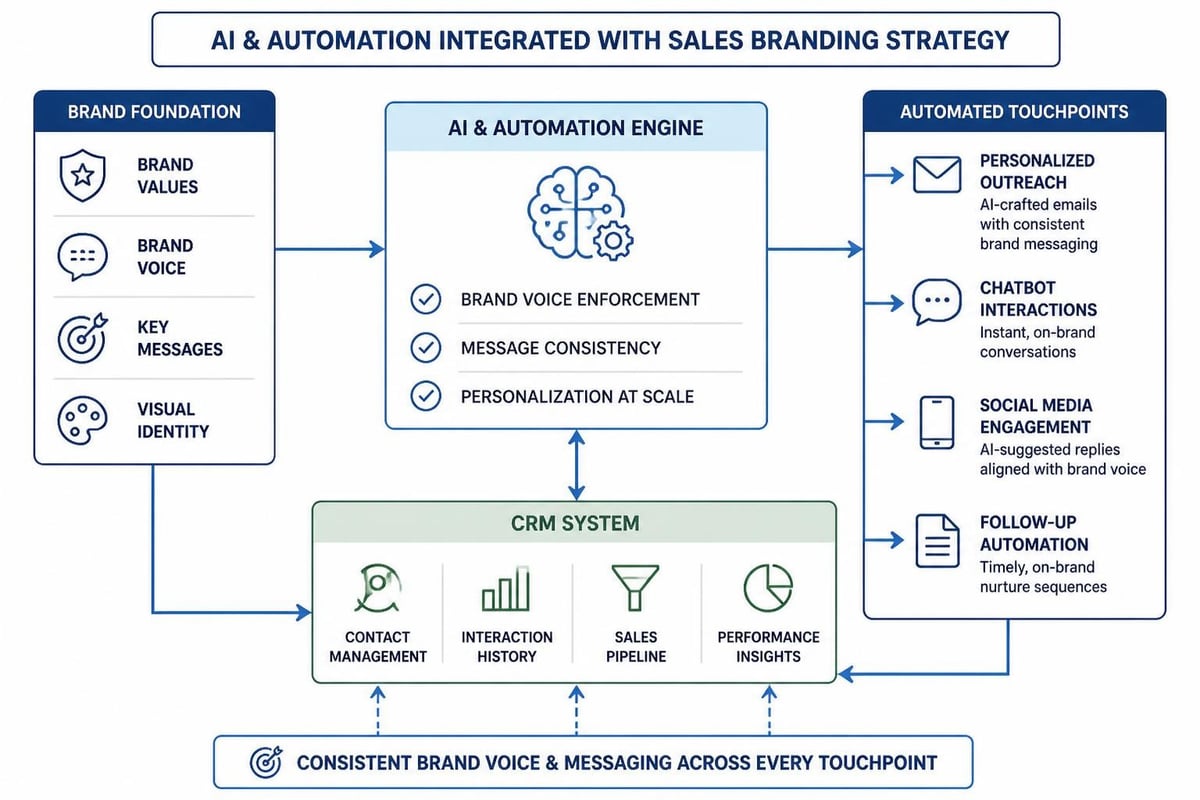
The rise of AI in sales has transformed how prospects experience your brand. From chatbots to AI-powered lead generation, your brand now communicates through both human and automated channels.
This creates new sales branding challenges and opportunities. Your AI touchpoints must deliver the same brand experience as your human team members, or you risk creating jarring inconsistencies.
Maintaining Brand Authenticity Through Automation
Automation should amplify your sales branding, not replace its human elements. The most successful approaches use AI to handle repetitive tasks while preserving brand personality in every interaction.
When you implement advertising and AI strategies, ensure your automated outreach carries the same brand voice your prospects will encounter during sales calls. Generic automation destroys the brand equity you've worked to build.
Smart automation preserves sales branding through:
- Customized email sequences that reflect brand tone
- AI chat responses trained on your brand guidelines
- Automated scheduling that maintains professional brand standards
- Personalization engines that adapt content while keeping core messaging intact
Industry-Specific Sales Branding Strategies
Different markets demand different sales branding approaches. A business lead in the enterprise software space requires different brand touchpoints than a local service business.
For companies in the lead generation industry, sales branding carries unique weight. You're not just selling a product; you're selling your ability to represent your clients' brands effectively.
Building Sales Branding That Demonstrates Expertise
Service businesses face a specific challenge: proving intangible value before prospects commit. Your sales branding must communicate competence, reliability, and results through every interaction.
This means your brand assets should showcase:
- Detailed case studies with measurable outcomes
- Process transparency that builds confidence
- Industry-specific knowledge that establishes authority
- Client testimonials that validate your brand promises
When working with professional lead generation services, prospects evaluate not just your capabilities but your brand's alignment with their own. Your sales branding must demonstrate that you understand their market deeply enough to represent them effectively.
Creating Urgency Without Compromising Brand Trust
Pressure tactics might close some deals, but they erode long-term brand equity. Effective sales branding creates urgency through value demonstration, not manipulation.
The distinction matters enormously. When prospects feel pressured, they remember that negative brand experience even if they initially buy. When they feel excited about potential outcomes, they become brand advocates who refer others.
Urgency Tactics That Strengthen Sales Branding
Authentic urgency creation strategies:
- Limited-time bonuses that add genuine value
- Market opportunity windows backed by data
- Capacity constraints that are real and verifiable
- Seasonal relevance tied to business cycles
Your demand funnel should naturally create urgency as prospects progress through education and qualification stages. By the time they reach sales conversations, the urgency stems from their own recognition of need, not artificial scarcity.
Visual Identity's Role in Sales Recognition
Never underestimate how visual consistency impacts sales performance. When prospects encounter the same color palette, typography, and design elements across all touchpoints, it reinforces brand legitimacy subconsciously.
Companies that invest in strong SaaS branding strategies understand this principle. Visual identity isn't vanity; it's a conversion tool that reduces cognitive friction and builds trust through familiarity.
| Visual Element | Sales Function | Implementation Priority |
|---|---|---|
| Logo usage | Immediate recognition | Critical |
| Color consistency | Emotional connection | High |
| Typography standards | Professionalism signal | Medium |
| Image style | Brand personality | Medium |
| Layout templates | Ease of consumption | High |
Your sales team should have access to branded templates for every customer-facing document. From email signatures to presentation decks, visual consistency communicates attention to detail and organizational maturity.
Scaling Sales Branding Across Growing Teams
As your sales organization expands, maintaining brand consistency becomes exponentially harder. What worked with three salespeople breaks down with thirty.
Scaling sales branding requires systems, not just guidelines. Documentation alone won't ensure consistent brand delivery when your team doubles or triples in size.
Building scalable sales branding infrastructure:
- Centralized brand asset libraries accessible to all team members
- Automated brand compliance tools that flag inconsistencies
- Regular brand training integrated into onboarding and ongoing development
- Brand champions within sales who model and reinforce standards
- Feedback loops that capture when brand messaging resonates or falls flat
When you're managing marketing agency tools and systems, remember that technology should support human brand delivery, not replace it. The best tools make it easier for salespeople to stay on-brand without constraining their authentic communication style.
The Competitive Advantage of Distinctive Sales Branding
In crowded markets, prospects evaluate multiple vendors who offer similar capabilities at comparable prices. Your sales branding becomes the differentiator that tips decisions in your favor.
Distinctive doesn't mean different for difference's sake. It means your brand occupies a clear, valuable position in prospects' minds that competitors can't easily replicate.
This positioning should permeate every sales interaction. When prospects can't distinguish between you and three competitors, price becomes the deciding factor. When your sales branding creates a unique identity, you compete on value instead.
Think about how you position yourself in leads in digital marketing conversations. Are you just another lead generation provider, or does your brand represent a specific approach, philosophy, or outcome that resonates with your ideal clients?
Strong sales branding transforms how prospects perceive value, shortens sales cycles, and creates premium positioning that commands higher prices. When your brand promise aligns seamlessly with your sales delivery, you build the trust and recognition that convert cold prospects into enthusiastic customers. Aletto specializes in creating this alignment through AI-powered lead generation systems and automated appointment booking that ensures consistent brand experiences from first contact through closed deal. If you're ready to transform your sales branding into a predictable revenue driver, discover how Aletto's guaranteed growth partnership model can accelerate your results.