
Every dollar you spend on marketing should work harder for your business. That's the fundamental promise of a performance marketing funnel-a systematic approach that transforms advertising spend into measurable revenue. Unlike traditional marketing campaigns that prioritize brand awareness without clear ROI metrics, a well-structured performance marketing funnel connects every prospect touchpoint to specific business outcomes. For companies focused on lead generation, this framework isn't just helpful; it's essential for survival in 2026's competitive landscape.
Understanding the Performance Marketing Funnel Framework
A performance marketing funnel operates on a simple but powerful principle: track everything, optimize constantly, and pay only for results that matter to your bottom line. This approach fundamentally differs from traditional advertising models where you pay for impressions or reach without guarantees of actual business impact.
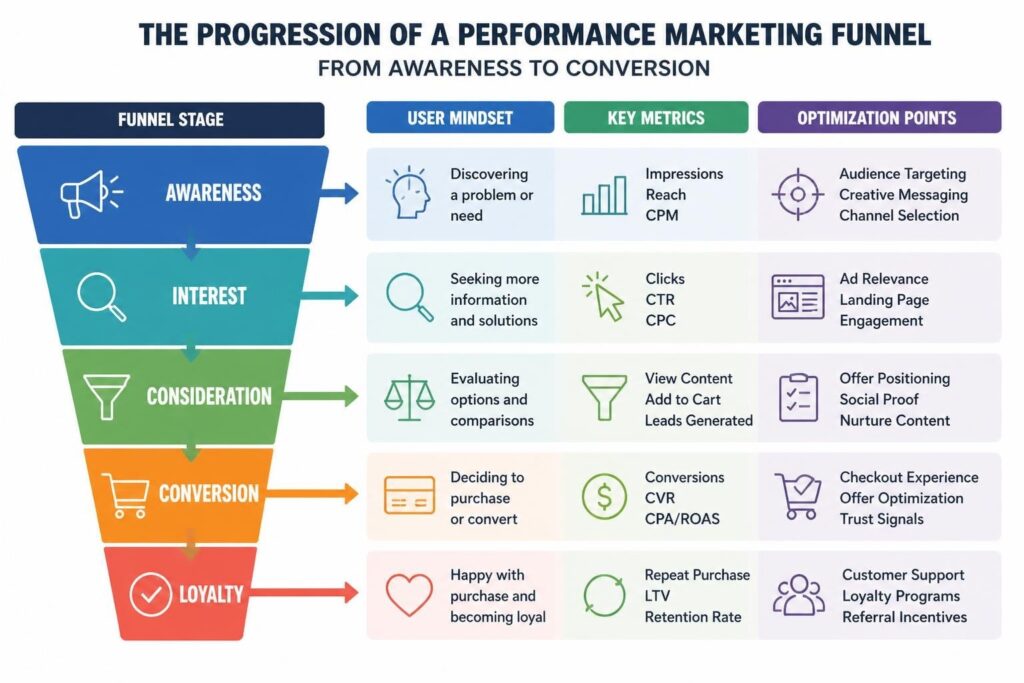
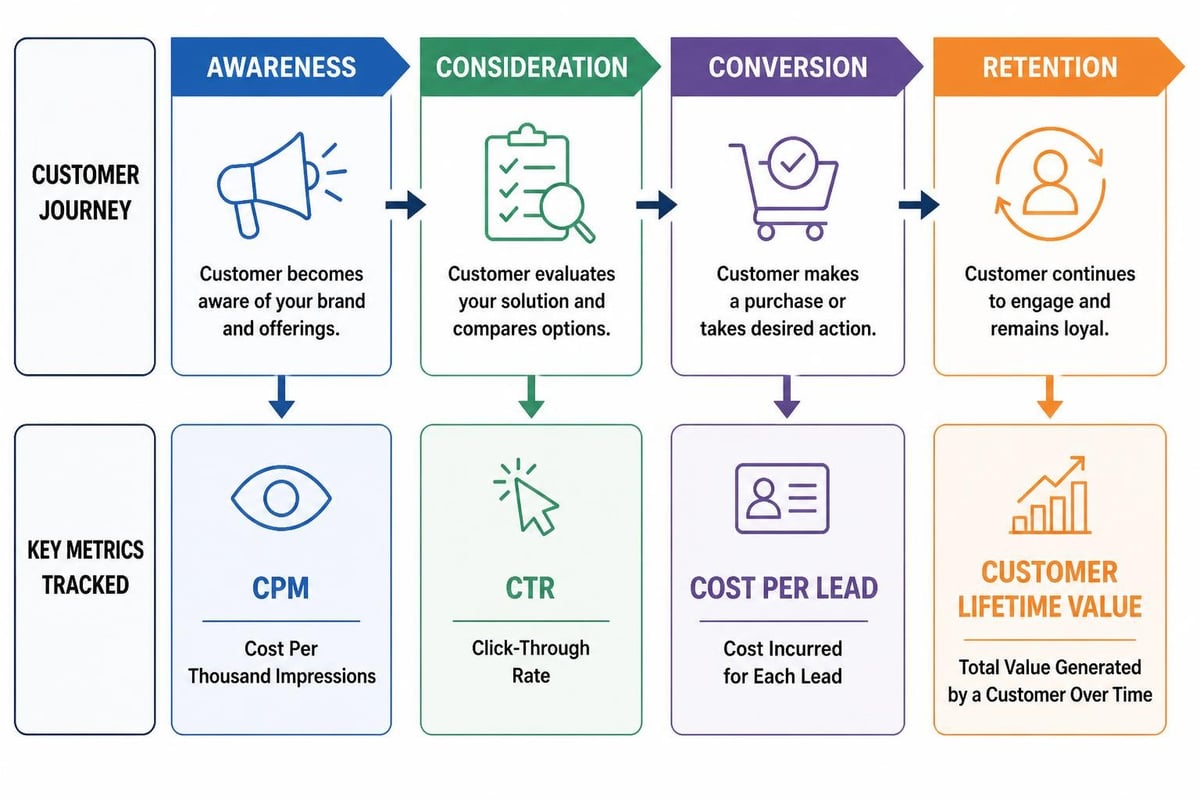
The structure follows the customer journey from complete strangers to paying customers, with each stage designed for specific measurable actions. Awareness introduces your solution to potential buyers, consideration educates them on why you're the best choice, conversion transforms interest into action, and retention maximizes customer lifetime value.
What makes this framework particularly valuable is its accountability. When you understand performance marketing funnel mechanics, you gain the ability to pinpoint exactly which marketing activities generate revenue and which waste budget.
The Data-Driven Advantage
Performance marketing funnels thrive on measurement. Every click, form submission, phone call, and purchase gets tracked back to its original source. This granular visibility allows you to:
- Identify which advertising channels deliver the highest quality leads
- Calculate precise cost-per-acquisition for each campaign
- Optimize spending in real-time based on conversion data
- Scale winning campaigns while eliminating underperformers
- Predict revenue outcomes with increasing accuracy
This data transparency creates a competitive advantage that traditional marketing approaches simply cannot match. When you know that every $100 spent on a specific campaign generates three qualified sales appointments worth $5,000 in potential revenue, scaling becomes a mathematical equation rather than a guessing game.
Building the Awareness Stage for Maximum Reach
The top of your performance marketing funnel serves one critical purpose: getting your solution in front of people who have the problem you solve. This stage isn't about immediate sales-it's about strategic visibility that positions your brand in the minds of potential customers.
Paid search advertising captures prospects actively looking for solutions right now. When someone searches "automated lead generation for law firms," your ad appears at the exact moment they're seeking help. This intent-driven approach delivers higher conversion rates than interruptive advertising methods.
Social media advertising expands reach to prospects who fit your ideal customer profile but haven't started actively searching yet. Advanced targeting capabilities on platforms like LinkedIn and Facebook allow you to reach decision-makers based on job title, company size, industry, and even specific behaviors that indicate buying readiness.
Awareness Stage Metrics That Matter
| Metric | What It Measures | Target Range |
|---|---|---|
| CPM (Cost Per Thousand Impressions) | How efficiently you're buying attention | $5-$25 depending on platform |
| CTR (Click-Through Rate) | How compelling your message is | 2-5% for B2B campaigns |
| Cost Per Click | Actual cost to drive traffic | $2-$50 based on competition |
| Reach | Unique people seeing your message | Aligned with TAM size |
The key to effective lead gen advertising at this stage is relevance. Your messaging must speak directly to the pain points your audience experiences. Generic value propositions get ignored; specific solutions to immediate problems get clicks.
Smart marketers also implement retargeting pixels at this stage. When prospects engage with your awareness content but don't convert immediately, retargeting keeps your solution visible as they continue researching options. This multi-touch approach significantly improves overall funnel performance.
Optimizing the Consideration Stage for Quality Engagement
Once prospects know you exist, they enter a critical evaluation phase where they determine whether your solution deserves serious consideration. The consideration stage of your performance marketing funnel must educate, build credibility, and differentiate your offering from competitors.
Content marketing plays a decisive role here. Prospects want to understand how your solution works, what results you've delivered for similar businesses, and why they should trust you with their budget. Case studies, comparison guides, and educational webinars address these questions while positioning your expertise.
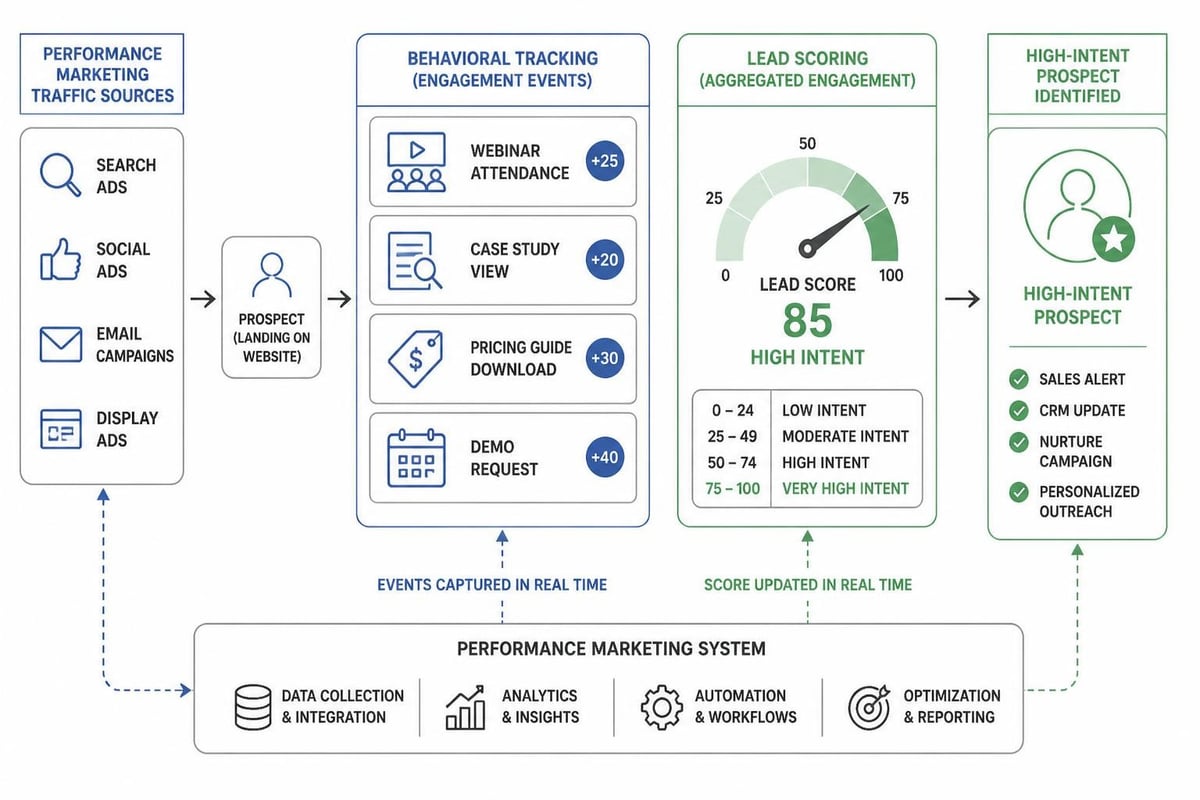
The consideration stage also reveals which prospects are genuinely qualified and which are just browsing. By tracking engagement with specific content pieces, you can score leads based on buying intent. Someone who downloads your pricing guide and watches a demo video shows significantly higher purchase intent than someone who just reads a blog post.
- Offer valuable resources that require contact information exchange
- Use progressive profiling to gather qualification data over time
- Implement lead scoring based on behavioral signals
- Segment prospects by industry, company size, and pain points
- Deploy nurture campaigns tailored to specific segments
One powerful consideration-stage tactic involves comparison content. When prospects search "[your solution] vs [competitor]," owning that conversation with honest, data-backed comparisons builds trust while highlighting your unique advantages. This approach to structuring your B2B performance marketing funnel ensures you're present during critical decision-making moments.
The Role of Social Proof
Nothing accelerates consideration like evidence that businesses similar to the prospect have succeeded with your solution. Customer testimonials, video case studies, industry awards, and third-party reviews remove risk from the buying decision.
Quantified results carry particular weight. "Our clients see 40% more qualified leads within 90 days" resonates more powerfully than "we help businesses generate more leads." Specificity builds credibility; vagueness breeds skepticism.
Smart performance marketers also leverage negative social proof strategically. Highlighting which types of businesses are NOT a good fit demonstrates honesty and actually increases trust among ideal prospects. This transparency improves lead quality while reducing wasted sales time on unqualified opportunities.
Converting Consideration Into Action
The conversion stage represents the moment of truth in your performance marketing funnel. All the awareness building and consideration nurturing culminates in prospects taking the specific action that drives your business forward-whether that's booking a sales call, starting a free trial, or making a purchase.
Conversion optimization focuses on eliminating every possible point of friction between prospect intent and completed action. The fewer steps required, the higher your conversion rate. A form asking for 15 fields converts significantly worse than one asking for just name and email, even if you want that additional information.
Your conversion experience should match the urgency and clarity that brought prospects to this point. If someone clicked an ad promising "Get qualified leads in 48 hours," the landing page must immediately reinforce that promise and provide a clear path to get started.
Conversion Stage Success Factors
The difference between a 2% conversion rate and a 10% conversion rate often comes down to these elements:
- Value proposition clarity – Prospects must instantly understand what they get and why it matters
- Trust signals – Security badges, guarantees, and testimonials reduce perceived risk
- Urgency – Limited-time offers or scarcity elements motivate immediate action
- Simplified process – Remove unnecessary steps and form fields
- Mobile optimization – Ensure seamless experience across all devices
Companies like Aletto understand that conversion optimization never stops. Continuous A/B testing of headlines, calls-to-action, form layouts, and page designs reveals incremental improvements that compound into significant revenue gains over time.
The integration of AI into conversion processes has revolutionized what's possible. AI-powered email marketing systems can now personalize follow-up sequences based on specific behaviors, dramatically increasing the percentage of consideration-stage prospects who convert.
Measuring Performance Marketing Funnel Success
A performance marketing funnel only delivers value when you measure the right metrics and optimize based on what the data reveals. Vanity metrics like impressions or page views feel good but don't pay the bills. Revenue-focused marketers obsess over metrics that connect directly to business outcomes.
Cost Per Acquisition (CPA) tells you exactly how much you spend to acquire each customer. This metric determines whether your funnel is profitable or burning cash. If your average customer generates $10,000 in lifetime value and your CPA is $500, you have a sustainable growth engine. If your CPA is $12,000, you have a crisis.
Return on Ad Spend (ROAS) measures revenue generated per dollar invested in advertising. A 5:1 ROAS means every $100 in ad spend produces $500 in revenue. Different industries and business models require different ROAS targets, but the principle remains constant: track it, improve it, scale it.
| Funnel Stage | Key Metrics | Optimization Focus |
|---|---|---|
| Awareness | CPM, Reach, CTR, Cost Per Click | Audience targeting, ad creative, platform selection |
| Consideration | Engagement rate, content downloads, time on page | Content quality, lead magnets, nurture sequences |
| Conversion | Conversion rate, cost per lead, lead quality score | Landing pages, forms, calls-to-action, trust signals |
| Retention | Customer lifetime value, repeat purchase rate, churn | Onboarding, customer success, upsell campaigns |
Understanding how different marketing platforms contribute to your overall funnel performance allows for strategic budget allocation. Some channels excel at generating awareness while others drive higher conversion rates. The optimal mix depends on your specific business model and target audience.
Attribution Modeling for Accurate Insights
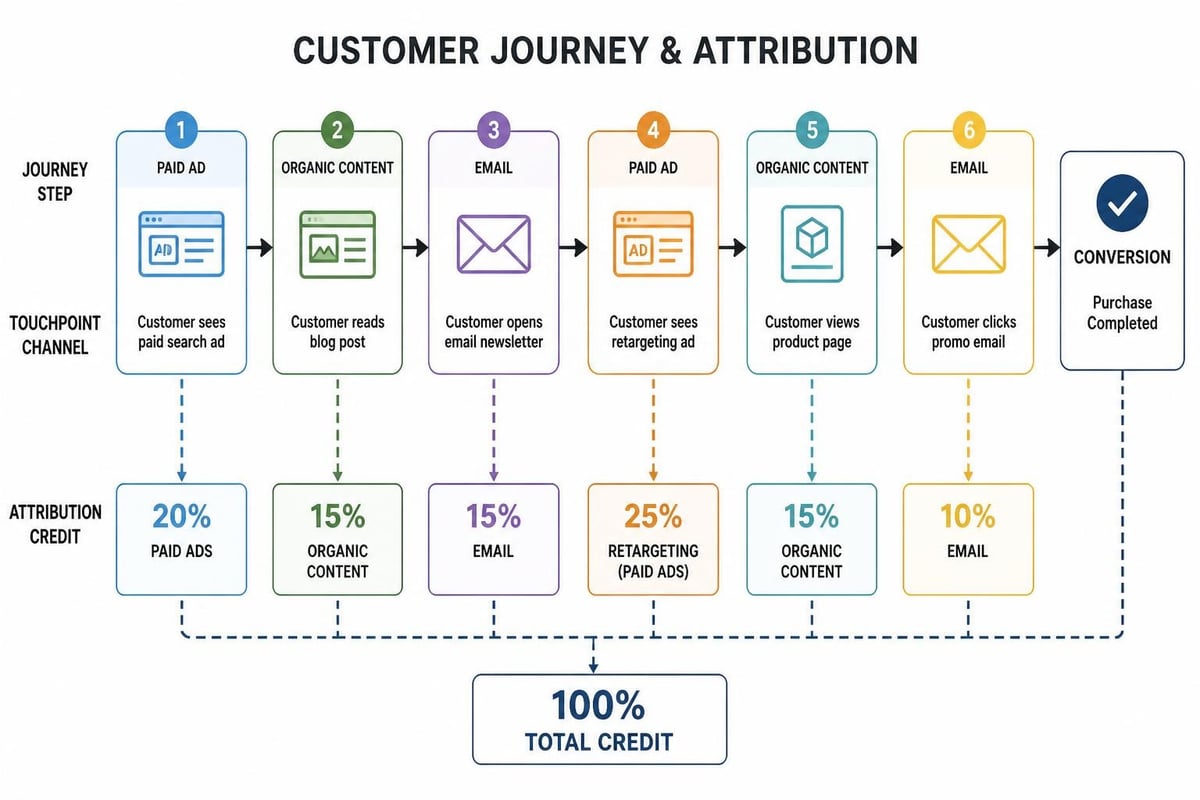
Modern customers rarely convert on their first interaction with your brand. They might see a Facebook ad, visit your website, read several blog posts, download a guide, receive email nurture sequences, and then finally book a sales call two weeks later. Which touchpoint deserves credit for that conversion?
Multi-touch attribution solves this puzzle by assigning appropriate credit to each interaction that contributed to the final conversion. This visibility prevents you from over-investing in channels that get last-click credit but actually play a minor role in the customer journey while under-investing in channels that initiate high-quality prospects into your funnel.
Advanced Funnel Strategies for 2026
The performance marketing funnel continues evolving as new technologies and consumer behaviors emerge. Staying competitive requires adopting advanced strategies that maximize efficiency at every stage.
Predictive analytics now allows marketers to identify which prospects are most likely to convert before they reach the bottom of the funnel. By analyzing thousands of data points including engagement patterns, demographic information, and behavioral signals, AI systems can score leads with remarkable accuracy. This capability enables sales teams to prioritize outreach to prospects with the highest conversion probability.
The integration of automated appointment booking systems eliminates friction in the conversion process. Instead of prospects filling out forms and waiting for sales reps to call, they can instantly schedule meetings at mutually convenient times. This immediacy dramatically improves conversion rates while reducing the administrative burden on sales teams.
Personalization at Scale
Generic marketing messages generate generic results. Prospects expect relevant, personalized experiences that acknowledge their specific situation, industry challenges, and business goals. Marketing automation platforms now make it possible to deliver this level of personalization to thousands of prospects simultaneously.
Dynamic content adapts messaging based on:
- Industry vertical and company size
- Previous interactions and content consumed
- Stage in the buying journey
- Geographic location and time zone
- Specific pain points indicated through behavior
This personalization extends beyond just inserting a first name in an email. Entire campaigns can be customized to speak directly to the unique needs of healthcare companies versus manufacturing businesses, or enterprise organizations versus small businesses.
Funnel Optimization Through Continuous Testing
Even the most sophisticated performance marketing funnel requires ongoing optimization to maintain peak effectiveness. Market conditions change, competitors adjust strategies, and customer preferences evolve. What worked brilliantly six months ago might deliver mediocre results today.
A/B testing provides the scientific method for continuous improvement. Rather than making decisions based on opinions or assumptions, you let actual prospect behavior guide optimization. Test one variable at a time-headline, image, call-to-action button color, form length-and measure the impact on conversion rates.
Smart marketers maintain a testing calendar that ensures consistent experimentation across all funnel stages. This disciplined approach compounds small improvements into significant performance gains over time. A 10% improvement in awareness CTR, combined with a 15% improvement in consideration engagement, and a 20% improvement in conversion rate doesn't just add up-it multiplies into substantially higher revenue.
The relationship between your sales funnel structure and your marketing funnel must align seamlessly. Marketing's job is generating qualified prospects; sales converts them into customers. When these functions operate in silos, opportunities fall through cracks. When they work together with shared metrics and regular communication, revenue accelerates.
Common Funnel Leaks and How to Fix Them
Most performance marketing funnels leak potential revenue at predictable points:
- Poor traffic quality – Targeting too broadly brings low-intent visitors who never convert
- Weak value propositions – Generic messaging fails to differentiate from competitors
- Complicated conversion processes – Each additional step reduces completion rates
- Slow follow-up – Prospects lose interest when responses take days instead of minutes
- Lack of nurture – Not every prospect is ready to buy immediately; many need ongoing education
Identifying where your funnel leaks requires analyzing drop-off rates between each stage. If 1,000 people visit your landing page but only 20 schedule calls, you likely have a conversion optimization problem. If 100 people schedule calls but only 5 become customers, your sales process or qualification criteria needs work.
Scaling Your Performance Marketing Funnel
Once you've built a performance marketing funnel that profitably converts prospects into customers, scaling becomes the next challenge. Growth requires maintaining or improving efficiency while dramatically increasing volume.
Budget allocation must be strategic when scaling. Simply doubling your ad spend rarely doubles your results due to audience saturation and increasing costs as you compete more aggressively for premium inventory. Smart scaling involves expanding into new channels, targeting new audience segments, and testing different offer variations.
The marketing agency tools you deploy determine how efficiently you can scale. Manual processes that work at 50 leads per month become bottlenecks at 500 leads per month. Automation, CRM integration, and AI-powered optimization allow you to maintain quality while dramatically increasing volume.
Specialized approaches like mortgage loan lead generation demonstrate how vertical-specific funnels can be optimized for particular industries with unique regulatory requirements and customer journeys.
Infrastructure for Scale
Before aggressively scaling marketing spend, ensure your infrastructure can handle increased volume:
- CRM can manage 10x current lead volume
- Sales team has capacity to follow up on increased opportunities
- Website can handle traffic spikes without performance degradation
- Customer success team can support growing customer base
- Financial systems can track increased transactions accurately
Many businesses make the mistake of scaling marketing before scaling operations. This creates a negative customer experience as overwhelmed teams struggle to serve growing demand, ultimately damaging the brand reputation that marketing worked hard to build.
Creating Alignment Between Marketing and Revenue
The ultimate test of any performance marketing funnel is its impact on actual business revenue. Marketing teams that operate independent of revenue goals often optimize for metrics that don't correlate with business success. Alignment requires shared objectives, transparent reporting, and consistent communication.
Revenue attribution connects marketing activities to closed deals and customer lifetime value. This visibility proves marketing's contribution to the bottom line while identifying which campaigns and channels deliver the highest-quality customers. When marketing and sales share revenue targets, they naturally collaborate more effectively.
Companies implementing a demand generation marketing approach recognize that building pipeline requires coordination across multiple functions. Marketing generates awareness and interest, sales converts opportunities, and customer success drives retention and expansion revenue.
The guaranteed growth partnership model represents the evolution of agency relationships. Instead of paying for activities or outputs, businesses increasingly seek partners who share revenue risk and reward. This alignment ensures agencies focus relentlessly on metrics that actually drive business growth rather than vanity metrics that look good in reports but don't pay bills.
Understanding whether you have any qualified leads in your current pipeline starts with defining what "qualified" means for your specific business. Lead qualification criteria should be jointly established by marketing and sales, regularly refined based on which characteristics correlate with closed deals.
Building a high-performing marketing funnel that consistently converts prospects into revenue requires strategic thinking, continuous optimization, and the right technology infrastructure. The difference between companies that grow predictably and those that struggle often comes down to measurement discipline and alignment between marketing activities and business outcomes. If you're ready to transform your marketing from an expense into a predictable revenue engine, Aletto specializes in building AI-powered systems that generate qualified sales leads and automate appointment bookings while guaranteeing measurable growth outcomes. Our partnership model means we succeed only when you succeed-creating the alignment that drives real results.