
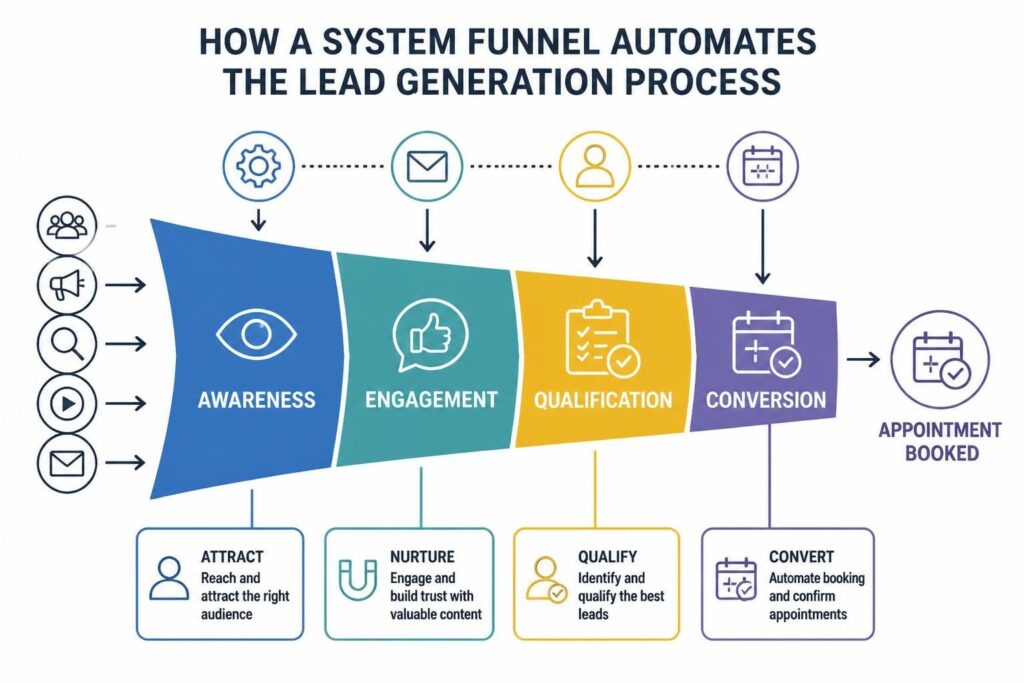
Your business deserves more than just random leads that go nowhere. You need a predictable, automated process that consistently turns prospects into paying customers while you focus on delivering exceptional service. That's exactly what a system funnel delivers: a strategic framework that guides potential clients through every stage of their buying journey with precision and purpose. Unlike traditional marketing approaches that rely on guesswork and manual follow-up, a properly designed system funnel operates like a well-oiled machine, nurturing relationships and converting interest into revenue around the clock.
Understanding the System Funnel Framework
A system funnel represents the complete automated pathway that transforms strangers into loyal customers through strategic touchpoints and deliberate engagement. Think of it as your 24/7 sales team that never sleeps, never takes breaks, and consistently delivers qualified prospects ready to buy.
The power of a sales funnel lies in its ability to systematize what top performers do naturally. When you build a system funnel, you're essentially capturing your best sales processes and scaling them infinitely. This means every prospect receives the perfect message at the perfect time, regardless of when they enter your ecosystem.
The Core Components That Drive Results
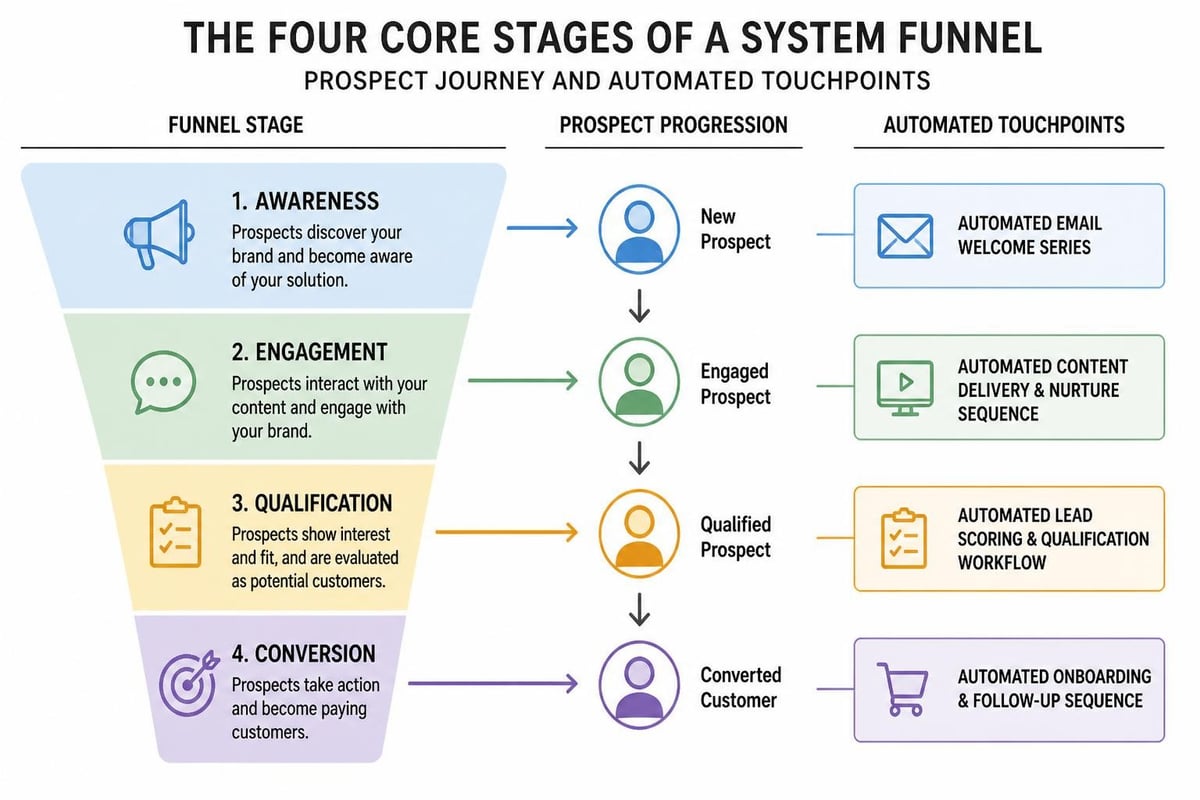
Every effective system funnel includes four critical stages that work together seamlessly:
- Awareness Stage: Where prospects first discover your solution exists
- Engagement Stage: When potential clients interact with your content and brand
- Qualification Stage: The critical phase where interest transforms into genuine buying intent
- Conversion Stage: Where qualified prospects become paying customers
What separates a system funnel from random marketing activities is the deliberate integration between each stage. Your funnel doesn't just capture attention; it strategically moves people forward through a series of calculated interactions designed to build trust, demonstrate value, and eliminate objections before they arise.
Building Your Lead Generation System Funnel
Creating a system funnel that generates predictable revenue requires more than throwing up a landing page and hoping for the best. You need a strategic architecture that accounts for human psychology, buying behaviors, and the specific pain points your ideal clients experience.
Mapping Your Customer Journey
Before you build a single page, you must understand exactly how your prospects think, feel, and behave at each stage of their decision-making process. This mapping exercise separates amateur funnels from professional revenue generators.
Start by identifying the specific questions your prospects ask at each funnel stage. In the awareness phase, they're asking "Do I even have a problem?" By the conversion stage, they're thinking "Is this the right solution for me right now?" Your system funnel must answer these questions automatically through strategic content placement.
The businesses that implement a sales conversion funnel with precision see dramatically higher close rates because they've removed friction from every step. Your job is to make saying "yes" the easiest, most logical next step at every touchpoint.
Selecting Your Funnel Architecture
Different business models require different funnel structures. A webinar funnel works brilliantly for high-ticket services, while a tripwire funnel excels at building customer lists for lower-priced offers. Here's how to choose:
| Funnel Type | Best For | Primary Goal | Average Conversion |
|---|---|---|---|
| Lead Magnet Funnel | Building email lists | Contact capture | 25-40% |
| Webinar Funnel | High-ticket sales | Appointment booking | 20-30% |
| Application Funnel | Service businesses | Qualified leads only | 5-15% |
| Tripwire Funnel | Product launches | Immediate purchases | 8-12% |
Your system funnel architecture should align perfectly with your business lead generation goals. If you're booking appointments for consultations, an application funnel that pre-qualifies prospects saves you countless hours wasted on tire-kickers. If you need volume for nurture campaigns, a lead magnet funnel might serve you better.
Implementing Advanced Automation Technologies
The "system" in system funnel comes from automation technologies that execute your strategy without human intervention. This is where modern lead generation separates itself from old-school methods that demanded constant manual effort.
Leveraging AI for Personalization at Scale
Artificial intelligence has revolutionized what's possible within a system funnel framework. Instead of sending the same generic message to everyone, AI ads and automated communication systems can personalize experiences based on behavior, demographics, and engagement patterns.
When someone enters your system funnel, AI can analyze their interactions to determine their level of interest, budget capacity, and timeline for purchase. This intelligence allows your funnel to automatically adjust messaging, offer different resources, and modify follow-up sequences without you lifting a finger.
Consider how email marketing AI enhances your system funnel performance. Rather than blast the same email to everyone on your list, intelligent systems segment automatically and deliver personalized content that speaks directly to where each prospect stands in their journey. This level of sophistication was impossible just a few years ago.
Integrating Multi-Channel Touchpoints
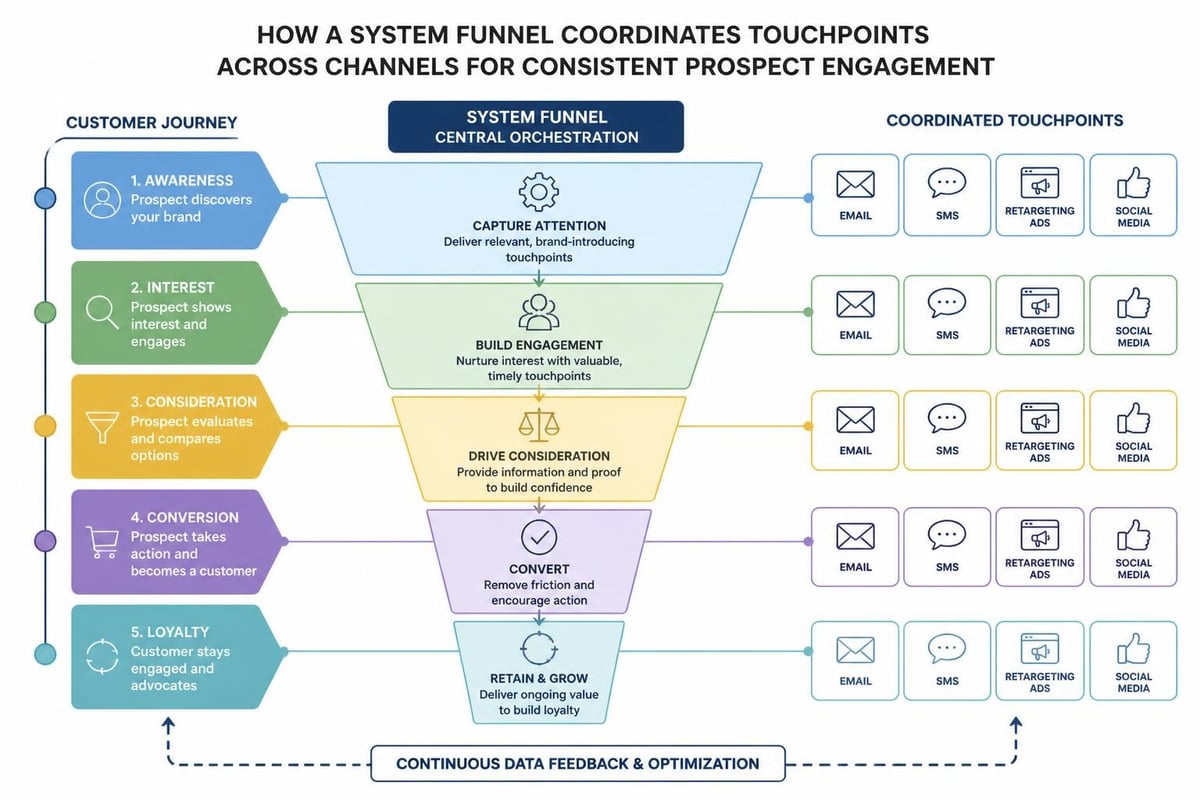
Your system funnel shouldn't exist in a single channel. The most effective implementations coordinate touchpoints across email, SMS, retargeting ads, direct mail, and social media to create an omnipresent experience that builds familiarity and trust.
Here's a strategic multi-channel sequence that works exceptionally well:
- Initial Contact: Prospect opts in through a valuable lead magnet
- Immediate Email: Welcome sequence begins automatically
- Retargeting Activation: Facebook and Google ads follow them online
- SMS Follow-Up: Text message delivered 48 hours after opt-in
- Social Proof: Case studies and testimonials shared via email day 4
- Direct Outreach: Personal video message or phone call for engaged prospects
- Scarcity Element: Limited-time offer introduced to drive decision
This coordinated approach ensures your message penetrates through the noise. Most prospects need 7-12 touchpoints before making a purchasing decision, and your system funnel delivers these interactions automatically across multiple platforms.
Optimizing System Funnel Performance
Building your system funnel is just the beginning. The real magic happens when you continuously optimize based on data, testing variations, and refining your approach based on what actually works in the real world.
Key Metrics That Matter
Not all metrics deserve your attention. Focus obsessively on these four numbers that directly impact your revenue:
- Opt-in Rate: Percentage of visitors who enter your funnel
- Engagement Rate: How many people actually consume your content
- Qualification Rate: Prospects who meet your ideal customer criteria
- Conversion Rate: Qualified leads who become paying customers
Track these metrics weekly at minimum. When you understand what's happening at each stage of your conversion funnel, you can identify exactly where prospects are dropping off and fix those specific leaks.
For example, if you're getting a strong opt-in rate but weak engagement, your lead magnet might be attracting the wrong audience or your follow-up content isn't delivering on the initial promise. If engagement is high but conversions are low, you likely have an offer problem or trust gap that needs addressing.
Testing Variables Systematically
Random testing wastes time and money. Professional system funnel optimization follows a structured approach that identifies high-impact variables first. Start with these elements that typically produce the biggest improvements:
Headlines and hooks can change performance by 40% or more overnight. Test different angles that speak to various pain points your prospects experience.
Offer structure dramatically impacts conversion rates. Sometimes changing from "book a call" to "get a personalized growth plan" doubles appointments simply because the framing feels less salesy and more valuable.
Proof elements like testimonials, case studies, and social proof badges can increase trust enough to overcome objections. Test different types and placements to find what resonates with your specific audience.
The businesses featured in these sales funnel examples succeeded because they committed to systematic testing rather than guessing what might work. Your system funnel deserves the same rigorous approach.
Scaling Your System Funnel for Growth
Once you've built and optimized a system funnel that consistently generates qualified leads, scaling becomes your next priority. The beautiful thing about a properly designed funnel is that it can handle 10x the volume without 10x the work.
Increasing Traffic Without Increasing Costs
Most businesses make scaling harder than necessary by simply throwing more money at paid ads. Smart scaling means finding leverage points that amplify your results without proportionally increasing expenses.
Strategic partnerships can inject massive traffic into your system funnel overnight. When you collaborate with complementary businesses that serve the same audience, you gain access to warm prospects who already trust the partner making the introduction. This partnership traffic typically converts 3-5x higher than cold traffic.
Content marketing creates compounding returns over time. When you develop high-quality content that ranks in search engines, you build an asset that generates traffic month after month without ongoing ad spend. Companies that incorporate this into their marketing agency strategy see their cost per lead decrease dramatically over 12-18 months.
Referral systems turn your customers into a growth engine. When you systematize the referral process within your funnel, encouraging satisfied clients to introduce others, you create viral growth loops that scale naturally.
Infrastructure for Higher Volume
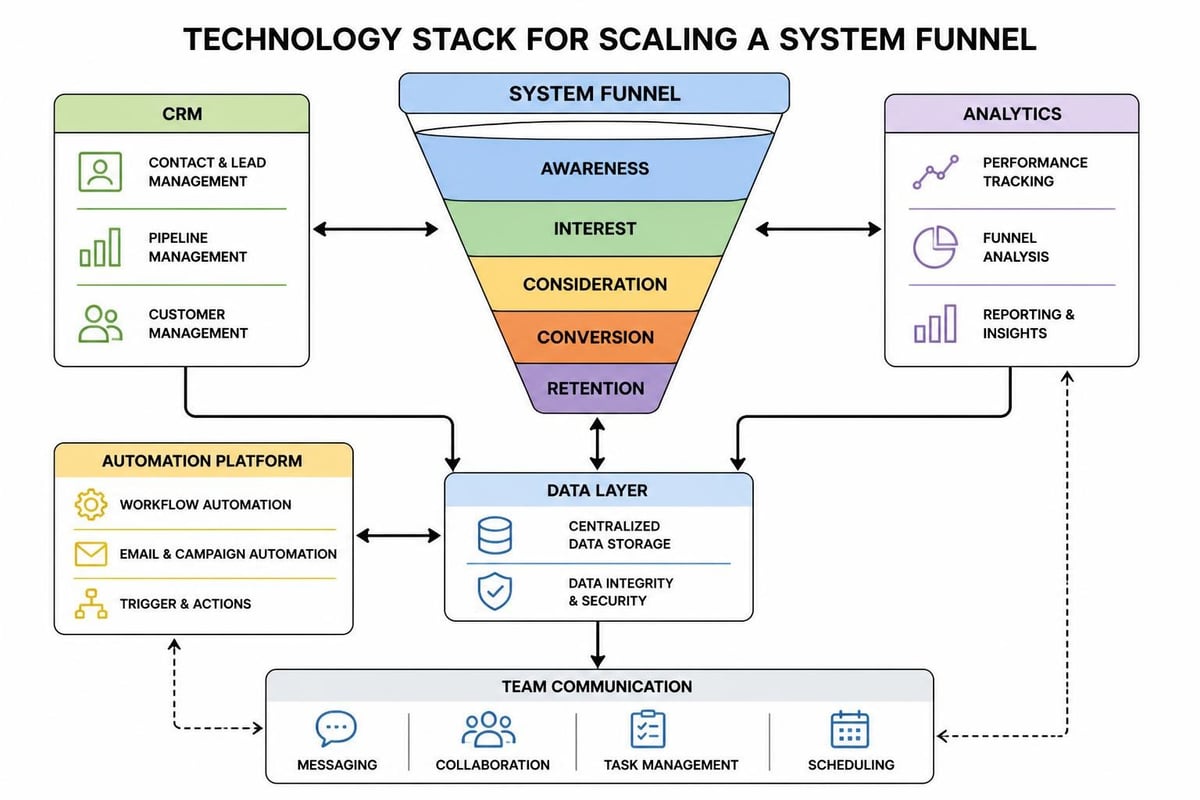
As your system funnel scales, you need infrastructure that maintains quality while handling increased demand. This means investing in the right technology stack and potentially partnering with specialists who understand lead generation at scale.
| Infrastructure Element | Purpose | When to Implement |
|---|---|---|
| CRM Integration | Manage growing lead database | 100+ leads/month |
| Advanced Analytics | Track complex attribution | Multiple traffic sources |
| Appointment Scheduling | Automate booking process | 20+ appointments/week |
| Team Communication Tools | Coordinate follow-up | 2+ team members |
Companies like Get To Page One Ltd specialize in the technical infrastructure required to support high-performing funnels, including website design optimized for conversion and SEO strategies that drive organic traffic consistently. The right technical foundation ensures your system funnel performs flawlessly even under heavy load.
Advanced System Funnel Strategies
Once you've mastered the fundamentals, these advanced strategies can take your system funnel from good to exceptional, creating competitive advantages that are difficult for others to replicate.
Segmentation for Hyper-Relevance
Not all leads are created equal, and treating them identically leaves money on the table. Advanced system funnel operators segment their audience based on multiple variables to deliver experiences that feel personally crafted.
Behavioral segmentation tracks what prospects actually do rather than what they say. Someone who watches 80% of your webinar but doesn't book a call is vastly different from someone who opts in but never engages with content. Your system funnel should treat these people differently.
Demographic segmentation ensures your messaging resonates with specific audience characteristics. A startup founder needs different reassurance than an established enterprise executive, even if they're solving the same problem.
Psychographic segmentation goes deeper into motivations and values. Some prospects are motivated by growth opportunity while others fear missing out. When you understand these psychological drivers, your system funnel can emphasize the right benefits at the right time.
Predictive Lead Scoring
The most sophisticated system funnels don't just move everyone forward equally. They use predictive algorithms to identify which prospects are most likely to convert, then allocate resources accordingly.
By analyzing patterns from past customers, you can assign scores to new prospects based on how closely they match your ideal customer profile. High-scoring leads receive more intensive follow-up, including potentially personal outreach, while lower-scoring leads continue through automated nurture sequences.
This approach maximizes ROI by focusing human effort where it creates the most value. When you're building a sales funnel with limited resources, predictive scoring ensures you're always working on the opportunities with the highest probability of closing.
Continuous Value Delivery
The best system funnels don't just push for the sale. They deliver genuine value at every stage, building goodwill and positioning your brand as the obvious choice when the prospect is ready to buy.
Educational content establishes expertise and answers questions before they're asked. When prospects consume your training, templates, or tools, they experience firsthand the quality of your thinking and approach.
Community building creates belonging and social proof simultaneously. When prospects see others succeeding with your solution, their confidence in moving forward increases dramatically.
The principle applies whether you're in coaching (as explained in this coaching funnel resource) or any other service business. Value-first approaches build relationship foundations that convert at higher rates and produce better customer lifetime value.
Integrating System Funnels with Your Business Model
Your system funnel shouldn't exist in isolation from the rest of your business operations. The most successful implementations integrate seamlessly with sales processes, customer onboarding, and long-term retention strategies.
Aligning Sales and Marketing Systems
Friction between marketing and sales teams destroys system funnel effectiveness. Marketing generates leads that sales considers unqualified, while sales complains they don't receive enough opportunities. Sound familiar?
Solve this by defining what constitutes a qualified lead before building your system funnel. Create specific criteria around budget, authority, need, and timeline. Then design your funnel to surface only prospects who meet these standards.
This alignment means your system funnel includes qualification questions, budget discussions, and timeline identification before anyone reaches your sales team. The result? Sales spends time with ready-to-buy prospects instead of educating people who aren't serious.
When exploring best marketing platforms, prioritize those with robust integration capabilities that connect marketing automation with sales CRM systems seamlessly. This technical integration ensures no lead falls through cracks during handoff.
From Funnel to Customer Success
Your system funnel shouldn't end at the sale. The most profitable businesses extend funnel thinking into onboarding, activation, and expansion phases.
Onboarding funnels systematically guide new customers toward their first win, reducing churn and increasing satisfaction. Activation funnels ensure customers actually use what they purchased rather than letting it sit dormant.
Expansion funnels identify opportunities for upsells, cross-sells, and referrals at strategic moments when customers are most receptive. This transforms your system funnel from a lead generation tool into a comprehensive revenue growth engine.
According to IBM’s analysis, companies that map the entire customer journey through interconnected funnels see dramatically higher lifetime value per customer compared to those focused solely on acquisition.
Measuring True ROI
Revenue generated isn't the only measure of system funnel success. Calculate these metrics to understand true performance:
- Cost Per Acquisition: Total funnel costs divided by customers generated
- Time to Conversion: Average days from lead to customer
- Lead Quality Score: Percentage of funnel leads that match ideal customer profile
- Customer Lifetime Value: Revenue generated per customer over relationship
- Funnel Efficiency Ratio: Revenue generated per dollar invested in funnel
When you track these numbers consistently, you can make intelligent decisions about where to invest more heavily and what to cut. Some channels might generate cheaper leads but lower lifetime value, making them less attractive than premium sources.
Future-Proofing Your System Funnel
The marketing landscape changes constantly, and what works today might underperform tomorrow. Build adaptability into your system funnel from the start so you can pivot quickly when market conditions shift.
Building on First-Party Data
As privacy regulations tighten and third-party cookies disappear, system funnels built on first-party data will dominate. This means owning your audience through email lists, SMS databases, and direct relationships rather than renting attention through platforms you don't control.
Every interaction within your system funnel should capture data that helps you understand prospects better. Preference centers let people self-select their interests. Engagement tracking reveals what content resonates. Purchase history predicts future needs.
This proprietary data becomes more valuable over time, creating a competitive moat that new entrants can't easily replicate. Your system funnel essentially becomes smarter with every prospect who enters it.
Embracing Emerging Technologies
Staying current with technological advances ensures your system funnel maintains its competitive edge. Voice search optimization, conversational AI, and interactive content formats all represent opportunities to enhance funnel performance.
The businesses that thrive in coming years will be those that experiment with emerging technologies while maintaining core funnel fundamentals. Balance innovation with proven principles, testing new approaches in controlled ways before rolling them out system-wide.
Strategic resources like those found in the B2B funnel context help you understand how professional organizations approach systematic lead generation, providing inspiration for your own implementations.
Your system funnel represents one of the most valuable assets your business can build. Unlike ad campaigns that stop working the moment you stop paying, a properly designed funnel continues generating qualified leads and revenue day after day, year after year. The investment you make in building, optimizing, and scaling your funnel compounds over time, creating predictable growth that transforms your business from reactive to proactive.
A well-executed system funnel transforms your lead generation from a constant struggle into a predictable growth engine. When you combine strategic funnel design with advanced automation, you create a business asset that generates qualified opportunities consistently. Aletto specializes in building these exact systems for businesses ready to move beyond traditional marketing approaches, leveraging AI-powered automation to deliver qualified leads and automated appointment bookings that drive real revenue growth. Ready to build a system funnel that actually works? Let's talk about creating your guaranteed growth partnership today.