

Every business knows the frustration of marketing campaigns that generate clicks but not customers. The difference between wasted ad spend and predictable revenue growth lies in how well you architect your campaign funnel. This strategic framework transforms scattered marketing efforts into a systematic engine that moves prospects from first contact to qualified sales conversations. When built correctly, a campaign funnel doesn't just attract attention-it cultivates interest, builds trust, and delivers ready-to-buy leads to your sales team with precision.
Understanding the Campaign Funnel Framework
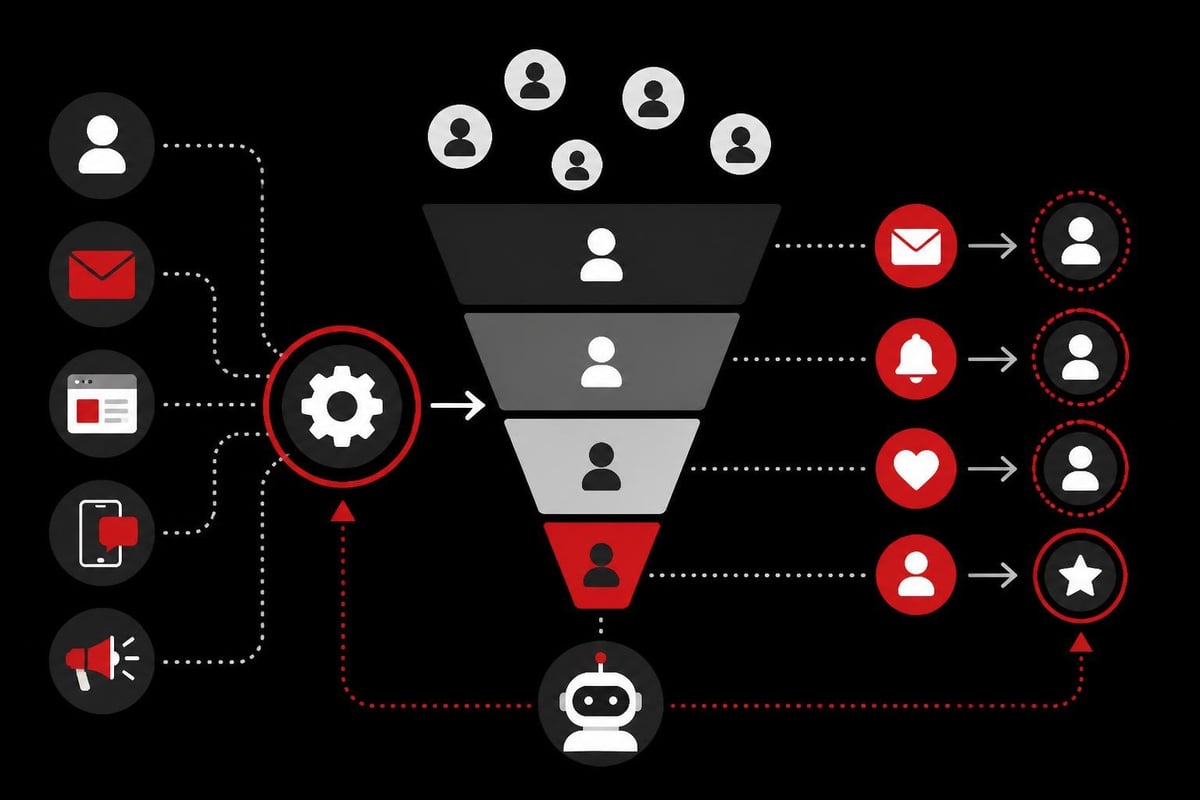
A campaign funnel represents the complete journey prospects take from discovering your business to becoming qualified leads ready for conversion. Unlike traditional marketing approaches that spray messages broadly, the campaign funnel segments audiences based on their awareness level and delivers targeted content that moves them progressively closer to a purchase decision.
The framework operates on a simple principle: different stages require different messages. Someone just learning about their problem needs educational content, while someone actively comparing solutions needs proof points and differentiation. This staged approach dramatically improves conversion rates because you're matching message to mindset.
The Three Core Stages
Top of funnel (TOFU) focuses on awareness and education. Campaigns at this stage cast a wider net, targeting audiences who match your ideal customer profile but haven't yet recognized their need for your solution. Content emphasizes problems, trends, and insights rather than product features.
Middle of funnel (MOFU) cultivates consideration among prospects who understand their challenge. These campaigns nurture relationships through case studies, comparison guides, and demonstrations of your approach. You're building trust and positioning your methodology as the superior choice.
Bottom of funnel (BOFU) drives conversion by addressing final objections and creating urgency. Campaigns target prospects showing buying signals-they've engaged with multiple pieces of content, visited pricing pages, or downloaded bottom-funnel assets. Your messaging focuses on outcomes, guarantees, and clear next steps.

Architecting Campaigns for Each Funnel Stage
Building an effective campaign funnel requires matching your media strategy, creative approach, and offer to each stage's objectives. Many businesses fail here because they apply the same tactics uniformly, wondering why top-of-funnel campaigns don't convert or why bottom-funnel audiences seem too small.
| Funnel Stage | Primary Goal | Campaign Types | Key Metrics |
|---|---|---|---|
| Top | Awareness & Education | Social media ads, content syndication, SEO | Reach, engagement, page views |
| Middle | Consideration & Trust | Retargeting, email sequences, webinars | Click-through rate, time on site, content downloads |
| Bottom | Conversion & Decision | Search ads, direct outreach, demo offers | Conversion rate, cost per lead, lead quality score |
Top-Funnel Campaign Architecture
Your awareness campaigns should prioritize volume and relevance over immediate conversion. Developing a content marketing strategy that addresses audience pain points creates the foundation for effective top-funnel campaigns.
Target broad audiences using interest-based and demographic filters. A company selling to restaurant owners might target "restaurant management" interests rather than specific solution keywords. Creative emphasizes the problem: "Why 60% of restaurants struggle with staff scheduling" performs better than "Try our scheduling software."
Offers at this stage should be low-commitment and high-value: industry reports, educational guides, assessment tools, or webinar registrations. You're trading valuable insights for contact information, starting the relationship on a foundation of value rather than sales pressure.
The campaign funnel strategy for acquiring leads begins here with volume, knowing that only a fraction will progress to qualified status. That's not failure; it's how funnels work.
Middle-Funnel Campaign Precision
Middle-stage campaigns require more sophisticated audience definition. You're targeting people who've already engaged with your content, visited your website, or fit specific behavioral profiles. This is where retargeting pixels, email list segmentation, and CRM integration become critical.
Behavioral triggers activate middle-funnel campaigns:
- Website visitors who viewed multiple pages but didn't convert
- Email subscribers who clicked links in awareness content
- Social media engagers who commented or shared
- Content downloaders who consumed top-funnel assets
Creative shifts from problem-focused to solution-oriented. Case studies, comparison frameworks, and methodology explanations dominate. If your top-funnel ad asked "Struggling with lead quality?", your middle-funnel ad might say "How 3 agencies increased lead quality by 47% using qualification automation."
The demand funnel concept becomes particularly relevant here, as you're cultivating latent demand into active consideration. Understanding nonlinear buyer journeys helps you create content mixes that accommodate how prospects actually research and evaluate solutions.
Bottom-Funnel Campaign Optimization
Bottom-of-funnel campaigns target your highest-intent audiences with direct conversion offers. These prospects have engaged extensively, show clear buying signals, and need a compelling reason to take action now.
Audience refinement reaches maximum precision:
- Visitors to pricing or contact pages
- Multiple content downloads from same contact
- Email subscribers who clicked MOFU links 2+ times
- High-value prospect segments from your CRM
- Lookalike audiences based on converted customers
Creative emphasizes outcomes, social proof, and risk reversal. Testimonials, ROI calculators, free trials, and strategy sessions become your primary offers. The campaign funnel has done its job nurturing awareness into intent; now you're removing final barriers to conversion.
Search campaigns focusing on bottom-funnel keywords ("[solution] pricing", "[solution] vs [competitor]", "[solution] demo") complement your retargeting efforts. These prospects are actively comparing options-your message needs to differentiate clearly and create urgency without seeming pushy.
Measurement and Attribution Across the Funnel
The campaign funnel's greatest challenge isn't building it-it's measuring it accurately. Traditional last-click attribution dramatically undervalues top and middle-funnel efforts, creating pressure to invest only in bottom-funnel tactics that deliver immediate conversions.
Multi-touch attribution models provide better insight into how campaigns work together. First-touch attribution credits the initial interaction, while linear models distribute credit equally across all touchpoints. More sophisticated approaches like time-decay or position-based models weight touches based on their likely influence.
Understanding attribution modeling and its impact on budget allocation helps you avoid the trap of starving top-funnel campaigns that actually drive your middle and bottom-funnel performance.
Key Performance Indicators by Stage
Different stages require different success metrics. Evaluating a top-funnel campaign by conversion rate makes as much sense as judging a bottom-funnel campaign by reach.
Top-funnel KPIs focus on efficient awareness:
- Cost per thousand impressions (CPM)
- Engagement rate (likes, shares, comments)
- Content consumption (video views, article reads)
- New audience growth
Middle-funnel KPIs measure nurture effectiveness:
- Click-through rate on retargeting ads
- Email open and click rates
- Content download conversion rate
- Lead scoring progression
Bottom-funnel KPIs prioritize conversion quality:
- Cost per qualified lead
- Conversion rate to sales conversation
- Lead-to-customer conversion rate
- Customer acquisition cost (CAC)
The relationship between these metrics reveals funnel health. If top-funnel reach grows but middle-funnel engagement stagnates, your awareness content isn't resonating. If middle-funnel metrics look strong but bottom-funnel conversions disappoint, you have a qualification or offer problem.
Automation and Technology Stack
Manual campaign funnel management becomes impossible at scale. The right technology stack automates stage progression, personalizes messaging, and optimizes budget allocation based on performance data.
Essential automation components include:
- Customer Relationship Management (CRM): Central database tracking all prospect interactions, enabling behavioral segmentation and lead scoring
- Marketing Automation Platform: Triggers email sequences, updates lead scores, and manages multi-channel nurture campaigns based on behavior
- Analytics and Attribution: Tracks customer journey across touchpoints, measuring true campaign contribution beyond last-click
- Ad Platform Integration: Syncs audience segments between CRM and advertising platforms, enabling automated retargeting and lookalike creation
AI-powered systems take this further by predicting which prospects are most likely to convert, automatically adjusting bids and budgets toward high-performing segments, and personalizing content based on engagement patterns. For businesses focused on B2B lead generation online, these capabilities transform campaign efficiency.
Building Automated Progression Rules
Lead scoring provides the foundation for automated campaign funnel progression. Assign point values to behaviors indicating increased interest: website visits (5 points), content downloads (10 points), pricing page views (25 points), demo requests (50 points).
When prospects cross thresholds, automation triggers stage-appropriate campaigns. A prospect reaching 25 points exits top-funnel audiences and enters middle-funnel retargeting. At 75 points, they trigger a direct outreach sequence or high-value offer campaign.
This systematic approach to finding leads for your business ensures consistent follow-up and prevents valuable prospects from slipping through gaps in manual processes.
Content Strategy Across Funnel Stages
Your campaign funnel performs only as well as the content supporting it. Prospects move through stages by consuming increasingly specific content that builds trust and addresses deepening questions.
Full-funnel marketing performance requires coordinating content creation with campaign objectives, ensuring every piece serves a strategic purpose in prospect progression.
Content Mapping Framework
| Content Type | Funnel Stage | Purpose | Distribution |
|---|---|---|---|
| Industry reports, trend analysis | Top | Attract broad audience | Social ads, SEO, syndication |
| How-to guides, problem frameworks | Top-Middle | Build authority | Email, retargeting, search |
| Case studies, comparison guides | Middle | Demonstrate value | Retargeting, email sequences |
| ROI calculators, product demos | Middle-Bottom | Facilitate evaluation | Direct mail, bottom-funnel ads |
| Testimonials, implementation plans | Bottom | Remove final objections | Sales enablement, demo flows |
Creating compelling video content across these stages often requires significant resources. Services like beCreatives provide unlimited video editing to help businesses maintain consistent content production without overwhelming internal teams.
The sales conversion funnel tightens when content directly addresses prospect objections and questions at each stage. Generic content performs poorly because it tries to serve everyone and resonates with no one.

Optimization Tactics That Compound Results
Campaign funnel optimization isn't about massive overhauls-it's about systematic testing and refinement that compounds over time. Small improvements at each stage multiply throughout the funnel, creating exponential gains in final conversion rates.
Testing Priorities by Stage
Top-funnel optimization focuses on audience expansion and engagement:
- Test broader versus narrower audience definitions
- Compare problem-focused versus solution-focused messaging
- Evaluate different content formats (video, article, infographic)
- Experiment with various offer types (guides, tools, webinars)
Middle-funnel optimization improves nurture effectiveness:
- Test email sequence timing and frequency
- Compare educational versus case study content
- Evaluate different retargeting creative approaches
- Optimize landing page layouts for content downloads
Bottom-funnel optimization maximizes conversion rate:
- Test offer types (free trial, demo, audit, consultation)
- Compare risk-reversal approaches (guarantees, money-back offers)
- Evaluate urgency tactics (limited slots, seasonal deadlines)
- Optimize form length and required fields
For businesses running Facebook leads campaigns or other platform-specific initiatives, platform algorithms reward consistent testing and iteration with lower costs and better targeting.
Budget Allocation Strategy
Conventional wisdom suggests investing heavily in bottom-funnel campaigns because they convert at higher rates. This creates a death spiral-starving top-funnel campaigns shrinks your overall prospect pool, eventually leaving too few bottom-funnel prospects to sustain growth.
Balanced allocation maintains funnel health:
- 40-50% to top-funnel awareness and audience building
- 25-35% to middle-funnel nurture and consideration
- 20-30% to bottom-funnel conversion campaigns
These ratios shift based on business maturity. New businesses need heavier top-funnel investment to build awareness. Established brands with large engaged audiences can weight more toward conversion.
The marketing agency strategy that sophisticated agencies employ involves continuous monitoring of stage-to-stage conversion rates, adjusting budget allocation to maintain healthy ratios throughout the funnel.
Common Pitfalls and How to Avoid Them
Even well-designed campaign funnels fail when execution breaks down. Common marketing mistakes often stem from misunderstanding how persuasion actually works across the customer journey.
The premature conversion push remains the most frequent error. Businesses bombard top-funnel prospects with demo offers and pricing information before establishing value or trust. This approach burns audience goodwill and wastes advertising spend on poorly matched prospects.
Neglecting the middle creates a funnel that leaks. You attract awareness and optimize conversion, but prospects disappear during consideration because you haven't built adequate nurture campaigns. Investing in middle-funnel content and retargeting fills this gap.
Ignoring funnel velocity means overlooking how quickly prospects move between stages. If your average sales cycle is 45 days but you're measuring campaign success at 7 days, you're drawing incorrect conclusions about performance. Align measurement windows with realistic progression timelines.
Over-segmentation paradoxically weakens campaigns by creating audiences too small for algorithms to optimize. Start with broader segments at each stage, then subdivide only when you have sufficient volume to maintain statistical significance.
The social media funnel requires particular attention to these pitfalls, as platform algorithms need adequate data volume to optimize delivery and targeting.
Advanced Tactics for 2026 and Beyond
Campaign funnel sophistication continues evolving as technology enables more precise targeting and personalization. Several emerging trends are reshaping how leading businesses architect their funnels.
Intent data integration allows you to target prospects based on behaviors across the web, not just interactions with your properties. When someone researches your category on industry sites, review platforms, or competitor websites, intent data captures those signals and feeds them into your targeting.
Conversational marketing uses chatbots and messaging apps to engage prospects in real-time, answering questions and qualifying interest immediately rather than waiting for email sequences to progress. This dramatically accelerates funnel velocity for engaged prospects.
Predictive analytics leverages machine learning to identify which top-funnel prospects are most likely to convert, enabling earlier intervention with high-potential leads. Rather than treating all awareness-stage prospects equally, you can fast-track those showing conversion patterns similar to past customers.
Account-based marketing (ABM) integration flips the funnel for B2B businesses, starting with bottom-funnel targeting of specific high-value accounts and working backward to create personalized campaigns for decision-makers within those organizations. This inverted approach makes sense when total addressable market is small and deal values are large.
For companies specializing in lead gen advertising, these advanced tactics provide competitive differentiation in increasingly crowded markets.
Integration with Sales Processes
The campaign funnel doesn't end at lead generation-it extends into sales handoff and conversion. Misalignment between marketing's definition of a qualified lead and sales' requirements creates friction that destroys funnel efficiency.
Service Level Agreements (SLAs) between teams formalize expectations. Marketing commits to delivering a specific volume of qualified leads meeting agreed criteria. Sales commits to contacting those leads within defined timeframes and providing feedback on quality.
Lead scoring alignment ensures both teams use the same definition of "qualified." Explicit criteria-company size, job title, budget authority, timeline, pain point acknowledgment-create objective standards rather than subjective judgment.
Closed-loop reporting tracks what happens to marketing-generated leads throughout the sales process. Which campaigns generate leads that actually close? What's the average deal size by source? How does time-to-close vary by campaign type? This intelligence refines future campaign funnel optimization.
Technology platforms that connect marketing automation with CRM systems enable seamless handoff and tracking. When sales updates a lead status or logs activity, that data flows back to marketing, triggering appropriate nurture sequences or removing prospects from campaigns.
Building a campaign funnel that consistently converts requires strategic thinking about audience progression, disciplined execution across multiple stages, and continuous optimization based on performance data. The businesses that win in 2026 aren't those with the biggest advertising budgets-they're the ones that architect systematic engines moving prospects from awareness to qualified conversations with precision. Aletto specializes in building these AI-powered campaign funnels that transform cold prospects into ready-to-buy leads, combining advanced automation with proven frameworks that guarantee growth. If you're ready to replace inconsistent lead flow with predictable revenue, let's architect your campaign funnel together.