Sales outreach is the set of actions a seller takes to start a conversation with a prospect who has not yet asked to talk, and the version that books the most B2B meetings in 2026 starts with buyers who have already raised a hand. Cold email and cold calling still exist, but they now lose to systems that attract interested prospects, follow up automatically, and let them book a time on their own.
That shift is driven by buyer behavior. A 2025 Gartner survey of 632 B2B buyers found that most buyers prefer a rep-free buying experience and actively avoid suppliers that send irrelevant outreach. This guide covers what sales outreach is, which channels deserve your budget, how to structure follow-up, and what to measure.
What Is Sales Outreach?
Sales outreach is any proactive contact a sales team makes to open a conversation with a prospect, using channels such as email, phone, social media, video, or direct mail. Its goal is a qualified meeting, not a reply count or a sent-message count.
Outreach differs from marketing in who starts the contact. Marketing draws people in through content, ads, and brand, while outreach has a person reaching out to a named prospect. In practice the line is blurring. Paid acquisition now produces the first touch, and automated follow-up handles the second, so the rep only appears when the prospect is ready to talk.
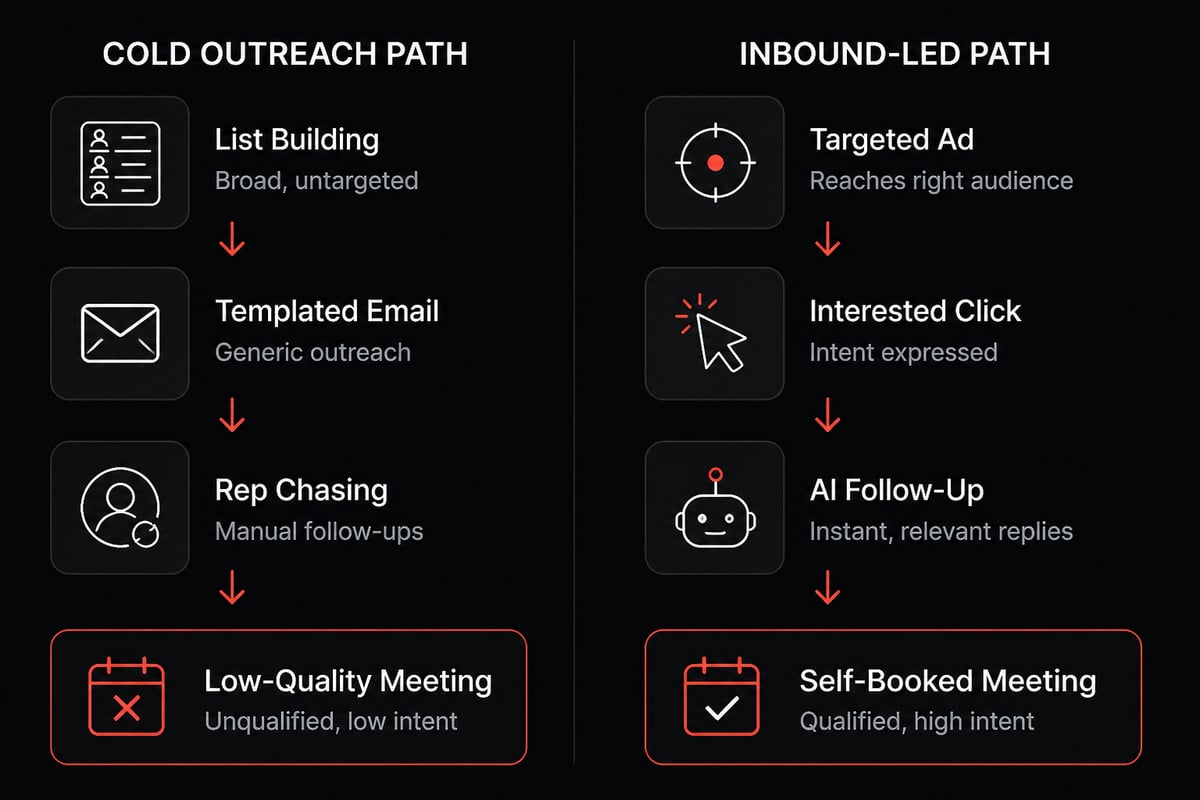
Consider a B2B SaaS company selling workflow software. Its reps send 200 cold emails a day and book three meetings a week. That is outreach in its traditional form: high effort, low yield, and dependent on rep stamina. The same company could run ads aimed at its buyers' stated problems, capture the interested clicks, and let an automated sequence handle booking. Both are sales outreach, but only one scales without adding headcount.
Why Does Traditional Sales Outreach Fail in 2026?
Traditional outreach fails because it interrupts people who never asked to be contacted, and buyers now have both the tools and the habit to ignore it. The Gartner data above shows the scale of the problem: most buyers avoid suppliers who send irrelevant messages.
Three specific failures show up repeatedly:
- Volume replaced relevance. Sequences of six or eight templated touches train prospects to filter you out.
- Rep time is the bottleneck. Every meeting costs research, writing, sending, and chasing, so output is capped by headcount.
- Quality is unpredictable. Meetings booked through persistence are often with people who agreed just to end the thread.
Personalization is the usual fix, and buyers do want it. A 2025 LinkedIn and Ipsos survey of 508 B2B buyers reported that most buyers strongly agree outreach to them should be personalized. But personalization at the level buyers expect is expensive to do by hand. Most teams cannot sustain it across hundreds of prospects a week, and a merge field that inserts a first name does not count.
My position is simple: if your pipeline depends on reps pushing messages at strangers, you are paying a premium for the lowest-converting channel available. Aletto has written at length on why cold outreach is failing and what replaces it.
Which Sales Outreach Channels Still Work?
Email, phone, LinkedIn, video, and direct mail all still work, but each performs best at a specific stage and none performs well against a cold, unqualified list. The useful question is which channel fits a prospect's level of interest, not which channel is best in the abstract.
Here is how the main channels compare for a B2B team:
| Channel | Best use | Main weakness |
|---|---|---|
| Following up with prospects who showed interest | Ignored when sent cold to strangers | |
| Phone | Confirming and qualifying warm leads | Low connect rates on cold lists |
| Light first touch and relationship building | Message limits and spam perception | |
| SMS | Fast follow-up after a form fill or click | Needs prior opt-in to be appropriate |
| Personalized video | High-value accounts | Slow to produce at volume |
| Direct mail | Named strategic accounts | Cost per contact |
The pattern is that every channel improves sharply once the prospect has signaled interest. SMS is a clear example. Aletto has described how interested leads responded well to an AI SMS bot, while cold email sequences tended to stall. The channel did not change the outcome. The warm audience did.
If you are comparing software for managing these channels, Aletto's breakdown of sales outreach tools covers what each category does.
How Do You Build a Sales Outreach System That Books Meetings?
A booking-focused outreach system has four parts: a targeted offer, paid or organic acquisition, automated follow-up, and a calendar that only qualified prospects can reach. Each part removes a manual step that caps your volume.
- Define one buyer and one problem. Write the offer in the words your buyers use, not your internal product language. Aletto builds creative from buyers' actual language and tests it weekly.
- Acquire interested prospects. Run ads or content that ask for a specific action, such as a demo or a diagnostic, rather than a generic download.
- Follow up within minutes. Speed matters more than polish. An AI-driven sequence across SMS and email can respond instantly at any hour.
- Let prospects book themselves. Automated booking removes the back-and-forth that kills momentum.
- Gate the calendar. Qualification questions before booking mean reps only meet people who fit.
Take an appointment-based service business, such as a commercial cleaning firm or a compliance consultancy. The owner used to chase every inquiry by phone and lose half of them to voicemail. With instant automated follow-up and self-booking, inquiries convert to calendar slots while the owner is on a job site. For a deeper look at the mechanics, see how to build a system that forces leads to book sales calls.
What Is the 2-2-2 Rule in Sales?
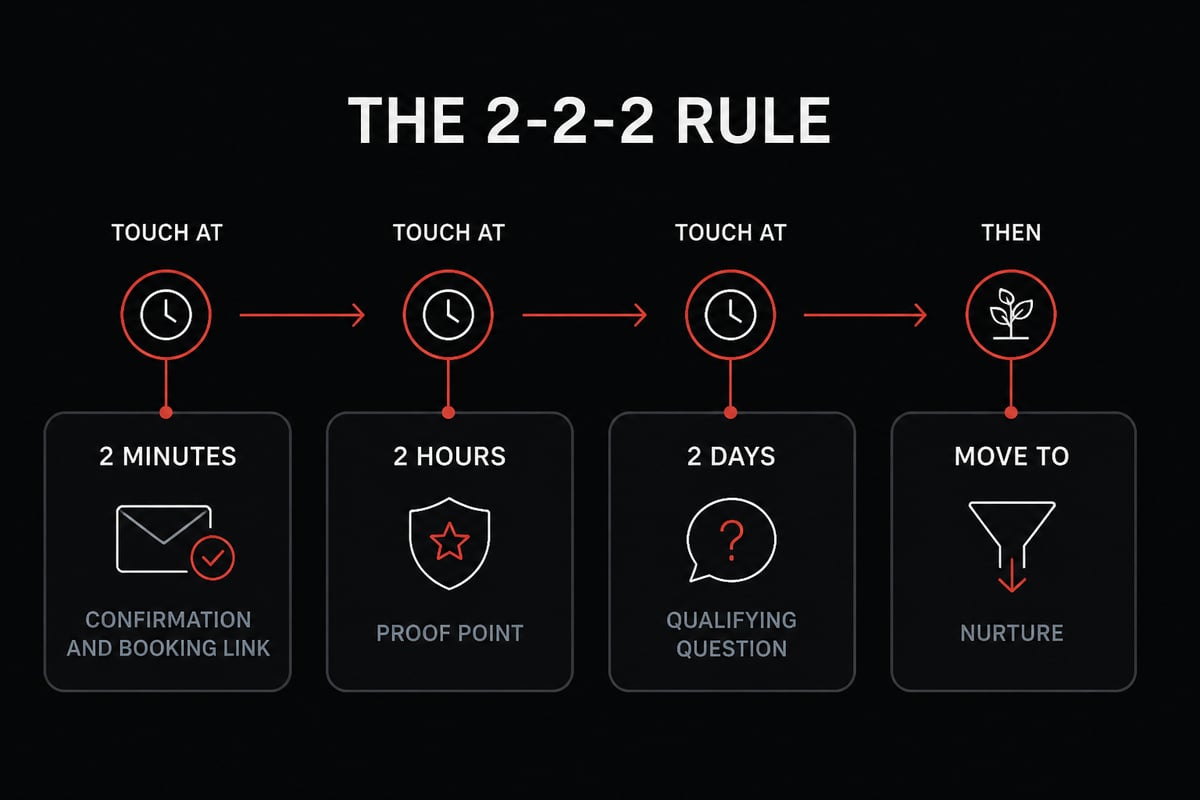
The 2-2-2 rule is a follow-up cadence: contact a new lead within 2 minutes, again within 2 hours, and again within 2 days. It exists because response speed is one of the few levers a team fully controls.
The rule works when the lead has just expressed interest, because attention fades quickly. It works poorly as a script for cold contacts, where three fast touches simply compress the annoyance. Automation is what makes it realistic. No rep reliably responds within two minutes at 9 p.m., but an AI follow-up sequence does, and it can hand off to a human once the prospect replies or books.
A practical version looks like this:
- Minute 2: Text or email confirming the request and offering a booking link.
- Hour 2: A short message with one relevant proof point, such as a result from a similar company.
- Day 2: A final check that asks one qualifying question and restates the booking link.
After that, move the lead to a slower nurture track instead of continuing to push. Respecting a "no" or a non-response protects your sender reputation and your brand.
How Much Does Sales Outreach Cost?
Sales outreach costs range from a few hundred dollars a month for basic email tools to tens of thousands for a full-time team, and the number that matters is cost per qualified meeting. Software subscriptions are the smallest line item. Salary, data, ad spend, and management time are larger.
A fair comparison counts all inputs:
- Rep salary and commission spent on prospecting instead of closing.
- Data and tools such as contact databases, sequencers, and dialers.
- Ad spend, if you acquire prospects through paid channels.
- Management and training time, which rarely appears on a budget.
Divide the total by qualified meetings held, not meetings booked. A cheap process that fills the calendar with poor-fit prospects is more expensive than it looks. Aletto reports it has managed over $50M in ad spend and reduced average customer acquisition cost by 34% for clients, with attribution verified by Hyros. The point for your own planning: pay for visibility. If you cannot see where each dollar goes, you cannot tell which part of the system is working.
How Should Outreach Be Personalized Without Spending Hours Per Prospect?
Effective personalization ties your message to a specific business problem the prospect has, not to trivia about their profile. Mentioning a recent post or alma mater is cosmetic. Naming the operational issue their role typically faces is relevant.
LinkedIn's research on top performers is instructive here. In its B2B sales playbook, LinkedIn reported that top-performing sellers were twice as likely to hit quota, that 62% conducted industry research for prospects, and that 75% of quota-hitting sellers used AI to help. The takeaway is not to research each person for an hour. It is to research the segment well, then use automation to deliver segment-specific messages at scale.
A workable approach:
- Group prospects by industry and role, then write one strong angle per group.
- Use the language buyers use in reviews, forums, and sales calls.
- Let an AI follow-up bot answer common questions so the conversation feels responsive.
- Reserve manual, one-to-one research for your top 20 target accounts.
For the thinking behind message-to-market fit, Aletto's piece on why people buy and how to build campaigns around it is a useful reference.
What Is the Difference Between Marketing and Outreach?
Marketing attracts an audience through content and advertising, while outreach has a seller contacting a specific prospect directly. In a modern B2B system the two overlap, because marketing now produces the interested prospects that outreach follows up with.
The cleanest way to run both is to treat them as one pipeline with a handoff point. Marketing earns the response. Automated outreach converts the response into a booked meeting. The rep owns the conversation after the booking. Teams that keep them in separate silos tend to argue about lead quality, since neither side sees the full path from ad to meeting. Where marketing and sales share one dashboard, the argument is replaced by numbers.
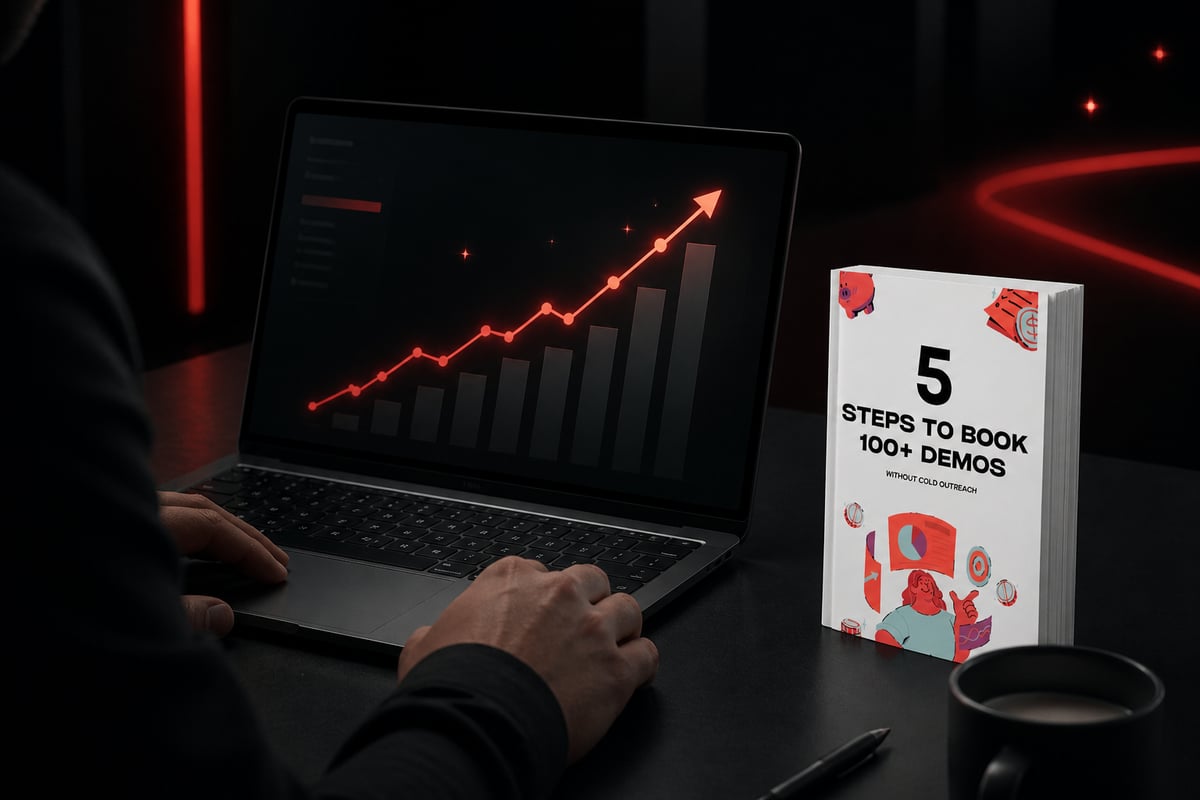
If you want to see what this looks like in practice, the Free AI Call Booking Report shows how Aletto books qualified sales calls without cold emails, cold calls, events, or begging for referrals.
Which Metrics Show Whether Outreach Is Working?
The metrics that matter are qualified meetings held, cost per qualified meeting, show rate, and pipeline created per meeting. Reply rate and emails sent are activity measures and say little about revenue.
Track these in order:
- Qualified meetings held. The only count that reflects real conversations with fit prospects.
- Cost per qualified meeting. Total spend divided by meetings held.
- Show rate. The share of booked meetings that actually happen, which reveals whether your booking flow attracts committed people.
- Meeting-to-opportunity rate. Whether those meetings turn into pipeline.
- Time from first touch to booking. Shorter is almost always better.
Each of these should be attributable to a source. Aletto reports that a majority of client campaigns reach a home-run rate of 10x ROI or more, and it credits that to cutting underperforming creative quickly rather than monitoring it for weeks. That discipline applies to any outreach program: set a threshold, review weekly, and retire what misses it. For the stage-by-stage view, the sales conversion funnel guide maps where prospects drop.
Frequently Asked Questions
What is the best sales outreach channel for B2B?
No single channel wins. Email, SMS, and phone all perform well on prospects who have already shown interest, and all perform poorly on cold lists. Choose the channel that matches your buyer's habits, then use paid acquisition to bring warm prospects into it instead of forcing contact on strangers.
Is cold outreach still worth doing?
It can work in narrow cases, such as a short list of strategic accounts where a rep does real research. As a primary engine for steady pipeline, it is weak. Gartner found 73% of buyers avoid suppliers who send irrelevant outreach, so volume-based cold sequences carry a growing reputational cost.
How many follow-ups should a sales outreach sequence include?
For warm leads, three to five well-spaced touches over about two weeks is enough, with the first within minutes. Beyond that, move the lead to a slower nurture track. Continuing to push after repeated silence damages deliverability and goodwill without adding meetings.
Can small teams run sales outreach without hiring more reps?
Yes. Automated follow-up and self-booking remove most of the repetitive work that normally requires headcount. A small team can handle far more prospects when software replies instantly and reps only join conversations that are already qualified.
Your next step is to pull the last 90 days of your outreach data and calculate your actual cost per qualified meeting held, because that single number will show whether your current approach is worth scaling. If the figure is high or hard to calculate, the problem is usually the same one this guide described: too much manual effort aimed at people who never asked to hear from you. The Free AI Call Booking Report shows how a connected system of paid acquisition, AI follow-up, and automated booking fills a calendar without cold contact, and Aletto offers a free training for teams ready to build that system, so you can start free training and see how it fits your pipeline.