


The business landscape has fundamentally changed. Cold calling lists are getting ignored. Email open rates continue to plummet. Traditional advertising costs keep climbing while returns diminish. In this environment, lead gen companies have emerged as essential growth partners for businesses that refuse to accept stagnant revenue. These specialized firms don't just promise leads-the best ones guarantee qualified prospects who are actually ready to have sales conversations. Understanding how to evaluate and select the right partner could mean the difference between explosive growth and wasted marketing budgets.
What Lead Gen Companies Actually Do
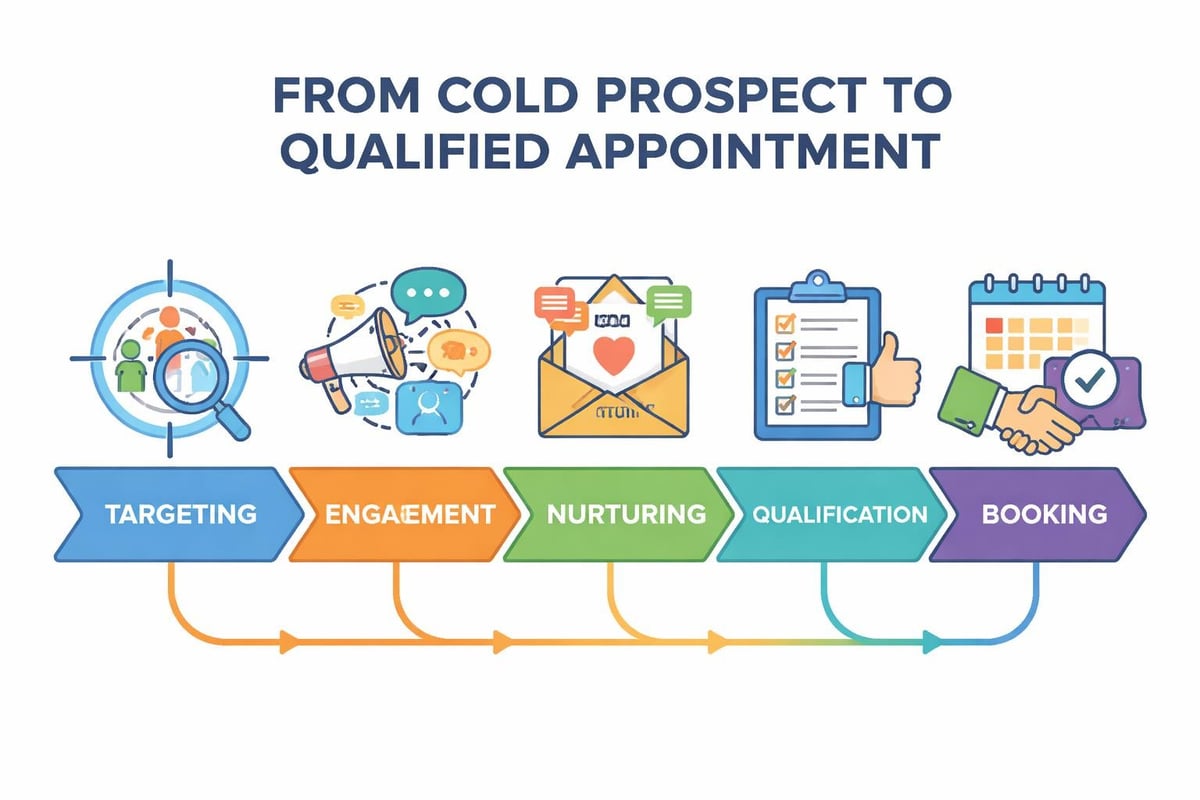
Lead gen companies specialize in identifying, attracting, and nurturing potential customers on behalf of other businesses. Unlike traditional marketing agencies that focus on brand awareness or creative campaigns, these firms are laser-focused on one metric: qualified leads that convert into revenue.
The modern lead generation landscape has evolved far beyond basic contact list purchases. Today's sophisticated providers leverage advanced technology stacks, data analytics, and behavioral targeting to find prospects who match your ideal customer profile. They create multi-channel campaigns that combine content marketing, paid advertising, SEO, social media outreach, and increasingly, AI-powered lead generation systems.
The Core Services Offered
Most reputable lead gen companies provide a comprehensive suite of services:
- Prospect identification and research using proprietary databases and market intelligence
- Multi-channel campaign execution across email, social media, search, and display advertising
- Lead qualification and scoring to separate tire-kickers from ready-to-buy prospects
- Appointment setting and calendar management to book qualified meetings directly into your sales team's schedule
- CRM integration and data management ensuring seamless handoff between marketing and sales
- Performance tracking and optimization with real-time reporting and continuous improvement
The B2B lead generation services market continues experiencing rapid expansion, driven by businesses recognizing that outsourcing lead generation often delivers better ROI than building in-house teams from scratch.
Why Businesses Partner with Lead Gen Companies
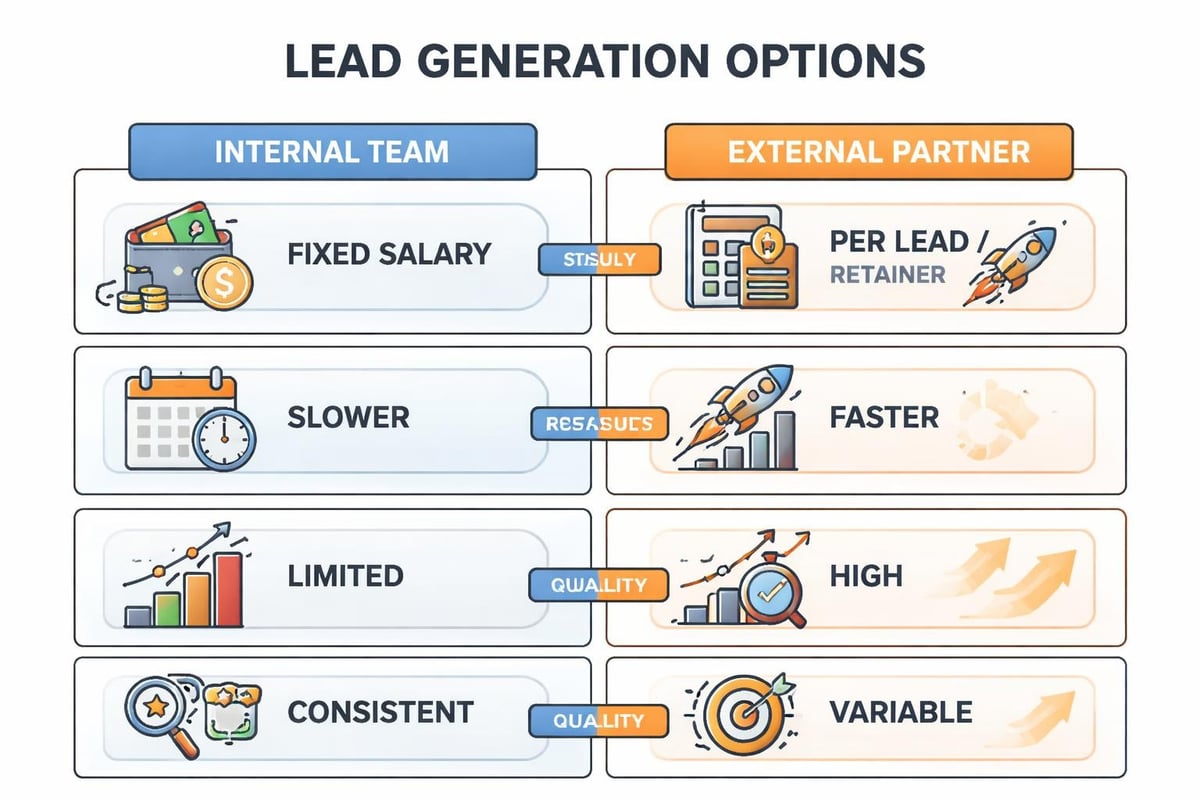
The decision to work with external lead generation providers stems from several compelling business realities. Building effective lead generation capabilities internally requires significant investment in personnel, technology, training, and experimentation. Most businesses would rather focus their internal resources on what they do best-delivering exceptional products and services-while partnering with specialists who live and breathe lead generation.
Time compression represents another critical factor. Developing proven lead generation systems through trial and error can take 12-18 months. Lead gen companies bring battle-tested methodologies and existing infrastructure that can start delivering results within weeks rather than years.
The Economics Make Sense
Consider the total cost of assembling an internal lead generation team:
| Role | Annual Cost | Notes |
|---|---|---|
| Marketing Manager | $85,000 – $120,000 | Strategy and oversight |
| Content Creator | $55,000 – $75,000 | Blogs, emails, landing pages |
| Paid Media Specialist | $65,000 – $95,000 | Ad campaign management |
| Marketing Technology | $25,000 – $50,000 | Software stack and tools |
| Total Annual Investment | $230,000 – $340,000 | Plus benefits and overhead |
Quality lead gen companies often deliver comparable or superior results at a fraction of this cost. More importantly, they operate on performance-based models where their success directly ties to your success. This alignment of incentives fundamentally changes the dynamic from vendor-client to true partnership.
The Technology Advantage
Modern lead generation has become a technology game. The firms that win are those deploying sophisticated systems that combine artificial intelligence, machine learning, and marketing automation to operate at scale while maintaining personalization.
AI systems can analyze millions of data points to identify patterns that predict buying behavior. They can test thousands of message variations, optimize campaign timing, personalize content for specific segments, and continuously learn from results. This technological advantage explains why many businesses find that specialized lead gen companies outperform internal teams despite having less intimate knowledge of the product.
Progressive firms have embraced lead generation software that automates repetitive tasks while freeing human strategists to focus on high-value activities like offer development, market positioning, and campaign creativity.
Building vs. Buying Capabilities
The build versus buy decision extends beyond simple cost comparison:
Building In-House:
- Complete control over messaging and brand
- Deep product knowledge from day one
- Direct accountability and immediate adjustments
- Long-term asset development within your organization
Partnering with Lead Gen Companies:
- Immediate access to proven systems and methodologies
- No learning curve or expensive experimentation
- Scalability without hiring challenges
- Fresh perspective unconstrained by internal politics
Neither approach is universally superior. The optimal choice depends on your business stage, available capital, timeline requirements, and strategic priorities. Many successful businesses use a hybrid model, maintaining core strategic functions internally while outsourcing tactical execution to specialized providers.
How to Evaluate Lead Gen Companies
Not all lead generation providers deliver equivalent value. The industry unfortunately includes both exceptional partners and firms that generate low-quality contacts that waste your sales team's time. Rigorous evaluation separates winners from pretenders.
Questions That Reveal Quality
When interviewing potential partners, these questions expose their true capabilities:
-
What industries do you specialize in? Specialists outperform generalists because they understand industry-specific buying cycles, decision-maker hierarchies, and regulatory considerations.
-
How do you define a qualified lead? This reveals whether they understand your business or simply chase vanity metrics. Quality providers should discuss your specific qualification criteria before proposing solutions.
-
What guarantees do you offer? The best firms stand behind their work with performance guarantees. Those who won't commit to results often can't deliver them.
-
How do you handle lead attribution? Multi-touch attribution models provide far more accurate insights than simplistic last-click attribution.
-
What's your approach to building lead generation systems? This reveals whether they create sustainable assets or rely on short-term tactics that stop working when you stop paying.
Red Flags to Avoid
Certain warning signs indicate you should continue your search:
- Guaranteed lead volume without quality commitments suggests they prioritize quantity over relevance
- Lack of industry case studies or references indicates limited experience or poor results
- Unwillingness to integrate with your existing systems creates data silos and operational friction
- Month-to-month contracts with no commitment often means they lack confidence in retention
- Vague methodology descriptions hide the absence of proven processes
The most successful partnerships form when lead gen companies demonstrate deep expertise in your market, offer transparent reporting, align compensation with outcomes, and genuinely invest in understanding your unique value proposition.
The Performance-Based Model Revolution
Traditional agency compensation models created inherent conflicts of interest. Agencies got paid regardless of results, incentivizing activity over outcomes. They recommended high-cost tactics that maximized their fees rather than your ROI. This misalignment frustrated countless business owners who felt they were funding experiments rather than investing in growth.
Performance-based lead gen companies flip this dynamic entirely. Their revenue directly correlates with the qualified leads or appointments they deliver. When you win, they win. When campaigns underperform, they don't get paid for failures.
| Compensation Model | Agency Incentive | Client Risk | Alignment Quality |
|---|---|---|---|
| Monthly Retainer | Maximize billable hours | High (pays regardless) | Low |
| Project-Based | Extend project scope | Medium (defined deliverables) | Medium |
| Performance-Based | Deliver qualified results | Low (pays for outcomes) | High |
| Hybrid (retainer + performance) | Balance activity and results | Medium | Medium-High |
This model attracts higher-quality providers because only firms confident in their methodologies will accept performance-based compensation. It also naturally filters out businesses whose products genuinely struggle to find market fit-ethical providers won't accept engagements they don't believe they can win.
What True Partnership Looks Like
The guaranteed growth partnership model goes beyond simple lead delivery. It encompasses:
- Shared investment in market research to deeply understand your ideal customer
- Collaborative offer development that positions your solution for maximum appeal
- Transparent reporting with full visibility into campaign performance and lead quality
- Continuous optimization based on feedback from your sales conversations
- Long-term strategic planning rather than month-to-month tactics
These partnerships recognize that effective B2B lead generation strategies require deep collaboration between the company that understands the product and the specialists who understand the channels.
Industry-Specific Considerations
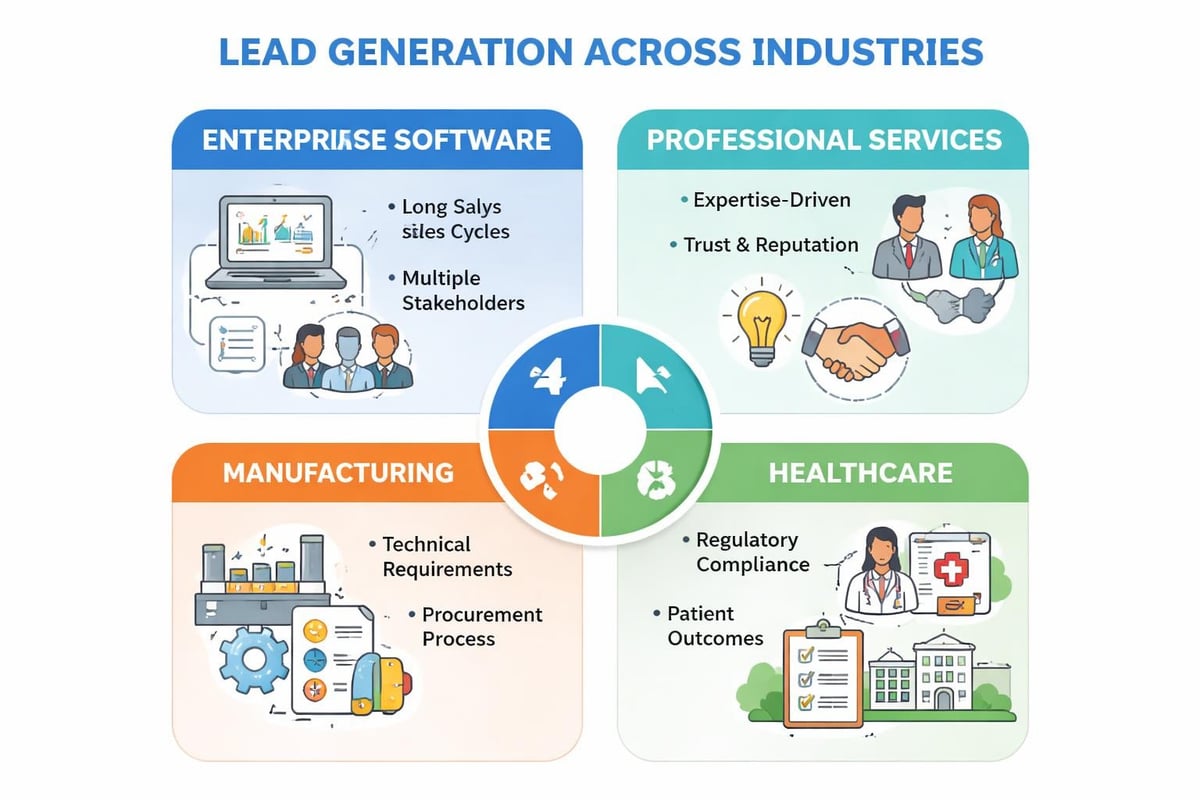
Lead generation strategies that work brilliantly in one industry often fail spectacularly in another. The buying cycle for enterprise software (6-12 months) bears no resemblance to the decision timeline for professional services (2-4 weeks). Marketing messages that resonate with healthcare administrators would confuse manufacturing executives.
Specialized lead gen companies understand these nuances. They know that B2B corporate lead generation requires different tactics than consumer lead generation. They recognize that compliance-heavy industries like finance and healthcare face restrictions that don't apply to technology or retail businesses.
Vertical Expertise Creates Competitive Advantage
Industry specialists bring immediate value:
- Pre-existing knowledge of buyer personas and decision-making units
- Established relationships with industry-specific media and influencers
- Understanding of seasonal patterns and budget cycles
- Awareness of regulatory requirements and messaging constraints
- Proven templates and frameworks adapted to specific markets
This expertise compresses the learning curve dramatically. Rather than spending months discovering what works through expensive trial and error, you benefit from accumulated wisdom across dozens or hundreds of similar engagements.
Measuring Success: Metrics That Matter
Lead gen companies should be evaluated on outcomes, not activities. Too many businesses track vanity metrics like website traffic, email open rates, or social media followers while ignoring the only numbers that truly matter: qualified leads, conversion rates, and revenue generated.
The Lead Quality Hierarchy
Not all leads deserve equal weight in your evaluation:
- Marketing Qualified Leads (MQLs) meet basic demographic and firmographic criteria but haven't necessarily expressed buying intent
- Sales Qualified Leads (SQLs) have demonstrated genuine interest and meet your qualification criteria
- Booked Appointments represent prospects committed enough to allocate time for a conversation
- Opportunities Created are leads that enter your formal sales pipeline
- Closed Revenue is the ultimate measure-actual customers generated
Elite lead gen companies focus on the bottom of this hierarchy. They understand that 10 booked appointments with decision-makers who have budget and timeline beats 1,000 MQLs that go nowhere.
The best providers implement lead generation best practices that emphasize quality over quantity, ensuring every lead passed to your sales team deserves their attention and effort.
The AI Revolution in Lead Generation
Artificial intelligence has transformed lead generation from an art into a science. Machine learning algorithms can now predict which prospects are most likely to convert, when they're most receptive to outreach, and what messages will resonate most powerfully.
AI-powered systems analyze behavioral signals across multiple touchpoints to build predictive models. They identify patterns invisible to human analysis: the specific combination of website pages visited, email engagement timing, content consumption preferences, and digital footprint characteristics that predict buying readiness.
Modern lead gen companies leverage these capabilities to:
- Automatically score leads based on conversion probability
- Personalize messaging at scale without sacrificing relevance
- Optimize ad spend by focusing budget on high-value prospects
- Predict customer lifetime value before the first purchase
- Identify early warning signs of deals at risk
This technological revolution explains why the lead generation services market continues experiencing explosive growth. Businesses recognize that AI-enhanced lead generation delivers competitive advantages that manual approaches simply cannot match.
Human Insight Plus Machine Intelligence
The most effective model combines artificial intelligence with human creativity and strategic thinking. AI excels at processing data, identifying patterns, and executing repetitive tasks at scale. Humans excel at understanding context, developing positioning strategies, and building authentic relationships.
Top-tier lead gen companies employ teams that leverage both capabilities. Data scientists build and refine algorithms. Marketing strategists develop positioning and offers. Copywriters craft compelling messages. Sales development representatives have qualified conversations. Each component reinforces the others in an integrated system designed to convert cold prospects into eager buyers.
Common Mistakes When Selecting Partners
Even sophisticated businesses make predictable errors when choosing lead gen companies. Understanding these pitfalls helps you avoid expensive mistakes.
Prioritizing cost over value represents the most common error. The cheapest provider rarely delivers the best results. Lead generation is an investment, not an expense. The right question isn't "What's the lowest price?" but rather "What's the best return on investment?"
Other Frequent Mistakes
- Expecting instant results when effective lead generation requires testing, optimization, and iteration
- Providing insufficient information about your ideal customer, value proposition, and competitive positioning
- Ignoring cultural fit between your organization and the partner's working style
- Failing to establish clear success metrics before engagement begins
- Not allocating adequate internal resources to support the partnership
- Switching providers too quickly before allowing sufficient time to optimize campaigns
Successful partnerships require patience, clear communication, and realistic expectations. The businesses achieving the best results treat their lead gen companies as strategic partners rather than tactical vendors.
The Future of Lead Generation Partnerships
The lead generation industry continues evolving rapidly. Several trends will shape the landscape over the coming years.
Privacy regulations like GDPR, CCPA, and emerging data protection laws are forcing lead gen companies to develop more sophisticated consent-based approaches. The era of purchasing contact lists and cold blasting thousands of prospects is ending. The future belongs to firms that attract interested prospects through valuable content and authentic engagement.
Account-based marketing integration represents another major shift. Rather than casting wide nets hoping to catch individual leads, advanced strategies target specific high-value accounts with personalized campaigns. This approach requires deep research and customization but generates dramatically higher conversion rates for businesses selling complex, high-value solutions.
Technology Integration Deepens
Leading lead gen companies increasingly position themselves as technology partners rather than service providers. They implement and manage sophisticated marketing technology stacks including:
- Customer relationship management (CRM) systems
- Marketing automation platforms
- Conversational AI and chatbot systems
- Predictive analytics and business intelligence tools
- Attribution modeling and revenue tracking platforms
This technology-first approach transforms the relationship from project-based engagements to long-term strategic partnerships. Businesses benefit from enterprise-grade systems without the capital investment, implementation complexity, or ongoing management burden.
Understanding lead capture and generation best practices becomes increasingly important as competition for attention intensifies across all channels.
Maximizing Your Partnership ROI
Once you've selected the right lead gen company, your behavior significantly influences the results achieved. Passive clients who simply hand over a credit card and wait for leads rarely experience optimal outcomes.
Active partnership produces the best results. This means:
- Providing detailed information about your best customers, their characteristics, pain points, and buying triggers
- Sharing insights from sales conversations about what's working and what's not
- Responding quickly to questions about positioning, pricing, and competitive differentiators
- Testing the leads promptly and providing feedback on quality
- Allowing sufficient time for optimization before making major strategic changes
The most successful clients view their lead gen company as an extension of their internal team. They include them in strategic planning sessions, share market intelligence, and collaborate on offer development rather than treating them as order-takers executing predefined tactics.
Setting Realistic Timelines
Effective lead generation is a marathon, not a sprint. Most programs require 60-90 days to gather sufficient data for meaningful optimization. The typical progression follows this pattern:
- Weeks 1-4: Campaign setup, initial testing, and baseline establishment
- Weeks 5-8: Data analysis, early optimizations, and refinement
- Weeks 9-12: Scaled execution of winning approaches
- Month 4+: Continuous improvement and expansion
Businesses that abandon partnerships after 30 days rarely give the relationship sufficient opportunity to succeed. Those that commit to quarterly evaluations while allowing month-to-month tactical adjustments typically achieve the strongest results.
Integration with Your Sales Process
The handoff between marketing and sales represents a critical success factor. Lead gen companies can deliver perfect prospects, but if your sales process drops the ball, revenue won't materialize.
Effective integration requires:
- Clear lead qualification criteria understood by both marketing and sales teams
- Rapid response protocols ensuring leads are contacted within minutes or hours, not days
- Feedback loops where sales provides detailed information about lead quality and conversion outcomes
- Aligned messaging so the sales conversation continues rather than contradicts the marketing promises
- Technology integration enabling seamless data flow between lead generation systems and your CRM
Many businesses discover that working with lead gen companies exposes weaknesses in their internal sales processes. This revelation, while sometimes uncomfortable, creates opportunities for improvement that ultimately strengthen the entire revenue generation system.
Implementing lead generation optimization strategies across both marketing and sales functions amplifies results and maximizes return on investment.
Making Your Decision
Selecting the right lead gen company represents a strategic decision that will influence your revenue trajectory for years. Approach the evaluation process with the same rigor you'd apply to hiring a senior executive or choosing a major technology platform.
Create a formal evaluation framework that weights factors according to your priorities:
- Industry expertise and vertical specialization (25%)
- Technology capabilities and AI integration (20%)
- Compensation model and performance guarantees (20%)
- Cultural fit and communication style (15%)
- References and case study relevance (10%)
- Pricing and contract terms (10%)
Interview multiple providers. Ask for references and actually contact them. Request detailed case studies from similar businesses. Understand their methodology at a granular level. Clarify exactly what success looks like and how it will be measured.
Most importantly, trust your instincts. The best partnerships form when there's genuine alignment on values, communication styles, and strategic vision. If something feels off during the sales process, it's unlikely to improve after the contract is signed.
The right lead gen company won't just deliver contacts-they'll become a strategic partner invested in your long-term growth. They'll challenge your assumptions, push you to improve your offer, and hold you accountable for following up on the opportunities they create. This kind of relationship transforms businesses, turning lead generation from a cost center into a profit engine that fuels predictable, sustainable growth.
Choosing the right partner among lead gen companies isn't just about filling your pipeline-it's about building a sustainable growth engine that transforms your business. The best partnerships combine cutting-edge technology, proven methodologies, and genuine alignment where your success becomes their success. If you're ready to stop wondering where your next customer will come from and start building a predictable revenue system, Adstra specializes in exactly that transformation. Our AI-powered systems and guaranteed growth partnership model ensure you only pay for qualified results, not empty promises or wasted experiments.