
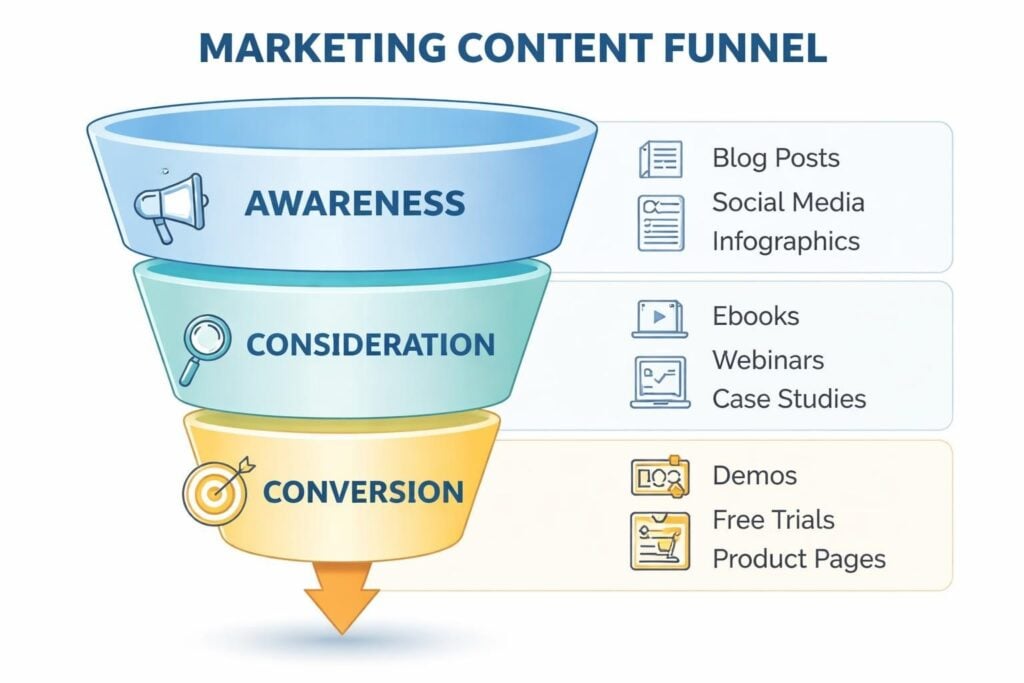
Every business faces the same challenge: turning strangers into customers. The difference between companies that thrive and those that struggle often comes down to how effectively they guide prospects through their buying journey. A well-designed marketing content funnel becomes your automated sales system, working around the clock to educate, nurture, and convert leads into paying customers. For businesses focused on lead generation, understanding and implementing this framework isn't optional anymore; it's essential for predictable revenue growth. When you align the right content with each stage of your buyer's journey, you transform scattered marketing efforts into a cohesive system that consistently delivers qualified prospects ready to make purchasing decisions.
Understanding the Marketing Content Funnel Framework
The marketing content funnel represents the systematic journey your potential customers take from first discovering your brand to becoming loyal advocates. Unlike traditional marketing funnels that focus solely on transactions, a content-driven approach emphasizes delivering value at every touchpoint.
At its core, this framework divides into three critical stages: awareness, consideration, and conversion. Each stage requires different content strategies, messaging approaches, and engagement tactics. The prospect at the top of your funnel has completely different needs and questions than someone ready to schedule a sales call.
Key characteristics of effective marketing content funnels include:
- Alignment between content type and buyer stage
- Progressive education that builds trust over time
- Clear pathways from one stage to the next
- Measurement systems that track content performance
- Continuous optimization based on conversion data
Think of your marketing content funnel as a relationship-building machine. At the awareness stage, you're introducing yourself to strangers who have a problem but might not know solutions exist. During consideration, you're educating prospects who are evaluating different approaches. Finally, at conversion, you're giving qualified leads the final information they need to choose your solution confidently.
Awareness Stage Content Strategy
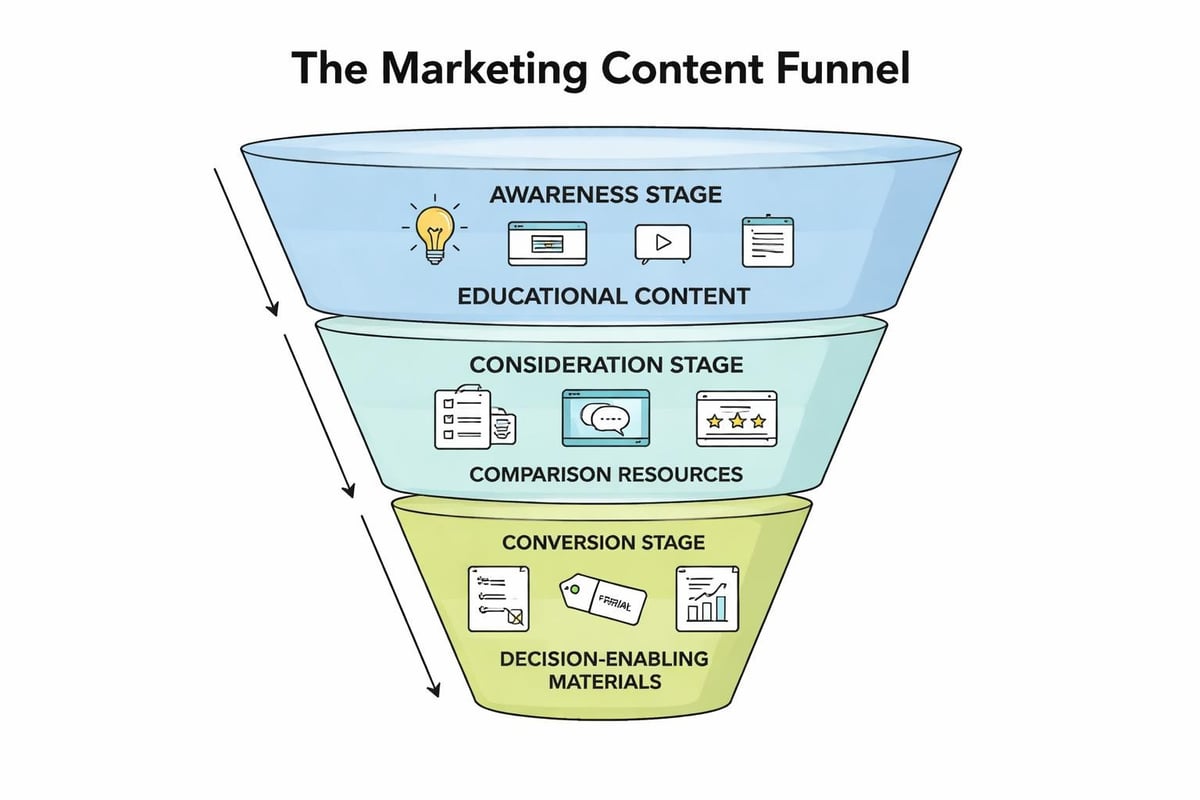
Your awareness stage content serves one primary purpose: attracting the right audience by addressing their pain points and questions. This is where different types of content work together to cast a wide net while maintaining relevance.
Blog articles, social media posts, infographics, and educational videos dominate this stage. These assets should focus on problems your prospects face rather than your solutions. When someone searches for answers to their challenges, your content should appear as a valuable resource, not a sales pitch.
For lead generation businesses, awareness content might address topics like "why traditional outbound isn't working" or "how to identify qualified prospects." The goal is positioning your brand as a knowledgeable authority while capturing contact information from interested parties. Educational value always comes first at this stage.
High-performing awareness content typically features:
- Problem-focused headlines that match search intent
- Actionable insights readers can implement immediately
- Clear explanations without industry jargon
- Multiple content formats to reach different learning styles
- Strategic calls-to-action for deeper engagement
The conversion metric here isn't sales; it's engagement. You're measuring email signups, content downloads, social shares, and time on page. These indicators tell you whether you're attracting qualified prospects who match your ideal customer profile.
Building Your Consideration Stage Assets
Once prospects enter your ecosystem, consideration stage content helps them evaluate solutions and understand their options. This middle funnel content bridges the gap between awareness and purchase readiness, making it perhaps the most critical component of your marketing content funnel.
| Content Type | Primary Goal | Example Format | Key Metric |
|---|---|---|---|
| Case Studies | Demonstrate results | PDF downloads | Lead quality |
| Comparison Guides | Position your solution | Interactive tools | Engagement time |
| Webinars | Build relationships | Live sessions | Attendance rate |
| Email Sequences | Nurture leads | Automated series | Click-through rate |
| Product Demos | Show capabilities | Video walkthroughs | Conversion rate |
Your consideration content should acknowledge that prospects are actively researching solutions. They're comparing different approaches, evaluating vendors, and building internal consensus. According to content marketing funnel experts, this stage requires balancing educational value with subtle positioning.
Crafting Compelling Comparison Content
Comparison content works exceptionally well during consideration because it meets prospects exactly where they are in their decision process. Rather than avoiding competitor mentions, strategic comparison guides demonstrate confidence and transparency.
Create detailed resources that honestly evaluate different approaches to solving your prospect's problem. If you're helping businesses generate leads, compare in-house teams versus agencies versus AI-powered systems. Show the real costs, timeline expectations, and resource requirements for each option.
This transparency builds trust faster than any sales pitch ever could. When prospects see you presenting balanced information, they perceive you as a trusted advisor rather than a pushy vendor. That perception dramatically increases conversion rates when they reach the decision stage.
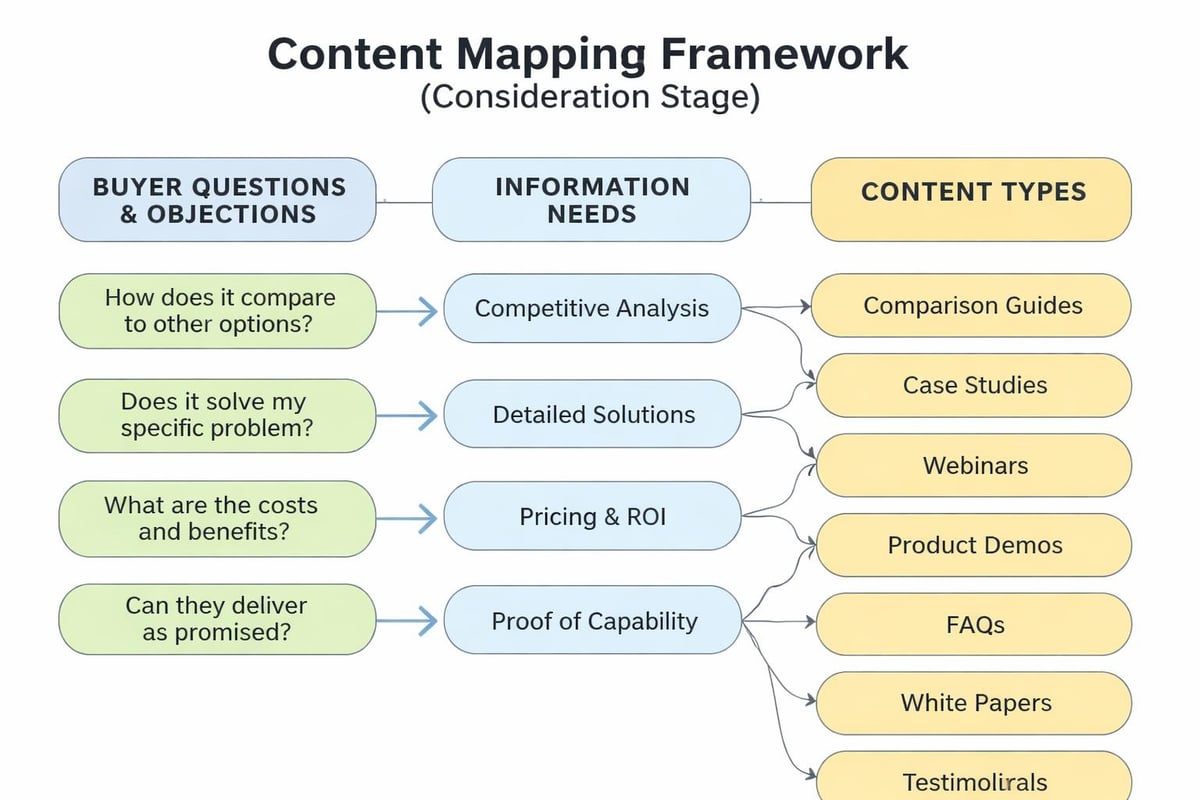
Smart consideration content also addresses common objections before they become barriers. If price concerns typically arise during sales conversations, create content that demonstrates ROI and breaks down investment versus returns. When you proactively answer questions, you accelerate the buying process while reducing sales cycle friction.
Conversion Stage Content That Closes Deals
Bottom-of-funnel content exists for one reason: helping qualified prospects make buying decisions. Your marketing content funnel culminates here, where all previous touchpoints converge to support the final conversion step. Every piece of conversion content should remove barriers and provide the specific information decision-makers need.
The most effective conversion content includes:
- Detailed product information and specifications
- Pricing transparency and package comparisons
- Customer testimonials and success metrics
- Free trials, consultations, or demonstrations
- FAQ resources addressing final concerns
Unlike awareness and consideration content, conversion assets should be explicitly sales-focused. This is where you make clear offers and direct asks. Prospects at this stage expect and want sales conversations; your content should facilitate rather than delay those interactions.
For companies leveraging AI tools in marketing, conversion content might showcase specific automation capabilities, guaranteed results, or case study metrics. The key is providing proof points that justify the investment decision. Numbers, testimonials, and guarantees carry more weight than features lists.
Optimizing Your Conversion Pathways
Every piece of conversion content needs a clear, compelling call-to-action. Whether it's scheduling a demo, starting a trial, or requesting a proposal, the next step should be obvious and frictionless. According to research on creating content for every funnel stage, reducing friction at this point can double conversion rates.
Remove unnecessary form fields. Eliminate approval requirements. Make it ridiculously easy for qualified prospects to move forward. Each additional step or question increases abandonment rates, so ruthlessly audit your conversion process for unnecessary complexity.
Consider offering multiple conversion paths for different buyer personas. Some prospects prefer human interaction and want to schedule calls. Others prefer self-service options like automated demos or instant access. By providing both paths, you capture more conversions without forcing everyone through the same process.
Measuring Marketing Content Funnel Performance
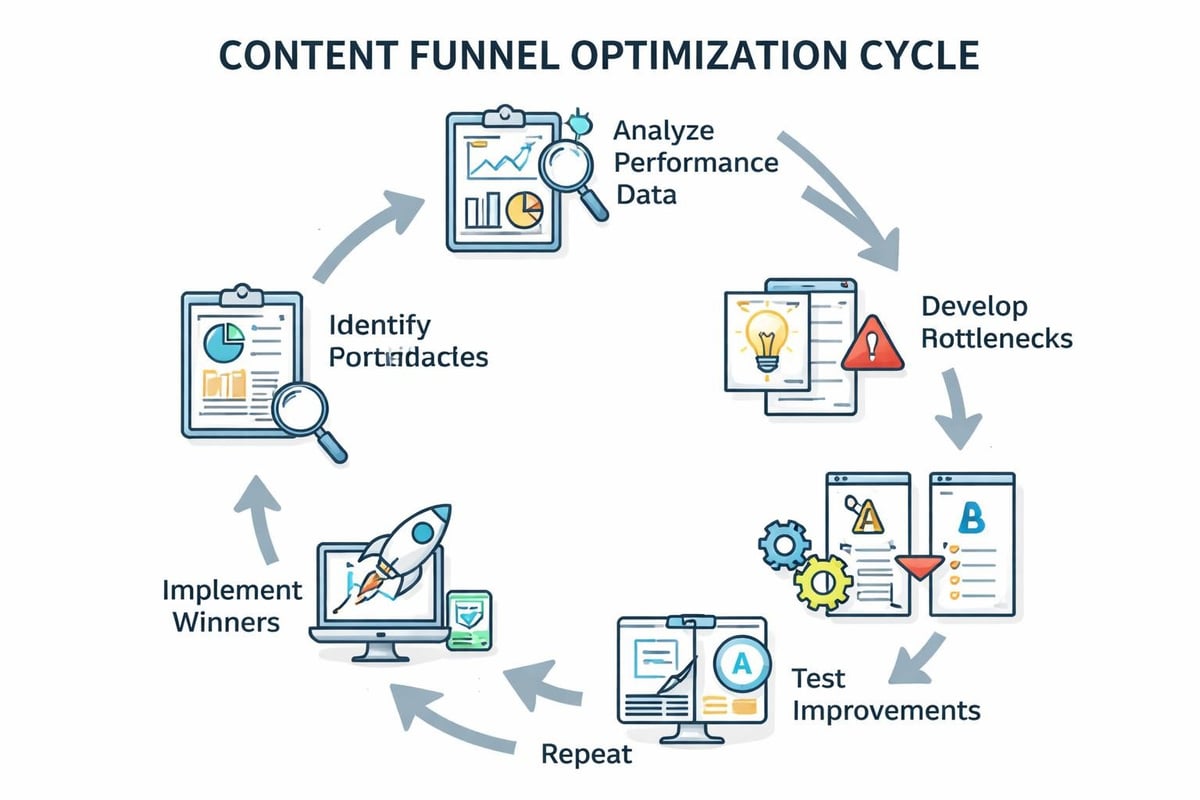
Building your marketing content funnel is just the beginning; optimizing it requires systematic measurement and testing. Without clear metrics at each stage, you're flying blind, unable to identify bottlenecks or improvement opportunities. The businesses that win with content funnels treat them as living systems requiring constant refinement.
Start by establishing baseline metrics for each funnel stage:
- Awareness: Traffic volume, content engagement, social reach
- Consideration: Lead generation rate, email engagement, content downloads
- Conversion: Sales qualified leads, close rate, customer acquisition cost
Track how prospects move between stages. Where do they enter your funnel? Which content pieces drive stage progression? What's your average time-to-conversion? These insights reveal optimization opportunities that can dramatically improve results. Companies focused on lead generation in the US particularly benefit from funnel analytics that identify high-converting content types.
| Funnel Stage | Primary Metric | Success Indicator | Common Bottleneck |
|---|---|---|---|
| Awareness | Traffic volume | Month-over-month growth | Poor search visibility |
| Consideration | Lead capture rate | 3-5% conversion | Weak value proposition |
| Conversion | Sales qualified leads | 20-30% of total leads | Unclear next steps |
| Overall | Customer acquisition cost | Decreasing over time | Misaligned content |
Attribution modeling becomes essential as your funnel matures. Which awareness content ultimately leads to customers? Does webinar attendance correlate with higher conversion rates? Understanding these relationships helps you allocate resources to high-impact content creation. The content marketing funnel concept emphasizes that not all content contributes equally to revenue generation.
A/B Testing for Continuous Improvement
Never assume your first version is optimal. Every element of your marketing content funnel deserves testing: headlines, content formats, calls-to-action, email subject lines, and landing page designs. Small improvements compound over time, turning mediocre funnels into revenue-generating machines.
Start with high-impact tests that could significantly move key metrics. Test different lead magnets to see which attracts higher-quality prospects. Experiment with email sequence timing and messaging. Compare video content against written guides for consideration stage engagement.
Document every test and result. Over time, you'll build a knowledge base of what works for your specific audience and market. This institutional knowledge becomes a competitive advantage that's difficult for competitors to replicate. Businesses using tools for lead generation should integrate testing capabilities into their technology stack from day one.
Advanced Marketing Content Funnel Strategies
Once you've mastered the fundamentals, advanced strategies can multiply your marketing content funnel effectiveness. These approaches require more sophisticated implementation but deliver outsized results for businesses ready to invest in optimization.
Segmentation transforms generic funnels into personalized experiences. Rather than pushing every prospect through identical content sequences, segment audiences based on industry, company size, role, or behavior. Create parallel funnel tracks that address specific segment needs and concerns. A CFO evaluating your solution has completely different priorities than a marketing director; your content should reflect those differences.
Dynamic content personalization takes segmentation further by automatically adjusting content based on prospect data. Show different case studies to different industries. Highlight relevant features based on company size. Adjust messaging based on traffic source or previous content consumption. These personalization tactics can increase conversion rates by 50% or more according to marketing funnel research.
Retargeting and Multi-Channel Integration
Your marketing content funnel shouldn't exist in isolation. Integrate it across every channel where your prospects spend time: email, social media, paid advertising, and even offline touchpoints. This omnichannel approach ensures consistent messaging while meeting prospects where they're most receptive.
Retargeting campaigns excel at re-engaging prospects who've entered your funnel but haven't progressed. Someone who downloaded your awareness content but hasn't engaged further needs different messaging than someone who attended a webinar. Segment your retargeting based on funnel stage and previous interactions for maximum relevance.
Consider how different channels support different funnel stages. LinkedIn might excel for awareness content distribution, while email dominates consideration stage nurturing. Paid search could capture high-intent prospects ready for conversion content. Map your channel strategy to your funnel stages rather than treating channels as separate initiatives.
Content Creation Workflows for Scale
Maintaining a robust marketing content funnel requires consistent content production across multiple stages and formats. Without efficient workflows, content creation becomes a bottleneck that limits funnel performance. The solution is developing systematic processes that enable scalable, quality content production.
Start by creating content calendars that map specific pieces to funnel stages and strategic initiatives. Plan quarterly themes that align awareness, consideration, and conversion content around cohesive narratives. This thematic approach helps prospects see how different content pieces connect while making creation more efficient.
Repurpose content aggressively to maximize ROI on creation efforts. Transform a comprehensive guide into multiple blog posts, social media content, email sequences, and video scripts. One substantial piece of research can fuel your marketing content funnel for months when properly repurposed across formats and channels.
Establish clear content briefs that include:
- Target funnel stage and audience segment
- Primary keyword and search intent
- Key messages and positioning
- Required format and length specifications
- Success metrics and performance goals
Template common content types to accelerate production. Your case study format should be standardized, making creation faster and ensuring consistency. Email sequence structures can follow proven frameworks that you customize for specific campaigns. These templates don't limit creativity; they provide scaffolding that supports efficient execution.
Businesses exploring strategies for acquiring leads benefit from documented workflows that ensure content quality remains high even as production scales. Consider investing in content management systems that support collaboration, version control, and publication scheduling across your team.
Aligning Sales and Marketing Through Content
The most successful marketing content funnels create seamless handoffs between marketing and sales teams. When these functions operate in silos, prospects experience jarring transitions that damage conversion rates. Alignment ensures consistent messaging and smooth progression from marketing-qualified to sales-qualified leads.
Sales teams possess invaluable insights about prospect questions, objections, and decision criteria. Regular feedback sessions between sales and marketing should inform content strategy and creation. What objections arise most frequently? Which questions indicate buying readiness? What content would help sales close deals faster? These insights directly shape your marketing content funnel development.
Create sales enablement content that equips your team with resources for every conversation stage. One-pagers that address specific objections, comparison sheets that position against competitors, and ROI calculators that justify investment all support sales effectiveness. When marketing provides these assets, sales cycles shorten and close rates improve.
Lead Scoring and Qualification Systems
Implement lead scoring that reflects content engagement and funnel progression. Prospects who consume multiple pieces across different funnel stages demonstrate higher intent than those who've only engaged with awareness content. Your scoring model should weight these behaviors appropriately, helping sales prioritize their outreach efforts.
Define clear criteria for marketing-qualified leads (MQLs) versus sales-qualified leads (SQLs). What engagement level indicates a prospect is ready for sales contact? Without these definitions, marketing might pass unqualified leads to sales, or sales might reject genuinely interested prospects because they need more nurturing. According to insights on leads in digital marketing, proper qualification dramatically improves conversion efficiency.
Service level agreements between marketing and sales create accountability on both sides. Marketing commits to delivering a specific volume and quality of qualified leads. Sales commits to following up promptly and providing feedback on lead quality. These agreements transform marketing and sales from separate departments into integrated revenue generation teams.
Technology Stack for Marketing Content Funnels
The right technology stack amplifies your marketing content funnel effectiveness while the wrong tools create friction and complexity. Building a streamlined, integrated system requires thoughtful selection of platforms that work together seamlessly. Every tool should serve a clear purpose in creating, distributing, or optimizing your funnel content.
At minimum, your stack needs:
- Content management system for publishing and organizing content
- Email marketing platform for automated nurture sequences
- CRM system for tracking prospect interactions and progression
- Analytics tools for measuring performance across channels
- Marketing automation for triggering content based on behaviors
Integration between these systems is non-negotiable. Your CRM should reflect email engagement. Your analytics should track content consumption by individual prospects. Your automation platform should trigger appropriate content based on funnel stage and behaviors. When systems work together, you gain visibility into the complete customer journey.
Evaluate tools based on your specific needs rather than feature lists. A platform with 100 features you'll never use is inferior to one with 20 capabilities you'll use daily. Prioritize ease of use, integration capabilities, and alignment with your content strategy over feature breadth. Resources like guides to the best marketing platforms can help inform technology decisions.
Common Marketing Content Funnel Mistakes
Even experienced marketers make critical errors when building content funnels. Recognizing these pitfalls helps you avoid costly mistakes that waste resources and limit results. The difference between funnels that drive revenue and those that consume budgets often comes down to avoiding these common traps.
The biggest mistakes include:
- Creating content without considering funnel stage
- Focusing exclusively on top-of-funnel awareness
- Neglecting measurement and optimization
- Treating the funnel as a linear path
- Failing to align content with sales processes
Many businesses create mountains of awareness content while starving consideration and conversion stages. This imbalance generates traffic without corresponding revenue growth. Your content distribution should reflect the importance of each funnel stage to overall business objectives, not just what's easiest to create.
Assuming prospects move linearly through your funnel represents another critical error. Real buyer journeys involve loops, pauses, and non-sequential content consumption. Someone might discover you through conversion-stage content, then circle back to awareness materials before purchasing. Your marketing content funnel should accommodate these non-linear paths rather than forcing rigid progression.
Ignoring content performance metrics prevents improvement. Without data, you're guessing about what works rather than knowing. Every content piece should have measurable objectives tied to funnel stage goals. Track performance religiously and let data guide your optimization efforts. Companies that generate qualified leads consistently treat measurement as a core competency, not an afterthought.
Building an effective marketing content funnel transforms how businesses attract, nurture, and convert prospects into customers. By strategically aligning content with each stage of the buyer journey, you create a systematic approach that generates predictable revenue growth rather than hoping for sporadic wins. The framework outlined here provides the foundation for sustainable lead generation that scales with your business ambitions. If you're ready to transform cold leads into ready-to-buy customers through AI-powered systems and strategic content deployment, Adstra offers guaranteed growth partnerships that align our success with yours. Our transparent, value-driven approach revolutionizes traditional marketing by delivering qualified leads and automated appointments that fill your sales calendar consistently.