


The gap between marketing and sales has cost businesses billions in lost revenue. When your marketing sales team operates as two separate entities rather than one unified force, leads fall through the cracks, opportunities vanish, and growth stalls. In 2026, the businesses winning market share aren't the ones with the biggest budgets. They're the ones that have mastered the art of aligning their marketing sales team around shared goals, streamlined processes, and data-driven decision making. This alignment transforms how you attract prospects, nurture leads, and close deals, creating a revenue engine that compounds growth month after month.
The Critical Foundation: Shared Goals and Accountability
Your marketing sales team will never function at peak performance if they're chasing different targets. Marketing celebrates lead volume while sales complains about quality. Sales demands more top-of-funnel activity while marketing insists their campaigns are working perfectly. This disconnect destroys momentum and wastes resources.
Start by establishing unified revenue goals that both teams own together. Instead of marketing focusing solely on lead generation metrics and sales focusing exclusively on closed deals, create shared accountability around qualified opportunities and revenue attribution. When both teams have skin in the game for the entire customer journey, behaviors change dramatically.
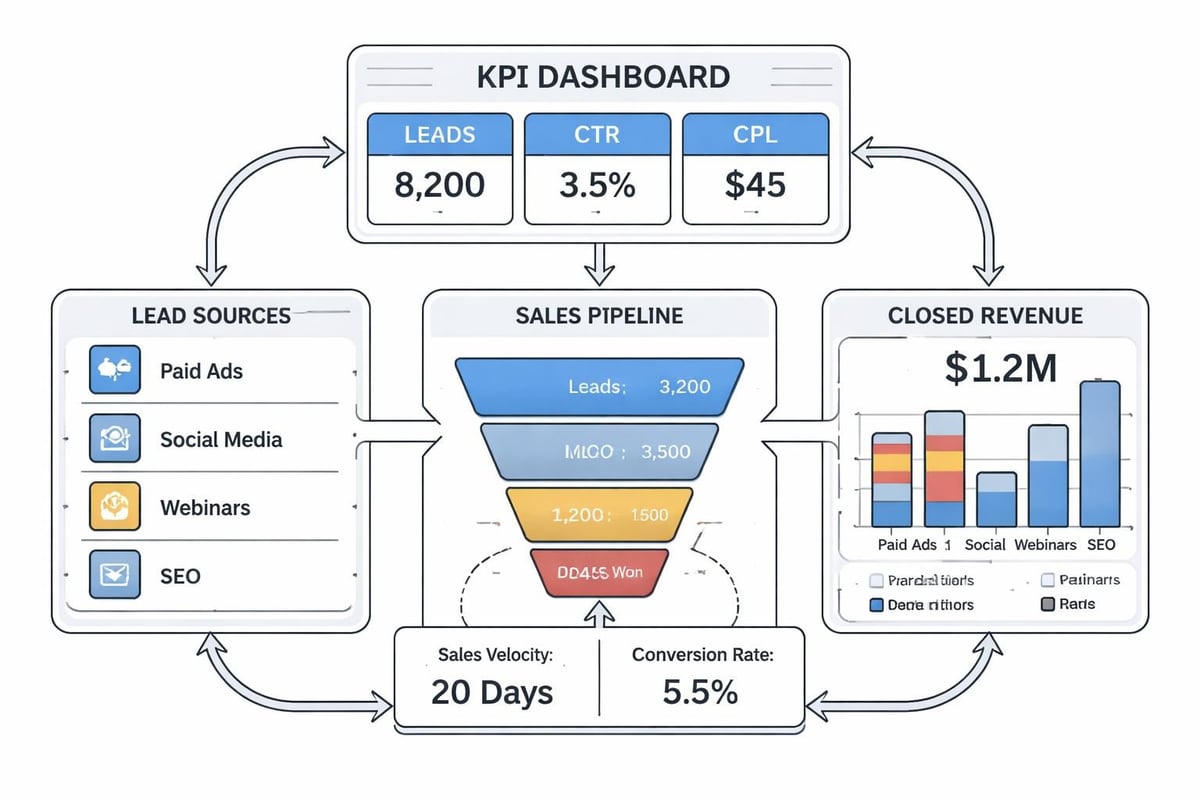
Consider implementing these shared KPIs:
- Qualified lead acceptance rate: Forces marketing to deliver quality, not just quantity
- Lead-to-opportunity conversion rate: Holds sales accountable for proper follow-up
- Revenue by campaign source: Shows marketing which efforts actually drive revenue
- Sales cycle length by lead source: Identifies which marketing channels produce ready-to-buy prospects
- Customer acquisition cost (CAC) by channel: Aligns both teams around profitability, not vanity metrics
The transformation happens when your marketing sales team realizes they succeed or fail together. Marketing can't hide behind "we delivered the leads" when those leads never convert. Sales can't blame marketing when they fail to follow up promptly or nurture relationships properly.
Building Communication Bridges That Actually Work
Too many organizations schedule weekly meetings where marketing and sales sit in a room, share updates nobody remembers, and leave frustrated. Establishing effective communication channels requires intentional structure and purpose-driven interaction.
Create three distinct communication rhythms for your marketing sales team:
- Daily stand-ups (10 minutes): Quick pulse check on lead flow, urgent issues, and immediate priorities
- Weekly strategy sessions (30-45 minutes): Review performance data, discuss campaign optimization, and align on tactical adjustments
- Monthly planning meetings (90 minutes): Deep dive into market insights, customer feedback, competitive analysis, and strategic shifts
But here's what separates high-performing teams from the rest: documentation and transparency. Every interaction should produce actionable takeaways stored in a shared system where both teams can access insights, feedback, and decisions. When sales shares why certain leads didn't convert, marketing adjusts targeting. When marketing reveals new market research, sales refines their pitch.
Data Integration: The Nervous System of Your Revenue Engine
Your marketing sales team needs a single source of truth. When marketing tracks leads in one system and sales works from a different database, you're operating blind. Lead handoff becomes a black hole where accountability disappears and opportunities die.
Modern CRM platforms paired with marketing automation tools create visibility across the entire customer journey. Marketing can see exactly what happens after they pass a lead to sales. Sales can trace back to understand which content, campaigns, and touchpoints influenced their best opportunities.
| Integration Point | Marketing Benefit | Sales Benefit |
|---|---|---|
| Lead scoring automation | Focus efforts on high-intent prospects | Prioritize outreach to ready-to-buy leads |
| Campaign attribution tracking | Prove ROI of marketing investments | Understand prospect context before calling |
| Real-time lead alerts | Immediate feedback on lead quality | Strike while prospect interest peaks |
| Closed-loop reporting | See which campaigns drive actual revenue | Access marketing intelligence for personalized outreach |
This infrastructure enables your marketing sales team to operate with precision. Implementing the right sales technology tools transforms scattered efforts into coordinated campaigns that compound results.
When you leverage AI for lead generation, the data integration becomes even more powerful. AI systems can analyze patterns across thousands of interactions, identifying which marketing messages resonate with which prospect segments, then automatically routing leads to the sales rep with the highest likelihood of closing based on expertise and past performance.
The Lead Qualification Framework That Eliminates Friction
Nothing destroys marketing sales team relationships faster than disagreements about lead quality. Marketing sends over contacts, sales rejects them as unqualified, and the blame game begins. You need an explicit, mutually-agreed-upon definition of what constitutes a qualified lead.
Implement a tiered qualification system:
- Marketing Qualified Lead (MQL): Prospect has engaged with content and shows interest signals
- Sales Accepted Lead (SAL): Sales confirms the lead meets basic criteria and accepts it for outreach
- Sales Qualified Lead (SQL): Sales has made contact and verified buying intent, authority, and fit
- Opportunity: Active deal in the pipeline with defined next steps
This framework creates checkpoints where your marketing sales team can course-correct before investing significant time and resources. When a lead moves from MQL to SAL, sales provides immediate feedback. If they're rejecting leads consistently, marketing knows to adjust targeting criteria.
The magic happens when you track conversion rates at each stage. You'll quickly identify where the real bottlenecks exist. Is marketing generating enough volume at the top? Are leads stalling between MQL and SAL? Is sales failing to convert qualified opportunities? The data reveals the truth.
Content Collaboration: Arming Sales With Marketing Intelligence
Your marketing sales team should operate as intelligence gatherers and storytellers working in concert. Marketing creates content that educates, persuades, and builds trust. Sales uses that content strategically throughout the buying journey to overcome objections, demonstrate value, and close deals.
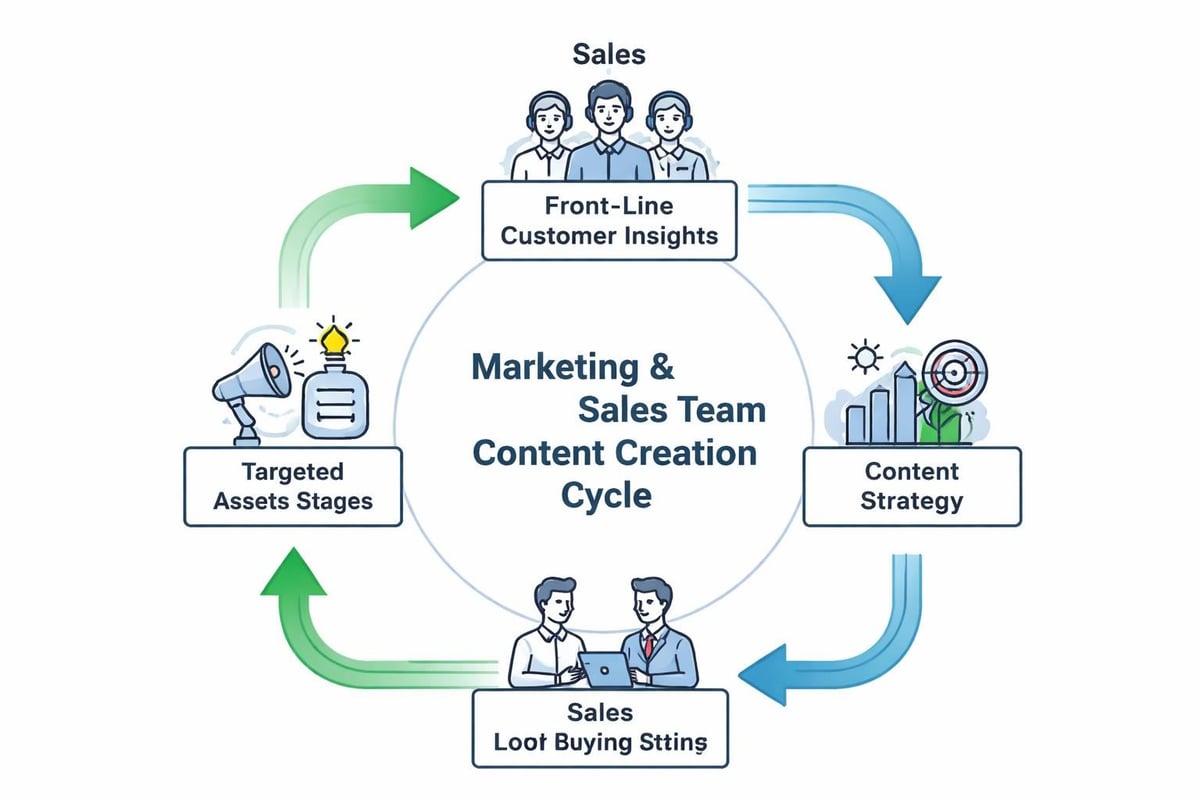
But here's where most companies fail: marketing creates content in a vacuum, guessing what prospects need, while sales sits on goldmines of customer insights they never share. Flip this dynamic and watch conversion rates soar.
Create a systematic feedback loop:
Sales should regularly share the questions prospects ask, the objections they raise, and the stories that resonate. Marketing transforms these insights into case studies, comparison guides, ROI calculators, and objection-handling content. Sales then deploys these assets at precisely the right moment in their conversations.
This collaborative approach works especially well when you're running lead generation campaigns on Facebook or building out a comprehensive social media funnel. The content marketing creates for top-of-funnel awareness needs to align perfectly with the messaging sales uses during discovery calls.
Consider creating these essential collaborative content assets:
- Battle cards: Competitive positioning guides co-authored by marketing and sales
- Email templates: Marketing-designed sequences that sales can personalize
- Demo scripts: Sales-tested narratives with marketing polish and brand consistency
- Objection libraries: Common concerns with proven responses backed by data and social proof
- Customer stories: Sales identifies the best examples, marketing produces compelling case studies
Territory and Target Account Alignment
When your marketing sales team pursues different accounts or markets, you waste resources and confuse prospects. Marketing runs campaigns targeting mid-market companies while sales focuses on enterprise deals. Marketing promotes one vertical while sales has relationships in another. This misalignment dilutes impact and slows growth.
Aligning sales and marketing teams around target account lists transforms scattered activity into concentrated force. Create a shared ideal customer profile (ICP) based on data, not opinions. Look at your best customers: Which industries do they operate in? What size are they? What problems drove them to buy? What characteristics predict success?
Once you've defined your ICP, build target account lists together. Marketing designs account-based campaigns that warm up these specific companies. Sales provides intelligence on key decision-makers and buying committees. Both teams coordinate touchpoints to create omnipresent awareness that builds trust before the first sales conversation.
This coordination proves especially valuable for B2B lead generation companies where complex buying processes involve multiple stakeholders. Your marketing sales team needs to orchestrate parallel conversations with different personas within the same organization, ensuring message consistency while addressing each role's unique priorities.
The Revenue Attribution Model That Ends Debates
Who gets credit when a deal closes? Did marketing generate the opportunity or did sales create it through prospecting? This question has fueled countless conflicts between marketing sales team members. The answer: implement multi-touch attribution that acknowledges the full customer journey.
Modern attribution models track every touchpoint, from the first blog post a prospect read to the final proposal that closed the deal. Instead of arguing about first-touch versus last-touch credit, you evaluate the contribution of each interaction.
| Attribution Model | What It Measures | Best For |
|---|---|---|
| First-touch | Initial discovery source | Understanding awareness channels |
| Last-touch | Final conversion driver | Identifying closing catalysts |
| Linear | Equal credit to all touchpoints | Long, complex sales cycles |
| Time-decay | More credit to recent interactions | Balance between discovery and closing |
| Custom/algorithmic | Data-driven weighting | Organizations with sufficient data volume |
When your marketing sales team understands that revenue results from orchestrated effort across multiple touchpoints, the finger-pointing stops. Marketing gets credit for creating awareness and nurturing interest. Sales gets credit for relationship building and closing execution. Both teams focus on optimizing their contribution rather than claiming sole ownership.
Training and Enablement: Continuous Skill Development
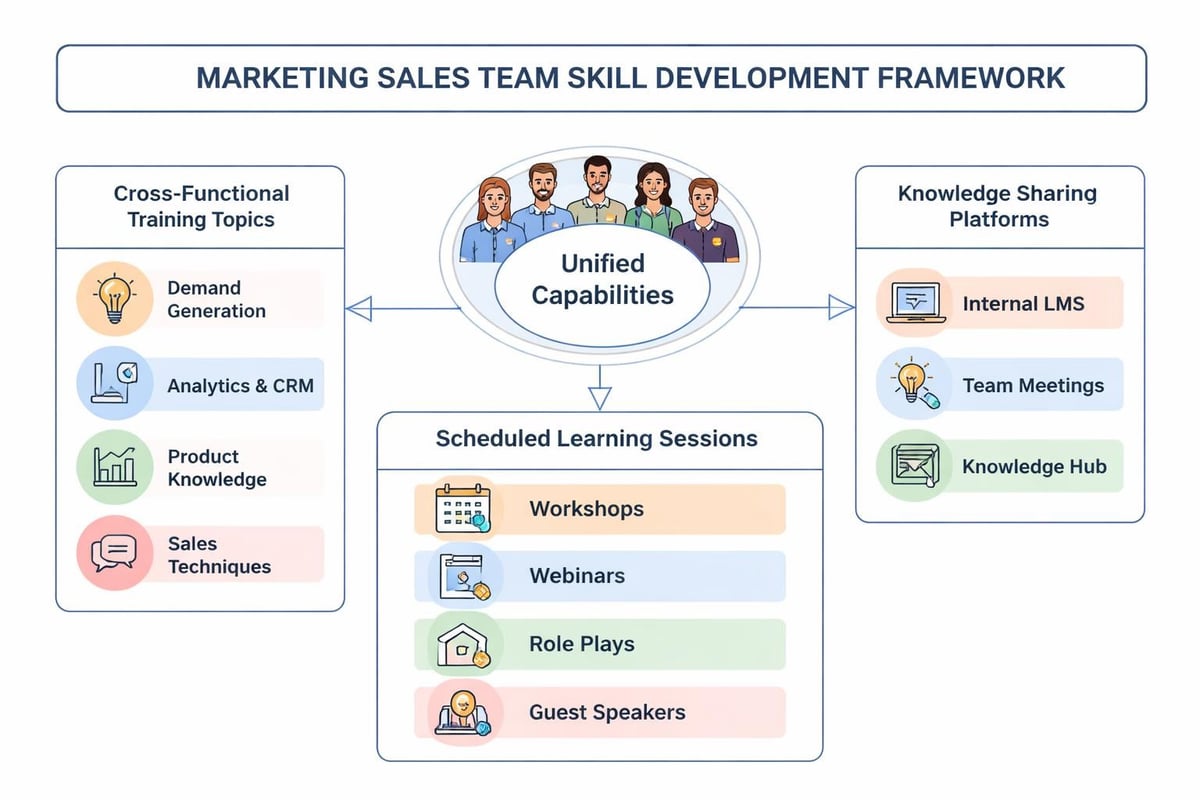
Your marketing sales team operates in a rapidly evolving landscape. Buyer behaviors shift, new technologies emerge, competitive threats evolve, and market conditions change. Static knowledge becomes obsolete quickly. High-performing teams commit to continuous learning and cross-functional skill development.
Create reciprocal training programs:
Marketing should understand basic sales methodology, objection handling, and negotiation principles. They'll create better lead magnets and content when they understand the sales process intimately. Sales should grasp marketing fundamentals like campaign strategy, content marketing, and digital advertising. They'll provide better feedback and appreciate marketing's complexity.
Schedule quarterly enablement sessions where your marketing sales team learns together. Bring in customer success teams to share insights about what happens after the sale. Invite product teams to explain roadmap developments that create new selling opportunities. Feature top performers who share what's working and what's not.
Implementing sales enablement best practices ensures your team has access to the tools, training, and resources they need exactly when they need them. Create a centralized knowledge base where both marketing and sales can access the latest presentations, case studies, pricing information, and competitive intelligence.
Performance Reviews and Recognition
Individual performance metrics create silos. Team-based rewards foster collaboration. Restructure how you evaluate and compensate your marketing sales team to incentivize the behaviors you want.
Consider implementing:
- Shared bonus pools: Both teams earn based on collective revenue achievement
- Cross-functional MVPs: Recognize individuals who best exemplify collaboration
- Joint customer win celebrations: Publicly acknowledge everyone who contributed to major deals
- Collaborative innovation awards: Reward teams that develop new processes improving both functions
When compensation and recognition systems reinforce teamwork over individual heroics, your marketing sales team naturally gravitates toward collaboration. They share insights freely, support each other's initiatives, and solve problems collectively rather than pointing fingers.
Technology Stack Integration for Seamless Workflow
The tools your marketing sales team uses either facilitate collaboration or create barriers. Disconnected systems force manual data entry, create version control nightmares, and obscure visibility. An integrated technology stack becomes the infrastructure enabling seamless coordination.
Your essential integrated stack should include:
- CRM platform: Central database for all customer and prospect information
- Marketing automation: Campaign execution, lead scoring, and nurture sequences
- Sales engagement tools: Outreach automation, email tracking, and call recording
- Analytics and reporting: Unified dashboards showing cross-functional metrics
- Communication platforms: Slack, Teams, or similar for real-time coordination
- Document management: Shared access to proposals, presentations, and collateral
The integration between these systems matters more than the individual tools. When a prospect downloads a whitepaper, that action should automatically update their lead score in the CRM, trigger an alert to the assigned sales rep, and add them to a relevant nurture sequence. No manual handoffs, no data gaps, no opportunities lost in transition.
For businesses working on specialized campaigns like financial advisor lead generation or LinkedIn B2B lead generation, the right technology stack adapts to industry-specific requirements while maintaining seamless marketing and sales coordination.
Feedback Mechanisms That Drive Continuous Improvement
Your marketing sales team needs structured channels for honest, actionable feedback. Too often, valuable insights stay trapped in one person's head because there's no systematic way to capture and act on them. Build feedback loops that turn field intelligence into strategic advantage.
Implement these feedback practices:
Weekly lead quality reviews: Sales rates incoming leads and provides specific feedback about why certain leads didn't qualify. Marketing uses this data to refine targeting parameters and lead scoring models.
Monthly campaign retrospectives: After major campaigns conclude, both teams analyze what worked, what didn't, and what to test next. Document lessons learned and update playbooks accordingly.
Quarterly ICP refinement sessions: Review closed deals to identify patterns in your best customers. Update your ideal customer profile based on actual results rather than assumptions.
Customer interview programs: Marketing and sales jointly conduct interviews with recent customers to understand the buying journey, decision criteria, and competitive alternatives considered.
Encouraging knowledge sharing transforms individual experiences into organizational wisdom. When your marketing sales team systematically captures and applies insights, you compound learning over time rather than repeatedly making the same mistakes.
The Competitive Advantage of True Alignment
Companies with tightly aligned marketing sales teams grow faster, acquire customers more efficiently, and build sustainable competitive advantages. While competitors waste energy on internal politics and finger-pointing, aligned teams focus that energy on serving customers and capturing market share.
The numbers tell the story. Organizations with strong marketing sales team alignment achieve 19% faster revenue growth and 15% higher profitability than those with poor alignment. The difference compounds over time, creating gaps competitors struggle to close.
But the benefits extend beyond the spreadsheet. Aligned teams create better customer experiences. Prospects receive consistent messaging across all touchpoints. The transition from marketing nurture to sales conversation feels seamless rather than jarring. Customers work with an organization that clearly has its act together rather than departments operating independently.
Your marketing sales team alignment also improves employee retention and satisfaction. People want to work in environments where collaboration thrives, where their contributions are valued, and where they're part of something bigger than individual quotas. High-performing teams attract high-performing talent, creating a virtuous cycle of continuous improvement.
The path forward requires commitment from leadership, investment in the right systems and processes, and willingness to change entrenched behaviors. Start small with shared goals and regular communication. Build trust through transparency and mutual accountability. Scale what works and iterate on what doesn't.
Your competitors are likely still operating with siloed teams, fighting over credit, and leaving revenue on the table. The organizations that master marketing sales team alignment in 2026 will dominate their markets for years to come. The question isn't whether you can afford to align your teams. It's whether you can afford not to.
Building a high-performing marketing sales team requires more than good intentions and occasional meetings. It demands systematic processes, shared accountability, and technology infrastructure that enables seamless collaboration at every stage of the customer journey. When you're ready to transform scattered marketing and sales efforts into a unified revenue engine that consistently delivers qualified opportunities and predictable growth, Adstra provides the AI-powered systems and strategic partnership that aligns your teams around what matters most: converting prospects into customers and driving measurable business results.