


The modern business landscape demands more than traditional marketing managers or sales directors. It requires a unique professional who bridges strategy, data, and execution with laser-focused precision on one metric: sustainable growth. The growth lead has emerged as the linchpin for organizations serious about scaling revenue predictably and systematically. This strategic position combines analytical rigor with creative problem-solving, transforming how companies approach customer acquisition, retention, and revenue optimization. For businesses leveraging AI-powered systems and data-driven strategies, having someone who orchestrates every growth lever becomes not just valuable but absolutely essential for competitive advantage.
Understanding the Growth Lead Position
A growth lead orchestrates the entire customer journey from initial awareness through conversion and retention, wielding both strategic vision and tactical execution capabilities.
Unlike traditional marketing roles that focus on brand awareness or sales positions that concentrate solely on closing deals, the growth lead operates at the intersection of multiple disciplines. This professional owns the growth function end-to-end, making data-informed decisions that impact every touchpoint in the customer lifecycle.
Core responsibilities include:
- Developing comprehensive growth strategies aligned with business objectives
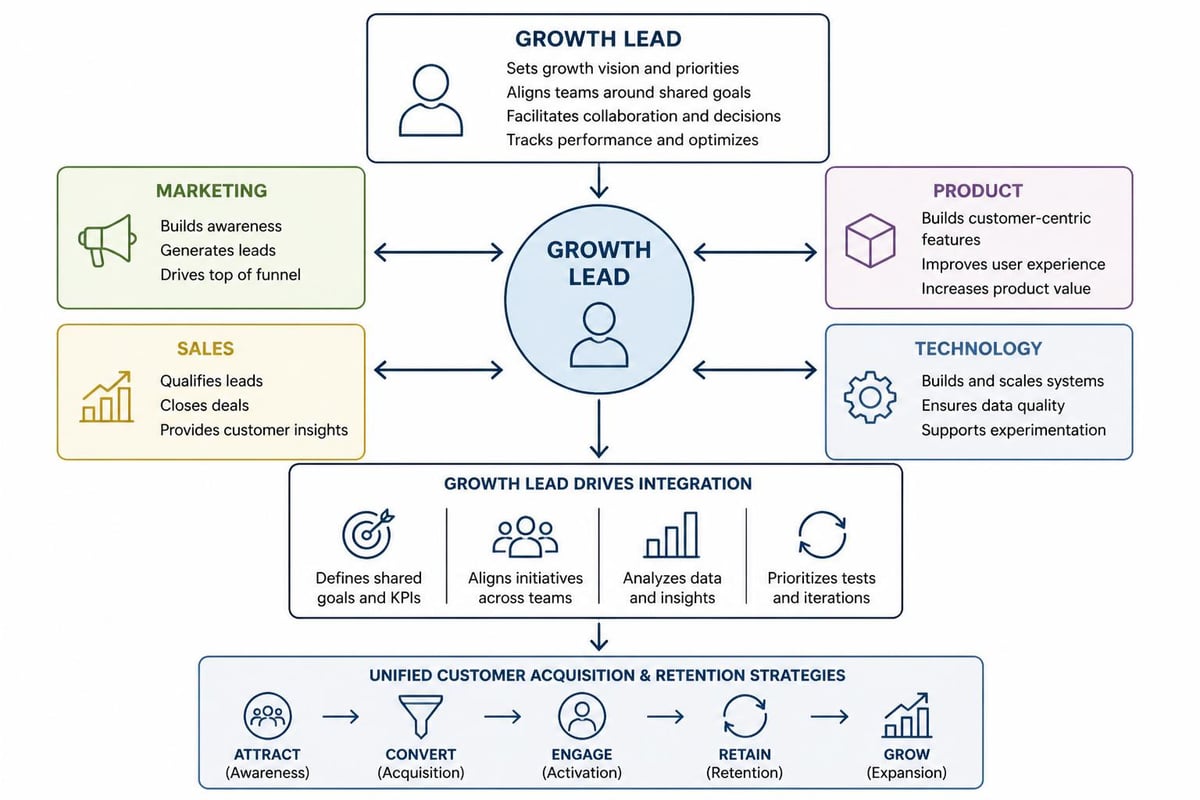
- Leading cross-functional teams across marketing, sales, product, and technology
- Implementing systematic testing frameworks for continuous optimization
- Analyzing customer behavior patterns to identify high-leverage opportunities
- Building scalable processes that compound results over time
The role demands someone who thinks like a scientist, executes like an operator, and communicates like a leader. Understanding the full scope of a growth lead’s responsibilities reveals why this position has become indispensable for scaling organizations.
The Evolution of Growth Leadership
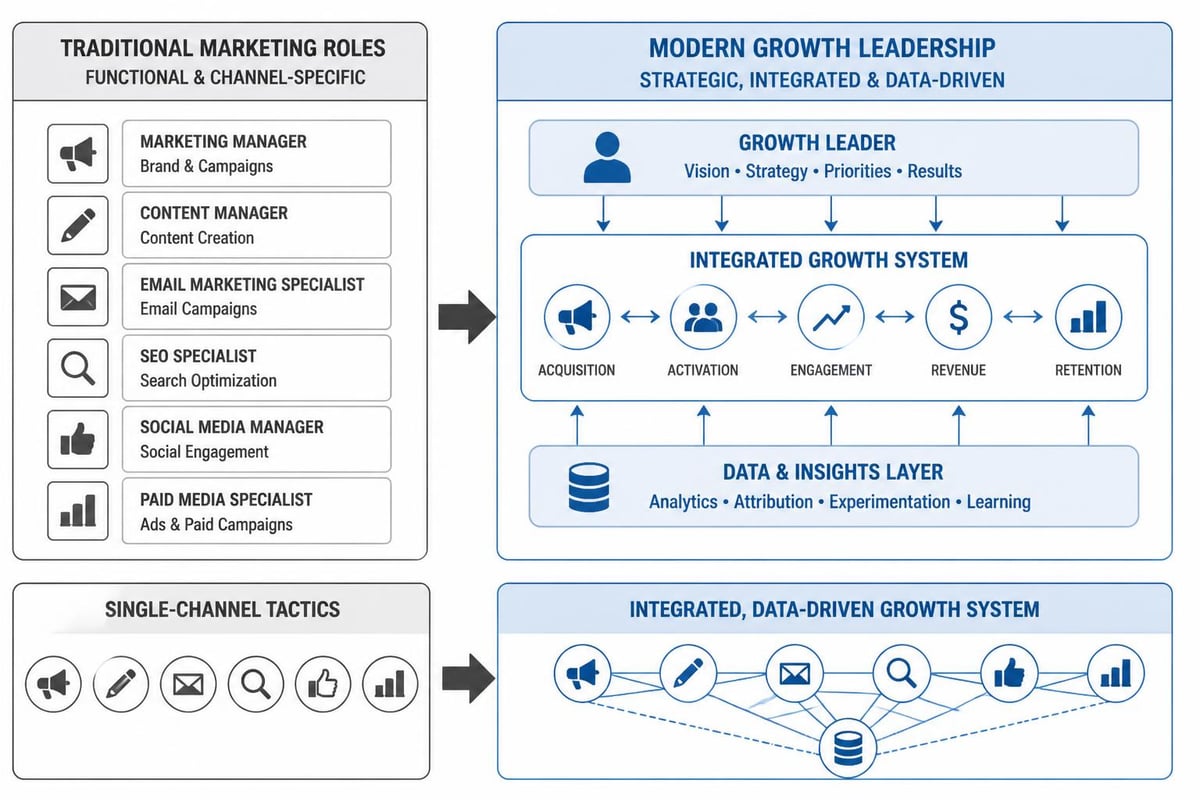
The growth lead position emerged from the growth hacking movement but has matured significantly beyond viral loops and tactical tricks. Today's growth leaders build sustainable systems rather than chasing short-term wins.
This evolution reflects broader market changes. Customer acquisition costs have skyrocketed across channels. Attribution has become increasingly complex. Buyers demand personalized experiences at scale. These pressures created the need for someone who could orchestrate sophisticated, multi-channel strategies while maintaining profitability metrics.
Critical Skills Every Growth Lead Must Master
Success in this role requires a unique combination of hard and soft skills that few professionals naturally possess. Building this skill set takes intentional development and real-world experience.
Data Analysis and Experimentation
Growth leads live and breathe data. They must extract actionable insights from complex datasets, identify patterns that others miss, and design experiments that validate hypotheses rigorously.
This goes beyond reading dashboards. It means understanding statistical significance, recognizing confounding variables, and knowing when correlation suggests causation worth exploring. The best growth leads build testing roadmaps that systematically improve conversion rates across every funnel stage.
| Skill Category | Specific Capabilities | Business Impact |
|---|---|---|
| Analytics | Cohort analysis, funnel optimization, LTV modeling | 20-40% improvement in customer value |
| Experimentation | A/B testing, multivariate testing, statistical analysis | 15-30% conversion rate gains |
| Technical | SQL, automation tools, API integrations | 50-70% efficiency improvements |
| Strategic | Market positioning, competitive analysis, growth modeling | 2-5x revenue acceleration |
Strategic Channel Management
A growth lead must determine where to invest resources for maximum return. This requires deep understanding of how different channels work, their costs, and how they interact within the broader customer journey.
Should you double down on content marketing? Scale paid advertising? Invest in partnership programs? The growth lead makes these calls based on data, not hunches. For companies focused on B2B lead generation strategies, this strategic channel allocation becomes even more critical given longer sales cycles and higher-value customers.
Channel expertise areas include:
- Organic search and content strategy
- Paid acquisition across multiple platforms
- Email marketing and marketing automation
- Referral and partnership programs
- Product-led growth mechanics
- Community and social engagement
Each channel requires different optimization approaches, time horizons for results, and measurement frameworks.
Building Growth Systems That Scale
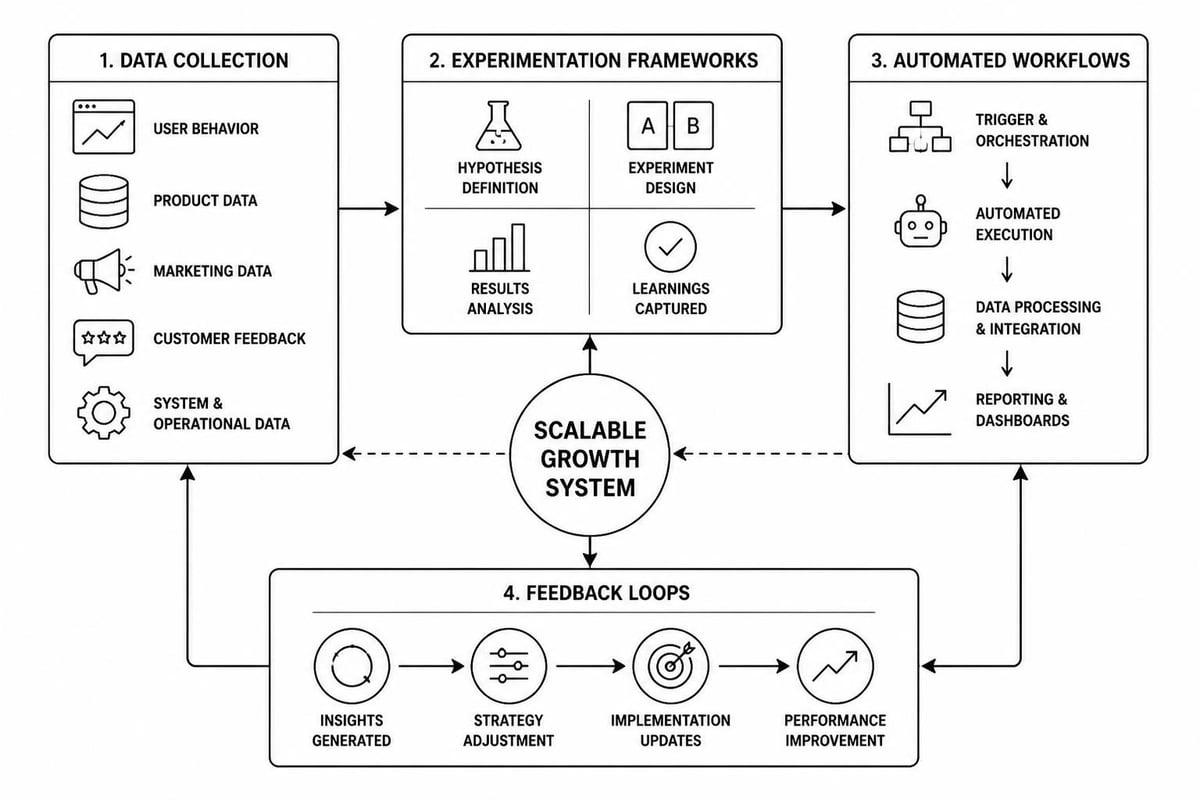
The most effective growth leads don't just run campaigns; they build systems that generate predictable results regardless of who executes them.
Creating Repeatable Processes
Systematization transforms individual wins into organizational capabilities. When a growth lead discovers a winning approach, they document it, template it, and train others to replicate it.
This might mean creating standard operating procedures for lead qualification, building automated workflows for nurture sequences, or developing frameworks for creative testing. The goal is removing dependency on individual heroics and creating institutional knowledge.
Many organizations struggle with transforming cold leads into ready-to-buy customers precisely because they lack these systematic approaches. Growth leads solve this by engineering processes that work consistently.
Implementing Growth Frameworks
Successful growth leads leverage established frameworks while adapting them to their specific context. Common approaches include:
- AARRR (Pirate Metrics): Acquisition, Activation, Retention, Revenue, Referral
- North Star Framework: Identifying the single metric that best predicts long-term success
- ICE Scoring: Prioritizing experiments based on Impact, Confidence, and Ease
- Growth Loops: Creating self-reinforcing cycles where output feeds back into input
These frameworks provide structure for decision-making and ensure teams focus on what matters most. Growth sessions and sprints utilize these frameworks to maximize team output and maintain momentum.
Driving Revenue Through Customer Acquisition
At its core, the growth lead role exists to generate predictable, profitable revenue growth. Everything else serves this objective.
Optimizing the Acquisition Funnel
Every business has unique funnel dynamics, but the growth lead's approach remains consistent: measure everything, identify bottlenecks, test solutions, scale what works.
This means tracking metrics at granular levels:
- Traffic sources and quality scores
- Landing page conversion rates by segment
- Lead qualification criteria and pass rates
- Sales cycle length by acquisition channel
- Customer lifetime value by cohort
The best growth leads obsess over these numbers. They know their cost per qualified lead, conversion rate from demo to close, and payback period by customer segment.
For businesses utilizing AI-powered lead generation systems, the growth lead ensures these technologies integrate seamlessly into the broader acquisition strategy while maintaining quality standards.
Balancing Volume and Quality
One of the growth lead's trickiest challenges involves balancing lead volume with lead quality. Generating thousands of low-quality leads wastes sales team time and damages brand reputation. Conversely, being too restrictive limits growth potential.
The solution lies in continuous optimization:
- Define clear ideal customer profiles with sales alignment
- Test different targeting criteria and messaging approaches
- Implement lead scoring to prioritize sales follow-up
- Create feedback loops between sales and marketing
- Adjust acquisition strategies based on close rate data
This iterative approach ensures the pipeline grows while maintaining efficiency. Companies that excel at generating qualified sales leads understand this balance comes from disciplined testing and refinement.
Managing Cross-Functional Collaboration
A growth lead cannot succeed in isolation. The role requires orchestrating efforts across multiple teams, each with different priorities and perspectives.
Aligning Marketing and Sales
The marketing-sales handoff represents the most critical junction in most growth strategies. Misalignment here creates friction, wastes resources, and kills momentum.
Growth leads bridge this gap by:
- Establishing shared definitions for qualified leads
- Creating transparent reporting on lead quality and conversion
- Facilitating regular communication between teams
- Building processes that honor both teams' workflows
- Implementing technology that provides visibility across the funnel
When marketing generates leads that sales ignores, or when sales complains about lead quality without providing specific feedback, the growth lead diagnoses and resolves these disconnects.
Coordinating with Product and Technology
Modern growth increasingly happens at the product level. Features that encourage viral sharing, onboarding flows that drive activation, and in-app experiences that reduce churn all require product team collaboration.
The growth lead must translate business objectives into product requirements, prioritize feature development based on growth impact, and work within product roadmap constraints. This requires understanding technical limitations, design principles, and user experience fundamentals.
| Collaboration Area | Key Activities | Success Metrics |
|---|---|---|
| Marketing Alignment | Lead definition, SLA creation, reporting cadence | Lead acceptance rate >80% |
| Sales Coordination | Feedback loops, territory planning, enablement | Sales qualified lead conversion >25% |
| Product Integration | Feature requests, growth experiments, UX optimization | Activation rate improvement >15% |
| Technology Enablement | Tool selection, integration management, automation | Process efficiency gains >40% |
Leveraging Technology and Automation
The modern growth lead operates as part strategist, part technologist. Understanding marketing technology stacks and automation capabilities separates good growth leads from great ones.
Building the Growth Tech Stack
No growth lead succeeds without the right tools. The technology stack should enable data collection, experimentation, automation, and analysis at scale.
Essential categories include:
- Customer relationship management (CRM) systems
- Marketing automation platforms
- Analytics and attribution tools
- A/B testing and optimization software
- Customer data platforms
- Communication and outreach automation
Selecting and integrating these tools requires technical literacy and strategic thinking. The growth lead must evaluate options based on capabilities, integration requirements, scalability, and total cost of ownership.
Organizations exploring AI tools for marketing automation need growth leads who can assess which technologies deliver genuine value versus which represent overhyped solutions.
Implementing Intelligent Automation
Automation amplifies the growth lead's impact by handling repetitive tasks at scale, but poor automation creates terrible customer experiences.
The key is identifying processes that benefit from automation while maintaining human judgment where it matters. Email sequences can be automated, but personalization requires understanding customer context. Lead scoring models can run automatically, but defining scoring criteria requires strategic input.
Effective automation strategies:
- Start with high-volume, low-complexity processes
- Build in quality checks and human review points
- Test thoroughly before scaling
- Monitor performance and optimize continuously
- Document workflows for team transparency
Measuring Success and Demonstrating ROI
Growth leads must justify their existence through measurable business impact. Vanity metrics don't cut it; leadership demands evidence of revenue contribution.
Defining North Star Metrics
Every growth strategy needs a primary metric that aligns with long-term business health. For some companies, this might be monthly recurring revenue. For others, it could be qualified pipeline generated or customer lifetime value.
The growth lead identifies this North Star metric, ensures everyone understands it, and relentlessly optimizes toward it. Supporting metrics matter, but this primary indicator keeps teams focused on what truly drives business value.
Common North Star metrics by business model:
- SaaS companies: Net revenue retention or expansion revenue
- Marketplace businesses: Gross merchandise value or transaction volume
- Service businesses: Qualified pipeline or booked revenue
- Freemium products: Conversion to paid or active user engagement
Reporting and Communication
Data without storytelling fails to influence decisions. The best growth leads translate complex analyses into clear narratives that drive action.
This means creating reporting dashboards that highlight what matters, presenting findings in executive-friendly formats, and making recommendations that account for business constraints. Monthly performance reviews should answer: What happened? Why did it happen? What are we doing about it?
Transparency builds trust. When experiments fail, effective growth leads explain what was learned and how it informs future testing. When results exceed expectations, they identify root causes and explore scaling opportunities. Implementing growth hacking best practices for B2B SaaS requires this kind of rigorous measurement and honest communication.
Navigating Common Growth Challenges
Every growth lead encounters predictable obstacles. Knowing these challenges in advance allows for better preparation and faster problem-solving.
Dealing with Attribution Complexity
Modern customer journeys span multiple touchpoints across weeks or months. Determining which marketing activities deserve credit for conversions challenges even sophisticated analytics teams.
Growth leads address this by:
- Implementing multi-touch attribution models that recognize multiple influences
- Using incrementality testing to measure true causal impact
- Accepting that perfect attribution is impossible and making decisions with available data
- Focusing on directional trends rather than obsessing over exact numbers
- Building business cases that account for attribution uncertainty
The goal is good-enough measurement that enables better decisions, not perfect measurement that delays action.
Managing Plateau Periods
Growth curves inevitably flatten. Channels saturate. Competition intensifies. Easy wins get exhausted. When growth stalls, the growth lead must diagnose causes and identify new opportunities.
This requires stepping back to reassess fundamental strategy. Are we targeting the right customers? Is our value proposition still compelling? Have market conditions shifted? What new channels or tactics deserve exploration?
Exploring proven growth hacking concepts can spark fresh thinking when traditional approaches plateau. The key is maintaining momentum through disciplined experimentation even when results slow.
Future-Proofing Your Growth Strategy
The growth lead role will continue evolving as technology, customer behavior, and competitive dynamics shift. Staying ahead requires continuous learning and strategic adaptation.
Embracing AI and Machine Learning
Artificial intelligence is transforming how growth leads operate. Machine learning models can predict customer churn, optimize bid strategies, personalize content at scale, and identify high-value prospects.
Growth leads who leverage these capabilities gain significant advantages. They can test more variations faster, personalize at unprecedented scale, and make predictions that inform resource allocation.
However, AI requires quality data, thoughtful implementation, and human oversight. The growth lead must understand both the potential and limitations of these technologies.
Building for Privacy-First Marketing
Regulatory changes and platform policies are making traditional tracking and targeting more difficult. Cookie deprecation, iOS privacy updates, and GDPR requirements force growth leads to adapt strategies.
This shift emphasizes first-party data collection, contextual targeting, and value exchange with customers. Growth leads must build strategies that respect privacy while still enabling effective personalization and measurement.
The transition creates opportunities for companies that prioritize transparent, value-driven approaches to customer relationships. Organizations partnering with firms that emphasize transparency and value-driven marketing position themselves well for this privacy-first future.
The growth lead role represents the future of revenue generation for organizations serious about scalable, predictable growth. By combining strategic vision, analytical rigor, technical capabilities, and cross-functional leadership, these professionals transform how businesses acquire and retain customers. Success requires mastering multiple disciplines while maintaining focus on the metrics that truly matter. If you're ready to implement systematic growth strategies backed by AI-powered systems and proven frameworks, Adstra specializes in transforming cold leads into qualified appointments through guaranteed growth partnerships that align our success with yours.