


The success of any business in 2026 hinges on one critical factor: the quality and quantity of market leads flowing into your sales pipeline. Whether you're a startup fighting for your first customers or an established enterprise scaling revenue, understanding how to generate, qualify, and convert market leads determines your growth trajectory. The landscape has shifted dramatically with AI-powered tools and automation platforms transforming how businesses identify and engage potential customers. Yet despite technological advances, many companies still struggle with lead quality, wasting resources on unqualified prospects while missing opportunities hiding in plain sight. This comprehensive guide reveals exactly how to build a market leads strategy that delivers predictable, scalable revenue growth.
Understanding What Market Leads Actually Mean for Your Business
Market leads represent potential customers who have shown interest in your products or services through specific actions or characteristics. Unlike random contacts in a database, these prospects have demonstrated behaviors indicating they might have a need you can solve. Understanding the fundamental definition of a sales lead helps clarify why not all contacts deserve equal attention.
The distinction between different types of market leads determines your entire approach to nurturing and conversion. Marketing-qualified leads (MQLs) have engaged with your content but aren't ready for direct sales contact. Sales-qualified leads (SQLs) have raised their hands and indicated readiness to have a conversation. Product-qualified leads (PQLs) have used your product or service and shown signals of purchase intent.
The Three-Tier Market Leads Framework
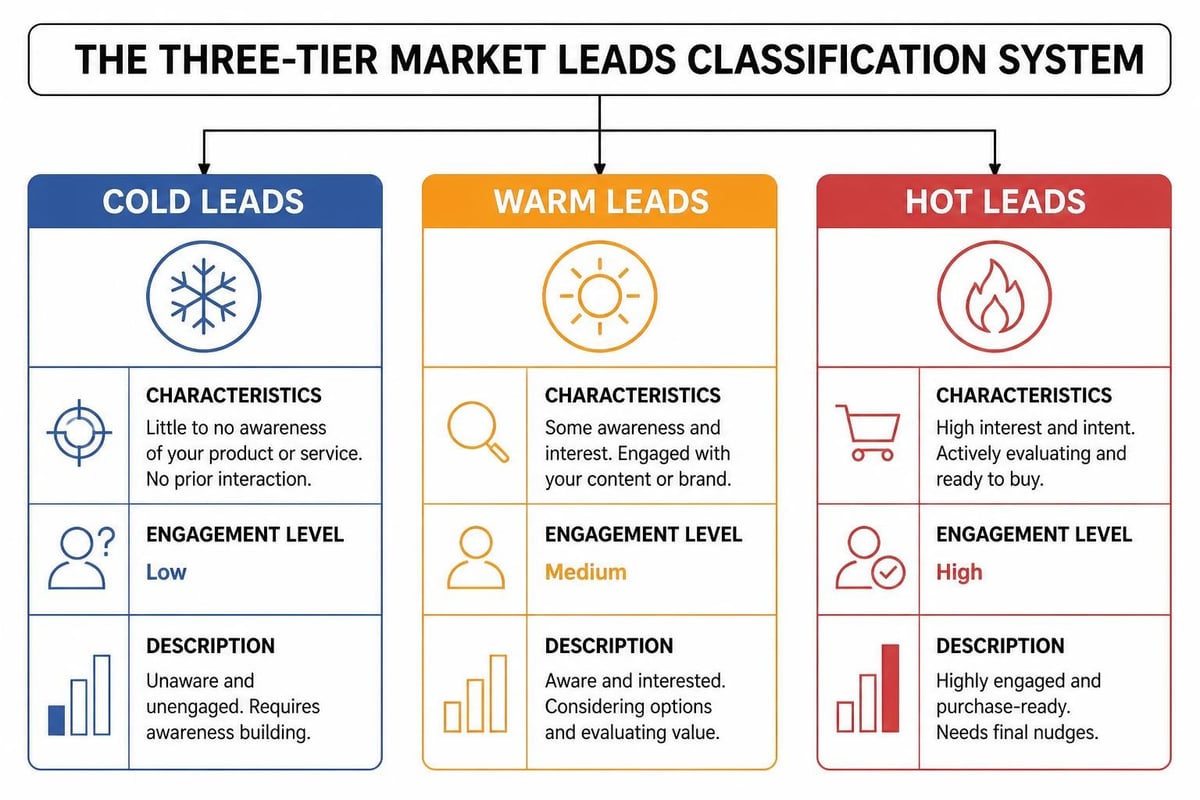
Every business needs a clear system for categorizing prospects. Here's how successful companies structure their market leads:
Tier 1: Cold Leads – These individuals match your ideal customer profile but haven't engaged with your brand. They require significant nurturing and education before becoming sales-ready.
Tier 2: Warm Leads – Prospects who have interacted with your content, attended webinars, or downloaded resources. They're familiar with your brand and exploring solutions.
Tier 3: Hot Leads – Ready-to-buy prospects actively seeking solutions. They've demonstrated clear purchase intent and need immediate sales engagement.
This framework ensures your team invests energy proportional to each lead's conversion probability. Pursuing cold leads with the same intensity as hot prospects burns resources and frustrates sales teams.
Proven Strategies for Generating High-Quality Market Leads
The methods you use to attract market leads directly impact their quality and conversion rates. In 2026, successful lead generation requires a multi-channel approach that meets prospects wherever they spend time.
Content marketing remains the foundation of sustainable lead generation. Publishing valuable resources that solve specific problems positions your brand as a trusted authority. Blog posts, whitepapers, case studies, and video tutorials attract prospects actively searching for solutions. The key is matching content to each stage of the buyer's journey, from awareness through decision-making.
Multi-Channel Lead Acquisition Tactics
Diversification protects your pipeline from platform changes and market shifts. Here are the channels delivering the highest ROI in 2026:
| Channel | Lead Quality | Volume Potential | Best For |
|---|---|---|---|
| SEO & Organic Content | Very High | High | Long-term growth |
| Paid Search Ads | High | Medium | Immediate results |
| LinkedIn Outreach | Very High | Medium | B2B services |
| Email Marketing | High | High | Nurturing existing contacts |
| Webinars & Events | Very High | Low | Complex solutions |
Social media platforms serve different purposes in your lead generation ecosystem. LinkedIn excels for B2B lead generation while Instagram and Facebook work better for consumer-focused businesses. The platform matters less than your ability to deliver value and capture contact information.
Paid advertising accelerates market leads when executed strategically. Google Ads captures high-intent searchers actively seeking solutions. Facebook and LinkedIn ads build awareness and retarget engaged prospects. The critical factor is tight audience targeting combined with compelling offers that motivate information exchange.
Converting Market Leads Into Revenue-Generating Customers
Generating market leads means nothing without systematic conversion processes. Too many businesses celebrate vanity metrics like website traffic or email subscribers while their conversion rates languish below 2%. The gap between lead acquisition and revenue realization destroys companies.
Lead scoring transforms subjective gut feelings into data-driven decisions. Assign point values to demographic characteristics and behavioral signals. A prospect who visits your pricing page three times, downloads two case studies, and matches your ideal customer profile scores dramatically higher than someone who clicked a social media ad once. Marketing-qualified leads require specific qualification criteria before sales engagement.
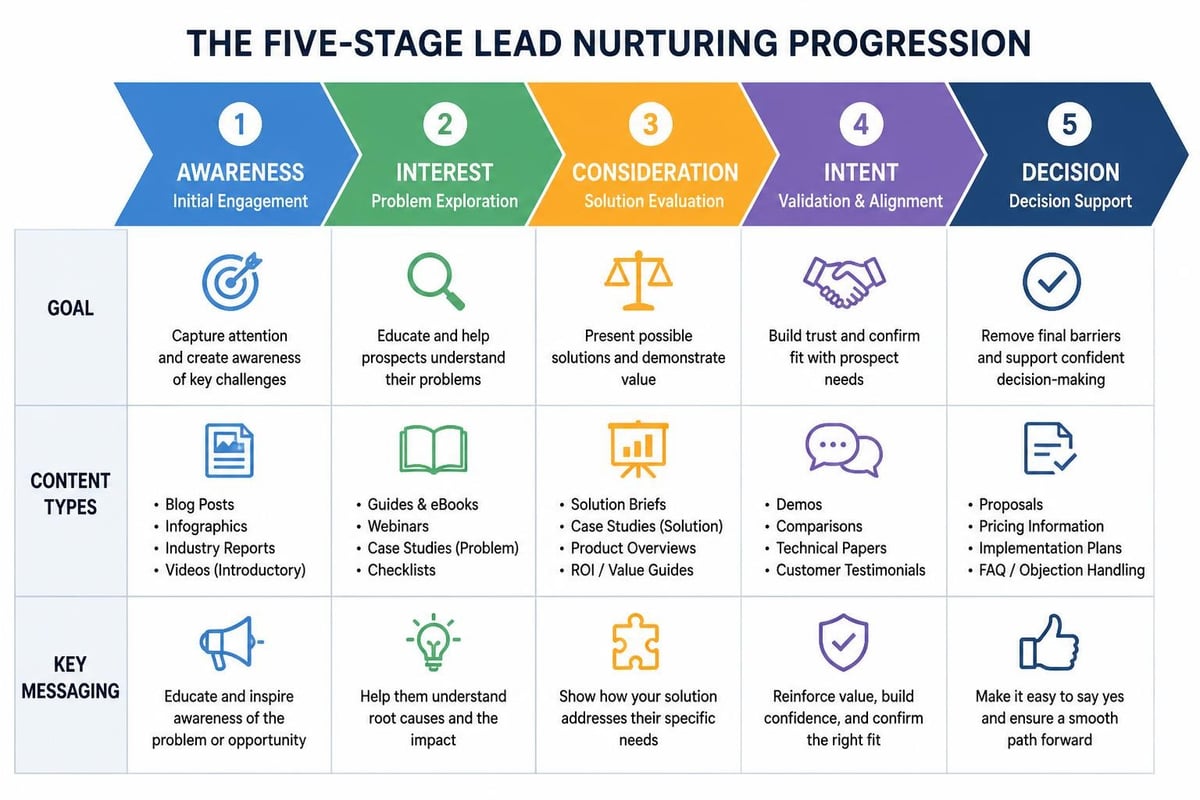
The Five-Stage Lead Nurturing System
Stage 1: Initial Engagement – Welcome sequences introduce your brand and establish communication patterns. Share your best educational content and set expectations.
Stage 2: Problem Education – Help prospects understand the full scope of their challenges. Content at this stage raises awareness of issues they might not fully recognize.
Stage 3: Solution Exploration – Present your approach to solving their problems. Case studies, comparison guides, and feature explanations belong here.
Stage 4: Objection Handling – Address common concerns proactively. Pricing transparency, implementation timelines, and ROI calculations remove barriers.
Stage 5: Decision Support – Provide the final information needed to move forward. Demos, consultations, and tailored proposals close deals.
Each stage requires different content formats and messaging strategies. Blasting the same generic emails to every contact wastes opportunities and erodes trust. Segmentation based on lead source, behavior, and qualification level ensures relevant communication.
Technology Systems That Scale Market Leads Generation
Manual lead management collapses under scale. What works when handling 50 leads monthly breaks completely at 500. Investing in proper technology infrastructure isn't optional anymore, it's survival.
Customer Relationship Management (CRM) platforms serve as your central nervous system. Every interaction, note, and touchpoint lives in one accessible location. Salesforce, HubSpot, and Pipedrive each offer different strengths. The best CRM is the one your team actually uses consistently.
Marketing automation platforms handle repetitive tasks while personalizing experiences. When someone downloads a guide, automation triggers a sequence of follow-up emails based on their actions. If they open every message and click multiple links, the system notifies sales. If they ignore communications, automation adjusts the cadence or content approach.
Essential Lead Generation Tools for 2026
Building a complete technology stack doesn't require massive budgets. Here are the core tools delivering maximum impact:
- Email Marketing Platform – Mailchimp, ConvertKit, or ActiveCampaign for automated sequences
- Landing Page Builder – Unbounce, Leadpages, or Instapage for conversion-optimized pages
- Lead Capture Forms – Typeform, Gravity Forms, or native CRM forms
- Analytics Platform – Google Analytics 4 for tracking lead source and behavior
- Scheduling Software – Calendly or Chili Piper for automated appointment booking
Integration between systems matters as much as individual tool quality. When your CRM connects to your email platform, which syncs with your analytics, you gain complete visibility into what's working. Exploring various tools for lead generation reveals options for every budget and business model.
AI-powered lead scoring analyzes patterns humans miss. Machine learning algorithms identify which characteristics and behaviors predict conversion, automatically prioritizing your highest-value market leads. This technology democratizes capabilities previously available only to enterprise companies with massive data science teams.
Measuring Market Leads Performance and ROI
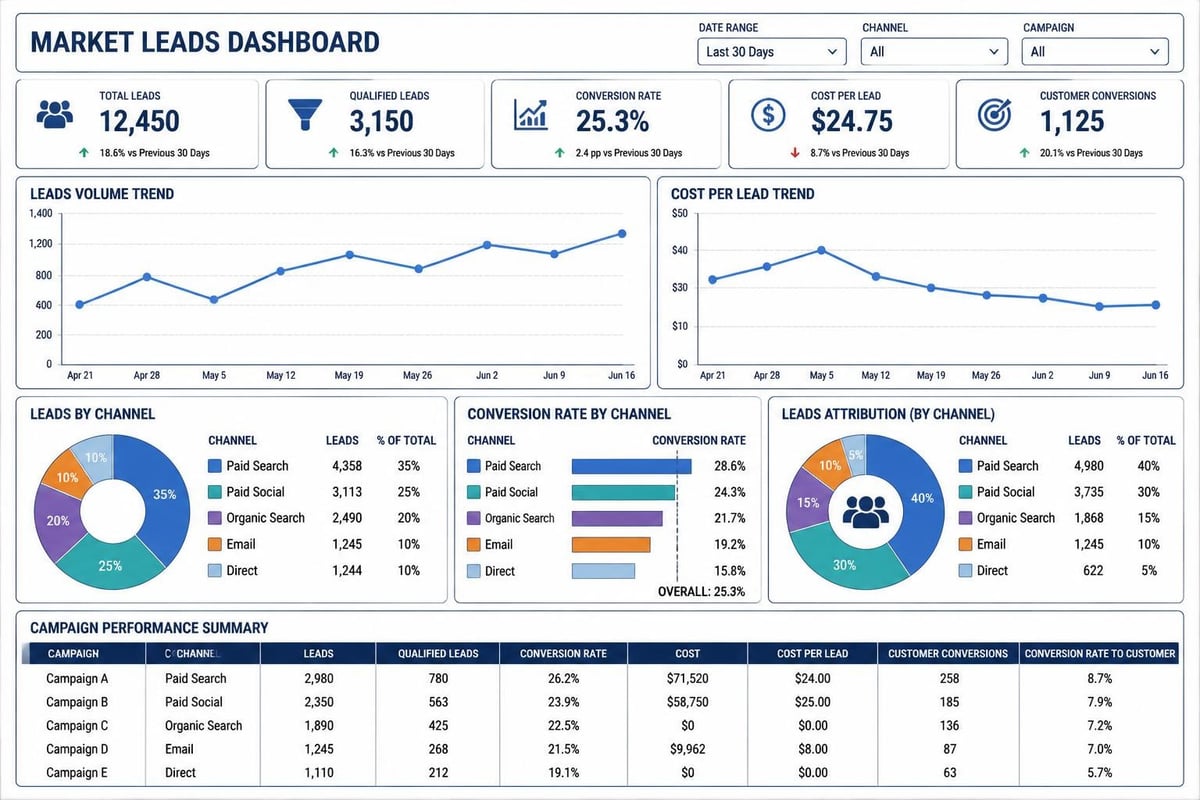
What gets measured gets improved. Yet most businesses track the wrong metrics, celebrating activity instead of outcomes. Vanity metrics feel good but don't pay bills.
Lead volume matters only if quality remains consistent. Generating 1,000 low-quality leads costs more than 100 high-quality prospects. Track total volume but weight it against conversion rates and customer lifetime value.
Cost per lead (CPL) reveals channel efficiency. Divide total acquisition costs by leads generated. A $50 CPL might be fantastic or terrible depending on your average customer value. Always view CPL in context of lifetime value.
Lead-to-customer conversion rate shows pipeline health. If only 1% of market leads become customers, you need either higher quality leads or better nurturing processes. Industry benchmarks vary, but consistently improving this metric compounds revenue growth.
Critical Metrics Dashboard
| Metric | Calculation | Target Range | Action Threshold |
|---|---|---|---|
| Lead Volume | Total new leads/month | Varies by industry | 20% month-over-month decline |
| Cost Per Lead | Marketing spend ÷ leads | $25-$200 B2B | Above industry average |
| MQL to SQL Rate | SQLs ÷ MQLs × 100 | 20-40% | Below 15% |
| Lead-to-Customer | Customers ÷ total leads × 100 | 2-10% | Below 1% |
| Customer Acquisition Cost | Total sales/marketing ÷ customers | 3-5x lower than LTV | Above lifetime value |
Time-to-conversion reveals process efficiency. How long does the average market lead take to become a customer? If your sales cycle extends six months, you need different strategies than a business with three-day cycles. Understanding this timeline helps forecast revenue and plan resource allocation.
Attribution modeling answers the critical question: which touchpoints actually generate revenue? First-touch attribution credits the initial interaction. Last-touch credits the final conversion point. Multi-touch models distribute credit across the entire journey. Most businesses need multi-touch attribution to understand their true lead generation strategies performance.
Advanced Tactics for Market Leads Optimization
Once foundational systems work consistently, advanced optimization strategies multiply results. These tactics separate market leaders from competitors stuck in mediocrity.
Retargeting campaigns recapture lost opportunities. Prospects who visit your site but don't convert aren't necessarily uninterested. They might need more information, better timing, or different messaging. Pixel-based retargeting keeps your brand visible across the web, bringing warm prospects back when they're ready.
Account-based marketing (ABM) flips traditional lead generation. Instead of casting wide nets, ABM targets specific high-value accounts with personalized campaigns. This approach works exceptionally well for B2B companies selling to enterprise customers where single deals justify significant acquisition investment.
Partnerships and co-marketing arrangements tap into established audiences. Find complementary businesses serving your ideal customers and create mutual value. Joint webinars, content collaborations, and referral programs generate high-quality market leads at fraction of cold advertising costs.
Conversion Rate Optimization Checklist
Minor improvements to conversion rates deliver exponential revenue impact. A landing page converting 2% instead of 1% doubles lead volume with identical traffic. Focus these optimization areas:
- Headline clarity – Does your headline immediately communicate value?
- Form friction – Are you asking for too much information too early?
- Trust signals – Do testimonials, logos, and guarantees build credibility?
- Mobile experience – Does everything work perfectly on smartphones?
- Load speed – Does your page load in under three seconds?
- Call-to-action placement – Can visitors immediately see what to do next?
A/B testing removes guesswork from optimization. Test one variable at a time, let experiments run until statistical significance, then implement winners permanently. Companies obsessed with testing outperform those relying on opinions and assumptions.
Building Predictable Lead Flow Through Systems Thinking
Sustainable growth requires moving beyond campaign-based thinking toward systematic lead generation. One-off tactics create revenue spikes followed by valleys. Systems create predictable, scalable flow.
Document every process from initial contact through closed deal. When systems live only in people's heads, growth stalls at their capacity limits. Written processes enable delegation, training, and continuous improvement. Your lead generation agency approach should be replicable and scalable.
Develop content libraries organized by buyer journey stage and customer persona. Instead of creating everything from scratch, modify proven templates. This systematization maintains quality while increasing output velocity.
Establish feedback loops between sales and marketing teams. Sales conversations reveal objections, questions, and concerns that marketing content should address. When these departments operate in silos, market leads suffer from misalignment between expectations and reality.
Regular pipeline reviews identify bottlenecks before they become crises. If leads pile up at specific stages, you've found your constraint. Maybe marketing generates plenty of MQLs but sales lacks capacity for follow-up. Perhaps nurturing sequences fail to address key objections. Data reveals where to focus improvement efforts.
The businesses thriving in 2026 treat market leads as assets requiring cultivation rather than commodities to exploit. They invest in relationship building, deliver consistent value, and earn customer trust through transparency. This approach takes longer but creates sustainable competitive advantages competitors can't easily replicate.
Understanding how lead generation works at a strategic level separates tactical execution from meaningful business growth. Every tactic connects to broader objectives and measurable outcomes.
Mastering market leads generation requires combining strategic thinking with systematic execution, measuring what matters, and continuously optimizing based on data rather than assumptions. The companies winning in 2026 don't rely on luck or sporadic efforts; they build predictable revenue engines powered by qualified prospects flowing consistently into their pipelines. If you're ready to transform your lead generation from frustrating guesswork into a reliable growth system, Aletto combines advanced AI technology with proven strategies to generate qualified sales leads and automate appointment bookings that drive predictable revenue. Our guaranteed growth partnership model means we invest in your success because your results determine ours.