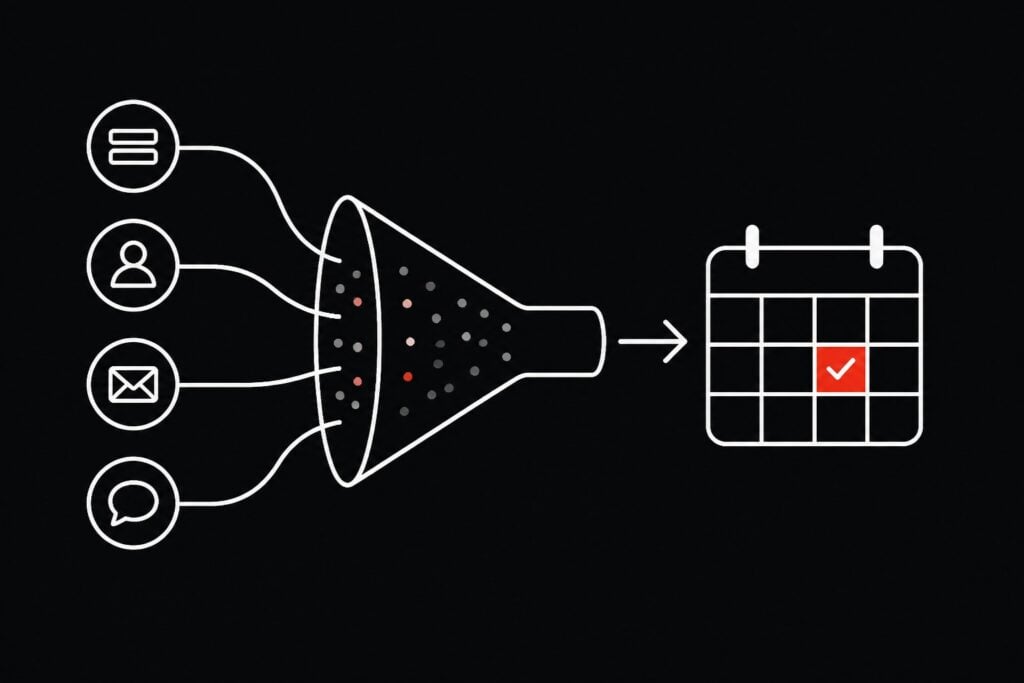
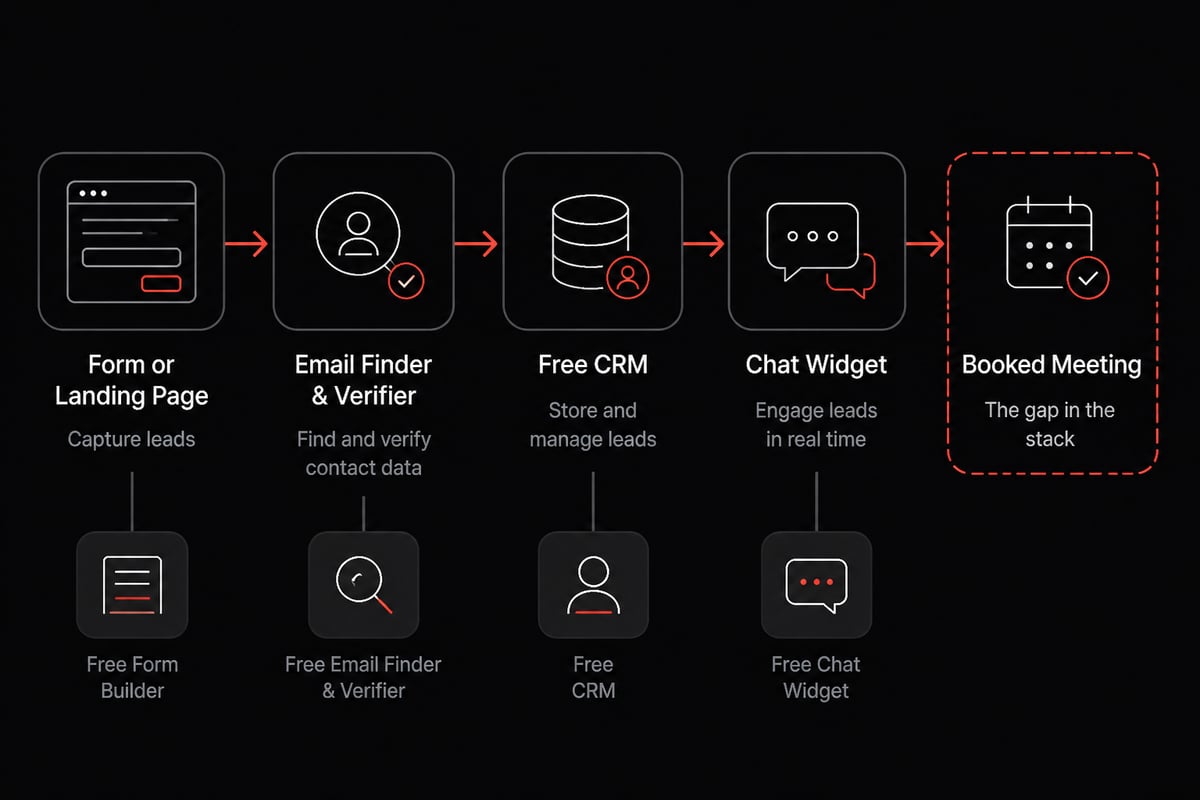
The best lead generation tools free of charge are a free CRM, a form builder, an email finder and verifier, and a chat widget, and together they can capture and organize leads at no cost. What they do not do is turn those leads into booked sales meetings. For B2B SaaS and service teams, that gap between a captured contact and a calendar slot is where most free stacks stall.
This guide covers what each category of free tool does, where the limits sit, and how to connect the pieces so the leads you collect become conversations.
What Are Free Lead Generation Tools?
A free lead generation tool is software that captures, finds, or organizes prospect contact data without a paid subscription, usually through a capped free plan.
Most fall into five categories:
- Capture tools: form builders, popups, and landing page builders that collect email addresses and details.
- Contact data tools: email finders and verifiers that return business emails for a named person at a named company.
- CRM tools: systems that store leads, track deal stages, and log activity.
- Engagement tools: live chat and chatbot widgets that talk to website visitors.
- Email tools: newsletter and sequence platforms with a free contact tier.
Free plans exist because they work as a trial. Vendors cap contacts, searches, emails per month, or features, and they expect growing teams to upgrade. That is a fair trade, and it means a free tool is best treated as a starting point with a known ceiling.
Which Free Lead Capture Tools Are Worth Using?
Free form builders and landing page tools are worth using because they cost nothing and sit closest to the moment a visitor shows intent. Google Forms, Jotform's free tier, and the free forms inside most CRMs all collect name, work email, and a qualifying question or two.
The tool matters less than what you ask. A form with only an email field produces volume and noise. A form that asks for company size, role, and the problem they want solved produces fewer leads and a much easier sorting job later.
Hypothetical example: a SaaS founder publishes a gated checklist with a four-field form. Of the people who download it, only some match the target company size, and the form answers let the team ignore the rest without a single call.
Here is the position worth taking: do not optimize for form fills. A bigger list of unqualified contacts creates work for your reps and adds nothing to your pipeline.
What Free Tools Find and Verify B2B Contact Data?
Free email finders and verifiers return a work email for a person at a company and check that the address will not bounce, usually within a monthly credit cap. Hunter and Snov.io both offer free tiers with a small number of searches and verifications each month, and Apollo and Lusha offer limited free credits.
Verification is not optional, and the reason is deliverability. Google’s Gmail sender requirements ask senders to set up SPF or DKIM authentication and keep reported spam rates low. A list full of stale addresses pushes bounce and complaint rates up quickly, which damages your domain for every email you send afterward.
Free credit caps are small by design. They are enough to test a list of a few dozen accounts and not enough to run outbound at scale. If your plan depends on cold email at volume, the free tier will not carry it, and the volume approach has its own problems that no data tool fixes. For a closer look at contact enrichment, see this breakdown of Lusha for lead generation.
Is There a 100% Free CRM?
Yes, a few CRMs offer a permanent free plan, but each one limits users, contacts, automation, or reporting. HubSpot's free CRM, Zoho CRM's free edition, and Bitrix24 are the common choices, and all of them cover the basics: contact records, a deal pipeline, task reminders, and email logging.
For a team of one to five reps, a free CRM is usually enough to start. The limits show up when you need:
- Automated lead routing and round-robin assignment
- Sequences that run without a rep clicking send
- Attribution that ties a closed deal back to the ad or page that produced it
- Reporting by source, stage, and rep
Pick the CRM you can see yourself staying with. Migrating records later costs more time than the first setup, so choose on the paid tier you might need in a year, not only on the free tier you need today. This overview of HubSpot lead generation shows what the platform covers as a team grows.
How Do Free Chat and Email Tools Fit In?
Free chat widgets and email platforms cover engagement and follow-up, and both come with caps that matter for B2B teams. Live chat tools with a free tier let you greet visitors on pricing and demo pages. Email platforms such as Mailchimp and MailerLite offer free plans with a limit on contacts and monthly sends.
Chat works best on high-intent pages only. A widget on every page interrupts people who are still reading, while one on the pricing page catches someone who is comparing options. The catch is coverage: a free chat tool is only useful while a person is watching it, and leads who visit at night or on weekends get a form and a wait.
Email follow-up has a similar weakness. A newsletter tool is built to broadcast, not to qualify. A free plan will send a welcome message, but it will not decide whether a lead is a fit or put a meeting on a rep's calendar.
What Is the 5 Minute Rule for Leads?
The 5 minute rule says you should respond to a new inbound lead within five minutes, because interest fades quickly and the first responder usually wins the conversation. It is widely used as a target for speed to lead.
The rule exposes the real weakness of a free stack. Free tools capture the lead and notify a person, and that person has to see the notification, read it, and reply within minutes, every day, including evenings and weekends. Most small teams cannot do that consistently.
You have two realistic ways to meet the rule:
- Staff it. Assign an owner for new leads and set alerts on a phone, then accept that coverage depends on that one person.
- Automate it. Use AI follow-up that replies immediately, asks qualifying questions, and offers a booking link so the lead picks a time without waiting.
A sub-hour response beats a next-day response in nearly every B2B setting, and the automated route is the only one that holds up at night and on weekends.

How Do You Generate Leads in Sales Without Cold Outreach?
You generate leads in sales without cold outreach by attracting people who already have the problem, then following up fast and booking the meeting while interest is high. Paid ads, content, and referrals all do this, and each one brings buyers to you instead of sending messages to strangers.
LinkedIn publishes B2B marketing research that is a useful reference for what B2B marketers are spending on and where.
Free tools support this path well at the top and middle: a landing page captures the click, a form qualifies, a CRM stores the record. Paid acquisition is where free tools stop being enough, because you need creative testing, tracking, and a clean handoff to the calendar. For a wider view of the options, this guide to B2B lead generation online compares the main channels.
At Aletto, every client runs the same system: paid acquisition, AI follow-up, and automated booking working as one machine. Only qualified prospects reach a rep's calendar, so the team walks in ready to close. Aletto has filled calendars for clients in many countries. Cold email and cold calling are not part of that system, and that is deliberate.

If you want to see how that approach books qualified calls without cold outreach, the Free AI Call Booking Report breaks down how 1,122 qualified sales calls were booked in 11 months.
Is Lead Generation Illegal?
Lead generation is legal, but how you collect and contact leads is regulated, and the rules differ by region. Capturing a lead who fills out your form is generally low risk. Buying lists, scraping data, and sending bulk unsolicited messages are where teams run into trouble.
Keep these practices in place:
- Get clear consent where the law requires it, especially for marketing email to people in the EU and UK under GDPR.
- Include an unsubscribe link and honor opt-outs promptly, as CAN-SPAM requires in the United States.
- Record where each lead came from and what they agreed to, so you can answer a data request.
- Avoid purchased lists of unknown origin, which cause both legal exposure and deliverability damage.
This is general information, not legal advice. Confirm your obligations with counsel for the regions you sell into. Inbound capture is the safer foundation, and it is another reason to build around people who raise their hand.
What Are the Limits of Free Lead Generation Tools?
Free lead generation tools limit volume, automation, integrations, and support, and none of them is built to produce booked meetings by itself. The limits are predictable once you know where to look.
| Tool category | What the free plan gives you | Where it usually stops |
|---|---|---|
| Form and landing page | Basic capture, a few fields | Branding, A/B testing, advanced logic |
| Email finder and verifier | A small monthly credit allowance | Scale, bulk exports, repeated checks |
| CRM | Contacts, pipeline, task reminders | Automation, routing, source reporting |
| Chat widget | Live chat with limited seats | Coverage outside staffed hours |
| Email platform | Capped contacts and sends | Sequences, segmentation, send volume |
The deeper problem is the handoff. Each tool holds a piece of the process, and no one connects capture, response, qualification, and booking. Leads sit between tools until someone notices them.
Attribution is the other gap. Free tools rarely show which ad or page produced a booked meeting, so you cannot tell what to scale and what to cut. Aletto runs every ad account with a kill-switch discipline: underperforming creative is cut, not monitored, and attribution is verified by Hyros. For the mechanics, read this SaaS lead generation tracking guide. If you want a fuller map of the free options, see free tools for lead generation.
How Should You Build a Free Lead Generation Stack?
Build the stack in the order a lead moves through it, and add paid tools only where a free limit starts costing you meetings. Six steps cover it.
- Define the buyer. Write down the role, company size, and trigger event that make someone worth a call.
- Set up capture. Build one landing page and one form that asks two or three qualifying questions.
- Connect a CRM. Send every form entry into a free CRM with the source recorded.
- Verify before you email. Run any new contact through a free verifier and set up SPF or DKIM on your sending domain.
- Add a response step. Alert an owner, or automate a reply with a booking link, so the five-minute window is met.
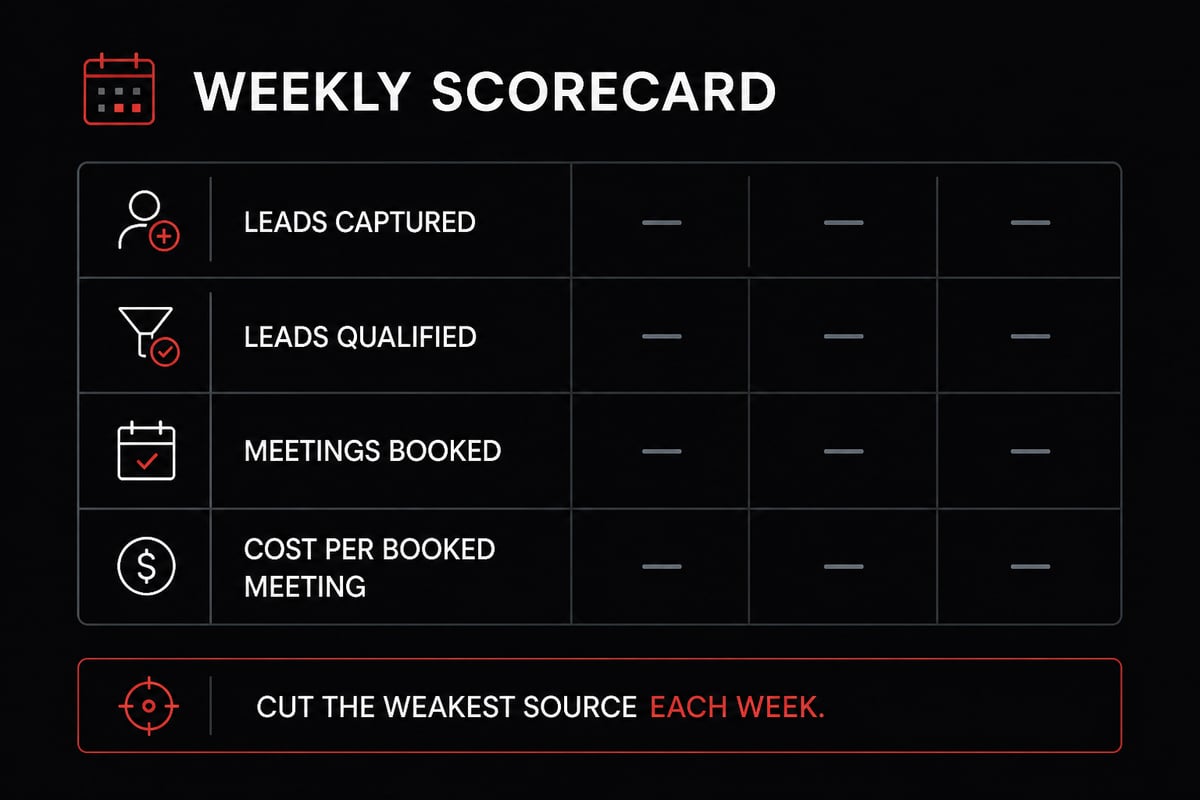
- Review weekly. Count leads, qualified leads, and booked meetings, and drop the sources that do not produce meetings.
Hypothetical example: a services firm captures a batch of leads in a month through one landing page. Without a response step, many wait a day or more for a reply. With automated follow-up and booking, more of the same leads reach the calendar because none wait for a human to wake up. The traffic is identical, and only the handoff changed.
When Should You Move Beyond Free Tools?
Move beyond free tools when leads are arriving faster than your team can answer them, or when you cannot say which source produces booked meetings. Those two signs mean the free stack has reached its ceiling.
The cost question is also about acquisition. If your cost per booked meeting keeps climbing, the answer is rarely another free tool. It is a tighter system with tested creative and visible spend. Aletto reports that clients see reduced customer acquisition costs, and that many client campaigns reach a home-run rate of 10x ROI or more. Creative is built from your buyers' actual language and tested weekly, and you see every dollar of ad spend.
Teams that want a managed system should note that Aletto is not built for one-off fixes or for cold outreach.
Frequently Asked Questions
Are free lead generation tools effective for B2B?
They are effective for capture, contact data, and basic tracking, but not for producing booked meetings alone. A free stack works as a starting point for a small team. Results depend on how fast you respond and how well you qualify, not on the number of tools you install.
What is the best free tool to start with?
Start with a free CRM and a form builder. The CRM gives every lead a record and a source, and the form gives you a way to qualify them. Add a verifier before any email outreach so your sending domain stays healthy.
How do free lead generation tools make money?
Vendors offer a capped free plan to attract users, then charge for higher contact limits, automation, integrations, and support. Some also earn from add-ons such as data credits. The free tier is the sales funnel for the paid tier.
Can free tools replace a paid acquisition system?
They cannot replace one if you need steady, qualified meetings. Free tools capture and store leads, but they do not run ad testing, instant AI follow-up, or automated booking. Those functions are what turn interest into calendar slots.
How many free tools should a team use?
Use as few as cover your funnel: capture, a CRM, a verifier, and a response step. More tools means more handoffs, and every handoff is a place where a lead goes cold. Consolidate when two tools overlap.
Your next step is to count how many leads from the last 30 days were answered within five minutes and how many became booked meetings, because that number shows whether your free stack is working or leaking. If the gap is large, the Free AI Call Booking Report shows how a combined system of paid acquisition, AI follow-up, and automated booking closes it without cold outreach. When you are ready to see how this applies to your own pipeline, you can start free training with Aletto and map your path from captured lead to booked call.