


The difference between businesses that thrive and those that merely survive often comes down to one critical factor: their ability to generate and convert acquisition leads effectively. In today's competitive marketplace, attracting potential customers is only half the battle. The real challenge lies in building systematic processes that transform strangers into qualified prospects and ultimately paying customers. Understanding how to optimize every stage of the acquisition journey determines whether your marketing budget generates exceptional returns or simply drains resources without meaningful results.
What Makes Acquisition Leads Different From Other Prospects
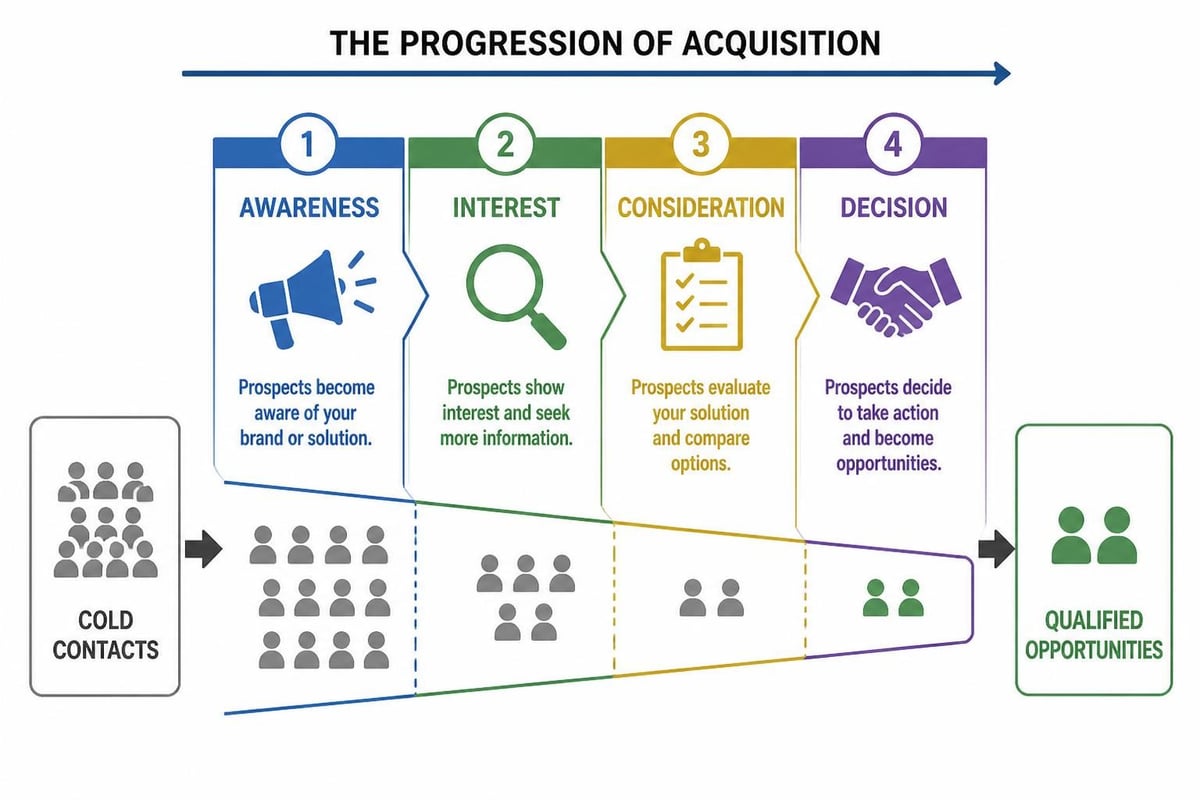
Acquisition leads represent potential customers at the very beginning of their relationship with your business. Unlike existing customers or warm referrals, these prospects have no prior connection to your brand and require strategic nurturing to move through the sales pipeline.
The fundamental characteristic that sets acquisition leads apart is their position in the customer lifecycle. They're essentially cold contacts who've shown initial interest through various touchpoints like downloading content, filling out forms, or engaging with your advertisements. This initial signal of interest creates an opportunity, but capitalizing on it requires understanding their specific needs and pain points.
The Investment Value of Quality Acquisition
Not all acquisition leads carry equal value. A high-quality lead from a decision-maker at your ideal customer profile company holds exponentially more potential than hundreds of unqualified contacts. This reality has shifted modern marketing away from pure volume metrics toward building effective lead acquisition strategies that prioritize relevance and intent.
Consider these quality indicators:
- Budget alignment with your solution pricing
- Authority to make purchasing decisions
- Need that matches your service offering
- Timeline for implementation
- Fit with your ideal customer profile
Organizations that focus exclusively on lead volume often discover their sales teams waste countless hours pursuing prospects who will never convert. By contrast, businesses that implement rigorous qualification criteria create predictable revenue streams from their demand generation efforts.
Building Your Acquisition Leads Framework
Creating a sustainable acquisition system requires more than launching advertisements and hoping for results. It demands a comprehensive framework that addresses every stage of the prospect journey.
Defining Your Ideal Customer Profile
Before generating your first acquisition lead, you must clearly articulate who you're trying to reach. Your ideal customer profile (ICP) serves as the foundation for all targeting decisions, messaging strategies, and qualification criteria.
Effective ICPs include:
- Demographic data (company size, industry, revenue)
- Psychographic information (challenges, goals, values)
- Behavioral patterns (buying cycles, decision processes)
- Technical requirements (existing systems, integration needs)
The more specific your ICP, the more efficiently you can allocate marketing resources toward prospects likely to convert. Companies like Cyrel P. Nicolas excel at helping businesses refine their targeting through comprehensive SEO and digital marketing strategies that attract the right audience segments.
Selecting High-Performance Channels
Where you acquire leads matters as much as how many you generate. Different channels attract prospects with varying levels of intent, awareness, and readiness to buy.
| Channel Type | Intent Level | Conversion Timeline | Cost Per Lead |
|---|---|---|---|
| Search Ads | High | Short (days-weeks) | Medium-High |
| Social Media | Medium | Medium (weeks-months) | Low-Medium |
| Content Marketing | Variable | Long (months) | Low |
| Paid Display | Low-Medium | Long (months) | Low |
| Email Outreach | Medium-High | Medium (weeks) | Medium |
Best practices for generating high-quality leads emphasize choosing conversion goals aligned with your customer journey. Rather than spreading budgets across every available channel, concentrate resources on platforms where your ideal customers actively search for solutions.
Optimizing Lead Capture and Qualification
The moment a prospect expresses interest represents your highest-leverage opportunity to gather qualifying information. Yet many businesses squander this critical touchpoint with generic forms that collect minimal data or overly complex questionnaires that reduce conversion rates.
Progressive Profiling Strategies
Smart acquisition systems implement progressive profiling, gradually collecting information across multiple interactions rather than demanding everything upfront. This approach balances conversion optimization with data collection needs.
Initial touchpoint: Capture essential contact information and one qualifying question. Follow-up interactions: Request additional details about budget, timeline, or specific challenges. Sales conversation: Gather remaining qualification criteria through direct dialogue.
This graduated approach, recommended in lead qualification best practices, significantly improves form completion rates while still providing sales teams with actionable intelligence.
Implementing Automated Qualification Scoring
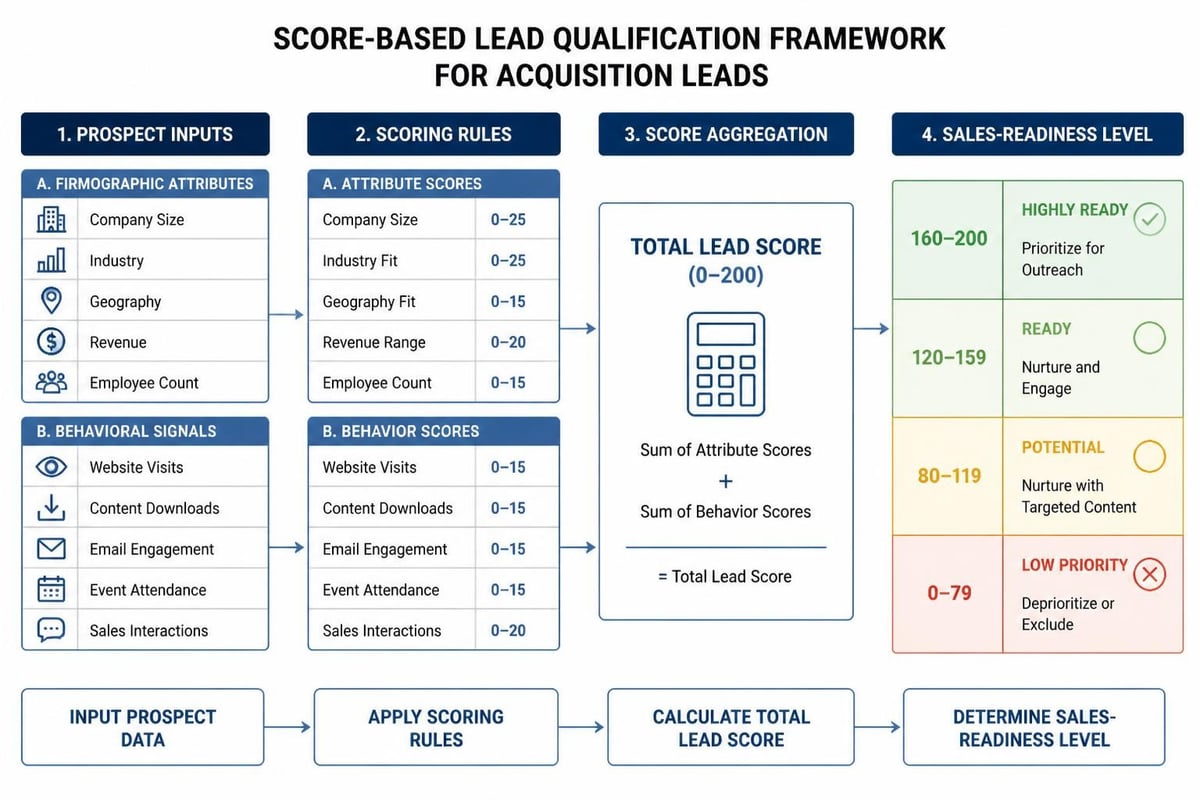
Manual lead review creates bottlenecks that slow response times and reduce conversion rates. Automated scoring systems evaluate acquisition leads instantly based on predetermined criteria, routing high-potential prospects to sales while nurturing lower-scoring contacts through marketing automation.
Effective scoring models weight factors like:
- Company characteristics (40% of total score)
- Behavioral signals (30% of total score)
- Engagement patterns (20% of total score)
- Demographic fit (10% of total score)
By automating early triage with score-based rules, businesses ensure their sales teams focus exclusively on prospects with genuine buying intent. This optimization becomes especially crucial when working with AI-powered marketing tools that can process thousands of leads simultaneously.
Balancing Quantity and Quality in Lead Acquisition
One of the most persistent challenges in acquisition marketing involves finding the optimal balance between lead volume and lead quality. Generating massive quantities of unqualified contacts wastes resources, yet overly restrictive targeting can starve sales pipelines.
Setting Progressive Qualification Gates
Rather than applying rigid qualification criteria at the initial touchpoint, implement progressive qualification gates that allow broader top-of-funnel capture while increasing selectivity as prospects progress.
Gate 1 (Initial Capture): Minimal qualification – basic fit with industry or role
Gate 2 (Marketing Qualification): Behavioral signals indicating active research
Gate 3 (Sales Qualification): Budget, authority, need, and timeline confirmation
This tiered approach maximizes pipeline flow while protecting sales resources from premature engagement with unready prospects. For businesses seeking to acquire leads systematically, this framework provides the structure needed for consistent results.
Measuring True Acquisition Costs
Understanding the complete cost of acquiring customers requires tracking metrics beyond initial lead generation expenses. Calculate your true customer acquisition cost by including:
- Marketing campaign expenses
- Sales team time and resources
- Technology and automation tools
- Lead nurturing and follow-up costs
- Opportunity cost of lost deals
When you measure the full acquisition journey, you often discover that cheaper lead sources generate higher total costs due to lower conversion rates or longer sales cycles. This insight helps optimize budget allocation toward channels delivering the best return on investment.
Advanced Strategies for Acquisition Lead Generation
As markets become increasingly competitive, basic lead generation tactics produce diminishing returns. Forward-thinking organizations implement sophisticated strategies that create sustainable competitive advantages.
Multi-Touch Attribution Modeling
Acquisition leads rarely convert after a single interaction. They typically engage with multiple touchpoints across various channels before making purchase decisions. Understanding which combinations drive conversions enables smarter budget allocation.
Modern attribution models track:
- First touch: Initial awareness channel
- Middle touches: Research and consideration interactions
- Last touch: Final conversion trigger
- Assist touches: Supporting influences throughout the journey
By analyzing lead sources comprehensively, businesses identify which channel combinations produce the highest-quality acquisition leads. This intelligence transforms marketing from guesswork into science.
Leveraging AI for Predictive Lead Scoring
Traditional lead scoring relies on historical patterns and predetermined rules. AI-powered systems continuously learn from conversion data, identifying subtle patterns human analysts might miss and adjusting scoring criteria in real-time.
These advanced systems can predict which acquisition leads will convert with remarkable accuracy, enabling sales teams to prioritize outreach strategically. Companies exploring advertising and AI integration gain significant competitive advantages in lead conversion efficiency.
Industry-Specific Acquisition Approaches
Different industries require tailored acquisition strategies that reflect unique buying cycles, decision-making processes, and regulatory constraints.
Professional Services and B2B Acquisition
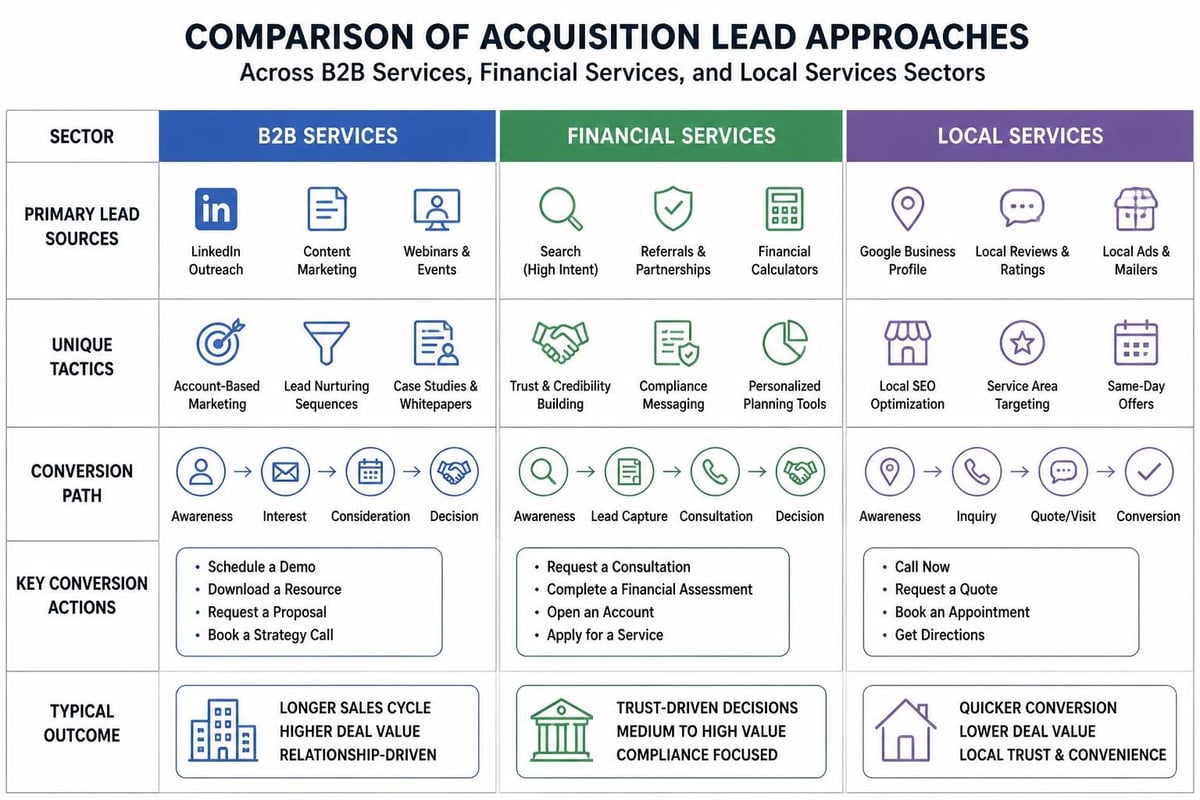
B2B leads typically involve longer sales cycles and multiple decision-makers. Successful acquisition strategies emphasize thought leadership content, account-based marketing, and relationship development over transactional tactics.
Effective B2B acquisition includes:
- Educational content addressing complex business challenges
- Case studies demonstrating measurable results
- Industry-specific solutions showing deep domain expertise
- Executive engagement building C-level relationships
Businesses can learn from successful implementations like MF Freight’s lead generation transformation, which achieved consistent high-quality lead flow while reducing acquisition costs.
Financial and Insurance Lead Acquisition
Heavily regulated industries like finance and insurance face unique constraints on marketing claims and data collection. Despite these challenges, targeted acquisition strategies deliver exceptional results when executed properly.
Specialized approaches for financial advisor lead generation and insurance lead acquisition emphasize compliance, trust-building, and educational marketing that positions advisors as trusted resources rather than aggressive salespeople.
Creating Irresistible Lead Magnets
The offers you present to potential acquisition leads directly impact both quantity and quality of responses. Generic content downloads rarely generate highly qualified prospects, while highly specific, valuable offers attract serious buyers.
Value-First Offer Development
Your lead magnets should deliver immediate, actionable value that addresses specific pain points your ideal customers experience. The most effective offers include:
- Diagnostic tools that help prospects assess their current situation
- Templates and frameworks enabling immediate implementation
- Research reports providing market intelligence unavailable elsewhere
- ROI calculators quantifying potential value from solutions
- Custom assessments offering personalized recommendations
When developing offers, consider what information prospects need at each stage of their buying journey. Early-stage leads benefit from educational content, while late-stage prospects value detailed implementation guides or pricing information.
Simplifying Form Design for Maximum Conversion
Even compelling offers fail if the capture mechanism creates friction. Leading strategies for lead acquisition emphasize form simplification as a critical conversion lever.
Follow these optimization principles:
- Request only essential information initially
- Use conditional logic to show relevant fields
- Provide clear value propositions above forms
- Eliminate optional fields that reduce completion
- Implement mobile-responsive design
- Test single-column versus multi-column layouts
Every additional form field reduces completion rates. Rigorously question whether each data point justifies its conversion impact.
Nurturing Acquisition Leads Through the Pipeline
Converting acquisition leads requires systematic nurturing that builds trust, demonstrates value, and addresses objections throughout the consideration process. Most prospects aren't ready to buy immediately, making patient, strategic follow-up essential.
Segmented Email Nurture Sequences
Generic email blasts produce minimal engagement. Effective nurture campaigns segment acquisition leads based on interests, behaviors, and qualification scores, delivering personalized content that advances each prospect toward purchase readiness.
Successful segmentation criteria include:
| Segment Type | Messaging Focus | Content Types | Typical Length |
|---|---|---|---|
| Industry-Specific | Vertical challenges | Case studies, industry reports | 8-12 emails |
| Use Case-Based | Solution applications | How-to guides, demos | 6-10 emails |
| Buyer Stage | Decision criteria | Comparisons, ROI data | 4-8 emails |
| Engagement Level | Re-activation | Special offers, new content | 3-6 emails |
Targeted campaigns like ImOn Communications’ acquisition email strategy demonstrate how audience segmentation dramatically improves conversion rates and customer lifetime value.
Multi-Channel Engagement Orchestration
Email alone rarely converts modern acquisition leads. Integrated campaigns coordinate touchpoints across email, social media, retargeting ads, direct mail, and phone outreach to maintain consistent presence without overwhelming prospects.
Strategic channel orchestration leverages each platform's unique strengths while respecting prospect preferences and engagement patterns. Some leads respond best to educational content, others to interactive tools, and still others to direct conversation with sales representatives.
Technology Stack for Acquisition Success
Effective lead acquisition requires more than strategy. The right technology infrastructure enables execution at scale while maintaining personalization and quality.
Essential Tools and Platforms
Modern acquisition systems integrate multiple technologies:
- CRM platforms for contact management and pipeline tracking
- Marketing automation for nurture campaigns and scoring
- Analytics tools for attribution and performance measurement
- Landing page builders for rapid testing and optimization
- Form optimization software for conversion rate improvement
- Communication tools for sales engagement and follow-up
Selecting the best marketing platforms depends on your specific needs, budget, and technical capabilities. While comprehensive suites offer integration advantages, best-of-breed tools often provide superior functionality in specialized areas.
For businesses operating in international markets, partnering with specialized agencies can accelerate results. Markkinointikone helps companies optimize their sales and marketing through freelancer networks that provide flexible, scalable support across multiple disciplines.
Integration and Data Flow Optimization
The most sophisticated tools deliver minimal value if data doesn't flow seamlessly between systems. Proper integration ensures acquisition leads move automatically through qualification stages, triggering appropriate actions without manual intervention.
Critical integration points include:
- Ad platforms to landing pages (tracking parameters)
- Forms to CRM (instant contact creation)
- CRM to marketing automation (nurture enrollment)
- Marketing automation to sales tools (alert notifications)
- All systems to analytics (unified reporting)
Companies focused on lead generation advertising benefit enormously from streamlined technology stacks that eliminate data silos and manual processes.
Measuring and Optimizing Acquisition Performance
What gets measured gets managed. Comprehensive performance tracking identifies which acquisition strategies deliver results and which waste resources.
Key Performance Indicators
Track metrics across the entire acquisition funnel:
Volume Metrics
- Total acquisition leads generated
- Leads by source/channel
- Cost per lead
Quality Metrics
- Lead-to-opportunity conversion rate
- Opportunity-to-customer conversion rate
- Average deal size by source
Efficiency Metrics
- Customer acquisition cost
- Return on ad spend
- Sales cycle length
Business Impact Metrics
- Customer lifetime value
- Revenue per lead source
- Marketing-influenced revenue
By monitoring these indicators weekly, you quickly identify underperforming campaigns and double down on successful strategies. For organizations working with specialized lead generation companies, clear metrics enable productive partnership conversations focused on continuous improvement.
Continuous Testing and Refinement
The highest-performing acquisition systems embrace experimentation as a core practice. Regular testing of offers, messaging, targeting, and creative elements uncovers incremental improvements that compound into significant competitive advantages.
Prioritize tests based on potential impact and ease of implementation. Start with high-traffic, low-effort changes before investing in complex optimizations. Document results systematically to build institutional knowledge that informs future decisions.
Strategic partners like Be Creative provide valuable expertise in digital transformation and optimization, helping businesses implement testing frameworks that drive measurable improvement across acquisition channels.
Building Sustainable Acquisition Systems
The ultimate goal isn't generating acquisition leads for a single campaign but building repeatable systems that consistently deliver qualified prospects at predictable costs. This requires strategic thinking beyond tactical execution.
Developing Proprietary Acquisition Assets
Companies that build unique acquisition advantages create defensible competitive positions. Proprietary assets might include:
- Exclusive data or research that attracts prospects
- Proprietary tools or calculators providing value
- Unique content formats or distribution channels
- Strategic partnerships enabling access to new audiences
- Technology platforms that streamline acquisition processes
When you own differentiated assets rather than relying solely on paid advertising, your acquisition costs decrease while lead quality improves. For businesses seeking comprehensive support, agencies like Stijl en Vorm offer integrated services from strategy through execution, helping organizations build sustainable growth engines.
Creating Feedback Loops Between Sales and Marketing
Acquisition optimization requires tight alignment between teams generating leads and teams converting them. Regular feedback sessions where sales shares lead quality insights and marketing explains source characteristics creates shared understanding that drives better results.
Implement structured processes for:
- Weekly lead quality reviews assessing recent acquisitions
- Monthly win/loss analysis identifying conversion patterns
- Quarterly strategy sessions aligning on priorities and improvements
- Ongoing communication channels enabling real-time feedback
This collaborative approach, combined with comprehensive marketing agency tools, transforms lead acquisition from a marketing function into an integrated business capability.
Mastering acquisition leads requires strategic thinking, systematic execution, and continuous optimization across every stage of the prospect journey. By implementing rigorous qualification frameworks, leveraging advanced technology, and maintaining relentless focus on quality over volume, businesses transform lead acquisition from an expense into a predictable revenue driver. Aletto specializes in exactly this transformation, leveraging advanced AI systems to generate qualified sales leads and automate appointment bookings while ensuring every prospect meets your ideal customer criteria. Our guaranteed growth partnership model aligns our success with yours, delivering transparent, value-driven results that create predictable revenue growth for your business.