


Every business owner faces the same challenge: attracting attention is easy, but converting strangers into paying customers requires a systematic approach. The marketing content funnel provides that system, transforming random website visitors into qualified leads who are ready to make purchasing decisions. This strategic framework aligns your content with each stage of the buyer's journey, ensuring you deliver the right message at precisely the right moment. For businesses focused on lead generation, understanding how to build and optimize a marketing content funnel isn't just helpful-it's essential for predictable, scalable growth.
Understanding the Marketing Content Funnel Framework
A marketing content funnel represents the complete journey your potential customers take from first discovering your brand to becoming loyal advocates. Unlike traditional marketing approaches that treat all prospects the same, the marketing funnel framework recognizes that people at different stages require different types of information and engagement.
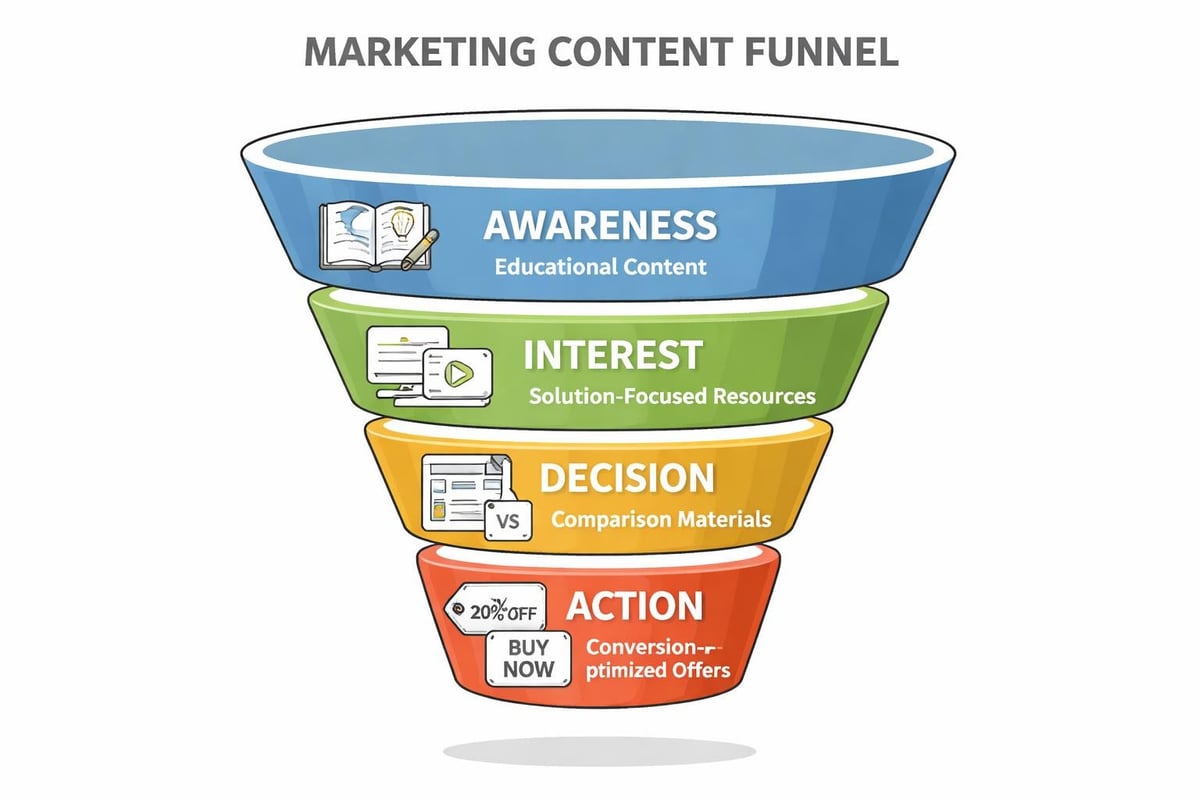
The funnel consists of four primary stages:
- Awareness: Prospects realize they have a problem but don't yet know about your solution
- Interest: They're actively researching potential solutions and evaluating options
- Decision: They're comparing specific providers and preparing to make a choice
- Action: They're ready to convert and become customers
What makes the marketing content funnel particularly powerful for lead generation is its focus on qualification. You're not just gathering contact information-you're nurturing prospects with valuable content that educates, builds trust, and naturally guides them toward conversion.
Why Traditional Funnels Fall Short
Most businesses make a critical mistake: they create content without considering where their audience is in the buying journey. Publishing blog posts randomly or running ads without a strategic content plan wastes resources and frustrates potential customers who receive irrelevant information.
The marketing content funnel solves this problem by matching content types to buyer readiness. Someone who just discovered they need lead generation services shouldn't receive a hard sales pitch about your pricing. Instead, they need educational content that helps them understand their options and establishes your expertise.
Building Your Awareness Stage Content Strategy
The top of your marketing content funnel focuses entirely on visibility and education. Prospects at this stage don't know your brand exists, and many haven't fully identified their problem. Your goal isn't conversion-it's establishing authority and capturing attention.
Effective awareness-stage content includes:
- Educational blog posts addressing common industry challenges
- Social media content that sparks conversations
- SEO-optimized articles targeting informational keywords
- Video content explaining complex concepts simply
- Infographics that visualize important data
For businesses in the lead generation space, awareness content might explore topics like why traditional outbound methods are failing or how market dynamics have shifted. The key is providing genuine value without demanding anything in return.
Creating Content That Attracts Quality Prospects
Not all traffic is created equal. The content marketing funnel approach emphasizes attracting the right audience, not just the largest one. This requires understanding your ideal customer profile and creating content that specifically addresses their pain points.
Think about the questions your best customers asked before working with you. What misconceptions did they have? What information were they searching for? Use these insights to create awareness content that naturally attracts qualified prospects while filtering out poor-fit leads.
| Content Type | Primary Goal | Distribution Channel | Key Metric |
|---|---|---|---|
| Blog Articles | Search Visibility | Organic Search | Page Views |
| Social Posts | Engagement | LinkedIn, Facebook | Shares/Comments |
| Videos | Brand Awareness | YouTube, Social | Watch Time |
| Podcasts | Thought Leadership | Spotify, Apple | Downloads |
The awareness stage sets the foundation for everything that follows. Prospects who discover your brand through valuable content are more receptive to your messaging in later stages.
Nurturing Interest Through Strategic Content
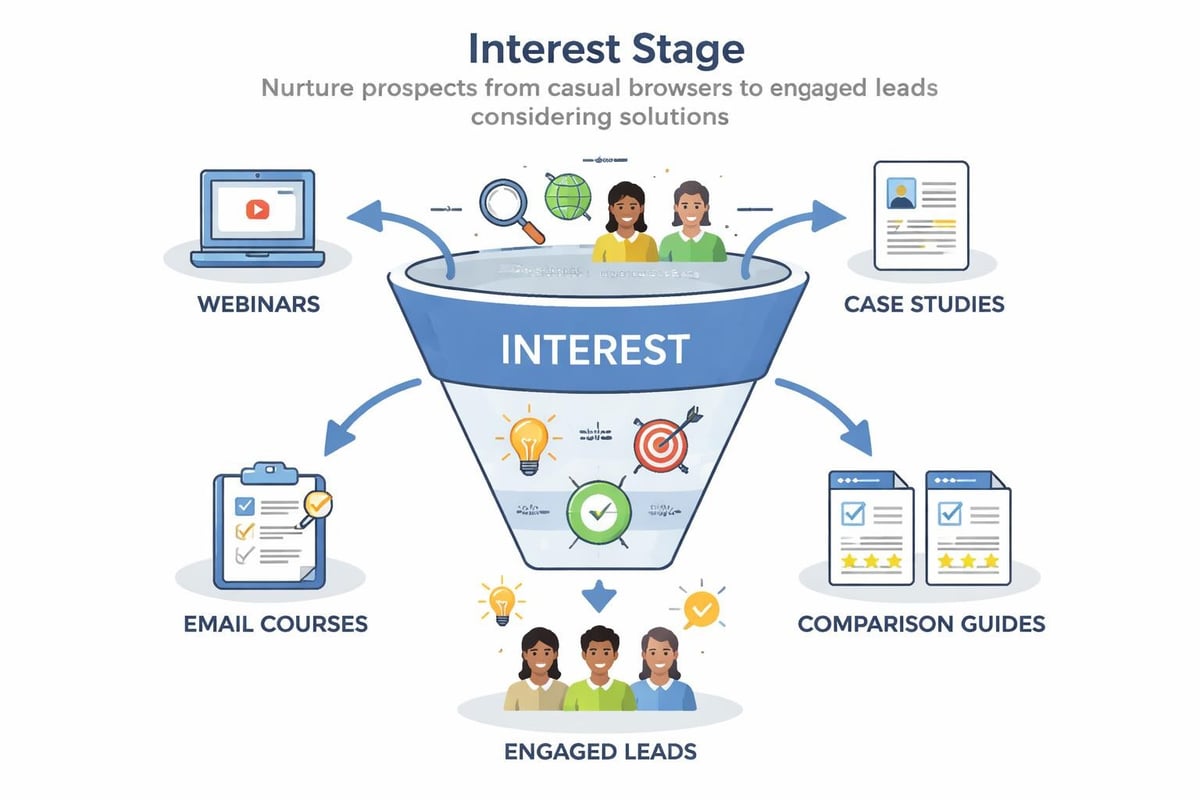
Once prospects enter the interest stage of your marketing content funnel, they're actively evaluating solutions. They understand their problem and are researching different approaches. Your content must shift from general education to demonstrating why your methodology works.
This middle-funnel content builds trust and positions your unique value proposition. Prospects want proof, case studies, and detailed explanations of how solutions work. They're comparing options and eliminating vendors who don't meet their criteria.
Interest-stage content that converts includes:
- Detailed case studies with specific results
- Comparison guides analyzing different approaches
- Webinars demonstrating your methodology
- Email courses that deliver value over time
- Research reports with proprietary data
For companies offering lead generation services, this stage is perfect for explaining your AI-driven approach, sharing client success stories, and demonstrating the difference between your guaranteed growth model and traditional agency relationships.
Leveraging Lead Magnets Strategically
The interest stage is where lead capture becomes crucial. Creating compelling lead magnets that require email registration allows you to continue the conversation beyond your website. However, the key is offering genuine value, not just gating content artificially.
Consider what information would be worth trading contact details for. Templates, calculators, comprehensive guides, or exclusive research often perform well. The quality of your lead magnet directly correlates with the quality of leads you generate.
Converting Decision-Stage Prospects Into Customers
The decision stage represents the bottom of your marketing content funnel where prospects are ready to choose a provider. Your content must address final objections, differentiate your offering clearly, and make the path to purchase frictionless.
At this stage, prospects don't need more education about their problem-they need confidence in their solution choice. Content should focus on specifics: pricing transparency, implementation details, support structures, and guarantees.
Decision-stage content that closes deals:
- Product demos showing exactly how your solution works
- Pricing pages with clear value propositions
- Customer testimonials addressing common concerns
- FAQ resources removing barriers to purchase
- Free trials or consultations reducing perceived risk
The content marketing funnel concept emphasizes that decision-stage content must be immediately actionable. Prospects at this level have limited patience for vague marketing speak-they want concrete information that helps them finalize their choice.
Removing Friction From the Conversion Process
Every additional step between decision and action represents potential drop-off. Audit your conversion process ruthlessly. How many form fields do prospects need to complete? How many clicks separate them from booking a consultation? How clear is your value proposition on conversion pages?
For B2B lead generation companies, decision-stage content might include transparent case studies showing ROI, detailed explanations of your guaranteed growth model, and clear next steps for getting started. The goal is making the decision feel obvious and low-risk.
| Conversion Element | Best Practice | Why It Matters |
|---|---|---|
| Form Length | 3-5 fields maximum | Reduces abandonment |
| Call-to-Action | Single, clear CTA | Eliminates confusion |
| Value Proposition | Above the fold | Immediate clarity |
| Social Proof | Visible testimonials | Builds trust quickly |
| Risk Reversal | Guarantee displayed | Reduces anxiety |
Understanding how digital marketing funnels work helps you identify and eliminate conversion bottlenecks. Small optimizations at this stage produce outsized results because you're working with pre-qualified, interested prospects.
Optimizing Each Funnel Stage Through Data
A marketing content funnel isn't a set-it-and-forget-it system. Continuous optimization based on actual performance data separates high-performing funnels from mediocre ones. Track metrics at each stage to identify where prospects drop off and which content drives the best results.
Critical metrics for funnel optimization:
- Awareness Stage: Traffic sources, bounce rate, time on page, pages per session
- Interest Stage: Email signup rate, lead magnet download rate, webinar attendance
- Decision Stage: Consultation booking rate, sales call conversion rate, proposal acceptance rate
- Action Stage: Customer acquisition cost, lifetime value, time to close
The comprehensive approach to content marketing funnels requires testing different content types, formats, and messaging at each stage. What works for one audience segment might not resonate with another.
Advanced Segmentation Strategies
Not all prospects should receive identical content even within the same funnel stage. Segmentation allows you to personalize the experience based on industry, company size, behavior, or specific pain points. This level of customization dramatically improves conversion rates.
For example, a prospect who downloaded a guide about Facebook real estate lead generation should receive follow-up content specific to real estate challenges, not generic lead generation advice. This relevance builds trust and accelerates the buying journey.
Aligning Content Types With Buyer Intent
The most effective marketing content funnel matches content format to user intent. Someone researching general concepts wants different content than someone comparing vendors. Understanding these preferences helps you allocate resources efficiently.
Content format preferences by stage:
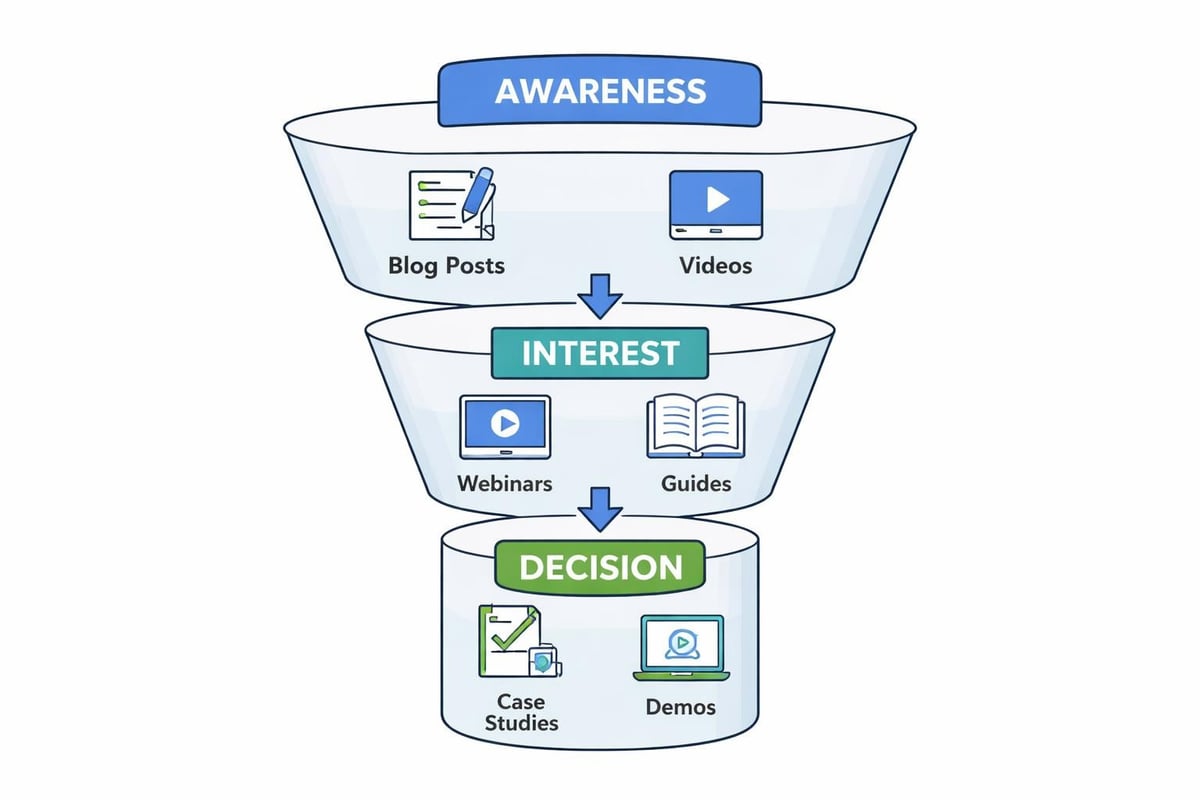
- Early Stage: Blog posts, social media, podcasts, explainer videos
- Middle Stage: Webinars, whitepapers, email courses, detailed guides
- Late Stage: Case studies, product demos, comparison sheets, pricing pages
This alignment extends beyond format to depth and specificity. Awareness content should be accessible and broad. Decision-stage content should be detailed and specific. The strategic framework for content marketing funnels emphasizes this progression from general to specific.
Creating Content That Moves Prospects Forward
Every piece of content in your marketing content funnel should have a clear next step. What action should someone take after reading your blog post? Where should they go after watching your video? This intentional progression prevents prospects from stalling at any stage.
Use internal linking strategically to guide readers deeper into your funnel. A prospect reading about lead acquisition strategies should see natural opportunities to explore specific tactics, book consultations, or access additional resources.
Automating Your Marketing Content Funnel
Manual follow-up doesn't scale. Marketing automation allows you to deliver the right content at the right time based on prospect behavior, creating a personalized experience for hundreds or thousands of leads simultaneously.
Email sequences triggered by specific actions nurture leads automatically. Someone who downloads your awareness-stage guide enters a sequence that gradually introduces more advanced concepts, eventually presenting decision-stage content when they've demonstrated sufficient interest.
Automation opportunities within your funnel:
- Welcome sequences for new subscribers
- Behavior-triggered email campaigns
- Retargeting ads for website visitors
- Lead scoring based on content engagement
- Automated webinar funnels
The key to successful automation is maintaining relevance. Generic email blasts destroy trust. Personalized sequences that respond to actual behavior build relationships at scale. This approach aligns perfectly with how modern marketing platforms enable sophisticated targeting and personalization.
Balancing Automation With Human Touch
While automation handles repetitive tasks efficiently, high-value prospects deserve personal attention. Use automation to identify when prospects reach critical stages, then involve sales teams for personalized outreach.
For instance, when someone views your pricing page three times and downloads two case studies, that signals strong buying intent. Automated systems can alert your team to reach out personally rather than continuing generic nurture sequences.
Measuring Marketing Content Funnel Performance
Without measurement, you're guessing. Establish clear KPIs for each funnel stage and track them consistently. This data reveals which content performs best, where prospects struggle, and what adjustments will drive the biggest improvements.
Calculate conversion rates between each stage. If 1000 people enter your funnel at awareness but only 10 become customers, where's the breakdown? Perhaps awareness content attracts the wrong audience, or decision-stage content fails to address key objections.
| Funnel Stage | Key Metrics | Target Benchmarks |
|---|---|---|
| Awareness | Traffic, Reach, Impressions | 10,000+ monthly visitors |
| Interest | Email Signups, Downloads | 3-5% conversion rate |
| Decision | Consultation Requests | 20-30% of qualified leads |
| Action | Customer Conversion | 30-50% of consultations |
Understanding the complete marketing funnel framework helps you set realistic benchmarks. Different industries and business models will see varying conversion rates, but tracking trends over time reveals whether your optimizations are working.
Attribution and Multi-Touch Analysis
Prospects rarely convert after a single interaction. They might discover you through a blog post, return for a webinar, download a guide, and finally book a consultation weeks later. Multi-touch attribution reveals which content actually contributes to conversions.
This insight prevents over-investing in last-touch content (like product demos) while under-investing in awareness content that starts the relationship. Both are essential, and proper attribution ensures you resource each stage appropriately.
Scaling Your Marketing Content Funnel
Once you've built and optimized a functioning marketing content funnel, scaling becomes the focus. This means increasing volume while maintaining quality-more traffic, more leads, more customers-without proportionally increasing costs.
Content repurposing accelerates scaling. Transform a comprehensive guide into blog posts, social media content, video scripts, and email sequences. This maximizes return on content creation investment while maintaining message consistency across channels.
Scaling strategies that work:
- Expanding into new content channels
- Creating content partnerships for broader reach
- Implementing AI-driven personalization
- Building community engagement programs
- Developing self-service resources
Companies specializing in B2B lead generation understand that scaling requires systems, not just effort. The marketing content funnel provides that system, creating predictable lead flow that supports sustainable growth.
Focus on quality over quantity throughout the scaling process. Ten highly qualified leads who fit your ideal customer profile are worth more than one hundred tire-kickers. Your funnel should attract and nurture the right prospects, filtering out poor fits naturally through increasingly specific content.
Building an effective marketing content funnel transforms lead generation from unpredictable to systematic, creating a reliable engine for business growth. By aligning content with buyer stages, optimizing based on data, and maintaining focus on quality over quantity, you create a sustainable competitive advantage. Adstra specializes in building these systems for businesses ready to move beyond traditional marketing approaches, leveraging AI-driven strategies to generate qualified leads and automate customer acquisition at scale.