


Breaking into a cold market feels like walking into a room full of strangers and trying to start meaningful conversations that lead to business relationships. It's uncomfortable, uncertain, and often met with resistance. Yet cold market prospecting remains one of the most powerful growth strategies for businesses willing to master its nuances. Unlike warm leads who already know your brand or referrals who come pre-qualified, the cold market represents untapped potential-thousands of prospects who have a problem you can solve but don't know you exist yet. The businesses that crack the cold market code unlock predictable, scalable revenue growth that doesn't depend on their existing network running dry.
Understanding the Cold Market Landscape
The cold market consists of prospects who have zero prior relationship with your business. They haven't visited your website, engaged with your content, or heard your name mentioned by a colleague.
These are complete strangers who fit your ideal customer profile but require strategic outreach to capture their attention.
What makes the cold market particularly challenging in 2026 is the sheer volume of outreach attempts flooding decision-makers' inboxes and phones. According to cold prospecting best practices, the average executive receives dozens of sales messages daily, making differentiation critical.
Why the Cold Market Matters for Growth
Most businesses exhaust their warm market within their first year of operation. Your friends, family, former colleagues, and immediate network can only take you so far.
Sustainable growth requires mastering cold outreach.
The cold market offers three distinct advantages:
- Unlimited scale: Unlike warm networks that deplete, cold markets contain millions of potential customers
- Predictable systems: Cold outreach can be tested, measured, and optimized for consistent results
- Independence: Your growth isn't limited by who you know or how many referrals you receive
Companies that build effective cold market systems gain competitive advantages that compound over time. When you can reliably generate qualified leads from strangers, you control your growth trajectory rather than hoping for referrals.
Core Cold Market Prospecting Strategies
Approaching the cold market requires a multi-channel strategy that meets prospects where they spend their time and attention.
Cold Email Outreach
Email remains one of the most effective cold market channels when executed properly. The key is personalization at scale-using technology to customize messages while maintaining efficiency.
Successful cold email campaigns in 2026 follow this structure:
- Research-driven targeting: Identify specific pain points before reaching out
- Compelling subject lines: Generate curiosity without clickbait
- Value-first messaging: Lead with insights, not sales pitches
- Clear calls-to-action: Make the next step obvious and low-commitment
- Strategic follow-up: Most conversions happen after multiple touchpoints
The businesses winning with cold email focus on helping rather than selling. They share relevant case studies, industry insights, or specific observations about the prospect's business that demonstrate genuine interest beyond making a sale.
Understanding how digital marketing funnels work helps you create email sequences that guide cold prospects through awareness, consideration, and decision stages systematically.
LinkedIn Cold Outreach
LinkedIn transformed from a digital resume platform into the premier cold market prospecting tool for B2B businesses. The platform offers unparalleled access to decision-makers and detailed information about their roles, challenges, and interests.
Effective LinkedIn prospecting follows a relationship-building approach:
| Strategy Element | Traditional Approach | High-Conversion Approach |
|---|---|---|
| Connection request | Generic template | Personalized note referencing shared interests |
| First message | Immediate pitch | Value-adding content or question |
| Follow-up | Multiple sales messages | Educational resources and insights |
| Conversion goal | Book demo immediately | Build relationship first |
The cold market on LinkedIn responds to authenticity and relevance. Prospects can spot generic templates instantly, so successful outreach requires genuine research and customization.
Cold Calling in the Modern Era
Many businesses declared cold calling dead years ago, yet cold calling remains effective when practiced with modern techniques. The difference between annoying interruption and welcome conversation lies in your approach.
Today's successful cold callers:
- Research extensively before dialing to personalize conversations
- Lead with pattern interrupts that break through autopilot rejections
- Ask permission to continue rather than launching into pitches
- Focus on problem identification instead of feature dumping
- Use technology to track, record, and improve their approach
The cold market responds to confidence combined with genuine curiosity about their challenges. When you call to learn rather than sell, conversations shift from confrontational to collaborative.
Converting Cold Leads Into Customers
Getting attention from the cold market is just the beginning. The real challenge lies in converting initial interest into qualified opportunities and eventual customers.
The Nurture Sequence Framework
Cold prospects rarely buy immediately. They need time to understand their problem, evaluate options, and build trust in your solution.
A strategic nurture sequence bridges this gap:
Most businesses lose cold market prospects because they push too hard too fast or give up too early. The optimal approach maintains consistent contact while providing genuine value at each interaction.
Implementing proven lead generation strategies helps you design nurture sequences that feel helpful rather than pushy.
Qualification Criteria for Cold Prospects
Not every cold market prospect deserves equal attention. Developing clear qualification criteria prevents wasting resources on poor-fit opportunities.
Strong qualification frameworks assess:
- Problem awareness: Does the prospect recognize they have a problem you solve?
- Budget availability: Can they afford your solution within a reasonable timeframe?
- Decision authority: Are you speaking with someone who can actually buy?
- Timeline urgency: Is there a compelling event driving action?
- Strategic fit: Does this prospect align with your ideal customer profile?
The cold market contains plenty of people who will take your time without buying. Qualifying aggressively ensures your energy focuses on genuine opportunities.
Creating Urgency Without Pressure
Cold prospects need compelling reasons to act now rather than later. Creating urgency requires balancing genuine scarcity with avoiding manipulative tactics that damage trust.
Ethical urgency strategies include:
- Capacity limitations: Honestly communicate when you can only take on limited clients
- Seasonal advantages: Highlight time-sensitive benefits (tax deadlines, seasonal trends)
- Competitive risks: Help prospects understand the cost of inaction
- Early-adopter incentives: Reward quick decision-makers with additional value
- Market changes: Point to industry shifts that make timing critical
When exploring cold market prospecting approaches, remember that authentic urgency stems from helping prospects avoid real consequences, not manufactured scarcity.
Technology and Automation for Cold Markets
Manual cold market prospecting doesn't scale. Technology multiplies your effectiveness while maintaining the personalization that drives conversions.
AI-Powered Personalization
Artificial intelligence transformed cold market prospecting by enabling mass customization. Modern AI systems analyze prospect data and generate personalized messaging that would take humans hours to create.
Key AI applications include:
- Dynamic email customization: Automatically inserting relevant details about prospect's company, industry, or recent news
- Optimal send timing: Analyzing when individual prospects are most likely to engage
- Response prediction: Identifying which prospects show highest conversion probability
- Content recommendations: Suggesting relevant case studies or resources for each prospect
- Conversation intelligence: Analyzing call recordings to identify winning patterns
Businesses leveraging AI for cold market prospecting report 3-5x higher response rates compared to generic outreach. The technology handles personalization grunt work while humans focus on strategic relationship building.
For companies seeking qualified sales leads, AI systems can dramatically compress the timeline from stranger to booked appointment.
CRM Integration and Tracking
Cold market success requires meticulous tracking of every interaction, response, and outcome. Customer relationship management systems serve as the central nervous system for prospecting operations.
| CRM Function | Cold Market Application | Business Impact |
|---|---|---|
| Contact management | Store detailed prospect information and interaction history | Personalized follow-up conversations |
| Pipeline tracking | Monitor progress from cold contact to closed deal | Identify bottlenecks and optimize conversion |
| Task automation | Trigger follow-ups and reminders automatically | Ensure no prospect falls through cracks |
| Reporting analytics | Measure channel effectiveness and ROI | Allocate resources to highest-performing tactics |
| Team coordination | Share prospect information across sales team | Prevent duplicate outreach and maintain consistency |
The cold market demands systematic approaches that CRMs enable. Without proper tracking, prospects receive duplicate messages, fall through follow-up cracks, or experience inconsistent communication.
Overcoming Cold Market Resistance
The cold market naturally resists sales outreach. Prospects have heard it all before and developed sophisticated defense mechanisms against unwanted solicitations.
Building Trust From Zero
Trust represents the fundamental challenge when approaching the cold market. Strangers have no reason to believe your claims or invest time in your message.
Accelerating trust-building requires:
- Social proof: Share specific results from similar companies or industries
- Expertise demonstration: Provide valuable insights that showcase your knowledge
- Transparency: Be honest about what you can and cannot deliver
- Risk reversal: Offer guarantees or trial periods that reduce prospect anxiety
- Third-party validation: Leverage testimonials, case studies, and industry recognition
The cold market responds to credibility signals more than marketing messages. Every interaction should deposit trust rather than withdraw it through pushy sales tactics.
Handling Common Objections
Cold prospects deploy predictable objections to end conversations quickly. Preparing thoughtful responses transforms obstacles into opportunities.
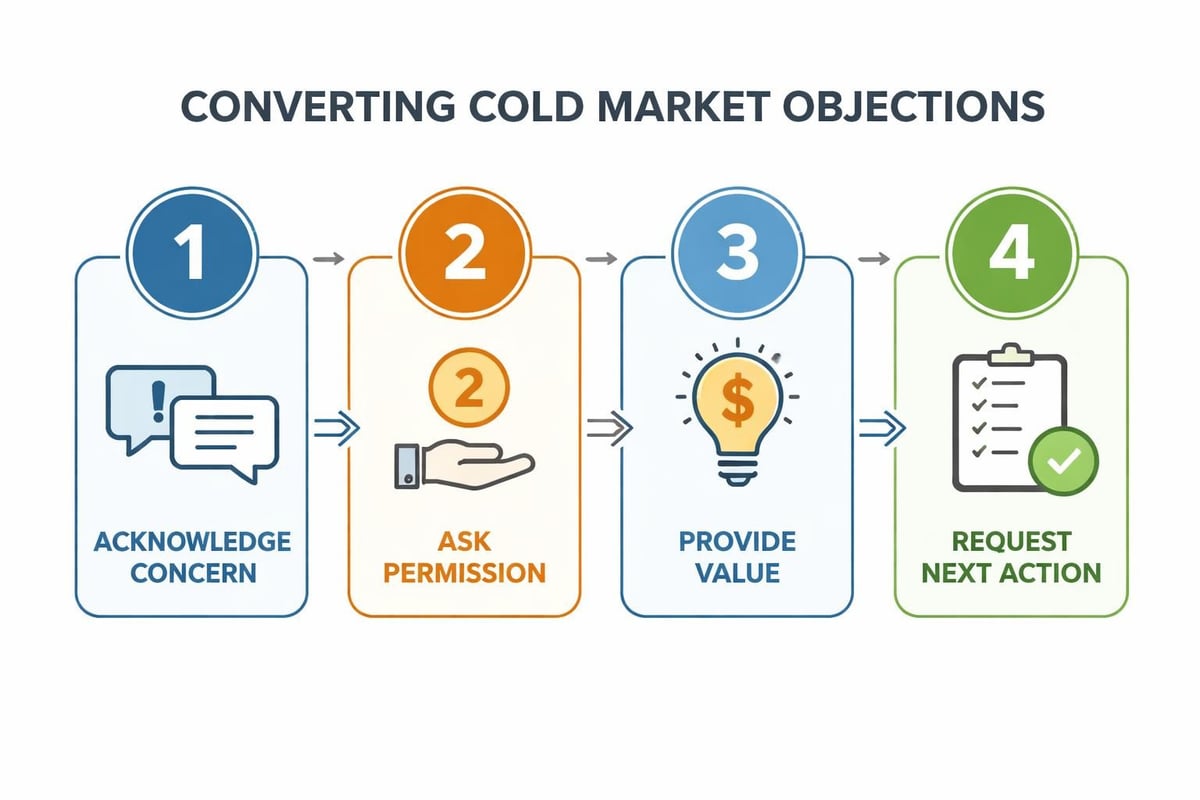
Standard objections include "not interested," "send me information," "we're already working with someone," and "call me back later." Each represents a test rather than a final answer.
The key is acknowledging the objection without accepting it as rejection. "I understand you're not interested in random sales calls-neither am I. That's why I researched your company and noticed [specific observation]. Can I share one quick insight that might be relevant?"
This approach respects the prospect's initial resistance while demonstrating you're different from typical cold market spam.
Measuring Cold Market Performance
What gets measured gets improved. Cold market prospecting requires tracking specific metrics that indicate strategy effectiveness.
Key Performance Indicators
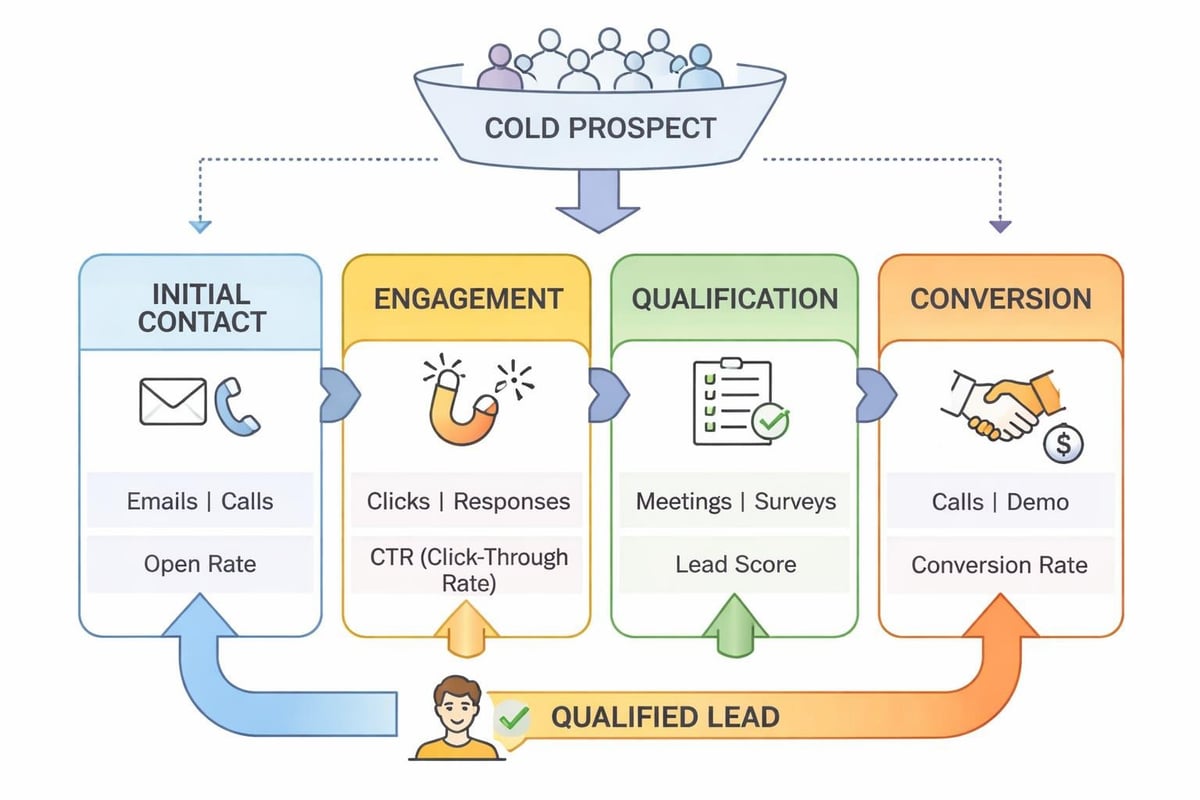
Different metrics matter at various stages of the cold market funnel:
Top-of-funnel metrics:
- Outreach volume (emails sent, calls made, connections requested)
- Contact rate (percentage of prospects reached)
- Response rate (percentage engaging with outreach)
- Meeting booking rate (percentage scheduling conversations)
Mid-funnel metrics:
- Qualification rate (percentage meeting buyer criteria)
- Conversation-to-opportunity conversion
- Average deal size from cold sources
- Sales cycle length for cold-sourced deals
Bottom-funnel metrics:
- Close rate on cold-sourced opportunities
- Customer acquisition cost from cold channels
- Lifetime value of cold-acquired customers
- Channel ROI comparison
Successful cold market programs optimize each stage independently rather than obsessing over final close rates alone. A 2% close rate on high-quality opportunities beats a 10% close rate on poor-fit prospects.
Testing and Optimization
The cold market rewards systematic experimentation. Small improvements in messaging, timing, or channel selection compound into significant performance gains.
Effective testing frameworks include:
- Isolate single variables: Test one change at a time for clear attribution
- Use sufficient sample sizes: Ensure statistical significance before drawing conclusions
- Document everything: Track what you tested, when, and the results
- Implement winners broadly: Roll out successful variations across campaigns
- Keep testing: Market conditions change, requiring continuous optimization
Many businesses exploring B2B lead generation companies discover that partnering with specialists accelerates the testing and optimization process through shared learnings across client portfolios.
Advanced Cold Market Techniques
Once you master basic cold market prospecting, advanced techniques unlock higher conversion rates and more qualified opportunities.
Multi-Channel Sequencing
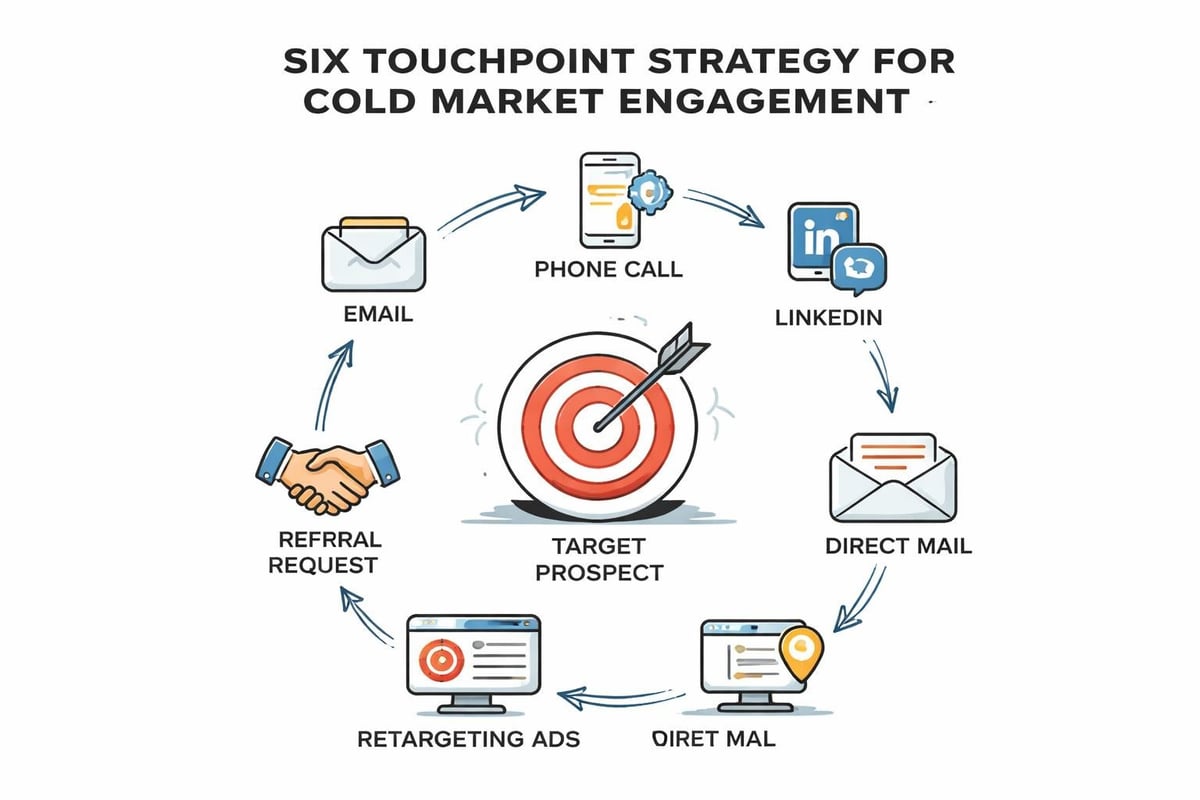
Cold prospects rarely respond to single-channel outreach. Coordinated campaigns that touch prospects across email, phone, LinkedIn, and direct mail generate substantially higher engagement.
A proven sequence might include:
- Day 1: Personalized LinkedIn connection request
- Day 3: First email with relevant insight
- Day 7: Phone call referencing previous touchpoints
- Day 10: Follow-up email with case study
- Day 14: LinkedIn message with additional value
- Day 21: Final email before moving to nurture sequence
This outbound lead generation strategy demonstrates persistence without harassment by varying channels and consistently providing value.
Account-Based Approaches
For high-value prospects in the cold market, account-based strategies concentrate resources on landing specific target accounts rather than casting wide nets.
Account-based cold prospecting involves:
- Deep research: Understanding organizational structure, initiatives, and challenges
- Multi-stakeholder engagement: Connecting with multiple decision-makers simultaneously
- Customized campaigns: Creating account-specific messaging and content
- Coordinated touchpoints: Orchestrating outreach across the buying committee
- Executive alignment: Involving your leadership to connect with their counterparts
This resource-intensive approach makes sense when targeting enterprise accounts where single customers generate six or seven-figure lifetime values.
Referral Leverage From Cold Contacts
Even when cold prospects don't buy, they can provide referrals to others who might. Building this into your cold market strategy creates additional pipeline without corresponding prospecting costs.
After delivering value through initial conversations, asking "Who else do you know facing similar challenges?" turns non-buyers into pipeline generators. The key is providing enough value during the cold interaction that prospects want to help.
Mastering the cold market transforms your business from dependent on referrals and inbound leads to controlling your own growth trajectory through systematic outreach. The strategies outlined here-from multi-channel sequencing to AI-powered personalization-give you the framework to convert strangers into customers predictably and profitably. When you're ready to scale your cold market prospecting without the learning curve, Adstra combines advanced AI systems with proven strategies to generate qualified leads and book appointments automatically, transforming your cold market into a predictable revenue engine with our guaranteed growth partnership model.