


The difference between businesses that struggle to find customers and those that enjoy predictable revenue growth often comes down to one thing: a strategic approach to guiding prospects through their buying journey. A well-executed funnel marketing strategy doesn't just attract attention; it systematically transforms strangers into loyal customers by meeting them exactly where they are in their decision-making process. In 2026, with AI-powered tools revolutionizing how we identify, engage, and convert leads, understanding the full funnel has become more critical than ever for businesses seeking sustainable growth.
Understanding the Foundation of Funnel Marketing Strategy
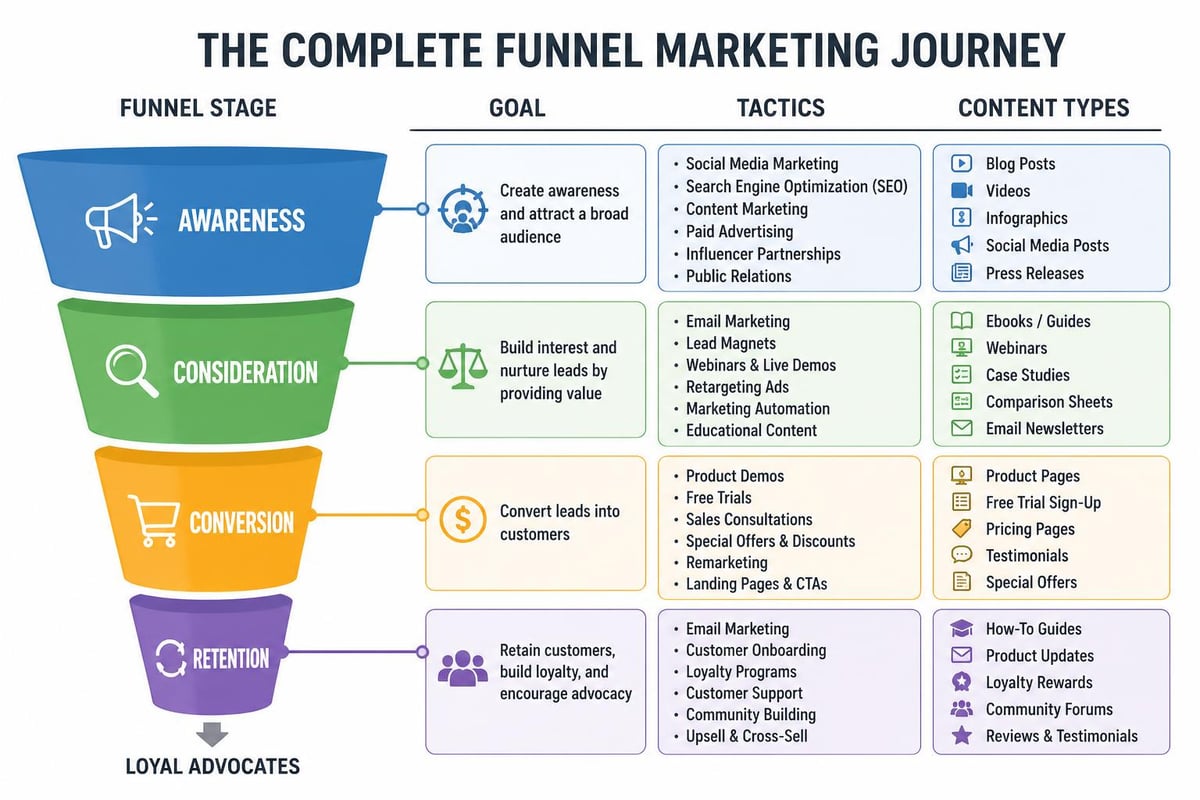
A funnel marketing strategy maps the complete customer journey from initial awareness through final purchase and beyond. Unlike traditional one-size-fits-all marketing, this approach recognizes that prospects have different needs, questions, and concerns at each stage of their buying process.
The traditional marketing funnel consists of several key stages that prospects move through:
- Awareness: Potential customers discover your brand or solution
- Interest: Prospects engage with your content and learn more
- Consideration: Leads actively evaluate your offering against alternatives
- Conversion: Qualified prospects become paying customers
- Loyalty: Customers return and refer others to your business
What makes implementing a comprehensive funnel marketing approach so powerful is that it allows you to deliver the right message at exactly the right time. Instead of pushing for a sale when someone has just discovered your brand, you nurture them with valuable information until they're ready to buy.
Why Traditional Marketing Approaches Fall Short
Most businesses make the fatal mistake of focusing all their energy on just one part of the funnel. They might excel at generating awareness through social media or paid advertising, but fail to nurture those leads toward conversion. Others invest heavily in closing tactics without building enough top-of-funnel awareness to keep their pipeline full.
The result? Feast-or-famine revenue cycles, wasted marketing spend, and frustrated sales teams chasing unqualified leads. A complete funnel marketing strategy solves these problems by ensuring every stage receives appropriate attention and resources.
Building Your Top-of-Funnel Awareness Strategy
The awareness stage is where potential customers first encounter your brand. Your goal here isn't to sell; it's to educate, inform, and establish credibility. This is where lead generation with AI becomes particularly valuable, helping you identify and reach prospects who match your ideal customer profile.
Creating Awareness Content That Attracts Quality Prospects
Your top-of-funnel content should address broad industry challenges and questions that your target audience is actively searching for. This includes:
- Educational blog posts and articles
- Industry research and trend reports
- Social media content that showcases expertise
- Video tutorials and explainer content
- Podcast appearances and webinars
The key is providing genuine value without requiring any commitment. When someone reads your article about industry challenges, they should walk away with actionable insights, whether they ever become a customer or not. This builds trust and positions your brand as a helpful resource rather than just another vendor.
| Channel Type | Best For | Typical Conversion Rate |
|---|---|---|
| Organic Search | Long-term qualified traffic | 2-5% |
| Paid Social | Targeted audience building | 1-3% |
| Content Marketing | Authority and trust | 3-7% |
| Referral Programs | High-intent prospects | 8-15% |
For businesses focused on B2B lead generation, awareness content must speak directly to business decision-makers. This means focusing on ROI, efficiency gains, and competitive advantages rather than generic benefits.
Nurturing Consideration-Stage Prospects
Once prospects are aware of your brand, they enter the consideration stage where they're actively evaluating solutions. This is where your funnel marketing strategy becomes more personalized and targeted. Understanding the B2B marketing funnel helps you tailor your approach for longer, more complex sales cycles.
Middle-of-Funnel Content That Educates and Qualifies
Consideration-stage prospects need detailed information to make informed decisions. They're comparing options, calculating ROI, and building internal consensus. Your content should help them through this process:
- Case studies showing real results from similar companies
- Product comparison guides that position your unique value
- ROI calculators that quantify potential benefits
- Expert webinars addressing specific challenges
- Email nurture sequences delivering progressive value
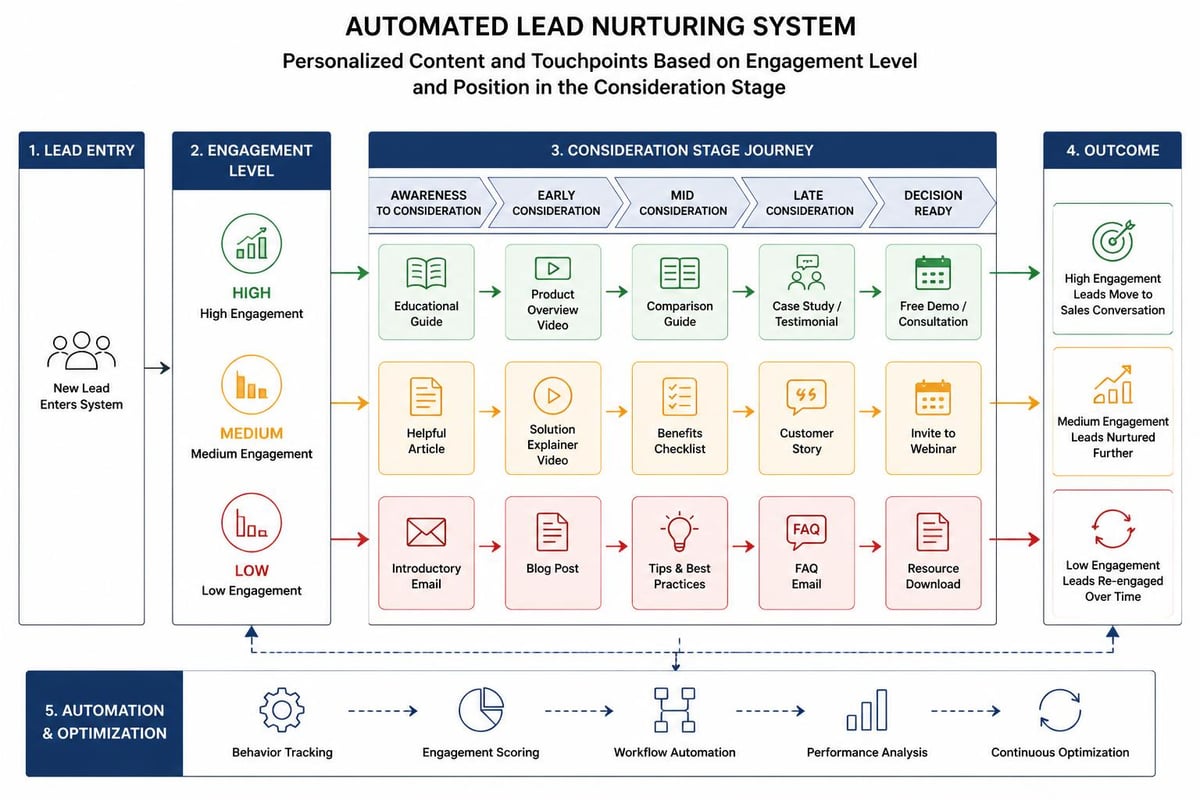
The beauty of modern funnel marketing strategy is the ability to track engagement and score leads based on behavior. When someone downloads your case study, watches three webinar recordings, and visits your pricing page multiple times, they're signaling buying intent.
Leveraging AI to Accelerate Funnel Progression
AI-powered systems can dramatically improve how you move prospects through the consideration stage. By analyzing behavioral patterns, AI can predict which leads are most likely to convert and determine the optimal next step for each prospect.
This is particularly valuable for digital agencies managing lead generation, where managing multiple client funnels simultaneously requires sophisticated automation and intelligence.
Converting Qualified Leads Into Customers
The conversion stage is where prospects make their final decision. Your funnel marketing strategy must address remaining objections, demonstrate clear value, and make the buying process as frictionless as possible.
Bottom-of-funnel tactics include:
- Free trials or demos that showcase your solution
- Consultations that identify specific prospect needs
- Proposal presentations customized to their situation
- Social proof through testimonials and reviews
- Limited-time offers that create urgency
The mistake many businesses make is treating all leads the same at this stage. A prospect who has engaged with your content for three months has very different needs than someone who just discovered you yesterday. Your social media funnel should segment and personalize based on engagement history.
Removing Friction From Your Conversion Process
Every additional step in your conversion process costs you customers. Evaluate your current funnel for these common friction points:
- Confusing or lengthy contact forms
- Unclear next steps after initial inquiry
- Slow response times to qualified leads
- Complicated pricing or purchasing process
- Lack of transparent information about deliverables
Modern buyers expect immediate responses and clear information. Automating appointment booking for qualified leads ensures you never lose a hot prospect to delayed follow-up. This is exactly how companies like CreateSell help entrepreneurs build digital product businesses-by removing friction and automating the sales process so products can sell while creators sleep.
Implementing Full-Funnel Marketing in 2026
Understanding what full-funnel marketing entails means recognizing that each stage requires different tactics, content, and success metrics. You can't measure top-of-funnel awareness campaigns using the same conversion metrics as bottom-of-funnel sales activities.
Measuring Success at Each Funnel Stage
Your funnel marketing strategy needs stage-specific KPIs that indicate health and progression:
| Funnel Stage | Primary Metrics | Secondary Metrics |
|---|---|---|
| Awareness | Reach, impressions, website traffic | Engagement rate, new visitors |
| Interest | Content downloads, email signups | Time on site, pages per session |
| Consideration | Webinar attendance, demo requests | Lead score progression, email opens |
| Conversion | Sales, revenue, customer acquisition cost | Conversion rate, sales cycle length |
| Loyalty | Repeat purchase rate, referrals | Customer lifetime value, NPS score |
The most effective approach involves creating a comprehensive full-funnel strategy that unifies sales and marketing efforts. When both teams understand where prospects are in the journey and what they need next, conversion rates improve dramatically.
Technology Stack for Modern Funnel Marketing
Executing an effective funnel marketing strategy in 2026 requires the right technology foundation. Essential tools include:
- CRM system to track all prospect interactions
- Marketing automation platform for email nurturing and scoring
- Analytics tools to understand funnel performance
- AI-powered lead qualification to identify high-intent prospects
- Content management system for delivering stage-appropriate content
The challenge isn't having enough tools; it's integrating them properly so data flows seamlessly and you get a complete view of each prospect's journey. AI tools for marketing have evolved to connect these systems and provide intelligent insights that human teams alone would miss.
Advanced Funnel Strategies for Lead Generation Businesses
For companies specializing in lead generation, your funnel marketing strategy must work double duty: converting your own prospects while demonstrating your expertise to potential clients. This requires sophistication in both execution and measurement.
Creating Demonstration Funnels That Sell Your Services
The most persuasive sales tool for a lead generation company is a working funnel that consistently delivers results. By documenting your own market research process and sharing transparent results, you build credibility that no case study can match.
Consider creating parallel funnels for different ideal customer profiles. A funnel targeting e-commerce businesses will look very different from one targeting professional services firms. This segmentation allows you to speak directly to each audience's specific challenges and opportunities.
Advanced funnel personalization includes:
- Dynamic landing pages that reflect visitor source and industry
- Behavioral triggers that adjust messaging based on engagement
- Predictive content that anticipates prospect questions
- Multi-channel orchestration across email, social, and retargeting
- Intent-based segmentation using AI analysis of behavior patterns
Optimizing Funnel Performance Through Testing
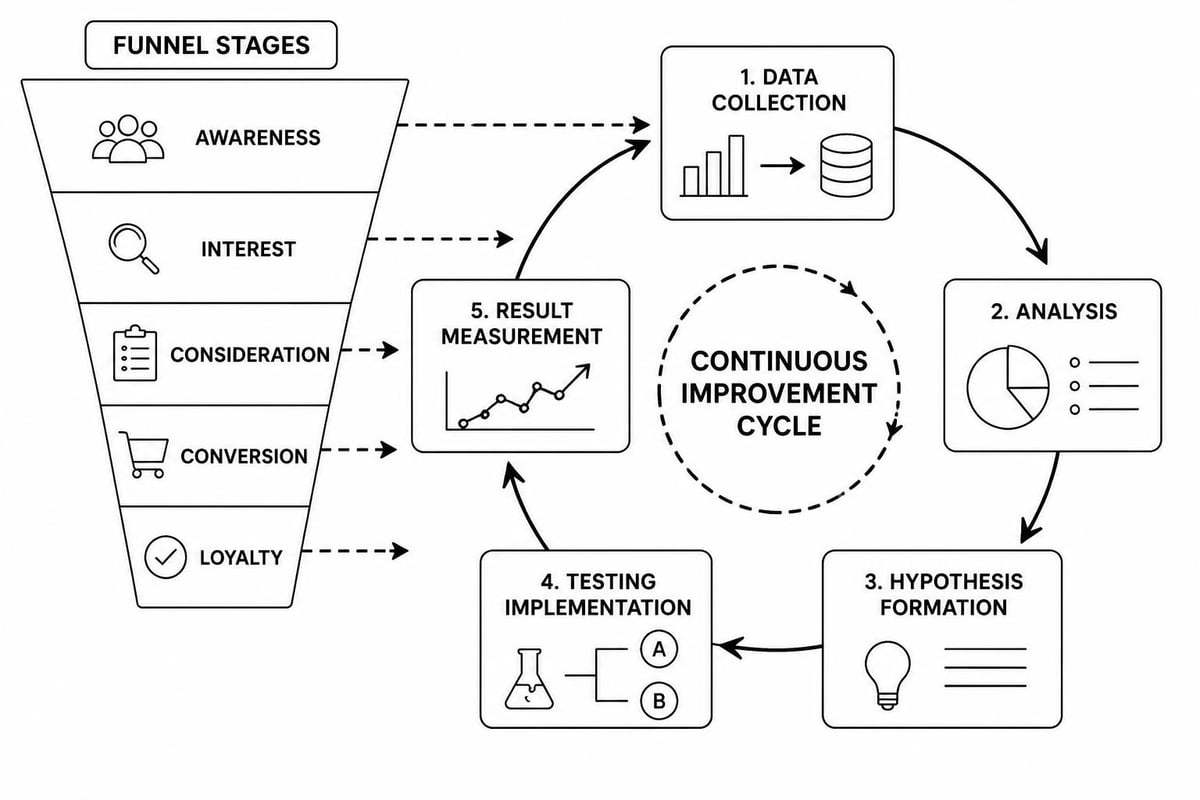
No funnel marketing strategy is complete without systematic testing and optimization. The difference between average and exceptional funnels often comes down to hundreds of small improvements compounded over time.
What to Test at Each Funnel Stage
Top-of-funnel testing focuses on reach and engagement. Test different content formats, headlines, and distribution channels to see what resonates with your target audience. Even small improvements in click-through rates compound as prospects move deeper into your funnel.
Middle-of-funnel optimization centers on lead quality and nurture effectiveness. Test email sequences, content offers, and scoring models to ensure you're identifying truly qualified prospects. For businesses working with LinkedIn B2B lead generation, testing connection requests, messaging sequences, and profile optimization can dramatically impact results.
Bottom-of-funnel testing directly impacts revenue. Test pricing presentation, trial length, onboarding sequences, and sales processes to maximize conversion rates and deal size.
- Develop a testing hypothesis based on data analysis
- Create variation that addresses the hypothesis
- Run test with sufficient sample size for statistical significance
- Analyze results and implement winning variation
- Document learnings and move to next test
The companies seeing the biggest gains from their funnel marketing strategy aren't necessarily the ones with the most creative campaigns. They're the ones testing consistently and learning from every interaction.
Retention and Loyalty: The Often-Forgotten Funnel Stage
Most discussions of funnel marketing strategy stop at conversion, but that's a costly mistake. Acquiring a new customer costs five to seven times more than retaining an existing one. Your funnel should extend well beyond the first purchase.
Building Post-Purchase Funnels That Drive Lifetime Value
After conversion, your funnel marketing strategy should focus on onboarding, engagement, expansion, and advocacy. New customers need clear guidance on getting value from your solution. The faster they see results, the less likely they are to churn.
Create onboarding sequences that guide customers through key features and early wins. Many businesses lose customers not because the product doesn't work, but because customers never fully implemented it. Like DoReset's approach to personal transformation through daily actions and guidance, your customer onboarding should provide clear next steps that build momentum toward success.
Post-purchase funnel elements:
- Automated onboarding sequences with clear milestones
- Regular check-ins and success metrics tracking
- Educational content for advanced features
- Community building and peer connections
- Referral programs that reward advocacy
When customers achieve results, they become your most powerful marketing channel. Their testimonials improve top-of-funnel conversion, their case studies help consideration-stage prospects, and their referrals arrive pre-qualified with built-in trust.
Aligning Sales and Marketing Around the Funnel
The most common failure point in funnel marketing strategy isn't tactical execution; it's organizational misalignment. When marketing focuses on generating volume while sales demands quality, the entire funnel suffers.
Creating Shared Definitions and Handoff Processes
Marketing and sales must agree on what constitutes a qualified lead and at what point handoff should occur. Without these shared definitions, marketing will claim they're delivering plenty of leads while sales complains they're all unqualified.
Document your lead qualification criteria clearly. What actions or characteristics indicate someone is ready for sales conversation? For some businesses, it's requesting a demo. For others, it's reaching a certain lead score through accumulated engagement. For companies focused on cold call leads, the qualification criteria might include company size, industry, and demonstrated need.
| Alignment Area | Marketing Responsibility | Sales Responsibility |
|---|---|---|
| Lead Quality | Score and qualify based on criteria | Provide feedback on lead quality |
| Handoff Timing | Alert sales when leads hit threshold | Contact qualified leads within SLA |
| Content Needs | Create stage-appropriate content | Share common objections and questions |
| Messaging | Develop positioning and value props | Use consistent messaging in conversations |
| Results | Report on funnel metrics and volume | Close deals and provide win/loss data |
Regular alignment meetings where both teams review funnel performance, discuss feedback, and adjust strategy keep everyone rowing in the same direction. The insights sales teams gain from prospect conversations should inform marketing's content and targeting decisions.
Future-Proofing Your Funnel Marketing Strategy
The fundamentals of funnel marketing remain constant, but the tactics and technologies evolve rapidly. Staying ahead requires both commitment to core principles and willingness to adapt to new opportunities.
AI will continue transforming how we execute funnel marketing strategy. From predictive lead scoring to automated content personalization to conversational interfaces that guide prospects through the funnel, artificial intelligence makes it possible to deliver individualized experiences at scale.
The businesses winning in 2026 and beyond will be those that combine human insight with AI capabilities. Technology handles the repetitive tasks of segmentation, scoring, and personalization, while humans focus on strategy, creativity, and relationship building. This is the approach that top lead generation companies have adopted to deliver consistent results for their clients.
Emerging trends shaping funnel marketing:
- Conversational AI that qualifies and nurtures leads through chat
- Predictive analytics that identify high-value prospects early
- Hyper-personalization based on behavioral and firmographic data
- Multi-touch attribution that shows true funnel impact
- Privacy-first approaches as third-party data becomes less available
The key is building flexible systems that can adapt as new channels, technologies, and customer expectations emerge. Your funnel marketing strategy should have a solid foundation while remaining agile enough to incorporate innovations that improve results.
A well-executed funnel marketing strategy transforms how businesses attract, engage, and convert prospects by delivering the right message at precisely the right moment in the buyer's journey. By mapping your tactics to each funnel stage and continuously optimizing based on data, you create a predictable system for revenue growth. If you're ready to implement a funnel marketing strategy that leverages AI to generate qualified leads and automate conversions, Adstra partners with businesses to build guaranteed growth systems that transform cold prospects into ready-to-buy customers.