


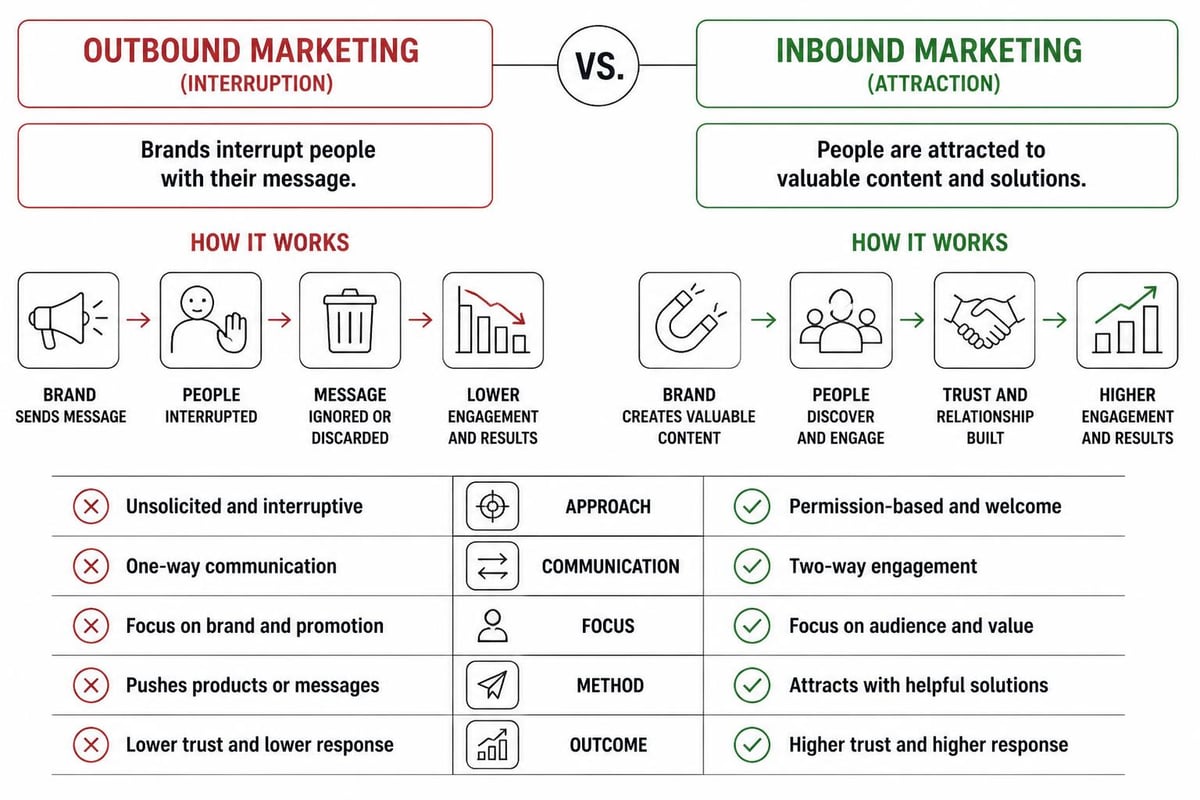
The traditional approach of interrupting potential customers with ads and cold calls is losing effectiveness. Today's buyers research solutions independently, ignore intrusive marketing, and expect personalized experiences. This shift has created an urgent need for businesses to adopt strategies that align with how modern buyers actually make purchasing decisions. The most successful companies in 2026 are those that have mastered the art of attracting customers naturally rather than chasing them aggressively.
Understanding the Power of Attraction-Based Marketing
Inbound marketing represents a fundamental shift from pushing messages to pulling interested prospects toward your business. Instead of buying attention through traditional advertising, this methodology earns it by creating valuable content and experiences tailored to your ideal customers. The approach focuses on being helpful rather than promotional, positioning your business as a trusted advisor rather than just another vendor competing for attention.
The methodology works through three core stages that build upon each other:
- Attract the right people with valuable content that addresses their specific challenges
- Engage these prospects by offering insights and solutions that align with their goals
- Delight customers with exceptional experiences that turn them into promoters
Research demonstrates the superior performance of this approach. According to the Digital Marketing Institute’s analysis of lead generation data, inbound marketing generates more than twice as many leads as traditional outbound methods while costing significantly less per acquisition.
Why Traditional Outbound Methods Are Failing
Cold outreach tactics face increasing resistance in 2026. Email filters have become more sophisticated, phone calls go unanswered, and ad blockers prevent display advertising from reaching audiences. More importantly, buyers have fundamentally changed their behavior. They conduct extensive research before ever speaking with a sales representative, often completing 70% of the buying journey independently.
Traditional cold outreach is failing because it interrupts people who haven't expressed interest in your solution. This creates friction and resistance rather than curiosity and engagement.
Building Your Content Foundation
Content serves as the engine that powers effective inbound marketing. Your content strategy should address specific questions and challenges your ideal customers face at different stages of their journey. This requires understanding not just what problems they need to solve, but how they think about these problems and what information they're seeking.
Creating Content That Attracts Qualified Prospects
The most effective content speaks directly to the pain points and aspirations of your target audience. For businesses focused on growth and revenue generation, content should demonstrate deep understanding of their challenges while providing actionable insights they can implement immediately.
High-performing content types for lead generation include:
- Educational blog posts that answer specific questions your prospects are searching for
- Industry research and data-driven insights that provide unique perspectives
- Case studies that demonstrate real results and build credibility
- How-to guides that solve specific problems your audience faces
- Comparison content that helps buyers evaluate different approaches or solutions
Your content creation process should start with thorough keyword research and topic analysis. Tools like those explored in our guide to AI tools for marketing can help identify what your target audience is actively searching for and create content that matches their intent.
Optimizing for Search and Discovery
Creating exceptional content means nothing if your target audience never finds it. Search engine optimization ensures your content appears when prospects are actively seeking solutions. This involves strategic keyword placement, technical optimization, and building authority through quality backlinks.
| SEO Element | Purpose | Best Practice |
|---|---|---|
| Title Tags | Attract clicks from search results | Include primary keyword and compelling benefit |
| Meta Descriptions | Increase click-through rates | Summarize value in 140-150 characters |
| Header Structure | Improve readability and SEO | Use logical H2/H3 hierarchy with keywords |
| Internal Links | Guide visitors and distribute authority | Link to relevant content naturally |
| External Links | Build credibility and context | Reference authoritative sources |
Beyond search engines, distribution matters tremendously. Social media platforms, email marketing, and strategic partnerships amplify your content's reach. For digital product businesses like CreateSell, content marketing becomes even more critical as it establishes expertise and builds an audience that can be converted into customers for digital products.
Converting Visitors Into Qualified Leads
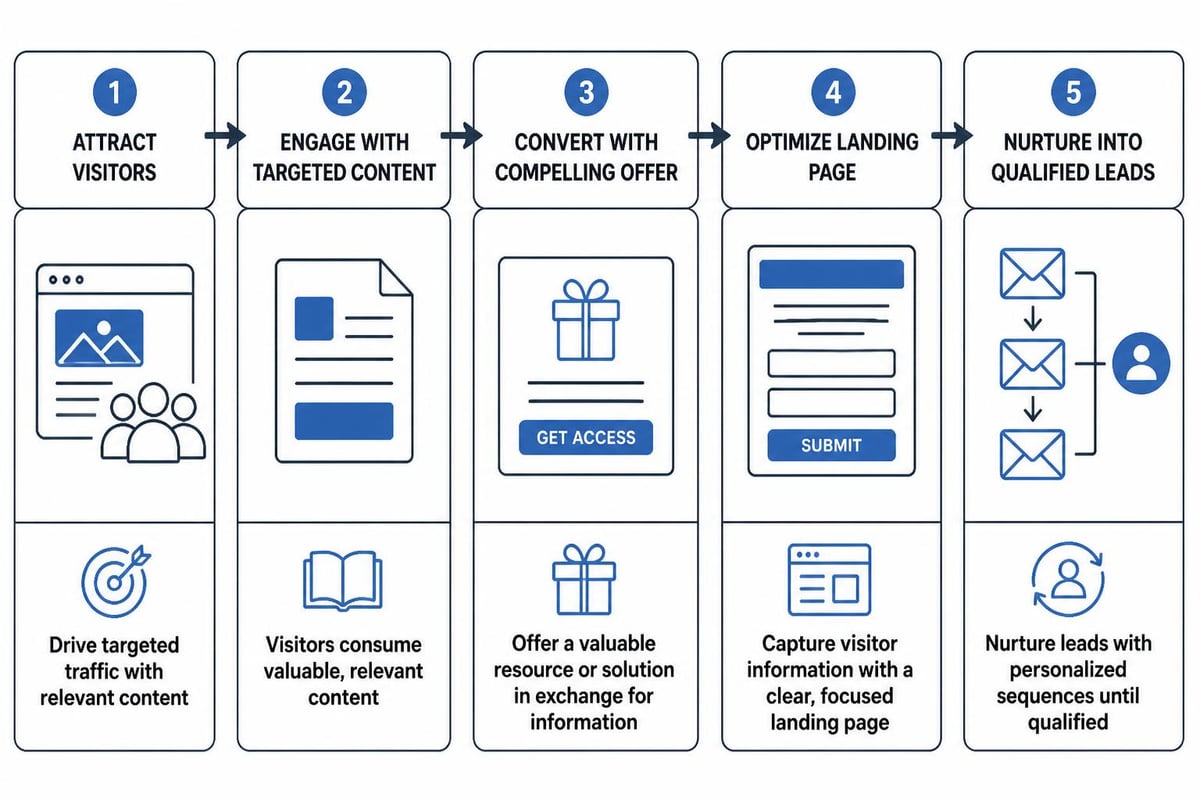
Attracting traffic represents only the first step. The real value comes from converting anonymous visitors into identified prospects you can nurture toward a purchase decision. This conversion process requires strategic offers and frictionless experiences that encourage people to exchange their contact information for valuable resources.
Designing Irresistible Lead Magnets
Lead magnets should provide immediate value while demonstrating your expertise and approach. The most effective offers solve a specific, urgent problem your prospect faces right now. They should be highly relevant to your core services while being valuable enough that someone would willingly pay for them.
Effective lead magnet formats include:
- Comprehensive guides or ebooks addressing major challenges
- Templates and frameworks that save time and provide structure
- Assessment tools that diagnose problems or opportunities
- Video training series delivering specialized knowledge
- Exclusive research reports with unique data and insights
The key is making your lead magnet so valuable and specific that your ideal customers eagerly provide their information to access it. Generic offers like "subscribe to our newsletter" no longer convert effectively. Your offer must clearly articulate what the prospect will learn and how it will help them achieve their goals.
Building Conversion-Optimized Landing Pages
Once you've created a compelling offer, your landing page determines whether visitors convert. Every element should focus on a single conversion goal without distractions. Effective landing pages follow proven principles that reduce friction and build confidence.
Your landing page should include:
- Clear headline that states the benefit immediately
- Compelling copy that explains why this offer matters now
- Visual elements that reinforce the value proposition
- Social proof demonstrating credibility and results
- Simple form requesting only essential information
- Strong call-to-action that tells people exactly what to do
For businesses implementing B2B lead generation strategies, landing page optimization becomes even more critical. B2B buyers are sophisticated and skeptical, requiring more proof and clarity before converting.
Nurturing Leads Through Strategic Automation
Generating leads represents only half the equation. Most prospects aren't ready to buy immediately when they first discover your business. EBSCO’s research on inbound marketing emphasizes the importance of nurturing relationships over time, providing relevant information as prospects move through their buying journey.
Implementing Email Nurture Sequences
Email automation allows you to deliver the right message at the right time without manual effort. Well-designed nurture sequences educate prospects, build trust, and guide them toward a purchase decision naturally. Each email should provide value while subtly moving the relationship forward.
| Sequence Type | Purpose | Typical Length |
|---|---|---|
| Welcome Series | Introduce brand and set expectations | 3-5 emails |
| Educational Drip | Build expertise and awareness | 5-10 emails |
| Product Launch | Create excitement for new offering | 4-7 emails |
| Re-engagement | Revive inactive subscribers | 3-4 emails |
| Sales Enablement | Support active opportunities | Ongoing |
Your nurture content should align with the prospect's stage in the buying journey. Early-stage content focuses on education and problem awareness. Mid-stage content explores solutions and approaches. Late-stage content addresses specific objections and demonstrates your unique value proposition.
Leveraging AI for Personalization at Scale
Advanced AI systems now enable personalization that was previously impossible at scale. These technologies analyze prospect behavior, engagement patterns, and characteristics to deliver customized experiences automatically. This represents a significant advantage for companies serious about maximizing conversion rates.
AI-powered personalization includes:
- Dynamic content that changes based on prospect attributes and behavior
- Predictive send times that deliver messages when recipients are most likely to engage
- Automated segmentation that groups prospects based on engagement and intent signals
- Lead scoring that identifies when prospects are ready for sales conversations
- Content recommendations that suggest the most relevant next steps
Businesses working with digital agencies for lead generation should demand this level of sophistication. The technology exists to deliver truly personalized experiences that dramatically improve conversion rates and customer lifetime value.
Measuring Performance and Optimizing Results
Inbound marketing's greatest advantage is its measurability. Every interaction can be tracked, analyzed, and optimized. This data-driven approach allows continuous improvement based on actual results rather than assumptions or opinions. The businesses that win are those that systematically test, measure, and refine their approach.
Essential Metrics to Track
Focus your attention on metrics that directly impact revenue rather than vanity metrics that look impressive but don't correlate with business outcomes. Backlinko’s comprehensive guide to inbound marketing emphasizes tracking metrics across the entire customer journey from first touch to closed deal.
Critical performance indicators include:
- Website traffic from organic search and referral sources
- Conversion rate from visitor to lead across different offers
- Lead quality scores based on engagement and fit
- Marketing qualified lead (MQL) to sales qualified lead (SQL) ratio
- Customer acquisition cost compared to customer lifetime value
- Revenue attributed to specific campaigns and content pieces
Many businesses struggle with attribution because prospects interact with multiple touchpoints before converting. Multi-touch attribution models provide more accurate understanding of what's actually driving results than simple last-click models.
The Continuous Improvement Cycle
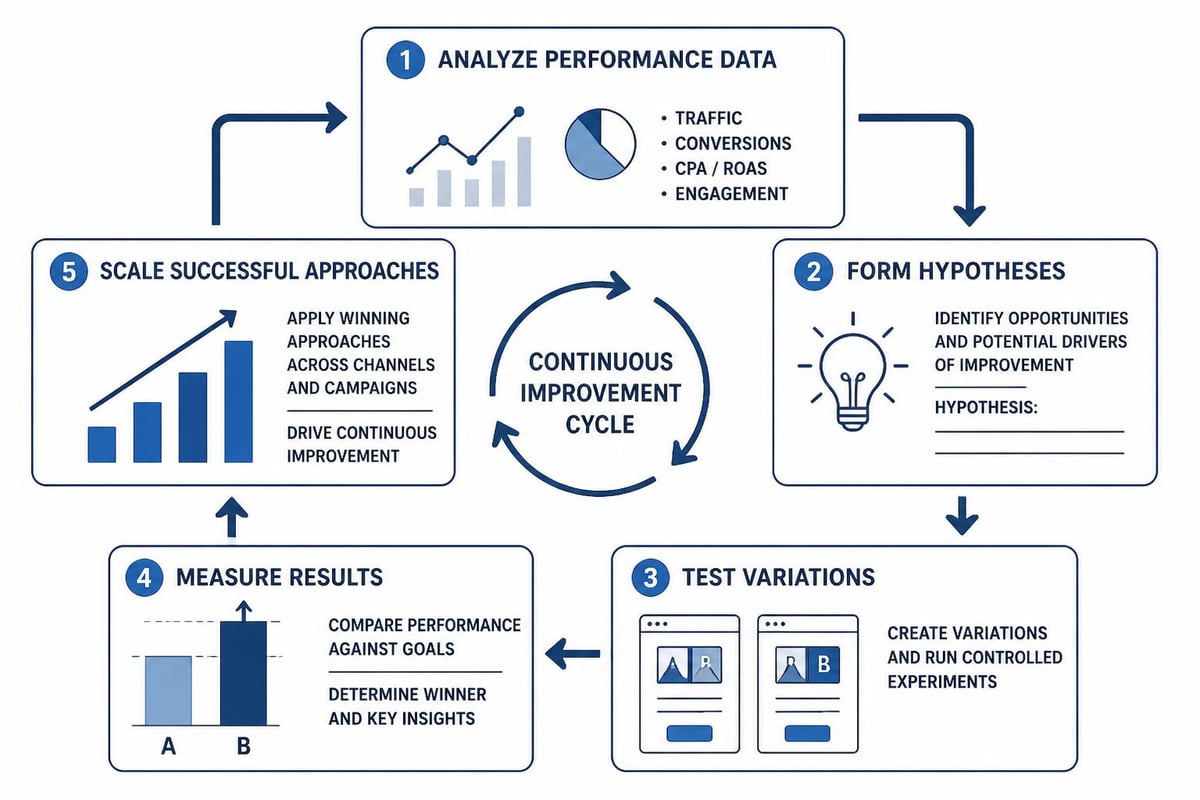
Peak performance comes from systematic testing and optimization. Run controlled experiments that isolate variables and produce clear insights. Test headlines, offers, email subject lines, landing page designs, and call-to-action placement. Small improvements compound over time to produce dramatically better results.
Your optimization process should follow these steps:
- Analyze current performance to identify the biggest opportunities
- Form hypotheses about what changes might improve results
- Design experiments that test these hypotheses systematically
- Implement changes for a statistically significant sample
- Measure results comparing test variants against control
- Scale winners and continue testing new variations
This approach mirrors what personal development programs like DoReset teach about systematic improvement. Small, consistent actions compound into transformational results over time.
Aligning Sales and Marketing Teams
Even the most sophisticated inbound marketing strategy fails without tight alignment between marketing and sales. These teams often operate in silos with different goals, metrics, and communication patterns. This misalignment wastes leads, frustrates prospects, and limits revenue growth.
Creating a Unified Revenue Engine
Coursera’s overview of inbound marketing fundamentals stresses that the methodology only reaches its full potential when marketing and sales work as one unified team focused on revenue generation. This requires shared definitions, processes, and accountability.
Essential alignment elements include:
- Agreed-upon lead definitions specifying what qualifies as an MQL and SQL
- Documented handoff process ensuring smooth transitions from marketing to sales
- Service level agreements committing both teams to response times and follow-up
- Shared technology platforms providing visibility into the complete customer journey
- Regular communication through joint meetings reviewing pipeline and performance
- Unified metrics measuring both teams on revenue outcomes rather than activities
When marketing and sales align effectively, conversion rates improve dramatically. Marketing better understands what messages resonate during sales conversations, while sales provides feedback that improves lead quality and campaign targeting.
Enabling Sales with Marketing Content
Your sales team needs content assets that support conversations at every stage of the buying process. This includes email templates, one-pagers, case studies, ROI calculators, and competitive comparisons. Marketing should create these assets based on direct input from sales about what prospects ask and what objections arise.
Platforms focused on LinkedIn B2B lead generation demonstrate the power of aligned sales and marketing efforts. When sales teams have the right content at the right time, they can nurture relationships more effectively and close deals faster.
Scaling Your Inbound Engine
As your inbound marketing matures, scaling becomes the primary challenge. The strategies that work when generating 10 leads per month may break down at 100 or 1,000 leads. Sustainable growth requires systems, technology, and processes that maintain quality while increasing volume.
Building Systems for Repeatable Success
Document every process so it can be delegated, automated, or systematized. Create templates, checklists, and standard operating procedures for content creation, campaign launches, lead nurturing, and performance reporting. This documentation enables you to scale without losing quality or consistency.
| Process | Documentation Type | Update Frequency |
|---|---|---|
| Content Creation | Editorial calendar and style guide | Monthly |
| Campaign Launches | Launch checklist and timeline | Per campaign |
| Lead Scoring | Scoring criteria and thresholds | Quarterly |
| Performance Reporting | Dashboard templates and KPIs | Weekly/Monthly |
| Technology Stack | Tool inventory and usage guidelines | Quarterly |
The right technology stack amplifies your team's capabilities. Invest in platforms that integrate seamlessly and provide automation capabilities. Many of the best marketing platforms in 2026 offer AI-powered features that handle repetitive tasks while enabling personalization at scale.
Partnering for Accelerated Growth
Sometimes the fastest path to scaling involves partnering with specialists who have already solved the challenges you're facing. Rather than building every capability in-house, strategic partnerships can provide immediate access to expertise, technology, and proven systems.
Working with top lead generation companies that specialize in inbound methodologies can accelerate your growth trajectory. The key is finding partners who align with your values and commit to your success rather than just delivering leads without accountability for quality or outcomes.
Inbound marketing isn't just a tactical shift but a strategic transformation that aligns your entire business with how modern buyers make decisions. By creating valuable content, optimizing for discovery, nurturing relationships, and measuring everything, you build a predictable revenue engine that compounds over time. Adstra specializes in implementing AI-powered inbound systems that generate qualified leads and automate appointment bookings, transforming your marketing from a cost center into a growth engine. Our guaranteed growth partnership model ensures we're invested in your success, delivering the systems and strategies that drive measurable revenue growth.