


Every business owner faces the same challenge: turning strangers into customers. Without a systematic approach, you're leaving money on the table and wasting resources on prospects who vanish without a trace. A well-designed business funnel solves this problem by creating a predictable path from first contact to final sale. This framework transforms random marketing activities into a revenue-generating machine that works whether you're sleeping or selling. Let me show you how to build one that actually delivers results.
Understanding the Business Funnel Framework
A business funnel represents the journey potential customers take from discovering your company to making a purchase decision. Think of it as a strategic filtering system that guides prospects through progressively deeper levels of engagement.
The concept gets its name from the shape: wide at the top where many prospects enter, narrow at the bottom where fewer committed buyers emerge. This isn't about losing customers-it's about focusing your energy on those most likely to convert.
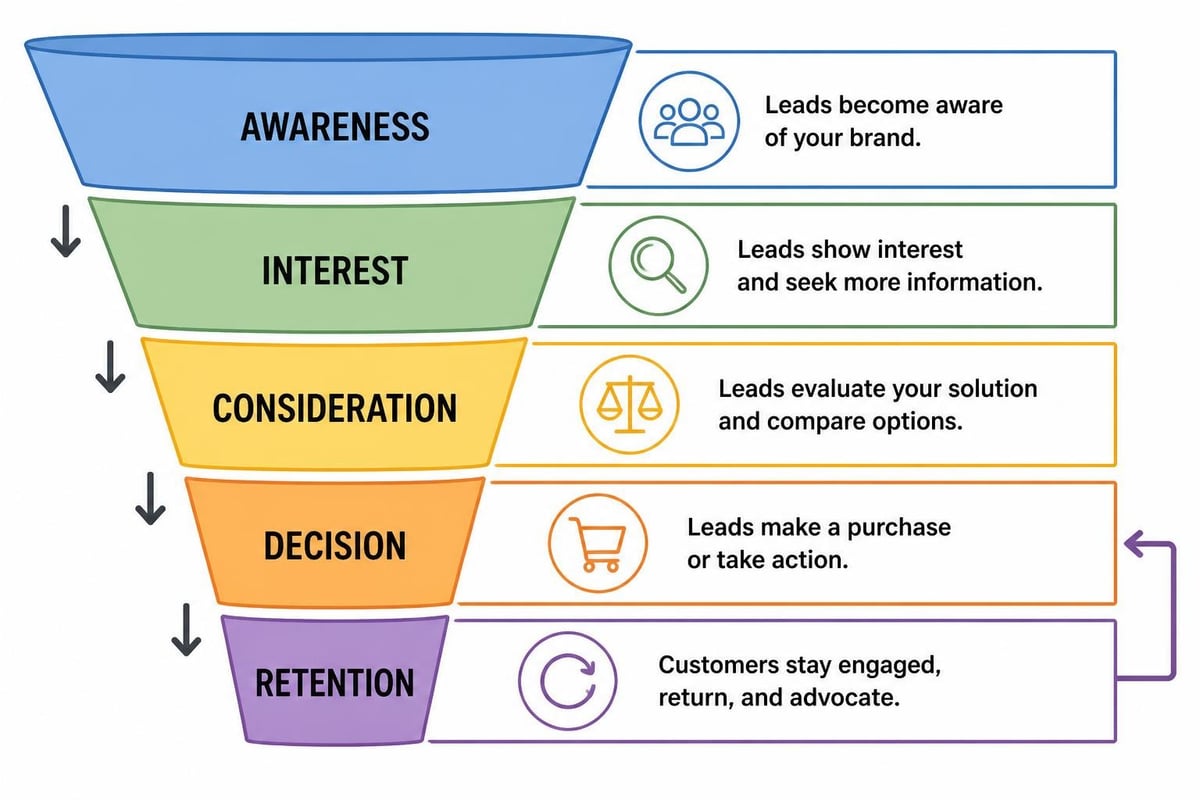
The Top of Funnel: Awareness Stage
Your primary goal here is visibility. Prospects can't buy from you if they don't know you exist. This stage captures attention through multiple channels and introduces your brand to potential customers who have problems you can solve.
At this awareness phase, focus on:
- Creating educational content that addresses pain points
- Running targeted advertising campaigns to specific demographics
- Building social media presence where your audience congregates
- Implementing SEO strategies that capture search intent
- Developing partnerships that expand your reach
The awareness stage of your sales funnel requires content that attracts without immediately selling. You're building trust and establishing credibility, not closing deals.
Middle of Funnel: Nurturing Engagement
Once prospects know who you are, they need reasons to care. The middle section transforms casual awareness into genuine interest through strategic relationship building.
This is where most businesses fail. They capture attention but lack the systems to maintain momentum. Your nurturing process should deliver consistent value while gradually positioning your solution as the obvious choice.
| Nurturing Tactic | Purpose | Expected Outcome |
|---|---|---|
| Email sequences | Educate and build trust | 15-25% engagement rate |
| Retargeting ads | Maintain visibility | 3-5x higher conversion |
| Content upgrades | Deepen relationship | 20-30% opt-in rate |
| Webinars/demos | Showcase value | 30-40% show rate |
Your business funnel at this stage needs automation. Manual follow-up doesn't scale, and inconsistency kills conversions. Modern lead generation strategies leverage AI and automation to maintain perfect timing and personalization across hundreds or thousands of prospects simultaneously.
Bottom of Funnel: Conversion and Decision
Here's where prospects become customers. They've moved from awareness to interest to active consideration-now they need the final push.
Remove every obstacle between them and yes. The decision stage of your business funnel should make buying frictionless. Complex processes, unclear pricing, or difficult-to-find contact information will sabotage conversions you've already earned.
Decision-stage optimization includes:
- Clear, compelling calls-to-action on every relevant page
- Transparent pricing or scheduling options
- Social proof through testimonials and case studies
- Risk reversal through guarantees or trials
- Multiple contact methods for different preferences
- Simplified checkout or booking processes
According to comprehensive sales funnel research, businesses that optimize their bottom-funnel experience see conversion rate improvements of 30-50%. That's not incremental growth-it's transformational.
Building Your Business Funnel Architecture
Theory means nothing without execution. Let's build a practical business funnel that generates revenue starting this month.
Step One: Map Your Customer Journey
Stop guessing and start documenting. Your business funnel must reflect how real customers actually move toward purchase, not how you wish they would.
Interview recent customers about their decision process. What questions did they have? Where did they find you? What nearly stopped them from buying? These insights reveal the true path you need to optimize.
Create a visual map showing:
- Initial discovery touchpoints
- Research behaviors and questions
- Decision criteria and comparisons
- Timing from awareness to purchase
- Post-purchase experience and retention
This becomes your blueprint. Every marketing activity should support movement through these documented stages.
Step Two: Create Stage-Appropriate Content
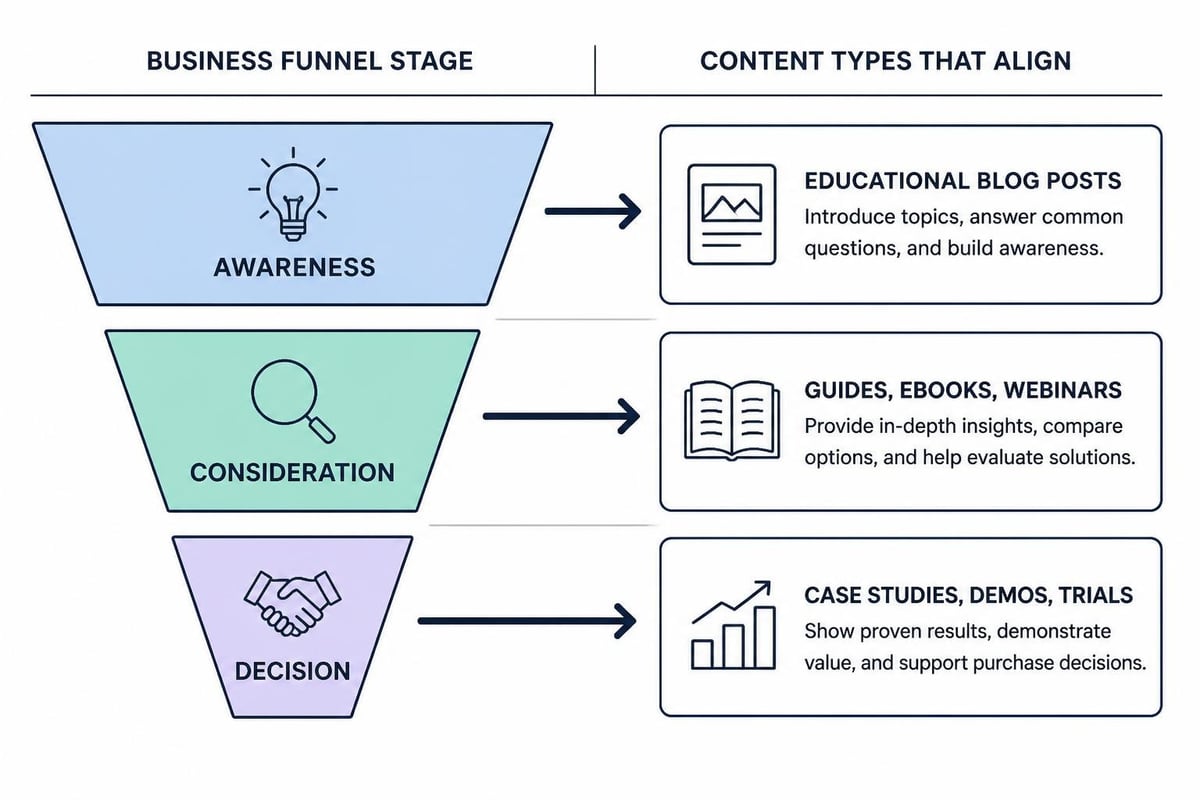
Each funnel stage requires different messaging. Top-of-funnel prospects need education, not sales pitches. Bottom-funnel prospects need specific solutions, not general information.
Match content to intent. Someone searching "what is lead generation" is nowhere near ready to book a consultation. Someone searching "best lead generation agency in [city]" is actively comparing options.
The marketing funnel approach emphasizes this alignment between customer awareness level and content sophistication. Your business funnel should deliver the right message at precisely the right moment.
Step Three: Implement Tracking and Measurement
You can't improve what you don't measure. Every stage of your business funnel needs specific metrics that reveal bottlenecks and opportunities.
| Funnel Stage | Key Metrics | Warning Signs |
|---|---|---|
| Awareness | Traffic volume, reach, impressions | Declining visibility, high cost per click |
| Interest | Email open rates, content engagement, time on site | Low engagement, high bounce rates |
| Consideration | Lead quality scores, demo requests, content downloads | Unqualified leads, low intent signals |
| Decision | Conversion rate, sales cycle length, win rate | Long cycles, price objections, ghosting |
Modern funnel system marketing relies on automated tracking that shows exactly where prospects enter, where they stall, and where they convert. This data-driven approach eliminates guesswork from optimization decisions.
Optimizing Business Funnel Performance
Building your initial funnel is just the beginning. Exceptional results come from continuous testing and refinement.
Eliminate Friction Points
Every unnecessary step costs you customers. Audit your business funnel ruthlessly, removing anything that doesn't directly advance the prospect toward conversion.
Common friction points include:
- Forms requesting irrelevant information
- Unclear next steps after content consumption
- Broken links or slow-loading pages
- Generic messaging that doesn't address specific concerns
- Complicated scheduling or purchasing processes
The sales funnel stages explained by Cognism highlight how reducing friction at each transition point dramatically improves overall conversion rates. Sometimes the best optimization is simply getting out of your own way.
Leverage Automation Intelligently
Manual follow-up doesn't scale and introduces inconsistency. Your business funnel needs automation that delivers perfect timing across unlimited prospects.
However, automation without strategy creates robotic experiences that repel rather than attract. The key is using technology to enhance personalization, not eliminate it.
Smart automation includes:
- Behavioral triggers that respond to specific actions (downloaded content, visited pricing page, abandoned cart)
- Segmented messaging based on industry, company size, or pain points
- Progressive profiling that gradually collects information without overwhelming prospects
- AI-powered lead scoring that identifies high-intent prospects for priority follow-up
- Automated appointment booking that eliminates phone tag and scheduling friction
Companies utilizing AI in digital advertising and lead generation see 40-60% improvements in conversion efficiency while reducing manual workload by similar margins.
Implement Multi-Channel Strategies
Your prospects don't live in a single channel. Your business funnel shouldn't either.
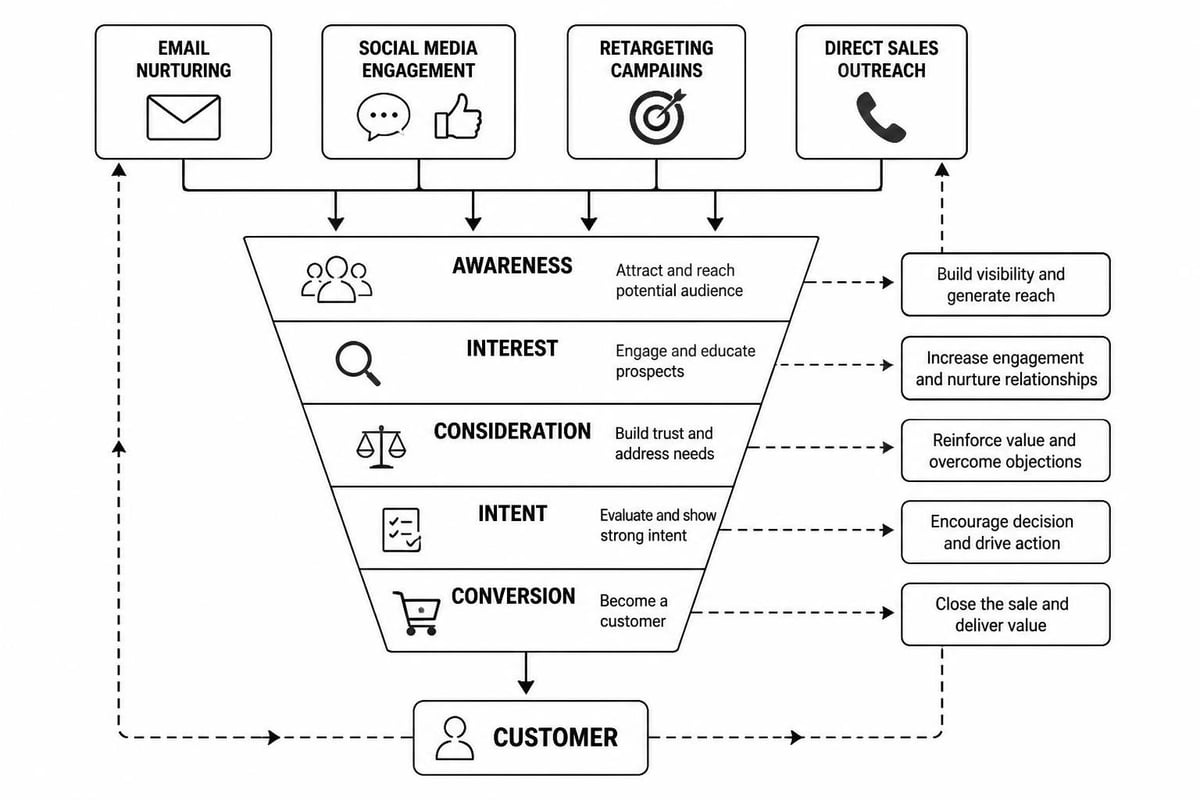
Effective funnels orchestrate touchpoints across email, social media, search, retargeting ads, and direct outreach. This creates the frequency and consistency needed to build trust while respecting how modern buyers actually research and decide.
According to TechTarget’s analysis of sales funnels, prospects typically need 7-13 touchpoints before converting. A single-channel approach simply can't deliver that exposure effectively.
Advanced Business Funnel Strategies
Once your foundation is solid, these advanced tactics will multiply results.
Retargeting for Funnel Re-Engagement
Not every prospect converts on their first visit. Most won't. Retargeting brings them back to your business funnel when they're ready to take the next step.
Strategic retargeting segments audiences by funnel stage. Someone who read a blog post needs different messaging than someone who abandoned a pricing page. This precision dramatically improves ad efficiency and conversion rates.
Lead Scoring and Qualification
Not all leads deserve equal attention. Lead scoring ranks prospects based on behaviors, demographics, and engagement patterns so your team focuses energy where it matters most.
Effective scoring models consider:
- Company size and industry fit
- Budget indicators and decision authority
- Engagement level with content
- Speed of progression through funnel stages
- Specific actions taken (pricing viewed, case studies downloaded)
This prioritization ensures your highest-value prospects receive immediate attention while lower-scoring leads continue automated nurturing. The result: shorter sales cycles and higher close rates.
Revenue Attribution and Analysis
Which marketing activities actually generate revenue? Most businesses can't answer this question accurately, so they keep funding tactics that don't work while under-investing in those that do.
Your business funnel needs attribution tracking that connects revenue to specific campaigns, channels, and content pieces. This reveals your true ROI and guides smarter budget allocation.
| Attribution Model | Best For | Key Insight |
|---|---|---|
| First-touch | Brand awareness impact | What initially attracts prospects |
| Last-touch | Closing tactics | What finalizes decisions |
| Multi-touch | Full journey understanding | How touchpoints work together |
| Time-decay | Recent influence | What matters most before conversion |
Understanding demand generation versus lead generation requires this attribution clarity. Some activities create awareness and interest; others drive immediate action. Both matter, but they require different measurement approaches.
Scaling Your Business Funnel
Growth means handling more leads without proportionally increasing costs. Your business funnel architecture determines whether scaling creates profit or chaos.
Automation at Scale
Manual processes that work for 50 leads monthly will collapse at 500. Before scaling lead volume, ensure your systems can handle increased flow without degrading quality.
This requires:
- Automated lead capture and data entry
- Triggered email sequences based on behaviors
- AI-powered chatbots for initial qualification
- Automated appointment scheduling
- CRM integration that tracks all interactions
The best B2B lead generation tools provide these capabilities either natively or through integrations, creating seamless experiences regardless of lead volume.
Team Alignment and Training
Your sales team must understand how the business funnel works and where their efforts fit. Misalignment between marketing and sales destroys funnel efficiency.
Marketing delivers qualified leads; sales converts them. When these functions work in isolation, leads fall through gaps and conversion rates suffer. Create shared definitions of lead quality, agreed-upon handoff criteria, and regular communication about what's working.
Continuous Testing Culture
Your business funnel should never be "finished." The best-performing funnels evolve through constant testing of messaging, offers, timing, and channels.
Implement systematic A/B testing of:
- Subject lines and email copy
- Landing page headlines and calls-to-action
- Offer positioning and value propositions
- Ad creative and targeting parameters
- Follow-up timing and sequences
Even small improvements compound dramatically. A 5% increase at each funnel stage creates exponential gains in overall conversion rates.
Common Business Funnel Mistakes
Avoid these pitfalls that sabotage otherwise solid funnels.
Focusing Only on Top-of-Funnel
More traffic doesn't automatically mean more revenue. Many businesses obsess over awareness metrics while ignoring conversion optimization. A smaller audience that converts at higher rates always outperforms a large audience with poor conversion.
The detailed explanation of sales funnel stages emphasizes this balance between volume and quality. Optimize the entire funnel, not just lead generation.
Neglecting Existing Customers
Your business funnel shouldn't end at purchase. Customer retention and expansion often deliver higher ROI than new customer acquisition.
Post-purchase funnels include:
- Onboarding sequences that ensure successful implementation
- Upsell campaigns introducing additional services
- Referral programs leveraging satisfied customers
- Retention messaging preventing churn
- Feedback loops improving offerings
Copying Competitor Funnels
What works for your competitor may fail for you. Different audiences, offers, and positioning require customized approaches. Study other funnels for inspiration, but build yours around your unique value proposition and customer journey.
Ignoring Mobile Experience
Over 60% of web traffic comes from mobile devices. If your business funnel isn't optimized for mobile, you're losing half your potential customers before they even enter your funnel.
Test every form, page, and email on actual mobile devices. Slow loading, difficult navigation, or tiny buttons aren't just annoying-they're conversion killers.
A properly designed business funnel transforms unpredictable marketing into a systematic revenue engine. By understanding each stage, implementing automation, and continuously optimizing based on data, you create a competitive advantage that compounds over time. When you're ready to build a funnel that actually delivers qualified leads and predictable growth, Aletto specializes in creating AI-powered systems that turn cold prospects into ready-to-buy customers with guaranteed results.