


The landscape of B2B marketing has undergone a radical transformation, and businesses that once relied on traditional outbound tactics are scrambling to adapt. In 2026, the most successful companies aren't just generating leads-they're mastering the art of demand generation to create genuine market interest before prospects even enter the sales funnel. The phrase "b2b in demand" has never been more relevant as organizations recognize that capturing attention and building trust happens long before a prospect fills out a contact form. This shift represents a fundamental change in how businesses approach growth, moving from interruption-based marketing to value-driven engagement that positions your company as the obvious choice when buyers are ready to make decisions.
Why B2B in Demand Generation Matters More Than Ever
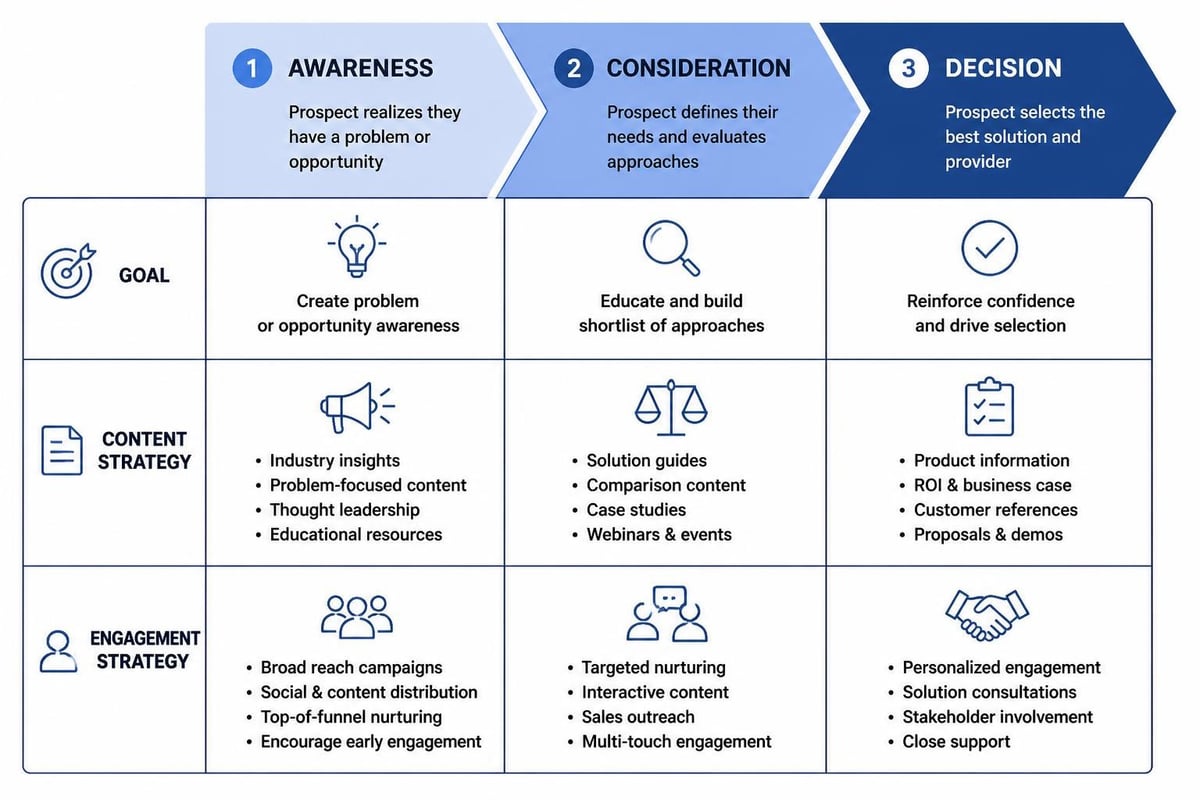
The buying journey has become increasingly complex, with decision-makers conducting extensive research independently before engaging with sales teams. B2B in demand strategies address this reality by creating awareness and building relationships throughout the entire customer journey, not just at the point of conversion.
Modern buyers interact with an average of 11 to 13 pieces of content before making a purchase decision. This means your marketing must work harder to capture attention, educate prospects, and establish authority across multiple touchpoints. B2B demand generation focuses on creating this sustained engagement rather than simply collecting contact information.
The Economic Imperative Behind B2B in Demand
Companies investing in comprehensive demand generation see measurable returns that justify the strategic shift. Consider these compelling factors:
- Shortened sales cycles through pre-qualified, educated prospects
- Higher close rates when buyers already understand your value proposition
- Improved marketing ROI by aligning efforts with actual buyer behavior
- Reduced customer acquisition costs through efficient funnel optimization
- Increased customer lifetime value from better-fit prospects
The financial case for prioritizing b2b in demand initiatives becomes clear when you examine the alternative. Traditional lead generation often produces high volumes of unqualified contacts that waste sales resources and create friction in the revenue pipeline. By contrast, demand generation cultivates genuine interest and builds trust, ensuring that when prospects do convert, they're already primed for productive sales conversations.
Strategic Pillars of Effective B2B Demand Generation
Building a robust b2b in demand program requires a multi-faceted approach that addresses every stage of the buyer journey. The most successful organizations in 2026 are implementing comprehensive strategies that blend content excellence, technological sophistication, and human insight.
Content as the Foundation
Educational content remains the cornerstone of demand generation, but the bar for quality has risen dramatically. Generic blog posts and recycled industry insights no longer capture attention in crowded markets. Instead, winning organizations create:
- Original research and data that provides unique market insights
- Interactive tools and calculators that deliver immediate value
- Comprehensive guides that address complex challenges thoroughly
- Case studies with specific metrics demonstrating real-world results
- Video content that explains sophisticated concepts accessibly
Understanding how to leverage copywriting effectively ensures your content resonates with target audiences and drives engagement. The key is creating resources that prospects would willingly consume even if they never became customers-content so valuable that it builds genuine goodwill and positions your brand as an indispensable resource.
Multi-Channel Orchestration
B2B in demand success requires coordinated presence across the channels where your prospects spend time. This isn't about being everywhere-it's about being strategic where it counts most.
| Channel | Primary Purpose | Key Metric |
|---|---|---|
| Thought leadership & networking | Engagement rate | |
| Nurture & relationship building | Open & click rates | |
| Webinars | Deep education & interaction | Attendance & engagement |
| Podcasts | Authority building | Listener growth |
| Communities | Peer learning & support | Active participation |
| SEO | Organic discovery | Qualified traffic |
The power of this orchestration lies in how these channels reinforce each other. A prospect might discover your brand through organic search, engage with LinkedIn content, attend a webinar, and join your email list-each touchpoint building familiarity and trust. This integrated approach ensures b2b in demand efforts create consistent momentum rather than isolated moments of engagement.
Leveraging AI and Automation for Demand Generation
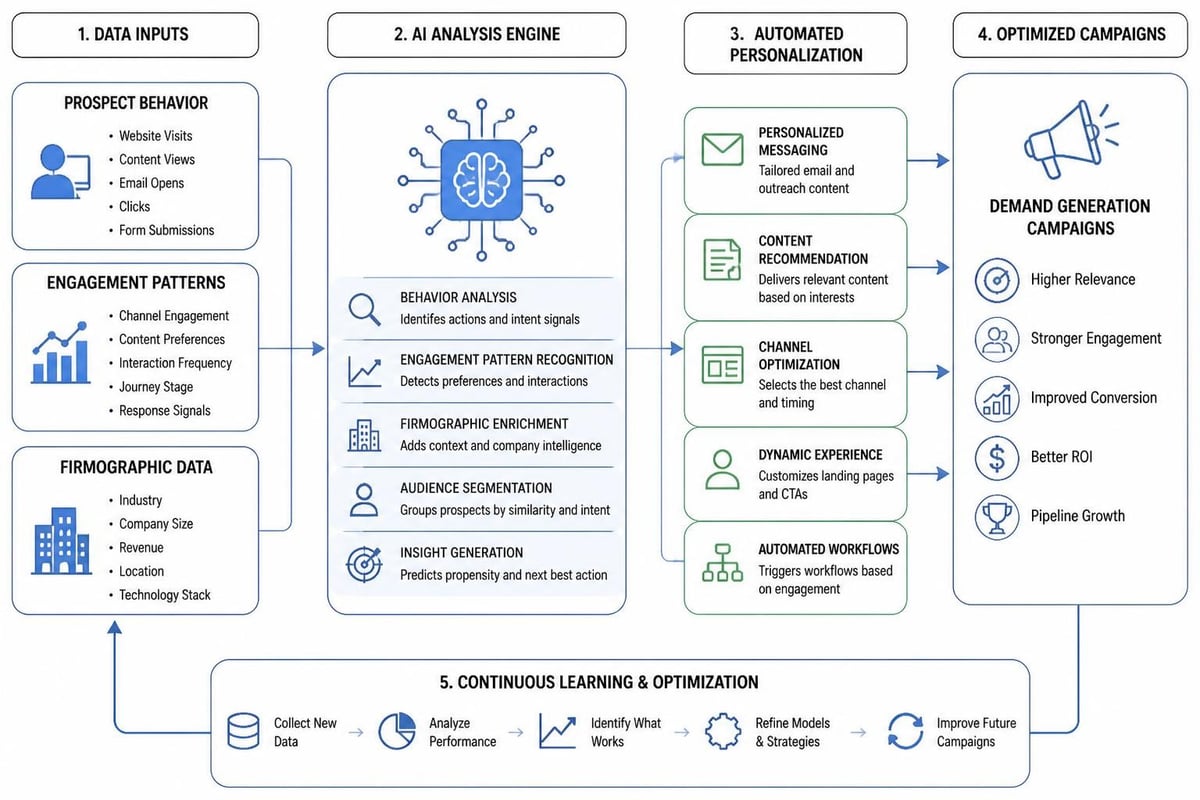
The integration of artificial intelligence into b2b in demand strategies has fundamentally altered what's possible in 2026. AI adoption is delivering measurable ROI for B2B teams by enabling personalization at scale, predictive analytics, and automated optimization that would be impossible manually.
Intelligent Lead Scoring and Qualification
Traditional lead scoring relied on simple demographic data and basic engagement metrics. Modern AI systems analyze hundreds of signals to identify genuine buying intent:
- Behavioral patterns across website visits and content consumption
- Engagement velocity showing accelerating or declining interest
- Firmographic fit matching ideal customer profiles
- Technographic data revealing technology stack compatibility
- Intent signals from third-party data sources
This sophisticated scoring enables sales teams to focus on prospects showing genuine readiness while marketing continues nurturing others. The result is more efficient resource allocation and higher conversion rates throughout the funnel. Companies using B2B lead generation tools can dramatically improve their qualification processes.
Personalization That Scales
AI-powered personalization delivers customized experiences without requiring manual intervention for each prospect. Advanced systems can:
- Dynamically adjust website content based on visitor industry and role
- Recommend specific resources aligned with current research stage
- Customize email messaging to address individual pain points
- Optimize send times based on historical engagement patterns
- Adjust ad creative to resonate with specific audience segments
This level of personalization makes b2b in demand efforts significantly more effective because prospects receive relevant information precisely when they need it. Rather than generic outreach that fails to resonate, AI enables marketing teams to deliver experiences that feel individually crafted.
Building a High-Performance Demand Generation System
Creating sustainable b2b in demand success requires more than individual tactics-it demands a comprehensive system that consistently attracts, engages, and converts your ideal prospects. The organizations winning in 2026 have moved beyond campaign-based thinking to build always-on demand engines.
Developing Your Ideal Customer Profile
Everything in demand generation flows from understanding exactly who you serve. Generic targeting wastes resources and dilutes messaging. Precision in defining your ICP enables every subsequent decision:
- Which content topics resonate most powerfully
- Where to invest advertising spend for maximum return
- How to structure nurture sequences for optimal conversion
- What messaging frameworks drive engagement
- Which channels deserve priority attention
Working with specialized lead generation companies can accelerate this process by bringing expertise in identifying and reaching your highest-value prospects. The investment in ICP development pays dividends across every marketing initiative because it ensures you're always speaking to the right audience with relevant messages.
Creating Conversion-Optimized Funnels
The b2b in demand funnel differs from traditional lead generation funnels in crucial ways. Rather than pushing for immediate conversion, it acknowledges the extended buyer journey and creates value at every stage.
Top of Funnel: Awareness & Education
- Thought leadership content establishing expertise
- SEO-optimized resources capturing organic search traffic
- Social media presence building brand recognition
- Industry event participation demonstrating category leadership
Middle of Funnel: Consideration & Evaluation
- Detailed comparison guides helping prospects evaluate options
- Interactive tools providing personalized insights
- Expert webinars addressing specific challenges
- Case studies demonstrating proven results
Bottom of Funnel: Decision & Conversion
- Product demonstrations showcasing specific capabilities
- ROI calculators quantifying potential value
- Customer testimonials providing social proof
- Consultative sales conversations addressing final concerns
Understanding funnel system marketing principles ensures each stage naturally progresses prospects toward conversion without forcing premature sales pressure.
Measuring and Optimizing B2B in Demand Performance
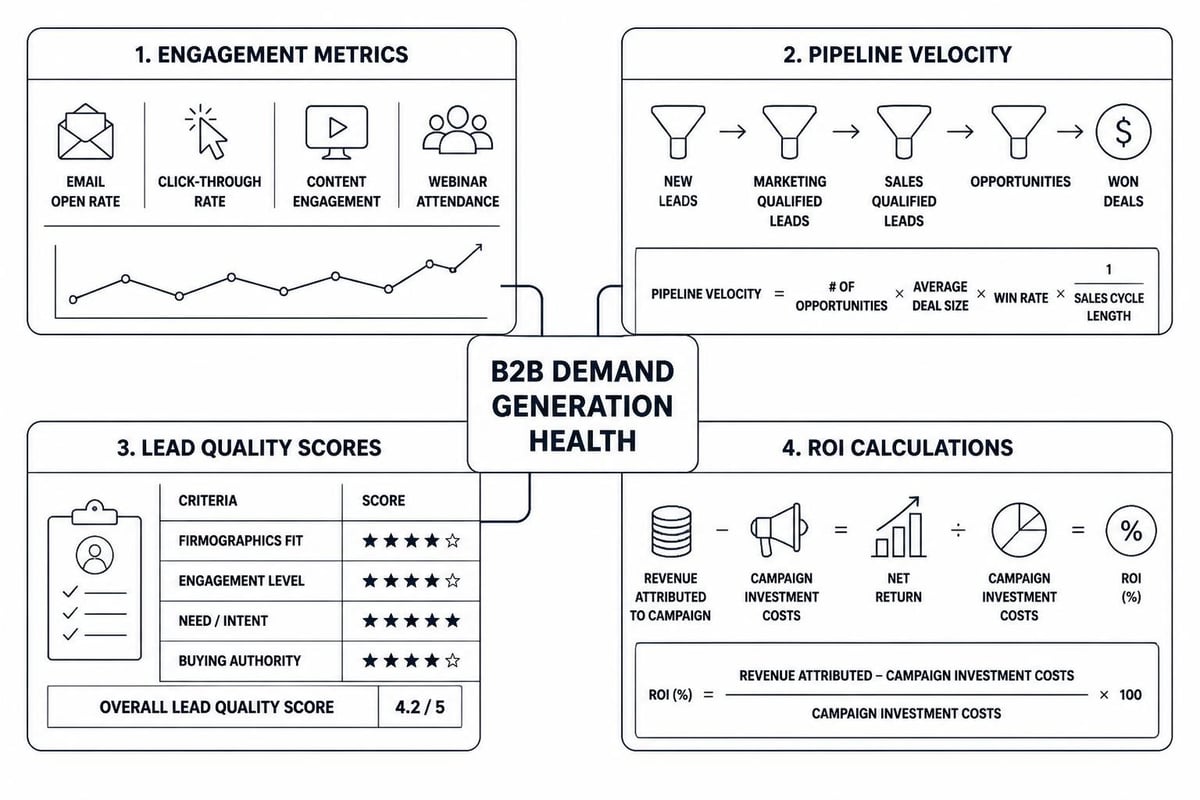
The complexity of demand generation requires sophisticated measurement approaches that go beyond surface-level vanity metrics. In 2026, successful organizations track indicators that reveal true program health and predictive future revenue.
Critical Metrics for Demand Generation Success
| Metric Category | Key Indicators | Why It Matters |
|---|---|---|
| Engagement | Content consumption depth, return visitor rate | Shows genuine interest vs. casual browsing |
| Pipeline Impact | Marketing-sourced opportunities, influence on deals | Demonstrates revenue contribution |
| Velocity | Time from first touch to opportunity, sales cycle length | Indicates funnel efficiency |
| Quality | Lead-to-opportunity rate, opportunity-to-close rate | Reveals targeting and qualification effectiveness |
| Efficiency | Cost per qualified lead, customer acquisition cost | Ensures sustainable economics |
These metrics provide actionable insights that drive continuous improvement. When b2b in demand programs underperform, the data reveals exactly where to focus optimization efforts-whether that's improving top-of-funnel awareness, strengthening middle-funnel nurture, or enhancing bottom-funnel conversion mechanisms.
Testing and Iteration Frameworks
Continuous optimization separates exceptional demand generation from mediocre efforts. The most effective teams implement structured testing protocols:
- A/B testing of messaging, offers, and creative elements
- Multivariate testing of landing page components
- Channel mix experimentation to find optimal investment allocation
- Timing tests to identify when prospects are most receptive
- Audience segmentation tests to refine targeting precision
This scientific approach to improvement compounds over time. Small gains across multiple areas create dramatic overall performance improvements. Organizations that treat b2b in demand as an ongoing optimization challenge rather than a set-it-and-forget-it program consistently outperform competitors.
Emerging Trends Shaping B2B in Demand for 2026
The demand generation landscape continues evolving rapidly, with several trends gaining momentum that will define success in coming years. Forward-thinking organizations are already adapting their strategies to capitalize on these shifts.
The Rise of Community-Led Growth
Traditional outbound marketing loses effectiveness as buyers increasingly tune out promotional messages. Community-led approaches flip this dynamic by creating spaces where prospects engage with peers, share insights, and solve problems together. Your brand facilitates value rather than pushing messages.
Successful b2b in demand strategies now include:
- Private online communities for customers and prospects
- User groups facilitating peer networking and learning
- Open-source contributions demonstrating expertise
- Collaborative content creation with community members
- Events designed for connection rather than selling
This approach builds authentic relationships and positions your brand as genuinely invested in customer success. When buying decisions arrive, you've already established trust through consistent value delivery.
Intent Data Revolutionizing Targeting
Understanding B2B technology trends for 2026 reveals how intent data has matured from experimental to essential. Third-party platforms now track billions of behavioral signals indicating active research and buying intent.
Organizations leveraging intent data can:
- Identify prospects actively researching solutions before competitors know they exist
- Prioritize accounts showing strongest buying signals for focused outreach
- Customize messaging based on specific topics prospects are researching
- Time engagement to coincide with active evaluation periods
- Measure share of voice compared to competitors in your category
This intelligence makes b2b in demand efforts dramatically more efficient by focusing resources on prospects genuinely in-market rather than spraying messages broadly hoping for response.
Account-Based Demand Generation Strategies
The convergence of account-based marketing and demand generation creates powerful opportunities for organizations targeting specific high-value accounts. Rather than casting wide nets, account-based demand generation focuses intense effort on defined target accounts.
Orchestrating Account-Level Campaigns
Successful account-based b2b in demand programs coordinate multiple touchpoints:
- Personalized content addressing specific account challenges
- Multi-threaded outreach engaging multiple stakeholders
- Targeted advertising reaching decision-makers at priority accounts
- Executive engagement connecting leadership to leadership
- Custom events designed for specific account groups
This concentrated approach makes particular sense for companies with clearly defined ICPs and high customer lifetime values. The investment per account increases, but so does conversion probability and deal size. Many B2B lead generation companies now specialize in account-based approaches that align perfectly with demand generation principles.
Technology Enabling ABM at Scale
What once required massive manual effort now benefits from sophisticated platforms that automate account-based workflows. Modern stacks enable marketers to:
- Identify target accounts matching ideal customer profiles automatically
- Track engagement across all touchpoints for complete account visibility
- Coordinate campaigns across email, advertising, and social channels
- Personalize content dynamically based on account characteristics
- Measure account-level ROI tying marketing efforts to revenue outcomes
The result is b2b in demand programs that deliver the personalization of traditional ABM with the efficiency needed to scale across larger account lists. This balance makes account-based approaches accessible to mid-market companies, not just enterprise organizations.
Aligning Sales and Marketing for Demand Success
No b2b in demand strategy succeeds without tight alignment between marketing and sales teams. The traditional handoff model-where marketing generates leads and "throws them over the wall" to sales-creates friction and reduces conversion rates.
Creating Unified Revenue Teams
Progressive organizations restructure around shared revenue goals rather than department-specific metrics. This alignment manifests in:
- Shared definitions of qualified leads and opportunities
- Joint accountability for pipeline and revenue targets
- Collaborative content creation leveraging sales insights
- Regular feedback loops informing continuous improvement
- Technology integration providing unified prospect views
When sales and marketing work as a coordinated revenue team, b2b in demand efforts become significantly more effective. Marketing gains deeper understanding of what messaging resonates in actual sales conversations, while sales receives prospects who are genuinely educated and engaged.
Service Level Agreements Driving Accountability
Formal SLAs between teams establish clear expectations and responsibilities:
| Marketing Commitments | Sales Commitments |
|---|---|
| Deliver X qualified leads monthly | Contact leads within Y hours |
| Maintain lead quality above Z% | Provide feedback on lead quality |
| Track and report on engagement | Update CRM with conversation details |
| Nurture unqualified prospects | Collaborate on content development |
These agreements ensure both teams understand their role in the demand generation ecosystem and maintain accountability for results. The structure prevents finger-pointing when results fall short and creates frameworks for collaborative problem-solving.
Content Strategies That Drive Demand Generation
Creating content that genuinely moves b2b in demand metrics requires moving beyond generic blog posts to strategic assets designed for specific funnel stages and buyer personas. The content that performs in 2026 demonstrates deep subject matter expertise and provides immediate, actionable value.
High-Impact Content Formats
Different formats serve different purposes in the demand generation journey:
- Long-form guides (3,000+ words) establishing comprehensive authority on key topics
- Original research reports generating media coverage and backlinks
- Interactive assessments providing personalized insights while capturing lead data
- Video series making complex topics accessible and engaging
- Podcasts building relationships through long-form conversations
- Comparison matrices helping prospects evaluate options objectively
The key is matching format to intent. Early-stage prospects need educational content that helps them understand their challenges. Mid-stage buyers want detailed comparisons and evaluation criteria. Late-stage prospects require proof points and implementation details. Mastering marketing agency strategy principles ensures content investments deliver maximum impact.
Distribution Strategies That Amplify Reach
Creating exceptional content represents only half the equation. Distribution determines whether your ideal prospects actually encounter your work. Sophisticated b2b in demand programs implement multi-channel distribution:
- SEO optimization ensuring organic discovery for relevant searches
- Social media promotion reaching engaged professional audiences
- Email distribution to existing subscribers and prospects
- Paid promotion targeting specific job titles and industries
- Partner distribution leveraging complementary audiences
- PR outreach securing coverage in industry publications
This comprehensive approach ensures your content investment generates maximum return by reaching prospects wherever they consume information. The compounding effect of multiple distribution channels dramatically increases total reach compared to relying on any single source.
B2B in demand generation represents the future of sustainable business growth, moving beyond transactional lead generation to build genuine market presence and buyer relationships. The strategies outlined here-from AI-powered personalization to community-led growth-provide the framework for capturing attention, building trust, and converting prospects in 2026's complex buying environment. If you're ready to transform your approach and implement a demand generation system that delivers predictable, scalable results, Aletto combines advanced AI technology with proven strategies to generate qualified leads and automate appointment bookings that drive revenue growth. Our guaranteed growth partnership model ensures we're invested in your success every step of the way.