


The intersection of digital marketing and AI has fundamentally changed how businesses approach customer acquisition and revenue generation. What once required extensive manual effort, countless hours of research, and significant guesswork now leverages intelligent systems that predict behavior, personalize outreach, and automate complex sales processes. For companies focused on lead generation, this technological revolution isn't just an advantage-it's become essential for survival in an increasingly competitive marketplace where prospects expect instant, relevant, and personalized interactions at every touchpoint.
The Evolution of Digital Marketing Through AI Integration
Traditional digital marketing relied heavily on broad segmentation, manual A/B testing, and delayed optimization cycles. Marketers would launch campaigns, wait weeks for data, analyze results, and make adjustments for the next iteration. This approach left money on the table and missed opportunities in real-time.
AI in digital marketing has compressed these cycles from weeks to milliseconds. Machine learning algorithms now analyze millions of data points simultaneously, identifying patterns human analysts would never detect. These systems adjust bidding strategies, creative elements, and targeting parameters automatically, optimizing campaigns while they run rather than after they conclude.
Real-Time Decision Making at Scale
The power of digital marketing and AI becomes most apparent when handling volume. A human team might effectively manage dozens of campaigns across multiple platforms. AI systems manage thousands simultaneously, each with unique targeting criteria, creative variations, and optimization goals.
Key capabilities that AI brings to digital marketing:
- Predictive lead scoring that identifies high-intent prospects before they convert
- Dynamic content personalization based on behavioral signals and historical data
- Automated bid management across multiple advertising platforms
- Real-time campaign performance optimization without manual intervention
- Natural language processing for customer sentiment analysis
- Intelligent budget allocation across channels and campaigns
Modern marketing agency tools integrate these AI capabilities natively, making sophisticated optimization accessible to businesses of all sizes. The barrier to entry has dropped dramatically, shifting competitive advantage from who has AI to who uses it most strategically.
Transforming Cold Leads Into Qualified Appointments
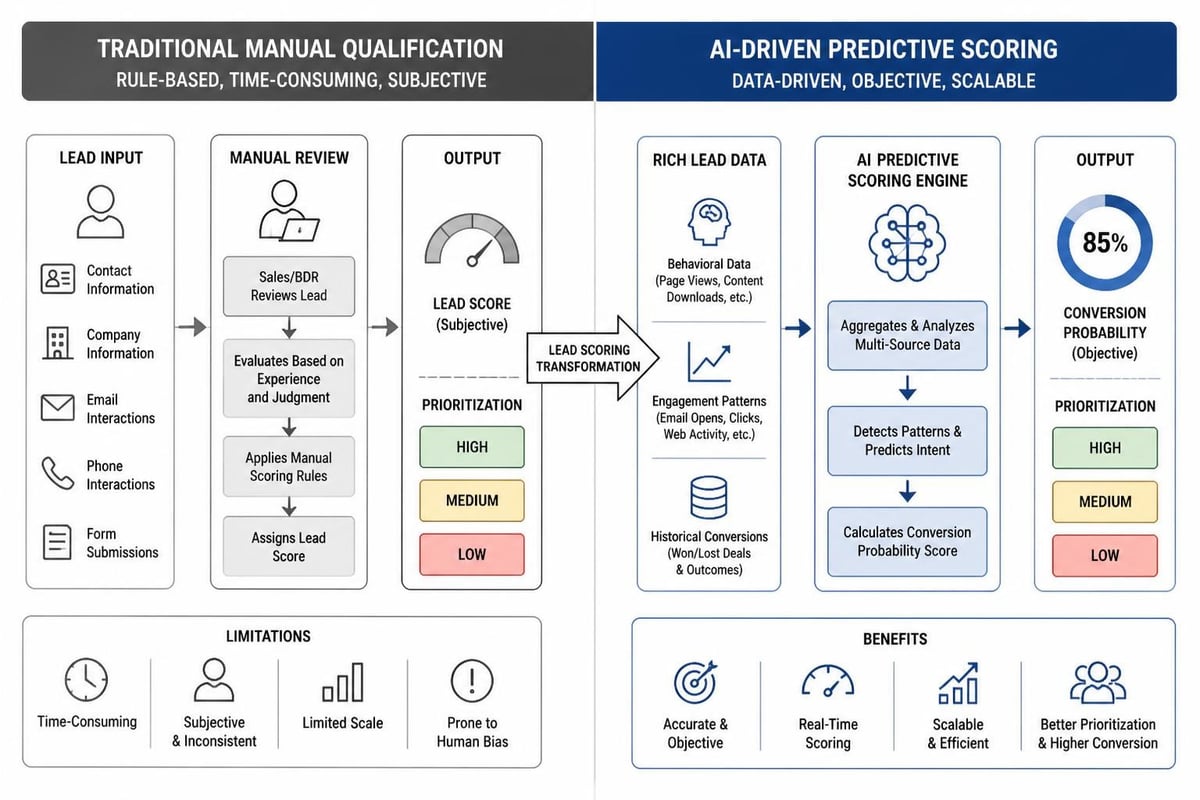
The most valuable application of digital marketing and AI for lead generation businesses centers on qualification and conversion acceleration. Every business faces the same fundamental challenge: separating genuinely interested prospects from tire-kickers who consume resources without converting.
AI-powered qualification systems analyze dozens of behavioral signals simultaneously. They track website interactions, email engagement, content consumption patterns, and social media activity to build comprehensive prospect profiles. These profiles reveal purchase intent with remarkable accuracy, often predicting conversion weeks before a human salesperson would recognize the opportunity.
Behavioral Analysis and Pattern Recognition
Consider how prospects interact with your digital properties before requesting information. One visitor might spend three minutes reading case studies, download a pricing guide, and visit your team page. Another might bounce after fifteen seconds. Traditional systems treat both equally if they complete the same form. AI systems recognize the first prospect shows significantly higher intent.
Understanding qualified leads requires moving beyond demographic data to behavioral indicators. The most sophisticated digital marketing and AI systems track micro-conversions: scroll depth, time on page, repeat visits, content downloads, and engagement with specific features or products. Each action receives a weighted score contributing to an overall intent rating.
| Traditional Lead Qualification | AI-Powered Lead Qualification |
|---|---|
| Manual review of form submissions | Automated behavioral analysis across touchpoints |
| Demographic-based scoring | Predictive modeling using hundreds of variables |
| Static lead grades | Dynamic scores updating in real-time |
| Hours or days to respond | Instant prioritization and routing |
| Generic follow-up sequences | Personalized nurture paths |
This data-driven approach to acquiring leads eliminates guesswork from the qualification process. Sales teams spend time with prospects most likely to convert rather than chasing unqualified contacts.
Automating Appointment Setting at Scale
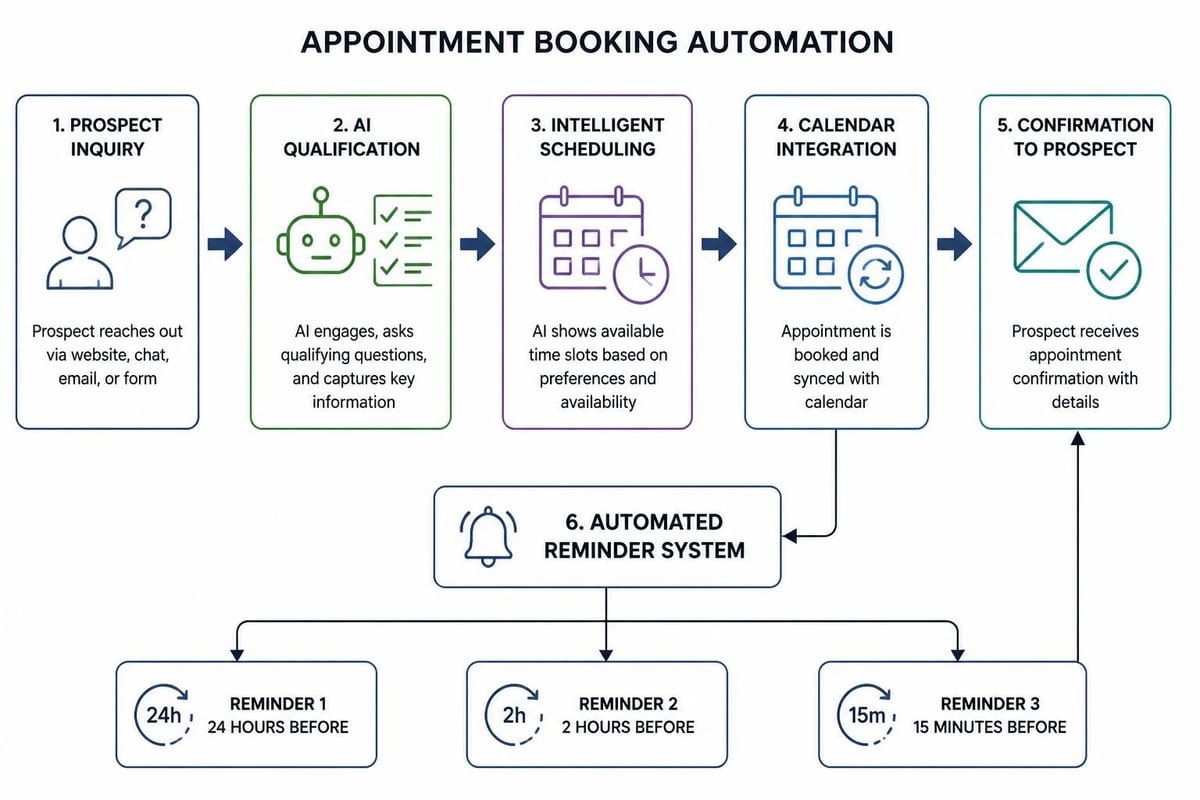
Appointment setting represents one of the most time-intensive aspects of lead generation. Traditional approaches require back-and-forth emails, phone tag, and manual calendar management. Digital marketing and AI automates this entire workflow, reducing friction and accelerating the path from interest to conversation.
Modern AI scheduling assistants understand context, preferences, and availability. They communicate naturally with prospects through email or chat, propose meeting times based on multiple calendars, handle rescheduling requests, and send confirmations with relevant preparation materials. The prospect experiences seamless coordination while your team gains hours previously lost to administrative tasks.
Intelligent Conversation Management
Natural language processing enables AI systems to engage prospects conversationally, answering common questions and qualifying interest before scheduling appointments. These systems recognize intent in prospect messages, extracting key information and routing conversations appropriately.
The AI appointment workflow:
- Prospect expresses interest through form, chat, or email
- AI system qualifies intent using behavioral data and conversation analysis
- Qualified prospects receive personalized scheduling invitation
- System proposes times based on team availability and prospect timezone
- Confirmation sent with meeting details and relevant preparation materials
- Automated reminders reduce no-show rates
- Post-meeting follow-up initiated based on outcome
This approach to lead generation removes bottlenecks that traditionally slowed sales cycles. Prospects book meetings when interest peaks rather than waiting for business hours or manual follow-up. Conversion rates improve simply by eliminating unnecessary friction.
Personalization That Converts
Generic marketing messages generate generic results. Prospects have learned to ignore one-size-fits-all communications, scrolling past content that doesn't address their specific situations. Digital marketing and AI solves this challenge through hyper-personalization at scale.
AI systems analyze prospect data to understand industry, company size, role, challenges, and goals. They dynamically generate messaging variations that speak directly to each prospect's context. A healthcare administrator sees examples from healthcare companies. A manufacturing executive sees manufacturing case studies. Same campaign, personalized delivery.
Salesforce’s perspective on AI in digital marketing emphasizes this personalization capability as transformative for engagement metrics. When prospects feel understood, they engage. When they engage, they convert.
Dynamic Content Optimization
The most advanced applications of digital marketing and AI extend beyond simple variable insertion. AI systems test creative variations, headlines, calls-to-action, and content formats, learning which combinations perform best for specific audience segments.
This optimization happens continuously. An underperforming ad gets replaced automatically. A high-converting email subject line gets expanded to similar segments. Budget shifts toward channels driving qualified conversions rather than vanity metrics like impressions or clicks.
Companies focusing on demand generation find this particularly valuable. AI identifies which content formats educate prospects most effectively at different funnel stages, automatically serving case studies to late-stage prospects and educational content to early-stage researchers.
Predictive Analytics for Strategic Planning
Historical data reveals what happened. Predictive analytics reveals what will happen. This distinction makes digital marketing and AI invaluable for strategic planning and resource allocation.
AI models analyze historical campaign performance, seasonal trends, competitive activity, and market conditions to forecast future results. These forecasts inform budget decisions, hiring plans, and strategic initiatives with data rather than intuition.
Predictive capabilities transforming marketing strategy:
- Revenue forecasting based on pipeline velocity and conversion rates
- Customer lifetime value prediction for acquisition cost optimization
- Churn risk identification enabling proactive retention efforts
- Market trend detection before competitors recognize opportunities
- Channel performance forecasting for budget allocation
- Content topic prediction based on search trends and audience interests
Businesses implementing marketing agency strategies backed by predictive analytics gain significant competitive advantages. They enter markets early, allocate budgets efficiently, and adjust strategies before results suffer.
Implementing AI Without Losing the Human Touch
The most common concern about digital marketing and AI centers on losing personal connection with prospects. Will automation make marketing feel robotic? Will prospects disengage when they realize they're interacting with machines?
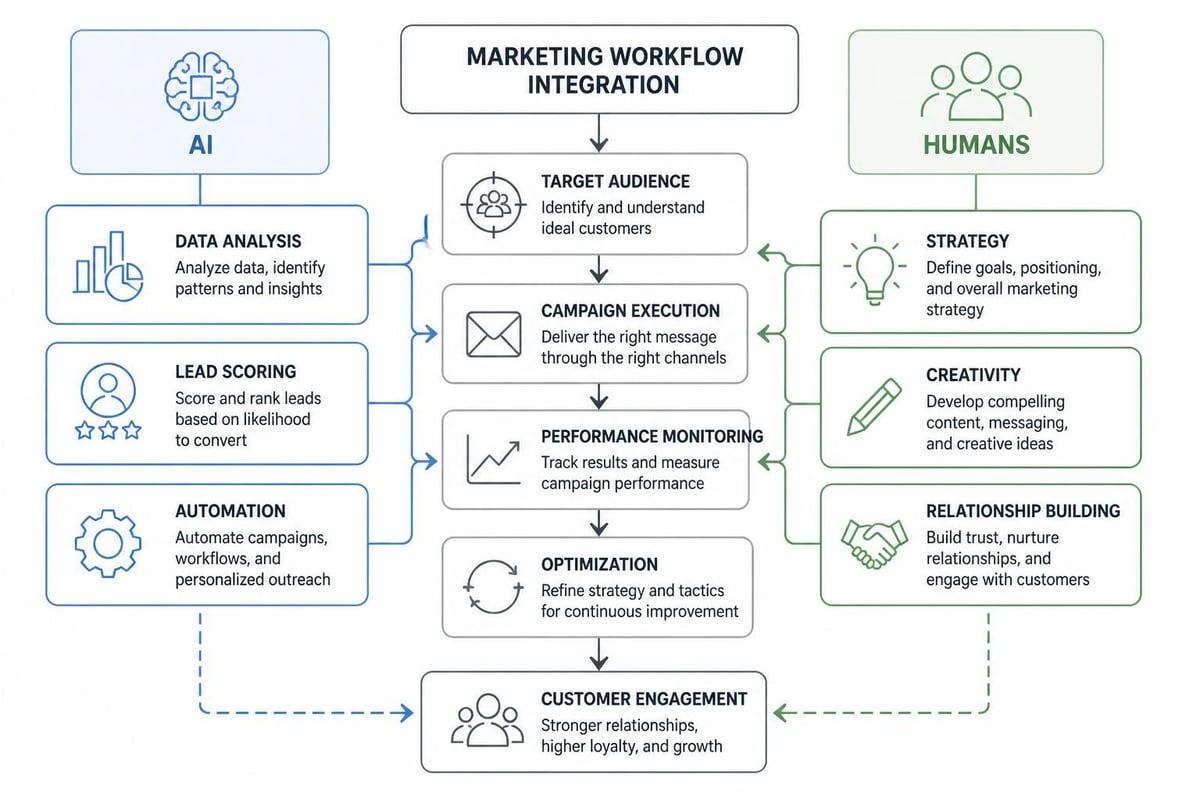
These concerns are valid but surmountable. The key lies in understanding where AI adds value and where human expertise remains essential. AI excels at data analysis, pattern recognition, repetitive tasks, and optimization at scale. Humans excel at creativity, strategy, relationship building, and handling complexity.
The Hybrid Approach
Successful implementation combines AI efficiency with human expertise. AI handles qualification, scheduling, initial outreach, and data analysis. Humans handle strategy development, relationship nurturing, complex problem-solving, and closing.
This division maximizes strengths while minimizing weaknesses. Your sales team spends time building relationships with qualified prospects rather than chasing unqualified leads. Your marketing team focuses on strategy and creative development rather than manual campaign management.
Research on AI techniques in digital marketing demonstrates that hybrid approaches outperform purely automated or purely manual systems. The combination leverages AI's analytical power with human judgment and creativity.
Measuring ROI in AI-Powered Marketing
Investment in digital marketing and AI requires justification through measurable returns. Unlike traditional marketing where attribution remained murky, AI systems provide unprecedented visibility into performance and ROI.
Modern analytics platforms track prospects from first touchpoint through final conversion, attributing revenue to specific campaigns, channels, and interactions. This visibility reveals exactly which investments generate returns and which consume budget without results.
| Metric | Traditional Measurement | AI-Enhanced Measurement |
|---|---|---|
| Lead Quality | Subjective sales feedback | Objective conversion probability scores |
| Campaign Performance | Aggregate click and conversion rates | Granular performance by segment, creative, and timing |
| Customer Acquisition Cost | Average across all channels | Specific to channel, segment, and campaign |
| Attribution | Last-touch or first-touch | Multi-touch with weighted contribution |
| Forecast Accuracy | ±30% variance typical | ±5% variance achievable |
This precision enables rapid optimization. Underperforming initiatives get cut quickly. High-performing tactics receive increased investment immediately. Budget allocation becomes scientific rather than speculative.
Companies focused on B2B leads particularly benefit from this measurement precision, as longer sales cycles and multiple touchpoints make attribution challenging without sophisticated analytics.
Overcoming Implementation Challenges
Implementing digital marketing and AI successfully requires addressing common challenges that derail adoption. Technology alone doesn't guarantee results. Strategy, data quality, and organizational alignment determine success.
Data Quality and Integration
AI systems are only as effective as the data they analyze. Incomplete, outdated, or siloed data produces unreliable insights and poor decisions. Successful implementation begins with data auditing and integration.
Critical data requirements for AI marketing:
- Clean, deduplicated contact records across all systems
- Comprehensive behavioral tracking across digital properties
- Integration between marketing platforms, CRM, and sales tools
- Historical performance data for model training
- Ongoing data hygiene processes maintaining quality
Many businesses discover their data infrastructure needs significant work before AI delivers value. This groundwork pays dividends, improving not just AI performance but overall marketing effectiveness.
Skills and Training
Your team needs different skills in an AI-powered environment. Deep platform expertise matters less than strategic thinking, data interpretation, and prompt engineering. Marketing teams must evolve from campaign executors to AI orchestrators.
Learning AI in digital marketing through structured programs helps teams build necessary competencies. Investment in training accelerates adoption and maximizes ROI from AI tools.
The Competitive Advantage of Early Adoption
Businesses implementing digital marketing and AI in 2026 gain significant advantages over late adopters. AI systems improve through use, learning from each campaign, interaction, and conversion. Early adopters accumulate more training data, building more sophisticated models that perform better over time.
This creates a compounding advantage. Better models generate better results. Better results provide more data. More data improves models further. The gap between leaders and laggards widens continuously.
Beyond performance advantages, early adoption builds organizational expertise. Teams develop fluency with AI tools, learning which applications deliver value and which disappoint. This knowledge informs future technology decisions and strategy development.
Companies specializing in lead gen advertising recognize that AI expertise has become a core competency rather than optional enhancement. The question isn't whether to adopt AI but how quickly you can implement it effectively.
Future Trends in AI-Powered Marketing
The current state of digital marketing and AI represents just the beginning. Emerging capabilities will further transform how businesses attract, qualify, and convert prospects.
Developments reshaping the landscape:
- Voice and conversational AI enabling natural prospect interactions
- Predictive content generation tailored to individual prospects
- Advanced attribution modeling across online and offline touchpoints
- Automated creative testing and generation at unprecedented scale
- Integration of AI across the entire customer lifecycle
- Privacy-focused AI working with less individual data
Research on AI-generated content applications suggests we're approaching a point where AI can create highly effective marketing materials with minimal human input. This doesn't eliminate the need for human marketers but shifts their focus from creation to strategy and quality control.
The businesses thriving in this environment will be those viewing AI as a strategic partner rather than a tactical tool. They'll integrate AI deeply into operations, culture, and decision-making processes rather than treating it as another marketing platform.
Building Systems for Sustainable Growth
The ultimate goal of implementing digital marketing and AI isn't just better campaigns or more leads. It's building systematic, predictable, scalable growth engines that deliver consistent results regardless of market conditions or competitive pressures.
These systems require careful design, ongoing optimization, and alignment between marketing, sales, and leadership. Technology enables the systems, but strategy determines their effectiveness.
Successful growth systems share common characteristics. They focus on qualified prospects rather than lead volume. They automate repetitive tasks while preserving personalization. They measure what matters rather than vanity metrics. They optimize continuously based on data rather than assumptions.
Companies like those focusing on advertising and AI integration understand that sustainable growth comes from systems thinking. Individual campaigns matter less than the overall architecture generating and converting prospects consistently.
This systematic approach transforms businesses from reactive to proactive, from hoping for results to engineering them. It shifts the conversation from "How can we get more leads?" to "How can we systematically attract, qualify, and convert our ideal customers at scale?"
The integration of digital marketing and AI has moved from experimental to essential for businesses serious about sustainable growth and competitive advantage. The technology exists, the methods are proven, and the competitive pressure continues mounting. At Aletto, we've built our entire approach around leveraging these AI systems to generate qualified sales leads and automate appointment bookings, transforming cold prospects into ready-to-buy customers through guaranteed growth partnerships. If you're ready to stop guessing and start systematically growing your business with AI-powered lead generation, we'd love to show you what's possible.