


Building a predictable revenue engine requires more than just throwing marketing dollars at random channels and hoping for results. You need a systematic approach that attracts the right prospects, engages them effectively, and converts them into qualified opportunities your sales team can close. The difference between businesses that struggle to fill their pipeline and those that enjoy consistent growth comes down to having a strategic framework that coordinates every touchpoint in the customer journey. This framework is your lead acquisition strategy, and when executed properly, it transforms marketing from a cost center into your most powerful revenue driver.
Understanding the Foundation of Modern Lead Acquisition
A robust lead acquisition strategy functions as the blueprint for how your business identifies, attracts, and captures potential customers who match your ideal customer profile. Unlike generic marketing tactics that cast wide nets hoping to catch something valuable, strategic lead acquisition focuses on precision targeting and systematic conversion optimization.
The most effective approaches combine three critical elements: deep audience understanding, multi-channel coordination, and relentless testing. Understanding your ideal customer means going beyond basic demographics to grasp their challenges, motivations, decision-making processes, and preferred communication channels.
Your strategy must align with how modern buyers actually research and make purchasing decisions. They consume content across multiple platforms, evaluate numerous options simultaneously, and demand personalized experiences that address their specific situation. Generic messaging and one-size-fits-all campaigns simply don't cut through the noise anymore.
Mapping Your Ideal Customer Journey
Before launching any campaigns, you need clarity on who you're targeting and how they move through the buying process. Create detailed buyer personas that capture not just demographic information but psychographic insights about what drives their decisions.
Key elements to document for each persona:
- Primary pain points and challenges they face daily
- Goals they're trying to achieve in their role
- Objections and concerns that prevent quick decisions
- Information sources they trust for research
- Typical decision-making timeline and approval processes
Map the specific journey your prospects take from initial awareness through consideration and final purchase decision. Different prospects enter at different stages, so your lead acquisition strategy must provide entry points for each phase.
Understanding these journeys allows you to optimize your lead generation approach by placing the right content and offers at precisely the moments prospects are ready to engage. When timing and messaging align perfectly with prospect readiness, conversion rates multiply.
Building Multi-Channel Acquisition Systems
Relying on a single channel creates dangerous vulnerabilities in your revenue pipeline. Algorithm changes, platform policy updates, or increased competition can devastate businesses dependent on one traffic source. Diversification isn't just smart; it's essential for sustainable growth.
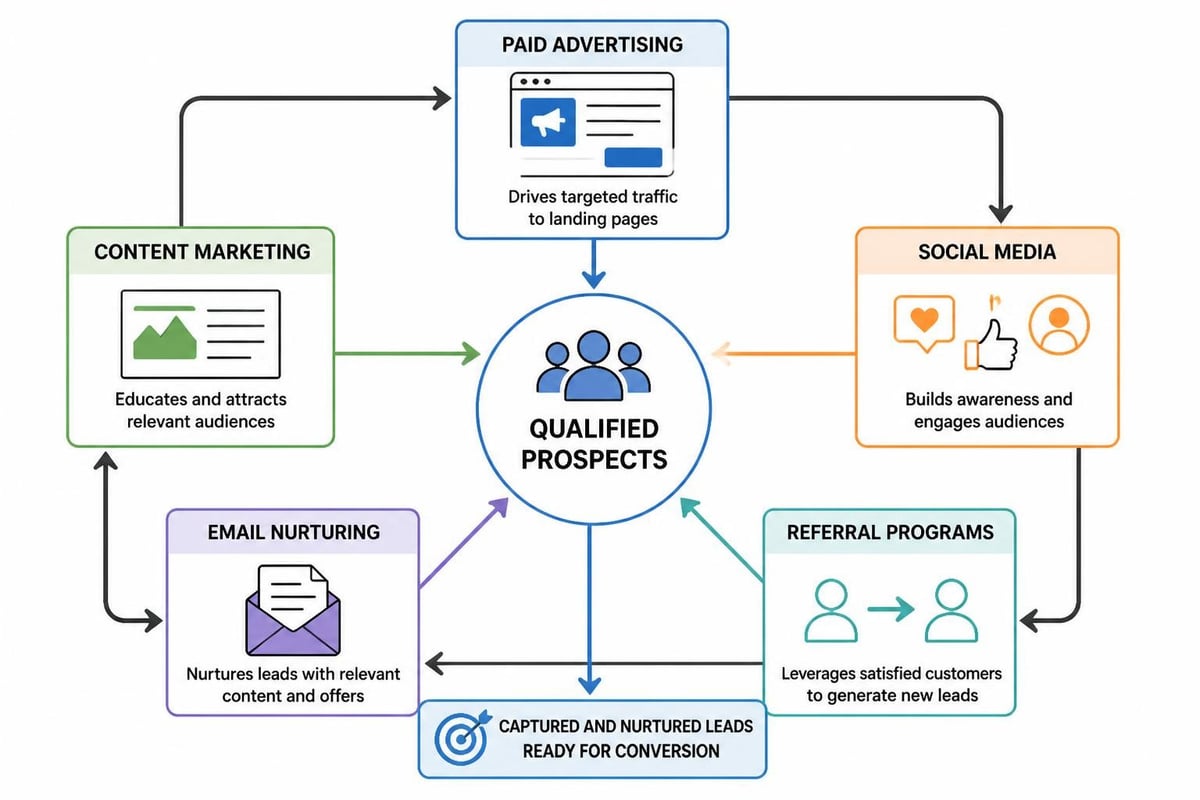
Your lead acquisition strategy should orchestrate multiple channels that work synergistically. Paid advertising drives immediate traffic while content marketing builds long-term authority. Social media creates engagement touchpoints while email nurturing maintains ongoing relationships. Each channel serves specific functions within your broader system.
Paid Advertising for Immediate Lead Flow
Paid channels deliver the fastest results when you need to scale lead volume quickly. Platforms like Google Ads, Facebook, LinkedIn, and programmatic display networks allow precise targeting based on demographics, interests, behaviors, and intent signals.
The key to profitable paid acquisition lies in understanding your unit economics. Calculate your maximum cost per acquisition by working backward from customer lifetime value and conversion rates. This number becomes your guardrail for campaign optimization.
| Channel Type | Best Use Cases | Average Conversion Rate | Typical Timeline to Results |
|---|---|---|---|
| Search Ads | High-intent prospects actively seeking solutions | 3-5% | 1-2 weeks |
| Social Ads | Awareness and consideration stage targeting | 1-3% | 2-4 weeks |
| Display Ads | Retargeting and broad brand awareness | 0.5-1% | 4-6 weeks |
| LinkedIn Ads | B2B decision-maker targeting | 2-4% | 2-3 weeks |
Effective AI-powered advertising systems now enable unprecedented targeting precision and automated optimization. These technologies analyze performance data in real-time and adjust bidding, creative selection, and audience targeting to maximize lead quality and minimize cost per acquisition.
Content Marketing as a Lead Magnet Engine
While paid advertising delivers immediate results, content marketing builds sustainable competitive advantages. High-quality content positions your brand as the trusted authority in your space, attracting prospects organically through search engines and social shares.
Your content strategy should map directly to buyer journey stages:
- Awareness stage content: Educational blog posts, research reports, and industry insights that attract prospects just beginning to recognize their problem
- Consideration stage content: Comparison guides, case studies, and webinars that help prospects evaluate different solution approaches
- Decision stage content: Product demos, free trials, and consultation offers that convert prospects ready to purchase
The most effective content doesn't just inform; it captures contact information through strategic lead magnets. These valuable resources provide immediate utility in exchange for prospect details, allowing you to continue nurturing the relationship.
Social Media for Relationship Building
Social platforms serve dual purposes in your lead acquisition strategy. They function as distribution channels for your content and as relationship-building environments where prospects experience your brand personality before committing.
Different platforms attract different audiences and support different interaction styles. LinkedIn dominates B2B professional networking, while Facebook and Instagram excel at visual storytelling for consumer-oriented businesses. Selecting the best marketing platforms for your specific audience ensures you invest time where it generates maximum return.
Consistency matters more than frequency. Regular posting maintains visibility and keeps your brand top-of-mind, but quality always trumps quantity. One genuinely valuable post per week outperforms seven mediocre updates.
Optimizing Your Conversion Infrastructure
Driving traffic means nothing if your conversion infrastructure fails to capture that interest effectively. Your landing pages, forms, and follow-up systems must work flawlessly to transform visitors into qualified leads.
Every element of your conversion path deserves systematic testing and optimization. Small improvements compound dramatically over time. A landing page that converts 5% instead of 3% generates 67% more leads from the same traffic investment.
Landing Page Optimization Fundamentals
Effective landing pages follow proven principles that have been validated across millions of conversions. They maintain singular focus on one specific offer, eliminate distractions that could derail conversion, and communicate value instantly.
Essential landing page elements:
- Clear, benefit-focused headline that communicates value within three seconds
- Concise explanation of what prospects receive and why it matters
- Visual elements that support your message without creating clutter
- Social proof through testimonials, client logos, or success metrics
- Friction-reducing form design that requests only essential information
- Compelling call-to-action that creates urgency without feeling manipulative
Understanding how sales funnels work helps you design landing experiences that guide prospects naturally toward conversion. Each element should answer unspoken questions and remove objections that prevent people from taking action.
Testing different variations systematically reveals what resonates most powerfully with your specific audience. Conversion rate testing best practices emphasize statistical significance and iterative improvement rather than radical redesigns.
Form Strategy and Progressive Profiling
The age-old tension in form design pits conversion rate against lead quality. Shorter forms convert more visitors but capture less qualification data. Longer forms gather comprehensive information but intimidate prospects who aren't ready to invest that much effort.
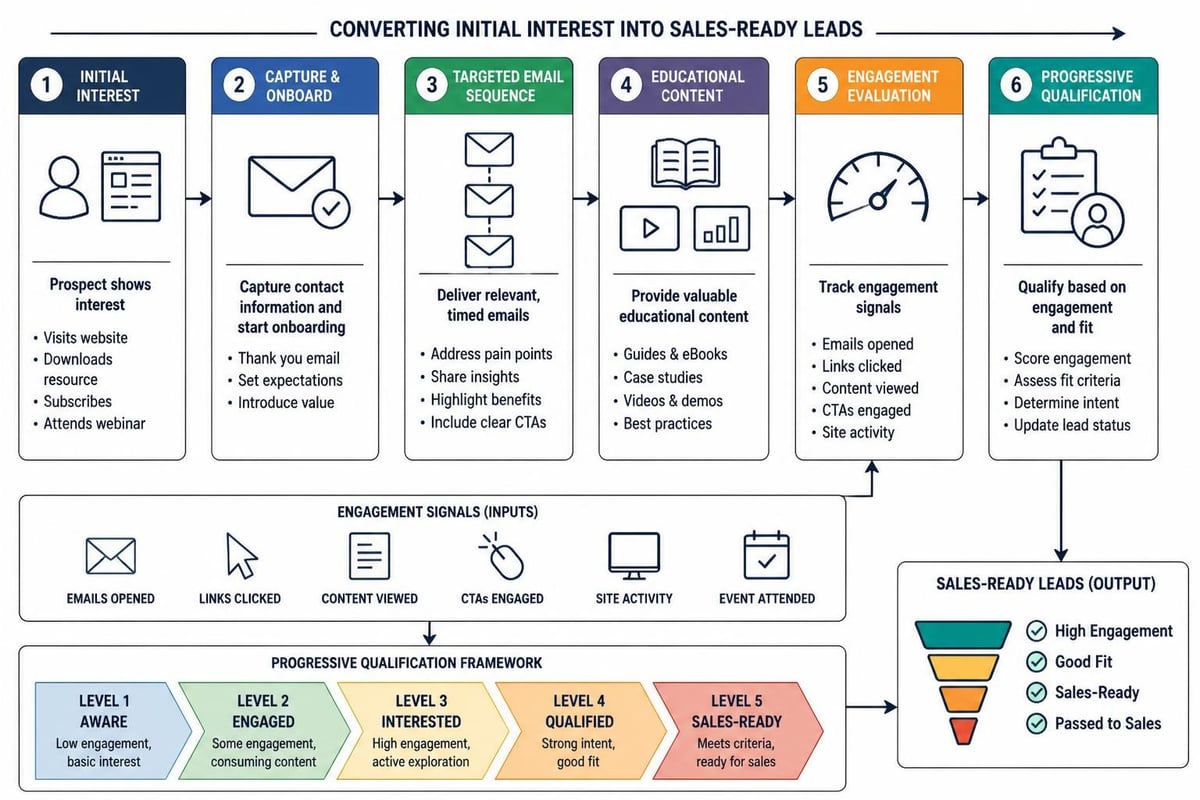
Smart lead acquisition strategies employ progressive profiling to resolve this dilemma. Initial forms request only essential information needed to start the conversation. Subsequent interactions gradually gather additional details as the relationship deepens and trust develops.
This approach maximizes top-of-funnel conversion rates while still building complete prospect profiles over time. It respects the prospect's journey rather than demanding commitment before they're ready to provide it.
Leveraging Technology and Automation
Modern lead acquisition demands technological sophistication that would have been impossible just five years ago. Advanced platforms now coordinate multi-channel campaigns, track prospect behavior across touchpoints, and automate personalized follow-up at scale.
The right technology stack transforms your lead acquisition strategy from manual chaos into a systematic machine. CRM systems centralize prospect data, marketing automation platforms orchestrate nurturing sequences, and analytics tools reveal optimization opportunities hidden in your performance data.
AI-Powered Lead Qualification
Artificial intelligence revolutionizes how businesses identify which leads deserve immediate sales attention versus continued nurturing. Machine learning algorithms analyze hundreds of behavioral and demographic signals to predict conversion probability with remarkable accuracy.
These systems track website visits, content downloads, email engagement, social interactions, and dozens of other indicators. They identify patterns that distinguish serious buyers from casual researchers, enabling your sales team to focus energy where it generates maximum return.
For businesses working with leads in digital marketing, AI qualification dramatically improves pipeline efficiency. Sales representatives stop wasting hours on prospects who aren't ready to buy, instead focusing on opportunities most likely to close.
Automated appointment booking systems take this efficiency even further. When prospects reach predefined qualification thresholds, intelligent systems can trigger immediate booking options, reducing the time between interest and conversation when motivation peaks.
Tracking and Attribution Across Touchpoints
Understanding which marketing activities actually generate revenue requires sophisticated attribution modeling. Prospects rarely convert on their first interaction with your brand. They typically engage multiple times across various channels before becoming customers.
| Attribution Model | How It Works | Best For |
|---|---|---|
| First-Touch | Credits the initial interaction | Understanding top-of-funnel effectiveness |
| Last-Touch | Credits the final interaction before conversion | Identifying closing tactics |
| Linear | Distributes credit equally across all touchpoints | Valuing entire journey contribution |
| Time-Decay | Gives more credit to recent interactions | Emphasizing late-stage influence |
| Position-Based | Credits first and last touches more heavily | Balancing awareness and conversion |
Comprehensive tracking reveals how your channels work together synergistically. Prospects might discover you through organic search, engage with social content, download a lead magnet through email, and finally convert through a retargeting ad. Each touchpoint played a role in the conversion.
Scaling Through Strategic Partnerships
The most sophisticated lead acquisition strategies extend beyond owned channels to include strategic partnerships that provide access to established audiences. These relationships multiply your reach without proportional increases in marketing investment.
Platforms like FreelanceDEV demonstrate how connecting service providers with businesses seeking specific expertise creates mutual value. For companies targeting freelance developers or businesses needing development talent, partnerships with such platforms provide direct access to qualified prospects actively seeking solutions.
Similarly, local commerce platforms like Bendo show how businesses can tap into community-focused audiences. While traditionally serving local merchants, the model illustrates how connecting with prospects through trusted intermediaries accelerates relationship development and trust building.
Partnership strategies work particularly well when you can provide genuine value to the partner's audience. Rather than treating partnerships as pure distribution channels, focus on creating win-win-win scenarios where you, your partner, and the end customer all benefit meaningfully.
Compliance and Quality Standards
Businesses operating in regulated industries must ensure their lead acquisition strategy adheres to relevant compliance requirements. For example, organizations providing compliance training understand that demonstrating regulatory adherence builds trust and credibility with prospects concerned about meeting industry standards.
Your lead acquisition practices should prioritize transparency, explicit consent, and data protection. Beyond legal requirements, ethical lead acquisition builds stronger customer relationships that drive higher lifetime value.
Quality standards matter as much as compliance. Implementing proven lead acquisition strategies emphasizes attracting prospects who actually match your ideal customer profile rather than simply maximizing volume. Ten qualified leads outperform one hundred poor-fit contacts every time.
Measuring and Optimizing Performance
Your lead acquisition strategy requires constant measurement and refinement. What works brilliantly today may deliver diminishing returns tomorrow as markets evolve, competition intensifies, and prospect preferences shift.
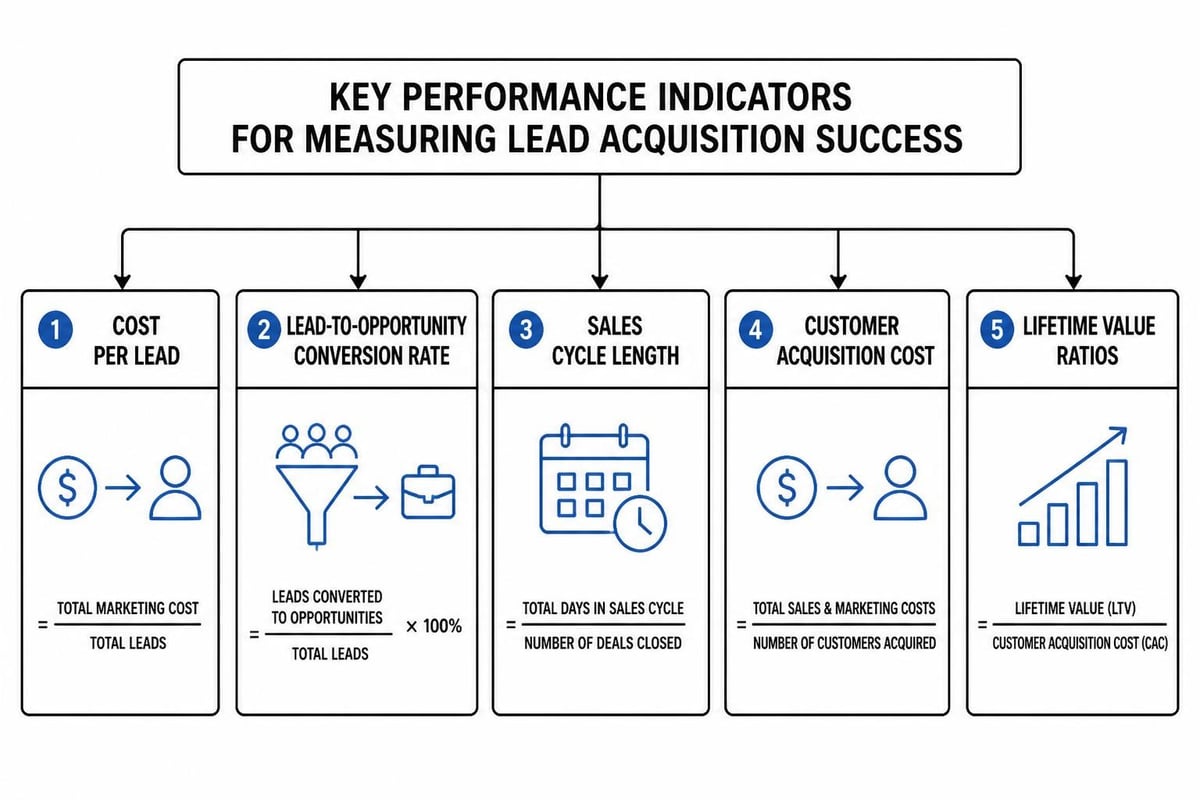
Establish clear key performance indicators that connect directly to business outcomes. Vanity metrics like traffic volume or social followers matter far less than actionable metrics that predict revenue.
Critical metrics to monitor:
- Cost per lead by channel and campaign
- Lead-to-opportunity conversion rate
- Opportunity-to-customer conversion rate
- Average sales cycle length
- Customer acquisition cost
- Customer lifetime value
- Return on ad spend
These metrics reveal which elements of your strategy generate actual business value versus which consume resources without corresponding returns. Regular analysis identifies optimization opportunities and prevents wasted investment on underperforming tactics.
Learning from successful lead generation case studies provides inspiration and practical frameworks you can adapt to your specific situation. While you should never simply copy another company's approach, understanding what worked for similar businesses accelerates your learning curve.
Testing Methodologies That Drive Improvement
Systematic testing transforms your lead acquisition strategy from static playbook into evolving system that continuously improves. Rather than making random changes based on hunches, structured experimentation reveals what actually moves performance metrics.
Prioritize tests based on potential impact and implementation effort. Changes affecting high-traffic pages or key conversion points deserve testing first, even if they require more work. Optimizing rarely-visited pages wastes resources regardless of how easy the changes might be.
Maintain statistical rigor by running tests long enough to achieve significance. Premature conclusions based on insufficient data lead to false positives that waste resources on ineffective changes. Most tests require at least 100-200 conversions per variation before drawing reliable conclusions.
Document everything. Your testing history becomes institutional knowledge that prevents repeating failed experiments and allows new team members to understand why current approaches exist.
Integrating Sales and Marketing Alignment
The handoff between marketing-generated leads and sales follow-up represents the most common breakdown point in the acquisition process. Misalignment between these functions destroys potential revenue and wastes marketing investment.
Your lead acquisition strategy must define clear criteria for sales-ready leads versus those requiring additional nurturing. Sales teams rightfully resist wasting time on unqualified prospects, while marketing teams become frustrated when sales ignores their generated opportunities.
Service Level Agreements (SLAs) between sales and marketing formalize mutual commitments. Marketing commits to delivering specific lead volumes meeting defined quality criteria. Sales commits to contacting those leads within established timeframes and providing feedback on lead quality.
Regular meetings between sales and marketing teams maintain alignment and surface issues before they become critical problems. Sales provides frontline insights about prospect concerns and competitive dynamics. Marketing shares campaign performance data and upcoming initiatives.
Understanding how to effectively manage leads for business growth requires this cross-functional collaboration. Neither department can optimize in isolation because their success depends fundamentally on the other's performance.
Nurturing Programs That Bridge the Gap
Not every lead is ready for immediate sales conversation. Effective nurturing programs maintain engagement with prospects who show interest but haven't reached purchase readiness, ensuring you remain top-of-mind when they're ready to move forward.
Automated email sequences provide value through educational content, success stories, and relevant insights while gradually qualifying prospects through their engagement behaviors. Opens, clicks, downloads, and website visits signal increasing interest levels that trigger appropriate follow-up actions.
The most sophisticated nurturing programs personalize content based on prospect characteristics and behaviors. Someone who downloaded a beginner's guide receives different follow-up than someone who requested a product demo. Relevance drives engagement, and engagement drives conversion.
Aligning your funnel for sales success means designing nurturing programs that deliver prospects to sales conversations at precisely the right moment-when they're educated about their problem, aware of solution options, and ready to evaluate specific vendors.
Managing Lead Acquisition Costs Strategically
Financial discipline separates sustainable lead acquisition programs from those that burn through budgets without delivering proportional value. Understanding lead acquisition costs and optimization strategies helps you make informed investment decisions that balance growth speed with profitability.
Calculate your maximum allowable cost per acquisition based on customer lifetime value and conversion metrics. This number provides clear guidance for campaign optimization and channel selection decisions. Channels exceeding this threshold require improvement or elimination unless they provide strategic value beyond immediate ROI.
Different channels carry vastly different cost structures:
- Organic search requires upfront content investment but delivers compound returns over time
- Paid advertising demands ongoing spend but scales quickly when you need rapid growth
- Referral programs leverage existing customer satisfaction with minimal marginal cost
- Partnership channels often involve revenue sharing rather than upfront costs
Portfolio approach balances immediate results from paid channels with long-term assets like content and partnerships. Over-indexing on any single approach creates vulnerability and limits optimization flexibility.
Budget Allocation and Resource Management
Strategic budget allocation matches investment levels to channel potential rather than distributing resources equally across all tactics. Concentrate spending where you see proven results while maintaining smaller experimental budgets for testing new approaches.
Monitor return on ad spend religiously across all paid channels. When ROAS exceeds targets, consider scaling investment to capture additional opportunity. When it falls short, diagnose root causes and implement corrective actions before throwing more money at underperforming campaigns.
Resource constraints force prioritization decisions. Businesses exploring free lead generation alternatives must invest time and expertise instead of advertising budgets. Neither approach is inherently superior; the right choice depends on your specific constraints and opportunities.
For specialized industries like mortgage lending, working with experienced mortgage lead companies who understand regulatory requirements and buyer behavior can dramatically improve results versus generic approaches.
Developing a comprehensive lead acquisition strategy transforms marketing from random acts of content creation into a systematic revenue engine that delivers predictable results. By combining deep audience understanding, multi-channel coordination, conversion optimization, and continuous improvement, you create sustainable competitive advantages that compound over time. Aletto leverages advanced AI systems and proven frameworks to build customized lead acquisition strategies that transform cold prospects into qualified opportunities, delivering guaranteed growth through transparent, value-driven partnerships designed specifically for your business objectives.