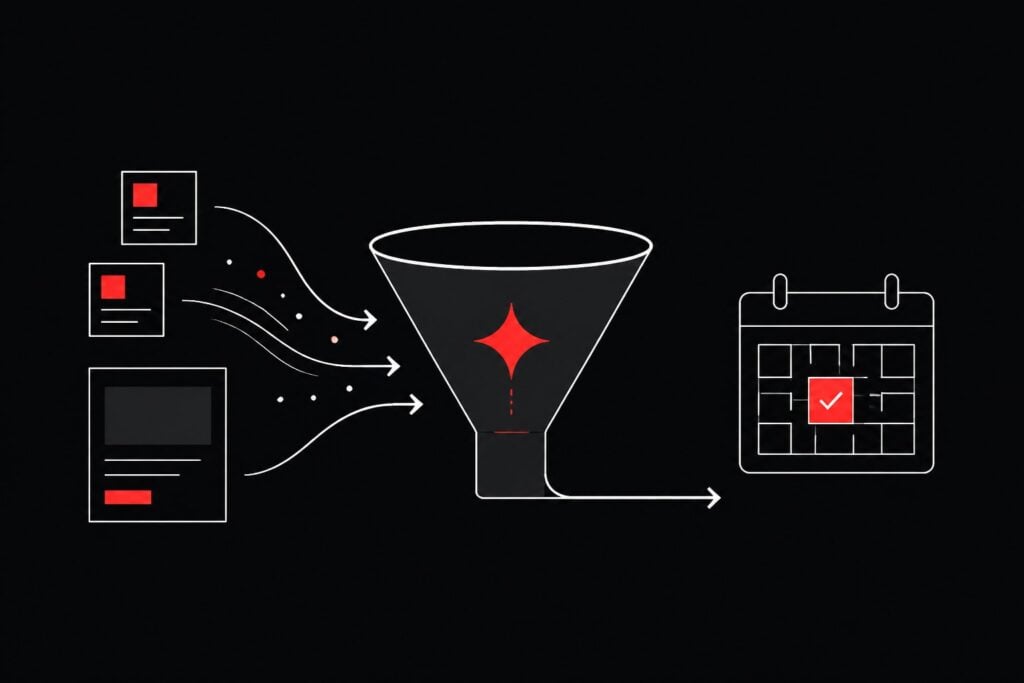
Lead generation in digital marketing is the process of attracting people who show interest in your offer and capturing their contact details so sales can follow up. For B2B teams, the goal is not a bigger list but more qualified meetings on the calendar, and the fastest route is a system that connects paid acquisition, quick follow-up, and automated booking.
Most teams treat these as separate jobs. Marketing buys clicks, a form collects emails, and sales eventually calls whoever is left. That gap between a click and a conversation is where most leads die, and it is the main thing this guide helps you close.
What Is Lead Generation in Digital Marketing?
Lead generation in digital marketing is the practice of using online channels such as paid ads, search, social platforms, and email to turn anonymous visitors into identified prospects who can be contacted and qualified.
A lead is any person or company that has given you permission to start a conversation, usually by submitting a form, booking a call, or requesting a resource. A lead is not a customer, and it is not automatically a sales opportunity. The difference between those three states is the entire discipline.
Consider a B2B SaaS company selling workflow software to operations managers. A visitor clicks a LinkedIn ad, lands on a page offering a benchmark report, and submits an email address. That person is a lead. If they later book a demo and match the ideal customer profile, they become a sales qualified lead. Treating both the same is how reps end up chasing people who were never going to buy.
Our own breakdown of leads in digital marketing goes deeper on the definitions, but the working rule is simple: count a lead only when someone could plausibly become a meeting.
What Are the Types of Leads in Sales?
The main types of leads are information qualified, marketing qualified, sales accepted, sales qualified, product qualified, service qualified, and referral or partner leads. Each type signals a different level of intent and needs a different response.
- Information qualified leads downloaded something but showed no buying signal.
- Marketing qualified leads (MQLs) match your profile and engaged repeatedly with your content or ads.
- Sales accepted leads passed an MQL review and a rep agreed to work them.
- Sales qualified leads (SQLs) confirmed budget, need, and timing, and are ready for a proper sales conversation.
- Product qualified leads used a free trial or freemium tier in a way that suggests purchase intent.
- Service qualified leads are existing customers who raise an upgrade or expansion need.
- Referral and partner leads arrive through a trusted third party and tend to close faster.
A practical position: stop reporting raw lead volume to your leadership team. Report SQLs and booked meetings. A founder who sees 400 leads feels good, then wonders why the pipeline is empty. A founder who sees 22 qualified meetings knows exactly where the business stands. For a deeper treatment of how to sort these tiers, see our guide to lead generation and qualification.
Which Channels Work Best for Lead Generation Digital Marketing?
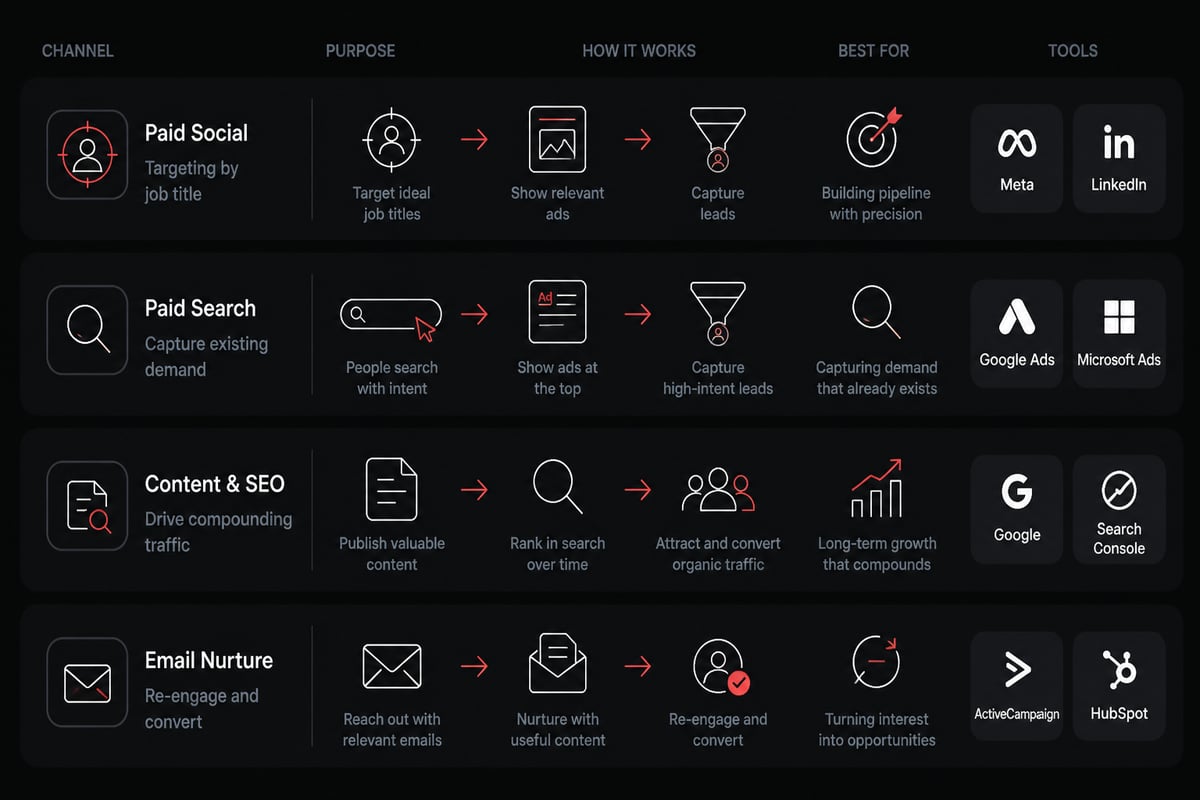
For B2B teams, the channels that reliably produce qualified meetings are paid social, paid search, and a content engine that feeds both, with email handling follow-up rather than cold prospecting. The mix matters less than how quickly each channel hands a lead to a conversation.
Here is how the main options compare for a B2B team that wants meetings, not downloads.
| Channel | Best use | Main weakness |
|---|---|---|
| Paid social (LinkedIn, Meta) | Targeting by job title and company | Cost per lead climbs without strong creative |
| Paid search (Google Ads) | Capturing people already looking for a solution | Limited volume for niche categories |
| Content and SEO | Compounding, lower-cost traffic over time | Slow to show results |
| Webinars and events | Deep engagement with warm audiences | Heavy effort, hard to scale |
| Email nurture | Re-engaging leads who did not book | Weak without a fresh lead source |
Paid channels deserve the most attention for teams that need meetings this quarter. LinkedIn reports that early results from its Conversions API showed a 39% decrease in cost per qualified lead, and that average users saw a 31% increase in attributed conversions. The lesson is practical: platforms reward you for feeding them better conversion data, so connect your CRM outcomes back to your ad accounts.
What does not work is cold outreach as a primary engine. Scraped lists and sequenced emails burn domains, irritate prospects, and put your brand in the spam folder before a buyer has ever heard of you. Inbound intent, captured by ads and followed up instantly, produces warmer conversations at lower cost.
How Do Lead Generation Ads Work?
Lead generation ads are ads that let a prospect submit their details directly inside the platform, through a native form, instead of clicking through to a separate landing page. They reduce friction, which usually raises form completions.
Google supports this through lead form assets, which can be used with Search and Performance Max campaigns, and Google recommends conversion-focused bidding optimized for a lead-form goal. Its guidance on how lead form assets collect submissions directly in ads is worth reading before you build one. LinkedIn and Meta offer similar native forms.
Two details matter in practice. Google's lead-form guidance recommends relevant questions, a clear call to action, and webhook integration to send lead information to a CRM. That last point is the one teams skip. A native form that dumps leads into a spreadsheet no one checks until Monday is worse than a landing page, because speed to contact decides whether the lead ever answers.
Example scenario: a managed IT services firm runs a LinkedIn lead ad offering a security audit. The form asks for work email, company size, and one qualifying question about current tooling. Without routing, the lead waits 14 hours for a reply. With instant follow-up and a booking link, the same lead can pick a time within minutes of submitting. The ad did not change. The handoff did.
What Does a Lead Generation Process Look Like Step by Step?
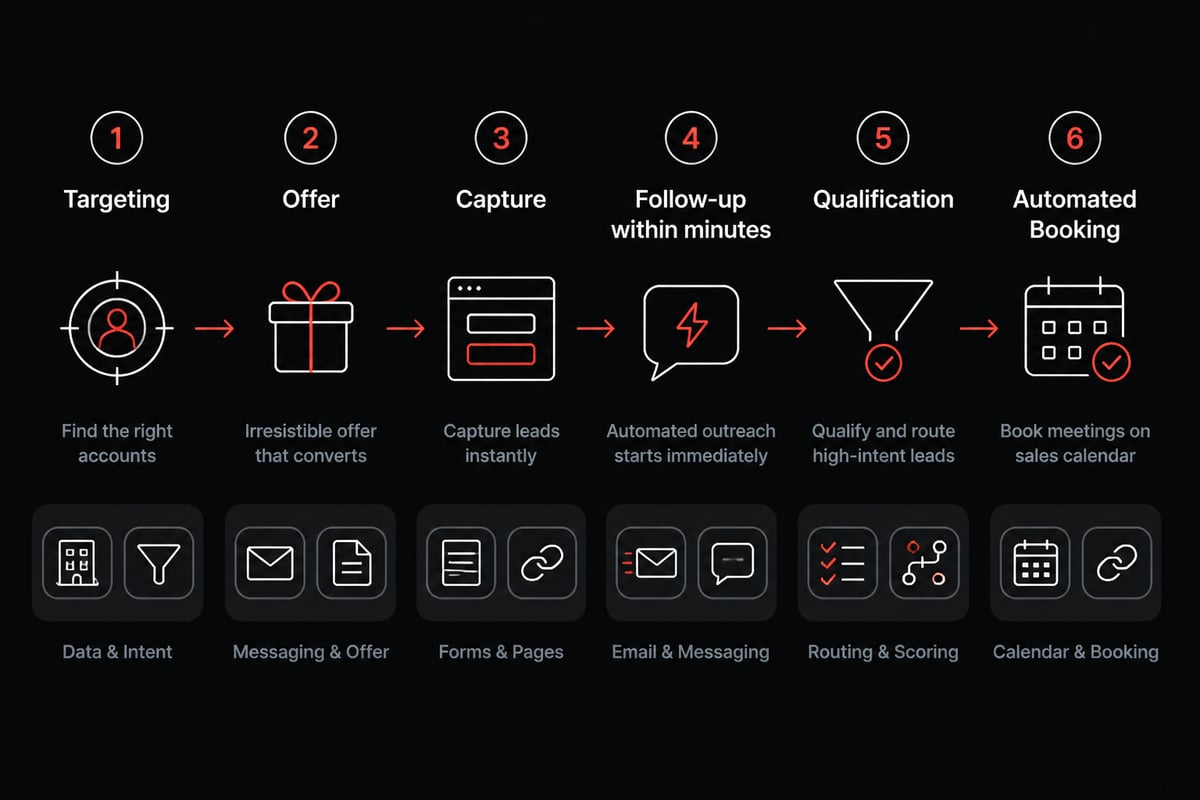
A working lead generation process moves a prospect through six stages: targeting, offer, capture, follow-up, qualification, and booking. Break any one and the others waste money.
- Target a defined audience. Pick job titles, industries, and company sizes that match customers you already closed.
- Build an offer worth trading contact details for. A generic ebook rarely does it. A benchmark, a calculator, an audit, or a direct demo offer outperforms vague content.
- Capture with the shortest form that still qualifies. Every extra field costs submissions, but a form with no qualifying question floods reps with noise.
- Follow up within minutes. Speed signals interest and catches the prospect while the offer is still on their mind.
- Qualify before a human gets involved. Confirm role, need, and timing so reps only see real opportunities.
- Book the meeting automatically. Remove the back-and-forth of scheduling.
Aletto runs this same sequence for every client: paid acquisition, AI follow-up, and automated booking working as one system, so only qualified prospects reach a rep's calendar. Aletto has packed over 1,500 calendars for clients in 100+ countries, and its attribution is verified by Hyros. For the strategic layer behind these steps, our lead generation strategy guide covers planning in more detail.
How Do You Make Landing Pages and Forms Convert?
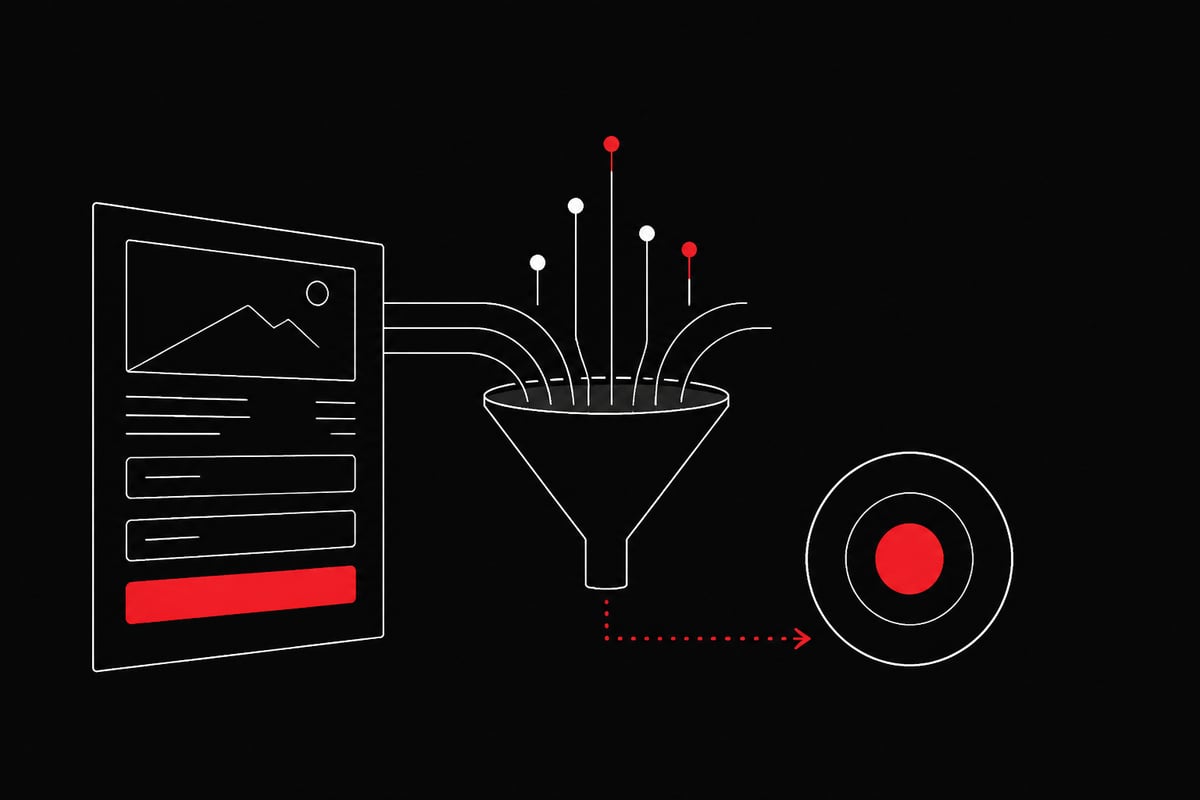
A converting lead page makes one promise, asks for the minimum information needed, and shows evidence that the promise is real. Anything that competes with that single action should go.
Keep the page focused on one offer. Remove the main navigation, since every extra link is an exit. Write the headline in your buyer's language, not your product's. Add proof close to the form: a named customer result, a logo strip, or a specific number.
Form length is a trade-off, not a rule. Fewer fields raise volume but lower quality, while more fields cut volume but pre-qualify. For B2B meetings, three to five fields with one qualifying question is a sound default. If a lead will not tell you their company size, they are unlikely to buy.
Aletto builds creative from buyers' actual language and cuts underperforming creative rather than watching it. That discipline applies to pages too. Run one change at a time, give it enough traffic to read the result, and drop what loses.
How Should You Measure Lead Generation Results?
Measure cost per qualified meeting, meeting-to-opportunity rate, and customer acquisition cost, not clicks or raw lead counts. Vanity metrics hide the problem until the quarter is over.
LinkedIn's data points to why attribution matters: its Conversions API users saw a decrease in cost per action once conversion signals flowed back to the platform. Better signal means better optimization.
A practical reporting set looks like this:
- Cost per qualified meeting, by channel and by campaign.
- Show rate, the share of booked meetings that actually happen.
- Meeting-to-opportunity and opportunity-to-close rates.
- Customer acquisition cost, tied to closed revenue rather than leads.
Across Aletto's client base, average customer acquisition cost has fallen, and many client campaigns reach a strong return on ad spend. Over $50M in ad spend has been managed with every dollar visible, no black box. Visibility is the point. If your agency or internal team cannot show where each dollar went and what it produced, you cannot make good decisions. Our SaaS lead tracking and attribution guide walks through setup in detail.
How Do You Generate Leads for a Digital Marketing Agency?
To generate leads for a digital marketing agency, pick one narrow client type, publish proof of results for that type, and run paid campaigns that send prospects straight to a booking page. Agencies fail at their own marketing by being generalists with no visible outcomes.
An agency that says it serves everyone competes on price. One that says it books qualified calls for B2B SaaS companies can show a case study, quote a number, and target a defined buyer. Specificity lowers cost per lead because the message lands harder with fewer people.
The cobbler's children problem is real here. Agencies often skip their own pipeline while busy with client work, then scramble when a contract ends. Treat your own acquisition as a client account: set a monthly target for booked calls, track it weekly, and cut what underperforms. Our guide on lead generation for digital agencies lays out the approach.
What Are the Best Lead Generation Tools?
A functional stack needs four things: an ad platform, a CRM, a follow-up and scheduling layer, and an attribution tool. Buying more tools than that rarely helps.
Common options include HubSpot and Salesforce as CRMs, Calendly and Chili Piper for scheduling, and Hyros for ad attribution. Pick for integration first. A tool that does not pass lead data cleanly into your CRM and back to your ad accounts creates the very delays you are trying to remove. If you want a vetted shortlist, our overview of tools for lead generation compares options by use case.
One position worth stating: a tool will not fix a weak offer. Teams often add software when the real issue is that the audience, the message, or the follow-up speed is wrong. Fix those first.
Where Do Most Lead Generation Programs Fail?
Most programs fail at the handoff, not the traffic. Leads arrive, then sit, because no one responds fast enough or qualifies them properly.
The common failure points are predictable:
- Slow or inconsistent follow-up, with reps replying hours or days later.
- No shared definition of a qualified lead between marketing and sales.
- Creative that runs unchanged for months while performance decays.
- Reporting on leads instead of meetings and revenue.
- Heavy reliance on a single channel with no fallback.
Local and appointment-based businesses face a specific version of this. A clinic or advisory firm buys leads from a marketplace, then competes with four other providers who were sent the same inquiry. Winning there means responding first, which is exactly why automated follow-up and booking matter more than the lead source. For a look at that dynamic, see our piece on Bark lead generation.
The same logic applies to physical workspaces and local services that depend on booked appointments. A coworking operator or a booking-led travel service lives or dies by how quickly an interested visitor becomes a confirmed reservation. Different industries, same principle: shorten the distance between interest and commitment.

If you want to see what a working system produces, the Free AI Call Booking Report shows how Aletto booked 1,122 qualified sales calls in 11 months without cold emails, cold calls, events, or begging for referrals. It is a concrete reference point for what a measurable system looks like before you commit budget to one.
Frequently Asked Questions
What is the difference between lead generation and demand generation?
Demand generation builds awareness and interest across a broad market, while lead generation captures contact details from people who already show interest. Demand creates the audience, and lead generation converts part of it into identifiable prospects. Most B2B teams need both, but lead generation is easier to measure.
How long does lead generation take to produce results?
Paid campaigns can produce leads within days, but stable performance usually takes several weeks of testing creative, audiences, and follow-up. Content and SEO compound more slowly, often over months. Teams that need meetings this quarter should lead with paid acquisition and use content as a second layer.
How much should I spend on lead generation?
Work backward from your target. Define the number of meetings you need, your expected close rate, and your average deal value, then set a customer acquisition cost ceiling. Spend only as much as that ceiling allows, and cut campaigns that exceed it rather than hoping they improve.
Is a lead form or a landing page better?
Native lead forms usually produce more submissions because they remove a click, but landing pages often yield better-qualified leads because they allow more context and proof. Test both against cost per qualified meeting, not cost per lead. Whichever you pick, route submissions to your CRM instantly.
Pull your last 90 days of leads and count how many became booked meetings; that single ratio shows whether your problem is traffic or follow-up. If the number is lower than you expected, the Free AI Call Booking Report shows what a connected system of paid acquisition, AI follow-up, and automated booking can produce. Aletto builds and runs that system for B2B SaaS and service teams, and you can start free training to see how it would fit your pipeline.