
A B2B demand generation agency builds and runs the programs that create buyer interest and turn it into qualified sales conversations, and you should choose one based on booked meetings and verified pipeline, not impressions or raw lead counts. For SaaS founders and sales leaders, the right partner shows you where every dollar goes, connects spend to calendar events, and cuts what does not work quickly.
This guide covers what these agencies do, which models exist, how to evaluate them, and which failure patterns to avoid before you sign.
What Does a B2B Demand Generation Agency Actually Do?
A B2B demand generation agency designs and operates the channels, creative, and follow-up systems that move a target account from unaware to ready to talk to sales. Demand generation is the practice of creating awareness and intent among a defined buyer group so that sales conversations start with interest already in place.
The work usually spans paid media, content, landing pages, email and nurture sequences, lead scoring, and handoff to sales. Some agencies stop at marketing-qualified leads. Better ones own the path through to a booked meeting.
Hypothetical example: a SaaS company selling workflow software to operations directors hires an agency that runs paid social and search, a webinar, and a nurture sequence. If the agency reports "4,000 clicks" and "300 downloads" but cannot say how many demos landed on a rep's calendar, the program is producing activity, not pipeline.
The budget environment supports hiring outside help. A 6sense survey of 392 B2B marketers found demand generation among the areas most likely to gain budget, with an 11.7% increase in reported allocation. Money is moving here, which also means more agencies are competing for it, and quality varies widely.
How Is Demand Generation Different From Lead Generation?
Demand generation builds interest across a market over time, while lead generation captures contact details from people who already show interest. The two overlap, but they answer different questions.
Demand generation asks whether the right buyers know you exist and think of you as a credible option. Lead generation asks how many identifiable prospects you can hand to sales this month. A SaaS team that needs meetings now cannot wait for brand awareness to compound, so the practical answer is a system that does both: paid acquisition that reaches the right buyers, plus fast follow-up that converts interest into a booking.
If you want more background on the distinction, Aletto's overview of B2B demand generation covers the mechanics in more detail.
What Types of B2B Demand Generation Agencies Exist?
There are four common agency models, and each fits a different problem. Matching the model to your bottleneck matters more than picking the agency with the biggest logo wall.
- Full-funnel demand agencies run strategy, content, paid media, and nurture. They suit teams with a marketing function that needs extra capacity and cross-channel coordination.
- Paid media specialists focus on Google, LinkedIn, and Meta. They are strong at acquisition but often weak on what happens after the click.
- Outbound and appointment-setting firms rely on cold email and cold calling. They can produce meetings, but they depend on volume tactics that many buyers now ignore.
- Pipeline-system providers combine paid acquisition, automated follow-up, and booking into one managed machine, and they are measured on meetings held.
My position: for a SaaS team whose goal is more sales meetings each month, the first two models leave a gap between "lead" and "calendar," and the third relies on tactics that have been declining in effectiveness. The gap between click and booked call is where most budget is lost.
How Do You Evaluate a B2B Demand Generation Agency?
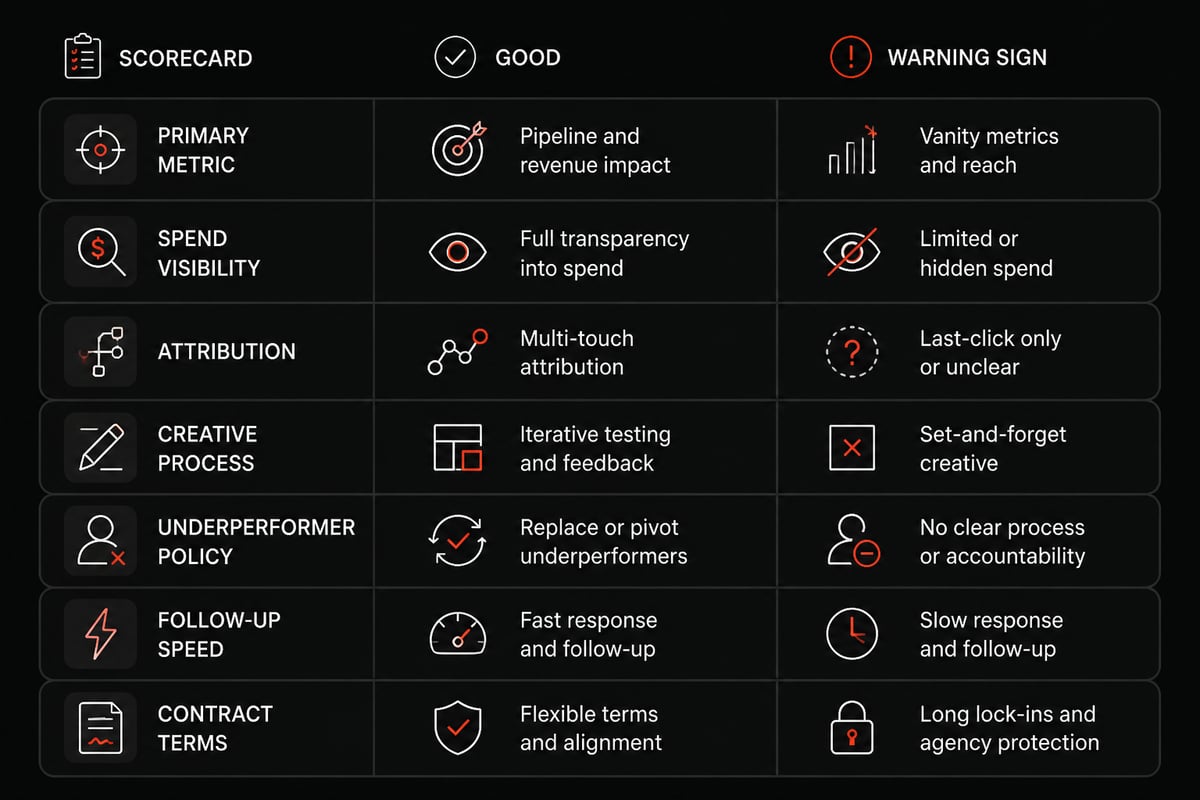
Evaluate an agency by asking for evidence tied to meetings and revenue, then testing whether its answers hold up under specifics. Use the criteria below as a scorecard.
| Criterion | What good looks like | Warning sign |
|---|---|---|
| Primary metric | Qualified meetings held, pipeline created | Impressions, clicks, MQL counts |
| Spend visibility | Line-by-line ad spend you can audit | Bundled fee with no breakdown |
| Attribution | Third-party verified tracking | Self-reported dashboards only |
| Creative process | Built from buyer language, tested on a set cadence | One-time creative set, reviewed quarterly |
| Underperformer policy | Poor ads cut fast on clear rules | "We'll monitor and optimize" |
| Follow-up speed | Automated response within minutes | Leads sit until a rep gets to them |
| Contract terms | Clear scope and exit terms | Long lock-in before any results |
Two items on that scorecard deserve extra attention.
Attribution you can verify
Ask which tool confirms that a meeting came from a given campaign. Agency-built dashboards tend to flatter the agency. Independent attribution tools make the numbers defensible in a board meeting. Aletto, for example, has its attribution verified by Hyros, which means the spend-to-meeting link is checked outside the team running the ads.
A kill-switch policy for ads
Ask how the agency handles an underperforming ad. "We monitor it" is not an answer. The disciplined answer is a defined threshold and a decision: cut it, replace it, test the next angle. Aletto runs every ad account with this kill-switch discipline, so weak creative is removed rather than left to drain budget while someone watches a dashboard.
What Does a B2B Demand Generation Agency Cost?
Pricing varies by model, and the structure of the fee tells you more than the number. I will not quote a market average, because published figures differ by scope and I cannot source a reliable one here. Instead, judge the structure.
- Monthly retainer plus ad spend. Common and workable if ad spend is transparent and the scope is written down.
- Percentage of ad spend. This creates an incentive to raise your budget regardless of results. Treat it with caution.
- Per-lead pricing. Cheap on paper, but lead quality is often poor, and your reps absorb the cost in wasted calls.
- Per-meeting or performance-linked pricing. Aligns incentives with your goal, provided "qualified" is defined in writing.
Whatever the model, insist on seeing every dollar of ad spend. A black box between your payment and the ad platform is the clearest sign to walk away. Aletto's approach is to show clients every dollar of spend, with no black box, and any agency you shortlist should be willing to match that.

What Questions Should You Ask Before You Sign?
Ask questions that force specifics, because vague agencies answer in generalities. Bring these to every call:
- How many qualified meetings did a comparable SaaS client book in the first 90 days, and how do you define "qualified"?
- Who owns the ad accounts and the data if we leave?
- What is your rule for cutting an underperforming ad, and how often do you test new creative?
- How fast does a new inquiry get a response, and is that automated?
- Which tool verifies attribution from ad to booked meeting?
- What does the ad spend breakdown look like each month?
- What happens to leads who are interested but not ready to book?
Hypothetical example: a founder asks question 4 and hears that leads are "routed to the sales team within one business day." That is a fixable answer for an internal team, but for an agency selling speed, it signals a manual process. Buyers who fill out a form expect a reply that day, often within minutes, and each hour of delay costs bookings.
Which Failure Patterns Should You Watch For?
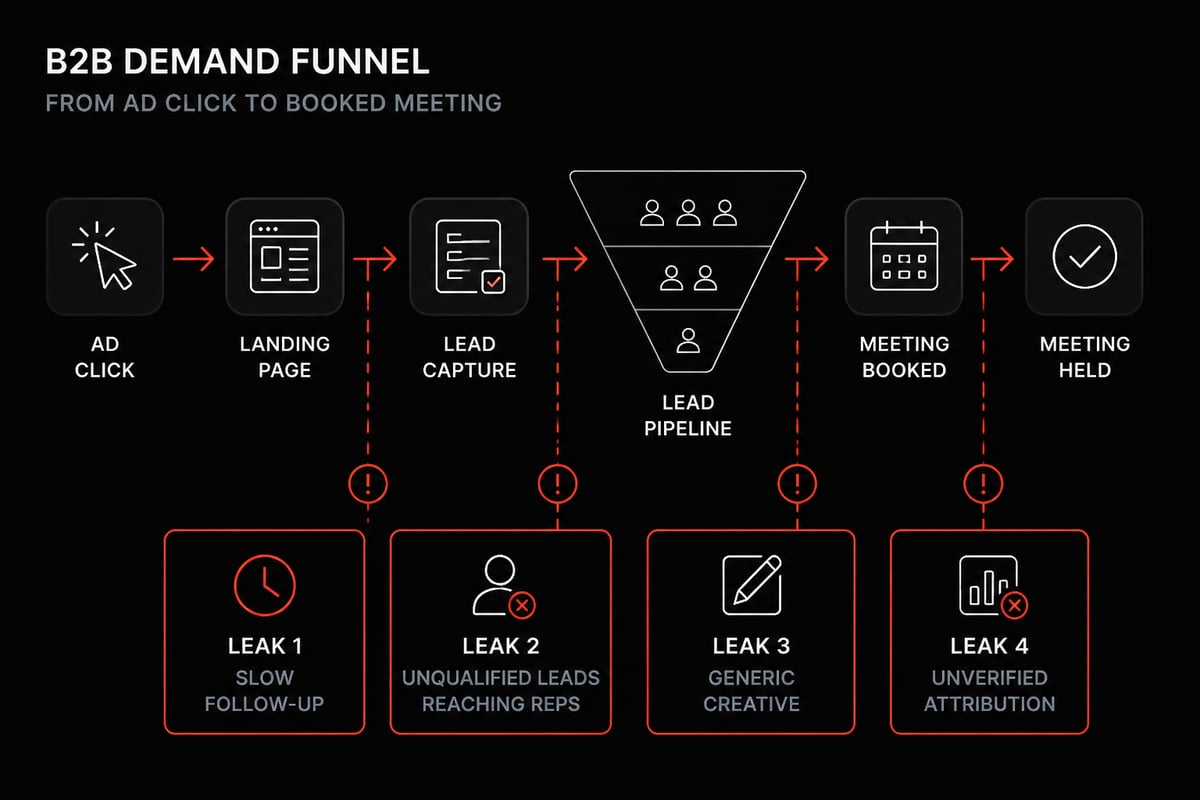
The most common failures are measuring the wrong thing, running disconnected tools, and relying on tactics that depend on the buyer's patience. Each one is avoidable if you spot it early.
Vanity reporting. Reports full of reach and click-through rate but light on meetings held. If you cannot trace a meeting back to a campaign, you cannot decide where to put the next dollar.
Lead handoff gaps. The agency generates a form fill, then hands it to a rep who calls two days later. The prospect has moved on. Paid acquisition without fast follow-up wastes the most expensive part of the funnel.
Reliance on cold outreach. Some agencies fill your calendar by scaling cold email and calls. That can work briefly, but it burns your domain reputation and your market. If your team is trying to hit targets without depending on cold outreach or events, this model works against you.
Generic creative. Ads written from internal assumptions rather than the buyer's actual words. The fix is testing language pulled from real customer conversations, on a weekly cycle, and keeping only what performs.
Unclear ownership. If the agency owns the ad accounts, a departure resets your learning to zero. Own your accounts.
Should You Hire an Agency or Build Demand Generation In-House?
Hire an agency when you need results faster than you can recruit, and build in-house when demand generation is a stable, long-term function with enough volume to justify full-time specialists. For most SaaS teams under a certain size, the decision comes down to speed and skills.
An in-house build requires a paid media buyer, a copywriter, a marketing automation specialist, and someone who owns reporting. That is several hires before the first campaign launches, and each one takes months to find and ramp. An agency gives you the whole bench at once, but you trade away some control and institutional knowledge.
A reasonable middle path: use an agency to prove the channel and the offer, then decide whether to bring parts in-house once you know what works. For teams exploring that decision, Aletto's guides on outsourced B2B lead generation and demand generation agencies lay out the trade-offs further. If your growth challenge is broader than meetings, a strategy partner such as Rise Reign Rule is a strategic consultancy for women-owned high-ticket service businesses that works on operational drag and founder bottlenecks.
What Results Should a Good Agency Be Able to Show?
A good agency can show meetings booked, cost per meeting, and verified return, with numbers you can audit. Ask for proof in the form of ranges and distributions, not a single cherry-picked win.
Aletto reports first-party data you can use as a benchmark for the kind of evidence to request from anyone you shortlist: calendars packed for clients across many countries, ad spend managed, leads generated, the share of campaigns reaching a target ROI, and the change in acquisition cost.
Notice the shape of that evidence: scale of spend, number of calendars, share of campaigns hitting a target, and a cost metric. An agency that can only give you a testimonial and a logo has not measured its own work.
The system matters as much as the stats. Every Aletto client runs the same setup: paid acquisition, AI follow-up, and automated booking working as one machine, so only qualified prospects reach a rep's calendar and the team walks into calls ready to close. For a view of how that plays out in a SaaS context, the SaaS demand generation guide goes deeper.
If you want to see the booking mechanics before you talk to anyone, the report below breaks down how one program produced qualified calls without cold email, cold calls, or events.
The Free AI Call Booking Report shows how Aletto books qualified sales calls without cold emails, cold calls, LinkedIn outreach, events, or heavy ad spend, and it is a useful reference point when you judge any agency's claims about booked meetings.

How Do You Run a Fair Agency Selection Process?
Run selection as a short, structured test rather than a series of sales calls. A four-step process keeps the decision tied to evidence.
- Define the outcome. Write down your target: qualified meetings per month, acceptable cost per meeting, and your ideal buyer profile.
- Shortlist three agencies. Include at least one that sells a managed system rather than a single channel, and compare them against the scorecard above.
- Request the same proof from each. Meetings booked, spend breakdown, attribution method, and the underperformer policy.
- Start with a defined test period. Agree the scope, budget, and success threshold in writing before the first dollar is spent.
If you want a wider view of the field, Aletto's guide to B2B lead generation companies and its breakdown of B2B demand generation strategy give useful context for the shortlist step. And if your team is also reworking its online presence, a Shopify-focused studio like Futur Media offers store design and conversion work for ecommerce brands, which is a different need than SaaS meeting generation but worth knowing about.
Frequently Asked Questions
What does a B2B demand generation agency do?
It plans and runs the channels, creative, and follow-up that create buyer interest and convert it into sales conversations. That typically includes paid media, content, landing pages, nurture sequences, and handoff to sales. The strongest agencies are accountable for booked meetings, not just traffic or lead counts.
What is the difference between demand generation and lead generation?
Demand generation builds awareness and intent across a target market so buyers want to talk to you. Lead generation captures contact details from people already showing interest. SaaS teams that need meetings soon usually need both working together, with fast follow-up connecting the two.
How do I know if an agency's results are real?
Ask for third-party attribution that links spend to booked meetings, a full spend breakdown, and results from comparable SaaS clients. Self-reported dashboards are not enough. If an agency will not let you audit ad spend or confirm attribution independently, treat that as a reason to look elsewhere.
Should a SaaS company avoid agencies that rely on cold outreach?
If your goal is to hit targets without depending on cold email, cold calls, or events, yes. Outreach-heavy agencies can produce short-term meetings, but they put pressure on your domain reputation and market. A system built on paid acquisition and automated follow-up avoids that dependence.
How long before an agency should show results?
Agree a test period and success threshold before you start, rather than accepting an open-ended timeline. Paid programs generate early signals quickly, such as cost per booked meeting, while larger pipeline effects take longer. A good agency states what it expects to see and when.
Your next step is to write down your monthly qualified-meeting target and your maximum cost per meeting, then hold every agency on your shortlist to those two numbers. The problem this article raised, paying for activity that never reaches a calendar, is exactly what a managed system of paid acquisition, AI follow-up, and automated booking is built to solve, and the Free AI Call Booking Report shows how that works for SaaS teams. If you would rather see how Aletto fills a SaaS sales calendar before committing to anything, Aletto offers a free training that walks you through the system, so you can start free training and judge the approach on its own merits.